Here’s what nobody tells you when you buy an EV in September.
Winter arrives. The temperature drops to -12°C on a Tuesday morning in Boston. Your Tesla Model Y, which showed 280 miles of range in October, now shows 198 miles before you’ve left the driveway. You plug into your home charger and it takes 40 minutes longer than usual to reach 80%. On the way to work you notice the regenerative braking feels different — reduced, somehow. At the public fast charger during your lunch break, the car accepts charge more slowly than the display suggested it would.
None of this is a fault. None of it means your EV is broken. All of it is normal cold weather EV behaviour that the September test drive didn’t prepare you for — and that most buying guides don’t explain clearly enough before purchase.
This winter EV charging guide 2026 cold weather performance US Northeast vs Europe covers everything that actually changes about EV charging in cold weather — the range reduction reality, the charging speed changes, the home charger hardware that performs versus the hardware that struggles, the pre-conditioning strategies that recover significant range, and the specific differences between cold weather EV ownership in the US Northeast (Boston, New York, Chicago, Minneapolis) and Northern Europe (UK, Scandinavia, Germany, the Alps).
By the end of this guide, winter EV charging will be predictable rather than mysterious — and you’ll have the specific hardware and habit recommendations that make cold weather EV ownership as reliable as mild weather ownership.
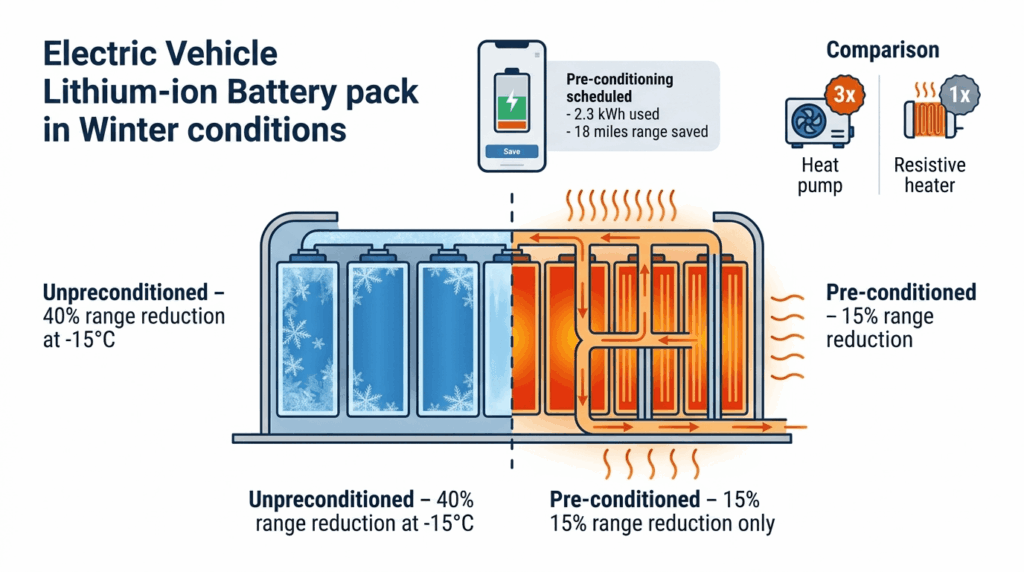
The Cold Weather Physics — What Actually Happens to EVs in Winter
Understanding why cold weather affects EVs is more useful than just knowing that it does — because the mechanism determines the solution.
Why Batteries Perform Differently in Cold
EV batteries are lithium-ion cells that rely on electrochemical reactions to store and release energy. These reactions happen most efficiently at 20-25°C. Below this range, the reactions slow — meaning:
Reduced energy delivery: Cold cells can’t release stored energy as quickly. This manifests as reduced range and reduced maximum power output.
Reduced charging acceptance: Cold cells can’t accept charge as quickly — the BMS reduces charging speed to prevent damage from rapid charge in cold conditions. This is why cold weather charging takes longer.
Increased internal resistance: Cold batteries have higher internal resistance, which means more energy is lost as heat during both charging and discharging. This is part of why range reduces in cold weather beyond just the heating load.
Recoverable capacity: Most cold weather capacity reduction is temporary — as the battery warms through use or pre-conditioning, capacity recovers toward normal. A battery that shows 15% less range at -10°C shows normal range once warmed to operating temperature.
The Heating Load — The Bigger Factor Than Most People Expect
The battery chemistry effects are real but quantifiable. The cabin heating load is often more significant than the battery chemistry effect — particularly for shorter range EVs.
A petrol car heats its cabin from waste engine heat — essentially free. An EV heats its cabin from battery energy. At -10°C, a 6-7 kW cabin heater running continuously for a 45-minute commute consumes approximately 4.5-5 kWh — reducing the effective range by approximately 25-30 km for a Renault 5 Standard Range.
Heat pump vs resistive heating: Most modern EVs have heat pumps rather than pure resistive electric heaters. Heat pumps are approximately 2-3x more efficient — delivering 6 kW of heating from 2 kW of battery draw rather than 6 kW from 6 kW draw. This is a significant real-world range advantage:
- Resistive heater at -10°C: 45-minute commute costs approximately 4.5-5 kWh in heating
- Heat pump at -10°C: Same commute costs approximately 1.5-2.5 kWh in heating
Heat pump vehicles (2026): Tesla Model 3 and Y (all current models), Renault 5 E-Tech, VW ID.3 (most variants), Hyundai Ioniq 5 and 6, BMW iX, Kia EV6, Ford Mustang Mach-E. Heat pumps are standard on most EVs above compact budget models.
Resistive heating only (check your specific variant): Some entry-level compact EVs and older variants still use resistive heating. If your EV has resistive heating only, cold weather range reduction will be more severe than for heat pump vehicles.
The Real Range Reduction Numbers — Honest Data
The winter EV charging guide 2026 cold weather performance US Northeast vs Europe is built on honest range reduction data — not manufacturer claims, but real-world measurements from independent testing organisations including AAA (US) and Geotab fleet data (global).
Range Reduction by Temperature
| Temperature | Typical Range Reduction | Heat Pump Vehicle | Resistive Heater Vehicle |
|---|---|---|---|
| +10°C (50°F) | 5-10% | 5-8% | 8-12% |
| 0°C (32°F) | 15-25% | 12-18% | 20-30% |
| -10°C (14°F) | 25-40% | 20-30% | 35-50% |
| -20°C (-4°F) | 35-50% | 28-40% | 50-65% |
| -30°C (-22°F) | 45-60% | 38-52% | 60-75% |
Important context: These figures assume the vehicle is driven immediately from cold — cabin heating from cold, battery from cold. Pre-conditioning (warming the battery and cabin while plugged in) significantly reduces these figures — covered in detail below.
Real-World Winter Range for Key Vehicles
Tesla Model Y Long Range (US):
- Rated range: 330 miles (EPA)
- At 0°C with heat pump (unpreconditioned): approximately 235-260 miles
- At -10°C with heat pump (unpreconditioned): approximately 200-230 miles
- At -20°C (Minneapolis winter) (unpreconditioned): approximately 175-200 miles
- Pre-conditioned at -10°C: approximately 230-255 miles
Renault 5 E-Tech Standard Range (Europe):
- Rated range: approximately 220 km (WLTP)
- At 0°C with heat pump (unpreconditioned): approximately 165-185 km
- At -10°C (UK winter) (unpreconditioned): approximately 140-165 km
- At -20°C (Norwegian winter): approximately 120-145 km
- Pre-conditioned at -10°C: approximately 165-185 km
Hyundai Ioniq 5 Long Range (US/Europe):
- Rated range: 266 miles / 430 km
- At -10°C (unpreconditioned): approximately 190-210 miles / 310-340 km
- Pre-conditioned at -10°C: approximately 220-240 miles / 355-390 km
VW ID.3 Pro Performance (Europe):
- Rated range: approximately 425 km (WLTP)
- At 0°C (unpreconditioned): approximately 310-355 km
- At -10°C (unpreconditioned): approximately 265-305 km
- Pre-conditioned at -10°C: approximately 305-335 km
BMW iX xDrive50 (Europe/US):
- Rated range: 380 miles / 620 km
- At -10°C (unpreconditioned): approximately 275-310 miles / 445-500 km
- Pre-conditioned at -10°C: approximately 315-345 miles / 510-555 km
Winter Charging Speed Changes — What Slows Down and Why
Range reduction is the visible cold weather effect. Charging speed changes are the less-discussed companion.
AC Home Charging in Cold Weather
AC home charging speed is affected less by temperature than DC fast charging — the onboard charger’s conversion electronics are somewhat temperature-sensitive but not dramatically so. The main cold weather AC charging effect is:
Slower initial charging speed: When the battery is very cold (below -5°C), the BMS may temporarily reduce AC charging acceptance rate by 10-20% until the battery warms slightly from the charging process itself.
For Renault 5 Standard Range at 7.2 kW home charger:
- At 20°C: 20-80% in approximately 3.5 hours
- At -5°C: 20-80% in approximately 3.8-4.0 hours (initial throttling warms within 20 minutes)
- At -15°C: 20-80% in approximately 4.0-4.5 hours
The practical impact: AC home charging is affected by cold weather but not severely. For most home charging scenarios, the difference is 20-40 minutes on a full overnight charge — generally not a planning concern if you charge overnight.
DC Fast Charging in Cold Weather
DC fast charging is significantly more affected by cold weather — because DC fast charging delivers power directly to the battery and the BMS aggressively protects cold cells from rapid charge.
Cold battery DC charging behaviour:
At 0°C, a Hyundai Ioniq 5 that accepts 235 kW at 25°C may accept only 80-100 kW from a cold start at a DC fast charger. The charging speed increases as the battery warms — reaching closer to peak rates after 10-15 minutes as charging heat warms the cells.
At -15°C, the same vehicle may start at 30-50 kW and take 20-25 minutes to reach a reasonable charging rate.
The practical DC charging rule for cold weather: Expect cold-start DC fast charging to take 25-40% longer than at optimal temperature for the first 10-20 minutes of a cold weather charging session.
Battery pre-conditioning for DC charging: Most modern EVs have a “DC fast charge pre-conditioning” feature that warms the battery to optimal temperature before you arrive at a fast charger — activated either through the navigation system (route to a Supercharger/Ionity station and the car pre-conditions automatically) or through the car’s app.
For a Hyundai Ioniq 5 navigating to an Ionity station in -10°C weather, pre-conditioning warms the battery to approximately 20-25°C before arrival — delivering full 235 kW charging speed from the start of the session. Pre-conditioning uses battery energy (approximately 1-3 kWh depending on external temperature and pre-conditioning duration) but the charging speed benefit significantly outweighs the energy cost on most DC fast charging sessions.
The Pre-Conditioning Strategy — The Single Most Impactful Winter Habit
If you take one practical action from this entire winter EV charging guide 2026 cold weather performance US Northeast vs Europe, it should be this: develop a pre-conditioning habit.
What Pre-Conditioning Does
Pre-conditioning warms both the vehicle cabin and the battery to optimal temperature while the car is still plugged in at home — before you begin your journey. When done correctly:
- Cabin heating load during the drive is minimised (cabin already warm) — saving 1-3 kWh compared to heating from cold
- Battery is at optimal temperature — reducing charging time at DC fast chargers and improving range
- Windscreen and mirrors are clear — no manual scraping, immediate full visibility
How to Pre-Condition — By Vehicle
Tesla Model Y/3 (US and Europe): Set a departure time in the Tesla app’s “Schedule” function. The car pre-conditions to your preferred temperature, warming both cabin and battery, starting 30-45 minutes before your departure time. Ensure the car is plugged in — pre-conditioning uses electricity from the grid rather than the battery, preserving your full range for the journey.
Hyundai Ioniq 5/6 (US and Europe): Use Bluelink app to activate climate control remotely. “Climate” function warms the cabin from the grid when plugged in. For DC fast charge pre-conditioning specifically, navigate to an IONIQ 5 compatible fast charger in the car’s navigation — the system automatically pre-conditions the battery for optimal fast charging upon arrival.
VW ID.3/4 (Europe/US): Use the myVolkswagen app’s “Climatise” function — schedule or immediately activate cabin pre-conditioning while plugged in. ID.4/ID.3 also pre-conditions the battery when navigating to a fast charger using the car’s built-in navigation.
Renault 5 E-Tech (Europe): My Renault app allows remote cabin pre-conditioning while plugged in. Schedule for departure time to ensure the car is warm and range-ready.
Ford F-150 Lightning / Mustang Mach-E (US): FordPass app’s “Remote Start” function activates climate and can be scheduled for a departure time.
BMW iX (Europe/US): My BMW app’s “Climate” function activates cabin pre-conditioning while plugged in.
The Pre-Conditioning Financial Value
At -10°C, pre-conditioning a Tesla Model Y Long Range while plugged in uses approximately 2-3 kWh of electricity from the grid. On Octopus Go at 7.5p/kWh: 2 kWh × 7.5p = 15p.
The range saved by pre-conditioning (cabin warm, battery warm) compared to driving without pre-conditioning at -10°C: approximately 15-25 miles.
Equivalent DC fast charging cost to recover 20 miles at Ionity (£0.75/kWh): approximately £0.94.
Net value of pre-conditioning vs charging from cold: 15p cost, approximately 79p in DC charging equivalent saved. Every winter morning you pre-condition, you save the equivalent of approximately 64p in public charging costs.
Over a 150-day winter season with daily pre-conditioning: 150 × £0.64 = £96 annual saving from the pre-conditioning habit alone — at a per-session electricity cost of 15p from a home charger.
Home Charger Cold Weather Performance — What the Spec Sheet Tells You and What It Doesn’t
This is the section most winter EV charging guides skip — the specific cold weather hardware specifications that determine whether your home charger works reliably at -20°C or becomes unreliable when you need it most.
The Key Cold Weather Charger Specifications
Minimum operating temperature: The lowest temperature at which the charger is rated to function normally. Below this temperature, the charger may refuse to start, deliver reduced power, or fail.
Cable temperature rating: The lowest temperature at which the charging cable remains flexible and safe to use. At very low temperatures, standard PVC cable jackets stiffen and can crack under repeated flexing.
IP rating: Resistance to water ingress. In winter, this includes protection against wet snow, ice, and the freeze-thaw cycles that drive water into enclosure seams.
Internal heating: Some chargers designed for cold climates include internal heating elements that warm the electronics before startup in very cold conditions — preventing cold-temperature startup failures.
Enclosure material: Metal enclosures (aluminium, steel) generally perform better than plastic in cold weather. Some plastics become brittle at sustained sub-zero temperatures.
Cold Weather Charger Performance — US Market
Tesla Wall Connector Gen3:
- Minimum operating temperature: -30°C (-22°F)
- Cable temperature rating: -30°C
- IP rating: IP55
- Internal heating: No
- Enclosure: Polycarbonate
- Cold weather assessment: Rated for US Northeast and Midwest winters. -30°C rating covers the vast majority of cold weather scenarios outside northern Canada and Alaska. No internal heating is a limitation at the extreme cold end but for Boston, New York, Chicago — adequate.
Emporia Pro:
- Minimum operating temperature: -30°C (-22°F)
- Cable temperature rating: -30°C
- IP rating: IP66 (better than Tesla Wall Connector)
- Internal heating: No
- Enclosure: Polycarbonate
- Cold weather assessment: IP66 is superior to the Tesla’s IP55 — better protection against ice and freezing water. -30°C rating adequate for Northeast and Midwest winters.
ChargePoint Home Flex:
- Minimum operating temperature: -30°C (-22°F)
- Cable temperature rating: -30°C
- IP rating: IP55
- Internal heating: No
- Cold weather assessment: Adequate for US Northeast and Midwest. Same limitations as Tesla Wall Connector at extreme cold end.
Grizzl-E Classic:
- Minimum operating temperature: -40°C (-40°F)
- Cable temperature rating: -40°C (specifically cold-rated cable compound)
- IP rating: IP67 (fully waterproof — best in mainstream US market)
- Internal heating: No
- Enclosure: Aluminium alloy
- Cold weather assessment: The best cold weather specification of any budget US home EV charger. IP67 withstands full immersion, the aluminium enclosure handles freeze-thaw better than plastic alternatives, and the -40°C cable compound remains flexible where standard cables stiffen. For Minnesota, Wisconsin, Montana, Vermont, and upstate New York winters, the Grizzl-E Classic outperforms chargers at twice its price on cold weather metrics alone.
Grizzl-E Ultimate:
- Minimum operating temperature: -40°C (-40°F)
- Cable temperature rating: -40°C
- IP rating: IP67
- Internal heating: ✅ Yes — the only mainstream US home charger with an internal heating element
- Enclosure: Aluminium alloy
- Cold weather assessment: The definitive cold weather US home EV charger. Internal heating prevents cold-temperature startup failures at temperatures where other chargers may refuse to initialise. For sustained -30°C to -40°C environments (northern Minnesota, Montana, Manitoba), no competing mainstream US charger approaches its cold weather capability.
Cold Weather Charger Performance — UK and European Market
Wallbox Pulsar Plus:
- Minimum operating temperature: -25°C
- IP rating: IP55
- Internal heating: No
- Enclosure: Polycarbonate
- Cold weather assessment: Adequate for UK winters (rarely below -15°C) and most Western European winters. Marginal for extended Scottish Highland winters and Scandinavian winters where sustained -20°C to -25°C occurs.
Myenergi Zappi:
- Minimum operating temperature: -20°C
- IP rating: IP65 (fully dustproof, better water resistance than Wallbox)
- Internal heating: No
- Cold weather assessment: IP65 is better than the Wallbox’s IP55 for winter water resistance. -20°C minimum operating temperature is sufficient for UK and most Western European winters but marginal for Norway, Sweden, and northern Finland where -25°C to -35°C occurs.
Hypervolt Home 3 Pro:
- Minimum operating temperature: -25°C
- IP rating: IP65
- Internal heating: No
- Cold weather assessment: Good UK and Northern European winter specification. -25°C covers most UK Highland and inland Scottish winter scenarios.
Easee One:
- Minimum operating temperature: -25°C
- IP rating: IP54 (lowest in European mainstream market)
- Internal heating: No
- Cold weather assessment: IP54 is the weakest weather protection rating in this comparison — less appropriate for fully exposed outdoor installations in heavy snow or driving rain. The Norwegian brand’s -25°C rating is adequate for most Scandinavian installations but the IP54 limitation means installation in a sheltered position is recommended.
Zaptec Go:
- Minimum operating temperature: -25°C
- IP rating: IP55
- Internal heating: No
- Cold weather assessment: Similar to Wallbox Pulsar Plus. Adequate for UK and most European winters.
ABB Terra AC W7:
- Minimum operating temperature: -25°C
- IP rating: IP55
- Internal heating: No
- Cold weather assessment: Industrial engineering heritage means reliable cold weather performance within rated parameters.
Ohme Home Pro:
- Minimum operating temperature: -20°C
- IP rating: IP65
- Internal heating: No
- Cold weather assessment: -20°C minimum is the most limiting of any UK mainstream charger — adequate for most UK winters but approaching its limit during severe cold snaps.
The US Northeast Winter — Specific Challenges and Solutions
The US Northeast — Massachusetts, Connecticut, Rhode Island, New York, New Jersey, Pennsylvania, Vermont, New Hampshire, Maine — presents specific winter EV charging challenges that differentiate it from both the Midwest and the European cold weather experience.
What Makes the Northeast Different
Variable temperature swings: The Northeast experiences dramatic temperature swings — a January week might include -15°C and +5°C in the same seven days. This freeze-thaw cycling is harder on outdoor charging hardware than sustained deep cold.
Ice storms: The Northeast’s particular weather pattern produces ice storms — freezing rain that coats everything in ice — in addition to conventional snowfall. Ice on a charging connector, charging port, or charger cable creates specific challenges that deep cold-climate areas with dry powder snow don’t face the same way.
Urban density with limited garage access: Boston, New York City, Providence, and similar Northeast cities have dense urban housing stock where many residents don’t have garage access — charging outdoors in full winter conditions.
Existing electrical infrastructure: Many Northeast homes have older 100-amp electrical panels and older wiring — relevant to EV charger installation capacity in a market where winter heating loads already stress the panel.
Northeast-Specific Winter EV Charging Advice
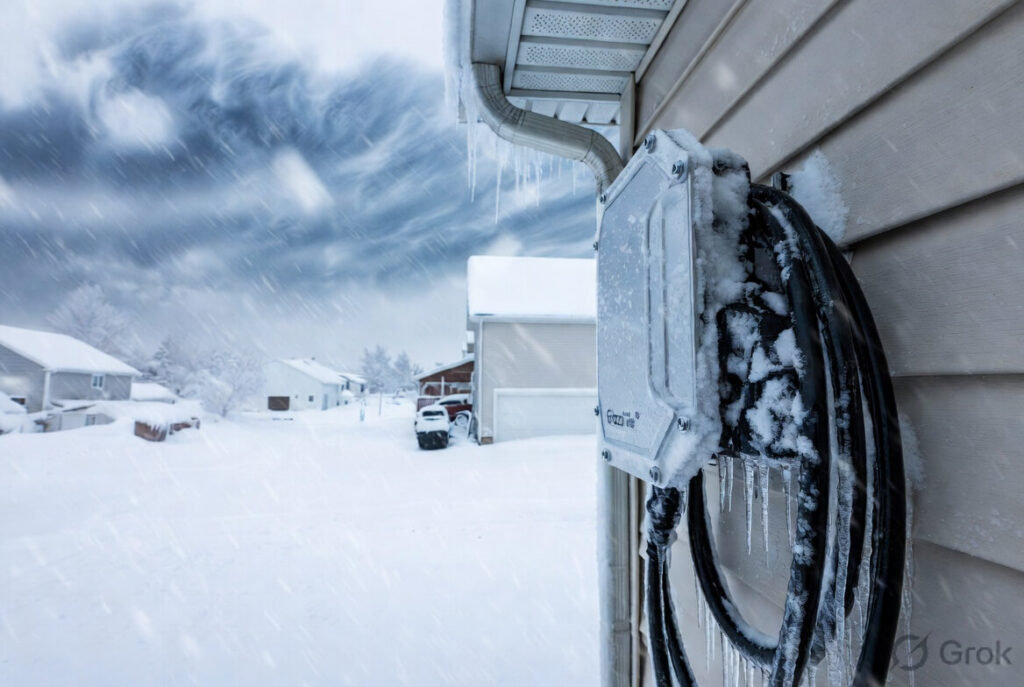
Handle connector ice proactively: In ice storm conditions, the Type 2/NACS connector on your cable and the charging port on your vehicle can freeze. Prevention:
- Keep the charging port cover closed when not charging
- Apply a thin layer of dielectric grease to connector contacts at the start of winter — prevents ice bonding and protects contacts from corrosion
- Keep a dedicated de-icer spray (automotive grade, safe for electrical contacts) in the car specifically for connector ice events
- Park the car plugged in when ice storms are forecast — a plugged-in car’s battery management keeps the port area slightly warmer
Manage the heat pump’s cold limit: Heat pumps lose efficiency as temperature drops — most heat pumps stop operating efficiently below approximately -15°C to -20°C and switch to resistive heating backup. In a Northeast cold snap at -18°C:
- Your car’s heat pump may be operating at reduced efficiency or in resistive backup mode
- Resistive heating at -18°C consumes significantly more battery than heat pump at -5°C
- Range reduction at -18°C can exceed 40% compared to the 25-30% at -10°C
The Northeast home charging scheduling adjustment: Winter in the Northeast means higher baseline electricity consumption for heating. For homeowners on a 100-amp panel, winter evenings (HVAC at 40A, electric water heater, cooking) leave less headroom for EV charging than summer evenings.
For 100-amp panel Northeast homeowners: The Emporia Pro + Vue combination’s dynamic load management is more critical in winter than summer — baseline consumption is higher, EV charging headroom is lower, and the load management prevents the breaker trips that cold weather peak consumption creates.
The European Winter — Country-by-Country Differences
The winter EV charging guide 2026 cold weather performance US Northeast vs Europe acknowledges that “Europe” encompasses dramatically different winter climates — from Scotland’s wet cold to Norway’s dry deep cold to the Alps’ mountain cold.
United Kingdom Winter
Temperature range: Typically -5°C to +5°C in winter, with occasional cold snaps to -15°C in Scotland and northern England.
Dominant winter challenge: Wet cold, ice storms, and frost rather than deep cold. UK temperatures rarely drop below -15°C even in Scotland — the cold weather charger hardware ratings discussed above are all adequate.
UK-specific concern: Damp conditions and freeze-thaw cycles are harder on charger hardware than sustained deep cold. IP65 chargers (Myenergi Zappi, Hypervolt Home 3 Pro) handle UK outdoor conditions better than IP55 alternatives over time.
The UK heat pump advantage: UK winters are mild enough that heat pumps maintain good efficiency throughout winter. Range reduction in UK winters is typically 15-25% — less severe than Nordic or continental European winters.
Octopus Go winter charging: The Octopus Go overnight cheap rate (7.5p/kWh) is unchanged in winter — but winter evenings make the timing more important. Pre-conditioning from grid during cheap rate overnight window maximises value.
UK winter recommendation: Myenergi Zappi (IP65 rating handles wet UK conditions best) or Hypervolt Home 3 Pro (IP65, excellent UK smart tariff integration). Either charger’s specifications exceed what UK winters demand.
Norway, Sweden, Finland Winter
Temperature range: -15°C to -35°C in inland areas of Norway, Sweden, and Finland. Coastal Norway is milder (-5°C to -15°C) but inland and mountain areas are severe.
Dominant winter challenge: Deep cold, sustained sub-zero temperatures, and the longest winter duration of any European market. Norwegian winter EV ownership represents the world’s largest real-world test of EVs in severe cold — Norway’s >80% EV market share means more EVs operate in genuine deep cold than anywhere else.
Nordic winter EV reality: Norway’s EV ownership experience provides the most honest global data on severe cold weather EV performance. Key findings from Norwegian EV owner data (2024-2026):
- At -20°C, most EVs experience 35-50% range reduction
- Battery pre-conditioning is standard practice — not an advanced tip but basic winter operating procedure
- Overnight charging at home while plugged in is universal — Norwegian EV owners almost never leave their EVs unplugged in winter
- The Grizzl-E Classic equivalent cold weather specification (IP67, -40°C cable, aluminium enclosure) is considered minimum appropriate for inland Norwegian installations
Nordic charger requirements: Norwegian, Swedish, and Finnish winters demand:
- Minimum -25°C operating temperature (some inland locations require -35°C to -40°C)
- IP65 or better (IP55 is insufficient for sustained Scandinavian winter conditions)
- Cold-rated cable compound that remains flexible at -30°C+
For Norwegian and Swedish inland installations: The Easee One is a Norwegian product designed for Norwegian conditions — but its IP54 rating is a limitation for the most severe outdoor installations. Easee recommends sheltered installation for their chargers in the most extreme Nordic environments.
For fully exposed outdoor installations in inland Norway, Sweden, or Finland experiencing sustained -30°C:
- A custom-installed commercial charger in a heated enclosure is the most reliable solution
- The Grizzl-E Ultimate (US-market import) represents the best cold weather specification of any available consumer charger globally
Tibber dynamic pricing in Nordic winters: Norway and Sweden’s Tibber dynamic electricity pricing provides specific winter value — electricity spot prices in Scandinavia can be near-zero or negative during periods of high wind and hydro generation (common in winter). An EV plugged in overnight with Tibber integration and Easee’s smart charging capability automatically charges during these low-cost windows.
Germany, Austria, Switzerland Winter
Temperature range: -5°C to -20°C in lowland Germany, -15°C to -30°C in Alpine areas.
Dominant winter challenge: Cold snaps and Alpine conditions for mountain residents. Lowland German winters are comparable to UK winters in severity.
German winter EV charging note: Germany’s high electricity rates (€0.30-0.40/kWh standard) make winter pre-conditioning from grid especially important financially — pre-conditioning from grid at the cheapest available rate saves significantly more per session than at UK or US electricity prices.
German charger recommendation: Wallbox Pulsar Plus or Easee One for lowland Germany. For Alpine or high-altitude installations, confirm -25°C rating is adequate for the specific location’s winter temperatures.
France Winter
Temperature range: Variable — -3°C to -10°C in northern France and Paris, -15°C to -25°C in the French Alps and Massif Central.
Dominant winter challenge: Alpine driving for mountain-area French EV owners. Urban French EV owners face mild winters comparable to UK.
French winter EV charging note: French Heures Creuses (off-peak) overnight electricity rate is even more valuable in winter — pre-conditioning from grid during off-peak hours is extremely cost-effective at €0.13-0.16/kWh.
French charger recommendation: Wallbox Pulsar Plus for most French locations. For Alpine installations above 800 metres altitude, confirm cold weather ratings and consider installation in a sheltered position.
Winter Charging at Public Infrastructure — Expectations and Realities
US Northeast Public Fast Charging in Winter
Electrify America in winter: Electrify America stations have historically had higher failure rates in cold weather — partially improved in recent years but still a concern. Always have a backup charging option (next nearest station) identified before relying on Electrify America in cold conditions.
Tesla Supercharger in winter: The most reliable public fast charging network in cold weather — Tesla’s proprietary infrastructure includes heating for the charging cables and better weatherproofing than most competitors. NACS vehicle owners have a cold weather reliability advantage through Supercharger access.
ChargePoint destination chargers in winter: Generally reliable in cold weather — the Level 2 chargers are less temperature-sensitive than DC fast chargers and the smaller form factor means fewer mechanical components to freeze.
The cold weather DC charging speed expectation: At a Northeast DC fast charger in January at -10°C:
- Arrive without pre-conditioning: 15-25 minutes before reaching peak charge rate as battery warms
- Arrive with pre-conditioning active: Near-peak charge rate from start of session
Pre-conditioning for DC fast charging in winter saves approximately 10-15 minutes per charging session. For a 35-minute charging stop, that’s a 25-40% reduction in station time.
European Public Fast Charging in Winter
Ionity in winter: Well-engineered stations with good cold weather reliability. Ionity’s 350 kW stations include cable heating that prevents connector freezing in extreme cold. Generally the most reliable European DC fast charging network in winter.
FastNed in winter: Good reliability in Netherlands, Belgium, and German winters. Less tested in extreme Nordic conditions.
Allego in winter: Variable — Allego’s estate includes older stations in rural Europe where reliability in severe cold is less consistent.
Nordic DC charging in winter: Norwegian charging operators (ChargeNet, Circle K Charge, Recharge) have extensive experience with Arctic charging conditions and have designed their stations accordingly. Nordic DC charging in winter is generally more reliable than Central or Southern European equivalents in cold weather — because the operators have designed for it.
The specific Type 2 connector ice challenge at public chargers: In heavy frost or freezing rain conditions, the Type 2 connector at a public charger can freeze into the vehicle’s charging port. Preventive action:
- Keep the port cover closed until ready to charge
- If the connector appears icy, use the car’s remote pre-conditioning to warm the port area before plugging in
- Carry de-icer spray specifically for the charging port — not windscreen de-icer (which may damage seals) but dielectric-safe de-icer appropriate for electrical connectors
Winter Range Management — The Practical Daily Strategy
Beyond hardware and pre-conditioning, winter EV range management requires specific daily habits that mild-weather EV ownership doesn’t.
The Winter Charging Target Adjustment
In summer, most EV owners charge to 80% daily — sufficient range with battery longevity benefits. In winter, adjusting the daily charge target upward compensates for range reduction.
Recommended winter charging targets:
- Mild winter (UK, Southern Germany, Northern France): 85-90% daily
- Moderate winter (US Northeast, Central Europe): 90-95% on days with extended driving
- Severe winter (Norway inland, Minnesota, Montana): 95-100% on days with extended driving — the battery longevity trade-off is acceptable when range reduction is severe
The daily charge target is set in your car’s app or infotainment system. Many cars have a seasonal charging profile feature that automatically adjusts for winter.
The Low Battery Threshold Adjustment
In summer, many EV owners are comfortable arriving home with 15-20% remaining. In winter, this buffer needs to be larger because:
- Emergency heating loads (getting stuck in traffic while the heater runs) consume more battery than in summer
- Cold weather DC charging from very low SOC is slower (BMS further throttles charging to protect cold, depleted cells)
- Winter roadside assistance for a depleted EV in cold conditions involves longer wait times
Recommended winter minimum threshold:
- Mild winter conditions: 20-25% minimum before charging
- Moderate winter: 25-30% minimum
- Severe winter: 30-35% minimum before charging
Adjust your car’s low battery warning threshold (if adjustable) to reflect these higher winter minimums.
The Winter Journey Planning Adjustment
For any journey over 60% of your winter range (not rated range — winter range), plan a DC charging stop even if you could theoretically complete the journey on a single charge in summer.
Winter journey planning rule: Use ABRP with your specific vehicle, current battery state, and the current temperature entered. ABRP’s winter range calculations for specific vehicles are significantly more accurate than mental arithmetic applied to a rated range figure.
The Winter Home Charging Setup Checklist
A practical checklist for optimising your home charging setup for winter:
Before Winter Begins
- Update charger firmware — most manufacturers release winter optimisation updates. Check your charger app for pending firmware updates before the cold season.
- Inspect charging cable — check for any cracking, stiffening, or damage to the cable jacket from last winter. Cold-damaged cables should be replaced before the season.
- Apply dielectric grease to connector contacts — a small amount prevents moisture ingress and ice bonding.
- Check IP rating vs installation position — if your charger is fully exposed to driving rain or snow, confirm the IP rating is adequate. IP55 is the minimum for exposed outdoor installation. IP65 or IP67 is preferable.
- Set up pre-conditioning schedule — schedule departure time pre-conditioning in your car’s app for your typical weekday departure time. Test it before the first cold morning.
- Join a smart tariff — if not already on an EV-specific overnight tariff (Octopus Go, Xcel TOU, etc.), the winter is when TOU savings are highest. Higher baseline energy costs in winter make the off-peak differential more valuable.
- Adjust daily charge target — increase from summer 80% to winter 85-90% minimum.
- Install load management if needed — winter heating loads increase baseline panel consumption. If your US 100-amp panel was marginally adequate in summer, winter may push it over without load management.
During Winter
- Always plug in overnight — never leave an EV unplugged in cold conditions. Even if the battery is 90%, plugging in allows the BMS to maintain optimal battery temperature using grid electricity rather than battery energy.
- Pre-condition before every journey — 30-45 minutes before departure for typical cars. Set departure time in the app the evening before.
- Use DC fast charge pre-conditioning — activate navigation to a fast charger before arrival. The 15 minutes of battery pre-conditioning during the drive saves 15-20 minutes at the charger.
- Check cable flexibility before plugging in at very low temperatures — at -20°C and below, allow a cold cable to warm slightly before bending sharply or forcing into the connector.
- Check charger display after plugging in — confirm charging has initiated and the correct power level is being delivered. Cold weather occasionally causes initial charge session failures that a simple unplug-replug resolves.
The Smart Charger Winter Features That Actually Matter
Not all smart charger features deliver equal winter value. Here’s what’s genuinely useful versus what’s irrelevant in cold weather:
Features That Matter More in Winter
TOU scheduling + pre-conditioning timing: Configuring your charger to complete charging and your car’s pre-conditioning to activate sequentially ensures maximum cheap-rate electricity use for both charging and pre-conditioning. The Myenergi Zappi and Ohme Home Pro’s departure-time scheduling handles this most elegantly for UK owners.
Load management: Winter peak home consumption (heating + cooking + EV charging simultaneously) makes load management more necessary than summer. The Emporia Pro’s dynamic load management prevents winter evening breaker trips that summer usage avoids.
Energy monitoring: Winter charging sessions show higher kWh consumption than summer (longer charge times + pre-conditioning load). Tracking your actual winter consumption helps you anticipate electricity bills and identify unusual charging patterns.
Features That Matter Less in Winter
Solar divert: Winter solar generation in northern latitudes is significantly lower than summer. In Scotland or Norway in January, solar surplus for Zappi Eco+ mode may be near-zero. The solar divert financial value of the Myenergi Zappi is reduced in winter — overnight TOU scheduling becomes the primary value in cold, dark months.
Bidirectional/V2H: Winter is when battery range is most valuable — depleting the battery for home power (V2H) during winter peak consumption conflicts with the range preservation that winter driving requires. V2H is most valuable in summer when range is less constrained and solar generation provides energy for home use.
Internal Links — Further Reading on Clean Energy Bazaar
The winter EV charging guide 2026 cold weather performance US Northeast vs Europe connects to every practical guide across this site.
For the cold weather charger hardware deep-dive comparing the Grizzl-E Ultimate against the Hypervolt Home 3 Pro, our Grizzl-E Ultimate vs Hypervolt Home 3 Pro cold weather comparison covers every relevant specification. For the IP rating guide that determines which chargers handle winter outdoor installation conditions, our weatherproof EV chargers 2026 IP ratings guide translates every rating into plain language. For the load balancing guide that explains why 100-amp US panel owners need dynamic load management in winter specifically, our load balancing EV chargers 2026 guide covers the full picture. For the TOU tariff savings that are most valuable in winter, our time-of-use EV charging savings guide covers every tariff and charger combination. For the charge time data including cold weather adjustments for specific vehicles, our EV charge time calculator 2026 covers the calculation framework. For the road trip charging kit including winter-specific adapter and equipment recommendations, our road trip charging kit 2026 guide covers portable charging for all seasons. And for the full visual comparison of all 15 chargers including cold weather specifications, our visual side-by-side 15 top EV chargers 2026 US and Europe compared covers every specification.
Final Thoughts
The winter EV charging guide 2026 cold weather performance US Northeast vs Europe resolves into a set of clear, actionable conclusions that make cold weather EV ownership as predictable and reliable as warm weather ownership.
The hardware conclusions:
For US Northeast owners: The Emporia Pro’s load management is critical in winter (baseline consumption is higher, headroom is lower). The Grizzl-E Classic’s IP67 and -40°C specification covers the Northeast’s temperature range with margin. The Grizzl-E Ultimate’s internal heating is only necessary for Minnesota, Montana, and Canadian winters where sustained -35°C+ occurs.
For UK owners: IP65 chargers (Myenergi Zappi, Hypervolt Home 3 Pro) handle the UK’s wet cold better than IP55 alternatives over time. The -20°C minimum operating temperature of every major UK charger comfortably covers UK winter conditions.
For Scandinavian owners: The Easee One’s IP54 limitation means sheltered installation is recommended for fully exposed outdoor positions. Sustained -30°C environments in inland Norway and Sweden justify importing a Grizzl-E Ultimate or using commercial charger hardware.
The habit conclusions:
Pre-conditioning is the single most impactful winter EV habit. Set it up before the first cold morning. The 30-minute grid electricity investment saves range, time at DC fast chargers, and the stress of a cold battery.
Always plug in overnight in winter. The BMS uses grid electricity to maintain battery temperature — a plugged-in winter EV is better rested and better ranged in the morning than an unplugged one.
Adjust your daily charge target upward in winter. 80% is a summer target. 90% is a sensible winter target for most drivers.
The financial conclusion:
TOU scheduling is more valuable in winter than summer — the rate differential is the same but the kWh you consume (more heating, more charging, pre-conditioning load) is higher. Getting onto Octopus Go or your local TOU tariff before winter maximises the financial benefit of every cold morning’s pre-conditioning session.
Winter EV charging is manageable. Pre-conditioned, planned, and on the right tariff, a cold weather EV is a reliable daily driver in Boston, Oslo, Edinburgh, and everywhere in between.