India’s battery swapping industry has spent years proving that the technology works. The next phase is about proving that the network can scale. And the partnership announced on August 11, 2026, between Indofast Energy and GLIDA is a direct answer to the single biggest obstacle standing in the way of that scale: finding the right sites.
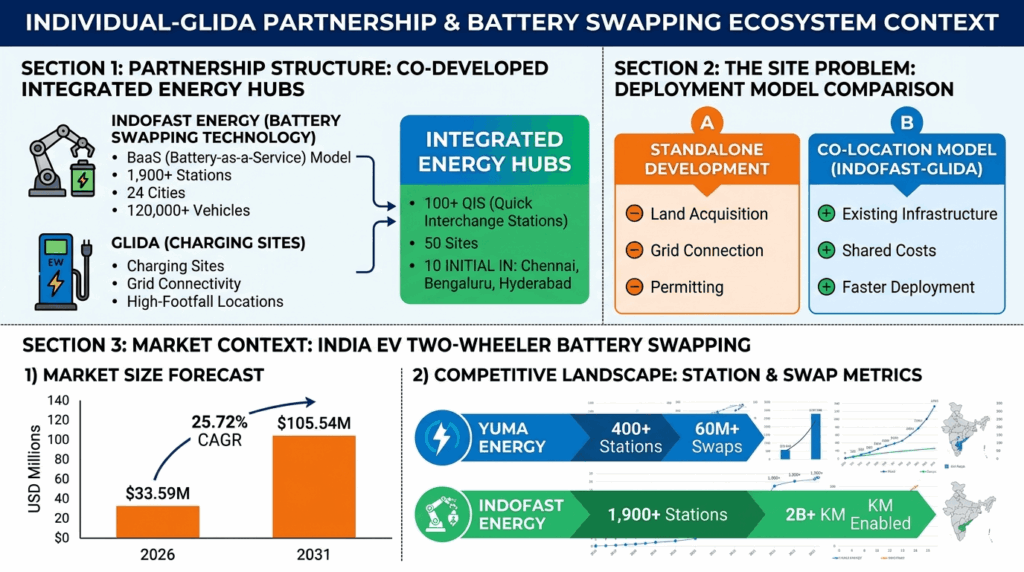
The collaboration will co-locate Indofast’s Quick Interchange Stations at GLIDA’s existing charging sites across India, beginning with 10 stations in Chennai, Bengaluru, and Hyderabad, with plans to scale to 50 sites and more than 100 stations over the next 12 months . This is India’s battery swapping network reaching critical mass, and the Indofast Energy and GLIDA partnership explains how the industry intends to get there.
The Partnership: Swapping Meets Charging
The logic of the deal is straightforward. Indofast Energy brings the battery swapping technology, the Battery-as-a-Service model, and a network that already spans more than 1,900 swap stations across 24 cities, enabling over 2 billion kilometers of clean mobility . GLIDA, formerly Fortum Charge and Drive India, brings something equally valuable: land in the right locations with dependable grid connectivity.
Deepak Paliwal, GLIDA’s Managing Director and CEO, framed the problem with unusual candor for a corporate press release: “Over the last decade we have learned that the hard part is not the technology, it is the site: land in the right location, dependable grid connectivity, and operations that run reliably every day” .
That is the insight the partnership is built on. GLIDA has already solved the site problem for charging infrastructure. By co-locating swapping stations at those same sites, Indofast can expand its network without having to replicate the costly and time-consuming process of site acquisition, grid connection, and permitting.
Subhash Bhat, Indofast’s Interim CEO, described the arrangement as a way to “rapidly expand our Battery-as-a-Service network by leveraging well-connected, power-ready sites that can be quickly activated for battery swapping operations” .
The result is what the companies call integrated EV energy destinations: locations where high-power charging and rapid battery swapping coexist, serving different vehicle categories from a single location . A passenger EV can fast-charge while a delivery rider swaps a depleted battery, and both can do so at the same site.
Why This Matters: The Site Problem Is the Industry’s Binding Constraint
The battery swapping industry in India has grown rapidly. Indofast alone operates 1,900-plus stations. Yuma Energy operates more than 400 stations with over 2,500 charging units and has completed more than 60 million swaps . Battery Smart and other operators have built networks across dozens of cities.
But the growth has been constrained by a factor that is rarely discussed in technology circles: real estate. A swapping station needs a physical location with sufficient power capacity, adequate space for battery inventory and exchange equipment, and convenient access for the high-utilisation riders who are the primary customers. Finding such locations in dense Indian cities is expensive, slow, and uncertain.
The Indofast-GLIDA partnership offers a template for solving this problem. Instead of building a standalone swapping network from scratch, Indofast can piggyback on GLIDA’s existing footprint. GLIDA’s charging hubs already have the land, the grid connections, and the operational infrastructure. Adding swapping stations to those sites is a matter of installing equipment rather than replicating the entire site development process.
The model is not unique to GLIDA. Indofast announced a similar partnership with Zeon Charging in early August 2026, deploying Quick Interchange Stations at Zeon’s premium mall and metro parking locations in Bengaluru, with expansion planned across South India . The strategy is consistent: partner with infrastructure owners who already control the sites, and focus on what Indofast does best.
The Critical Mass Argument
The phrase “critical mass” is often used loosely in technology discussions. In the context of battery swapping, it has a specific meaning.
A swapping network reaches critical mass when three conditions are met. First, there are enough stations in enough locations that riders can rely on the network for their daily operations without worrying about finding a charged battery. Second, there are enough riders using the network that each station generates sufficient revenue to be economically viable. Third, the network is dense enough in key corridors that the time saved by swapping, rather than charging, is not offset by the time spent traveling to a station.
Indofast’s existing network of 1,900-plus stations across 24 cities, supporting over 120,000 vehicles, suggests that the first condition is approaching . The company’s 2 billion kilometers of enabled clean mobility is evidence that the network is being used at scale .
The GLIDA partnership addresses the third condition directly. By placing swapping stations at high-visibility, high-footfall locations that riders already pass on their daily routes, the partnership reduces the detour cost of swapping. A rider who can swap at a mall or metro station they pass anyway does not lose time traveling to a dedicated swapping hub.
The second condition—station-level economic viability—is where the industry still faces challenges. Yuma Energy, one of the larger operators, is not yet profitable overall, though some of its older stations are EBITDA-positive . The capital intensity of the business means that profitability depends on scale. More stations in more locations, serving more riders, is the path to viability.
The Integrated Energy Hub Model
The partnership is part of a broader shift in India’s EV infrastructure market. Standalone charging networks and standalone swapping networks are giving way to integrated energy hubs that serve multiple vehicle categories and multiple energy delivery models from a single location .
This shift has several advantages. Land and grid infrastructure are shared, reducing the cost per vehicle served. Utilization rates improve because the site serves a broader customer base. And the customer experience improves because riders and drivers can access the energy solution that best fits their needs at a single location.
For GLIDA, the partnership is a way to extract more value from its existing sites. Paliwal noted that the company’s charging locations, especially its hubs, “have room for doing more for the benefit of the ecosystem” . Adding swapping stations increases the revenue per square foot without requiring new land acquisition.
For Indofast, the partnership is a way to expand without bearing the full cost of site development. The company can focus its capital on batteries and swapping equipment rather than real estate and grid connections.
The Road Ahead
The immediate target is 100-plus Quick Interchange Stations across 50 sites within 12 months . That is a meaningful expansion, but it is a fraction of the 1,900-plus stations Indofast already operates. The partnership is an accelerant, not a transformation of the company’s scale.
The longer-term significance lies in the model. If the GLIDA partnership succeeds, it demonstrates that co-location with existing charging infrastructure is a viable path to scaling battery swapping. That model can be replicated with other charging network operators, other real estate owners, and other infrastructure partners. The site problem, which has constrained the industry’s growth, becomes solvable through partnership rather than capital-intensive greenfield development.
The battery swapping market for electric two-wheelers in India is projected to grow from $33.59 million in 2026 to $105.54 million by 2031, a compound annual growth rate of 25.72% . That growth will require thousands of new stations. The Indofast-GLIDA partnership is one of the models that will determine whether the industry can build them fast enough.
The honest assessment is that critical mass is not a single milestone. It is a trajectory. Indofast’s 1,900 stations and 120,000 vehicles represent substantial progress. The GLIDA partnership represents a smarter way to add more. And the integrated energy hub model represents the infrastructure architecture that India’s EV ecosystem will need as it scales.
India’s battery swapping network is reaching critical mass. The Indofast Energy and GLIDA partnership shows how the industry intends to get the rest of the way there.