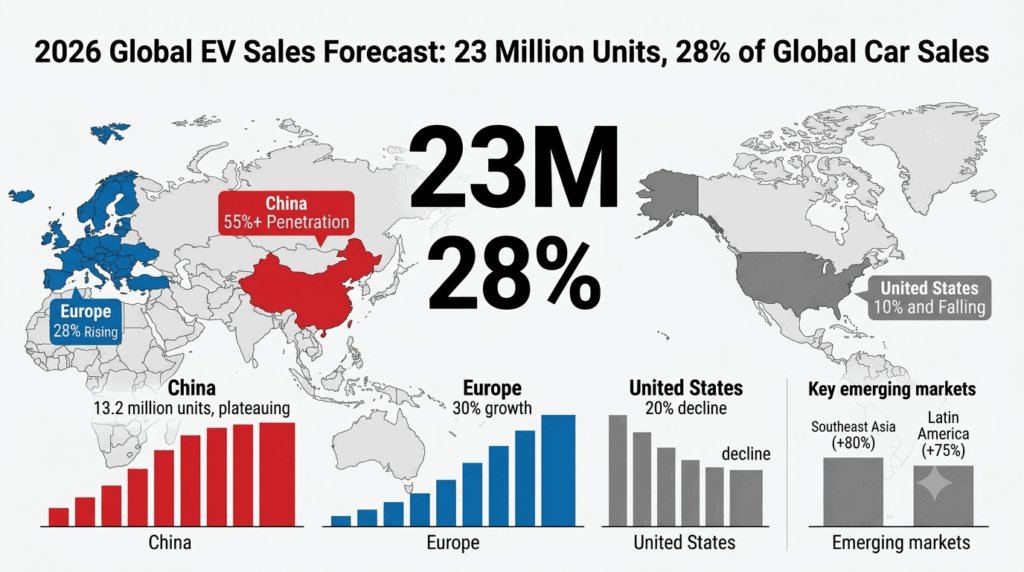
2026 global EV sales forecast: 23 million units, 28% of global car sales - infographic showing global EV sales reaching 23 million units and 28 percent market share, with China at 55 percent penetration, Europe at 28 percent, United States at 10 percent, and emerging markets growing 75 to 80 percent
EV charging

2026 Global EV Sales Forecast: 23 Million Units, 28% of Global Car Sales

The 2026 global EV sales forecast points to 23 million units and 28% of global car sales. This analysis breaks down the regional divergence behind the headline number: China approaching 60% market share, Europe growing 30% on regulatory momentum, the United States contracting 20% after losing federal tax credits, and emerging markets in Southeast Asia and Latin America surging 75% to 80%. It examines the energy security premium that has become the dominant purchase motivation, the supply chain concentration that underpins the forecast, and what the numbers actually mean for the future of global electric mobility.
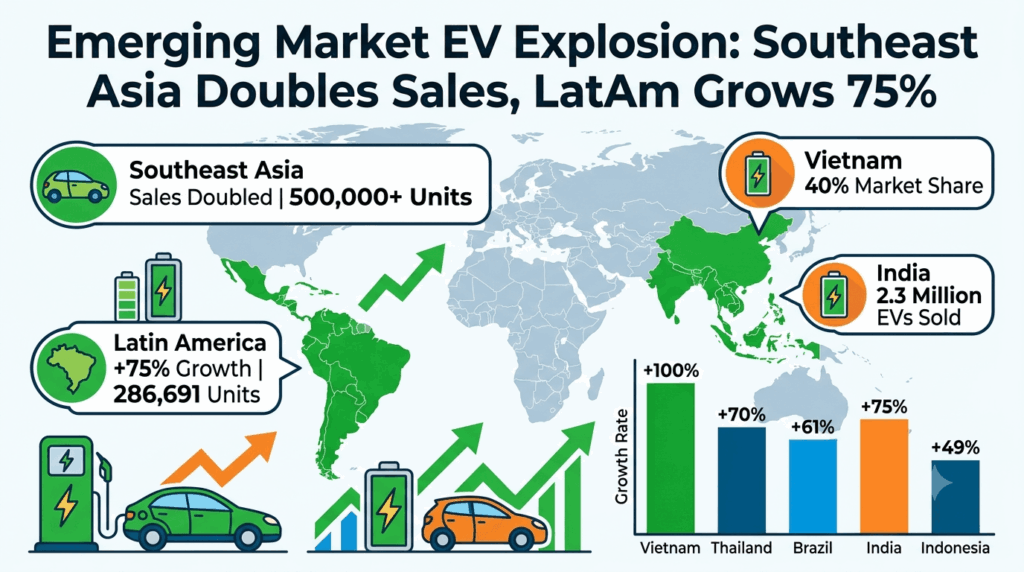
Emerging market EV explosion: Southeast Asia doubles sales, LatAm grows 75% — comparison chart showing Vietnam at 175,099 units, Thailand at 140,000, Indonesia at 100,000+, Brazil at 286,691, Mexico at 96,636, India at 2.3 million, and Colombia at 87,677 units
EV charging

Emerging Market EV Explosion: Southeast Asia Doubles Sales, LatAm Grows 75% — The Honest Complete Guide

Emerging market EV explosion: Southeast Asia doubles sales, LatAm grows 75% — and the data confirms that the Global South is no longer following in the EV transition. It is leading. This complete guide breaks down the record growth across emerging markets: Southeast Asia’s sales more than doubling to over half a million vehicles, Vietnam reaching nearly 40% market share, Thailand selling 140,000 EVs, Indonesia doubling to 15%, Latin America growing 75% with Brazil selling 286,691 electrified vehicles and Mexico reaching 96,636 units, and India hitting 2.3 million EV sales. It covers the policy drivers, the role of affordable Chinese models, the energy crisis catalyst, and what this means for the global automotive industry

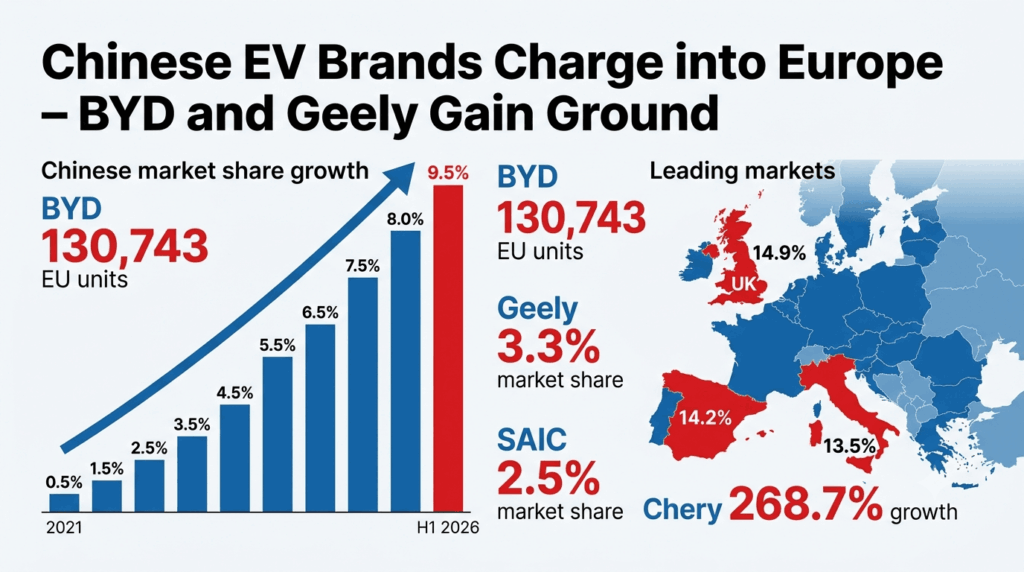
Chinese EV brands charge into Europe – BYD and Geely gain ground — infographic showing Chinese brands reaching 9.5% European market share in H1 2026, up from 0.5% in 2021, with BYD at 130,743 EU units and Geely at 3.3% market share
EV charging

Chinese EV Brands Charge into Europe – BYD and Geely Gain Ground: The Honest Complete Guide

Chinese EV brands charge into Europe – BYD and Geely gain ground — and the data confirms that the European automotive market is undergoing a structural realignment. This complete guide breaks down the combined 9% market share held by four major Chinese OEMs (BYD, Geely, SAIC, and Chery), BYD’s rise to become Europe’s bestselling Chinese brand (130,743 EU units in H1 2026), Geely’s quiet expansion through Volvo, Polestar, and Lynk & Co (3.3% market share), the EU tariff response and its PHEV loophole, the profitability challenges of the export model, and what this means for European consumers and the auto industry.

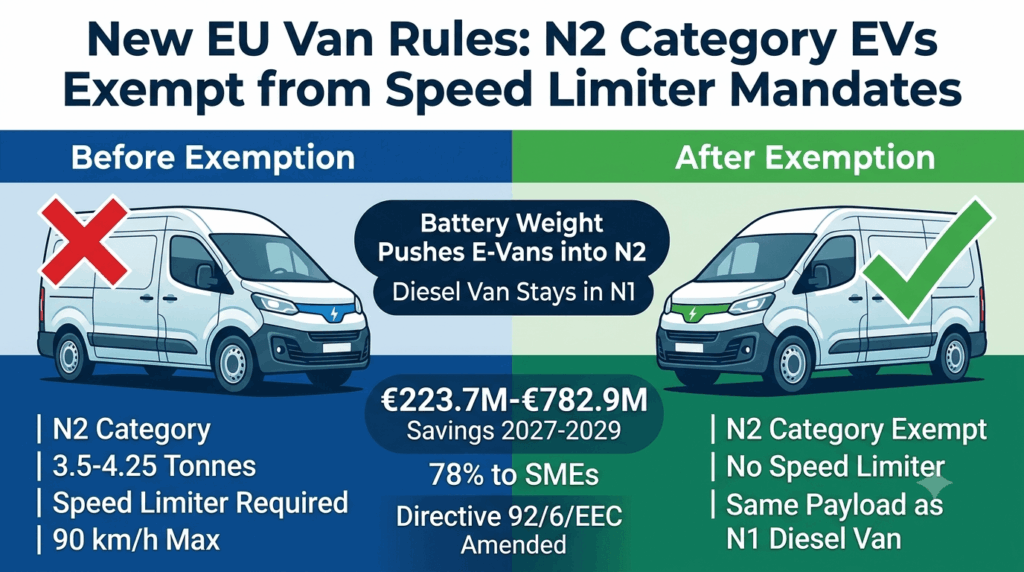
New EU van rules: N2 category EVs exempt from speed limiter mandates — infographic showing electric vans with battery weight pushed into N2 category facing 90 km/h speed limiter requirement, now exempt, with €782.9 million cumulative savings from 2027 to 2029 and 78 percent benefiting SMEs
EV charging

New EU Van Rules: N2 Category EVs Exempt from Speed Limiter Mandates — The Honest Complete Guide

New EU van rules: N2 category EVs exempt from speed limiter mandates — and the exemption represents a sensible correction to a regulatory anomaly that has been penalising electric vans for their own battery weight. This complete guide breaks down the specific legislative amendments to Directive 92/6/EEC and Regulation (EU) 2019/2144, the weight-based classification problem that pushed e-vans into N2 category, the estimated €223.7 million to €782.9 million in cumulative savings from 2027 to 2029, the road safety concerns raised by type-approval authorities, the EESC opinion and its recommendation for conditionality, and what this means for Europe’s rapidly growing electric van market.

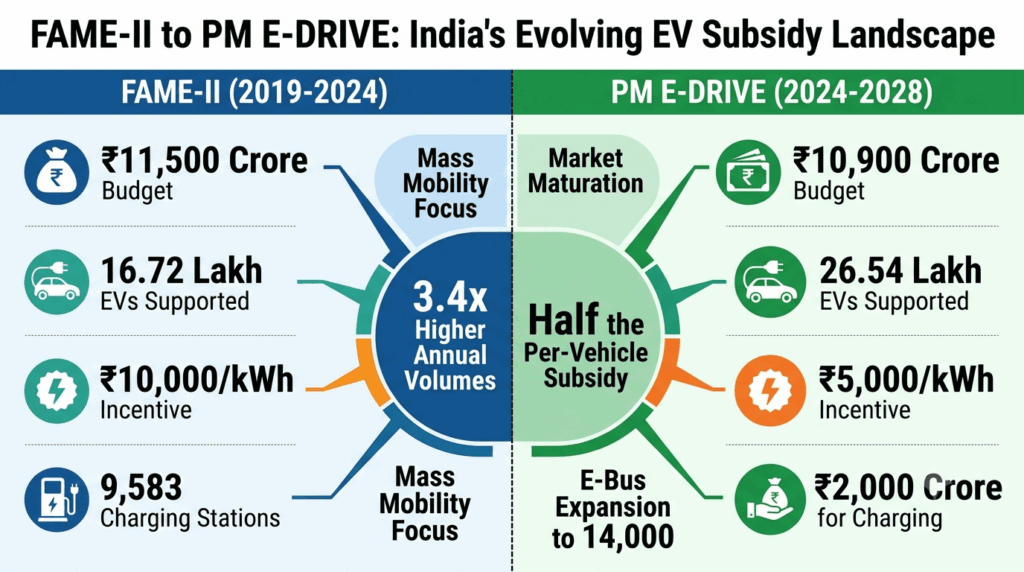
FAME-II to PM E-DRIVE: India's evolving EV subsidy landscape — infographic comparing FAME-II with ₹11,500 crore outlay and 16.72 lakh EVs supported against PM E-DRIVE with ₹10,900 crore and 26.54 lakh EVs supported, showing 3.4x higher annual volumes with half the subsidy
Uncategorized

FAME-II to PM E-DRIVE: India’s Evolving EV Subsidy Landscape — The Honest Complete Guide

FAME-II to PM E-DRIVE: India’s evolving EV subsidy landscape — and the data confirms that India’s EV subsidy framework has successfully transitioned from market activation to market consolidation. This complete guide breaks down the ₹11,500 crore FAME-II scheme (16.72 lakh EVs supported, 9,583 charging stations, ₹10,000/kWh incentive) and the ₹10,900 crore PM E-DRIVE scheme (26.54 lakh EVs supported, 3.4x higher annual volumes with half the subsidy, ₹2,000 crore for charging infrastructure), the CEEW study findings, the state-wise adoption patterns, and what this evolution means for India’s EV future.

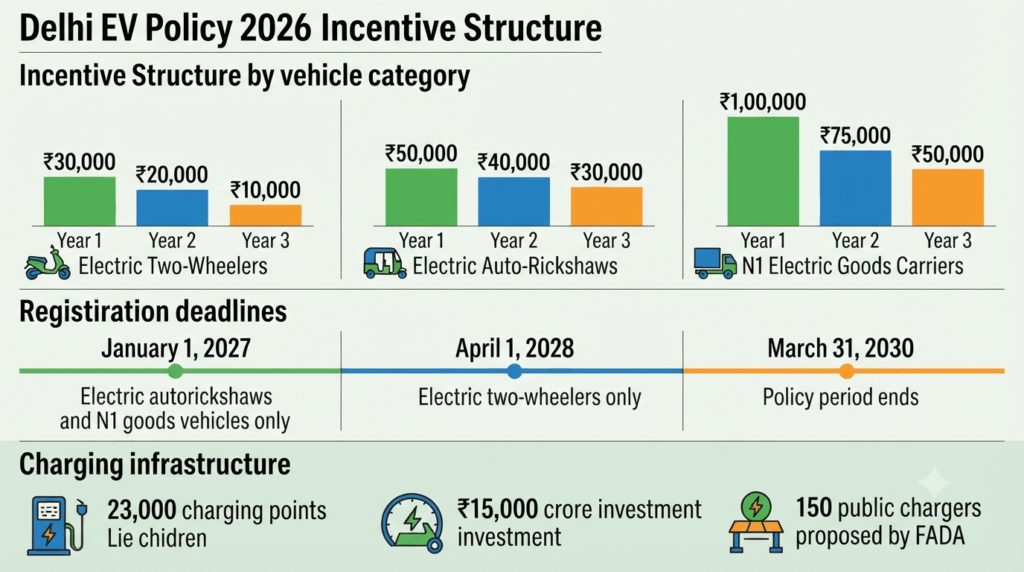
Delhi's new EV policy 2026: mandatory charging stations at dealerships and new rules — comparison chart showing incentive structure for two-wheelers, auto-rickshaws, and goods carriers, registration deadlines for January 2027 and April 2028, and 23,000 charging points target
EV charging

Delhi’s New EV Policy 2026: Mandatory Charging Stations at Dealerships and New Rules — The Honest Complete Guide

Delhi’s new EV policy 2026: mandatory charging stations at dealerships and new rules — and the policy represents a bold and comprehensive framework for accelerating electric mobility in India’s capital. This complete guide breaks down the dealership charging mandate (at least one public charging station at each dealership, three charging points for two- and three-wheelers, two for four-wheelers, within six months), the single-window clearance system, Delhi Transco Limited as nodal agency, the registration deadlines (electric autorickshaws from January 2027, electric two-wheelers only from April 2028), the incentive structure (up to ₹30,000 for two-wheelers, ₹50,000 for auto-rickshaws, ₹1 lakh for goods carriers), the 23,000 charging points target, and the impact on dealerships and urban charging infrastructure.

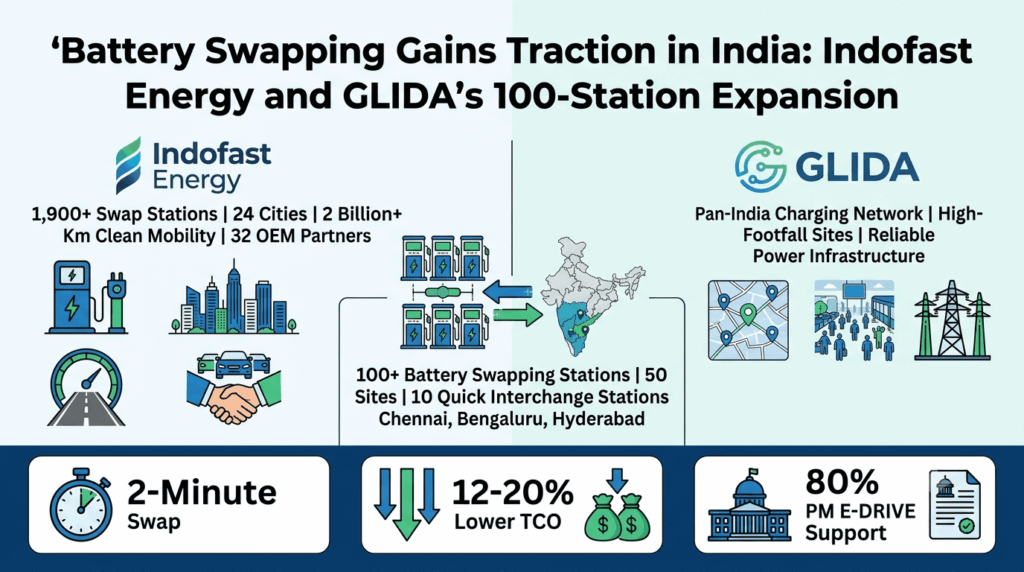
Battery swapping gains traction in India: Indofast Energy and GLIDA's 100-station expansion — infographic showing Indofast Energy with 1,900+ swap stations and GLIDA partnership to deploy 100+ battery-swapping stations across 50 sites with Quick Interchange Stations in Chennai, Bengaluru, and Hyderabad
EV charging

Battery Swapping Gains Traction in India: Indofast Energy and GLIDA’s 100-Station Expansion — The Honest Complete Guide

Battery swapping gains traction in India: Indofast Energy and GLIDA’s 100-station expansion — and the partnership represents a significant step forward for India’s EV infrastructure ecosystem. This complete guide breaks down the Indofast Energy and GLIDA partnership (100+ battery-swapping stations across 50 sites, 10 Quick Interchange Stations in Chennai, Bengaluru, and Hyderabad), Indofast’s 1,900+ swap stations across 24 cities, the Battery-as-a-Service model, the PM E-DRIVE policy support (80 percent upstream cost support), and what this means for India’s EV adoption journey.

Uncategorized

India’s EV Charging Network Expands to 67,657 Chargers: What It Means for EV Adoption — The Honest Complete Guide

India’s EV charging network expands to 67,657 chargers: what it means for EV adoption — and the honest answer is that India has made significant progress, but the journey is far from complete. This complete guide breaks down the 67,657 chargers installed by August 2026, the 29,151 public EV charging stations, the 1,139 battery-swapping station chargers, the FAME-II scheme (9,583 stations, 16.72 lakh EVs supported), the PM E-DRIVE scheme (₹10,900 crore allocation, ₹2,000 crore for charging, 5,871 chargers approved), the challenges (1-5% utilisation, high electricity tariffs, deployment gap), and the 2030 target of 1.32 million chargers.

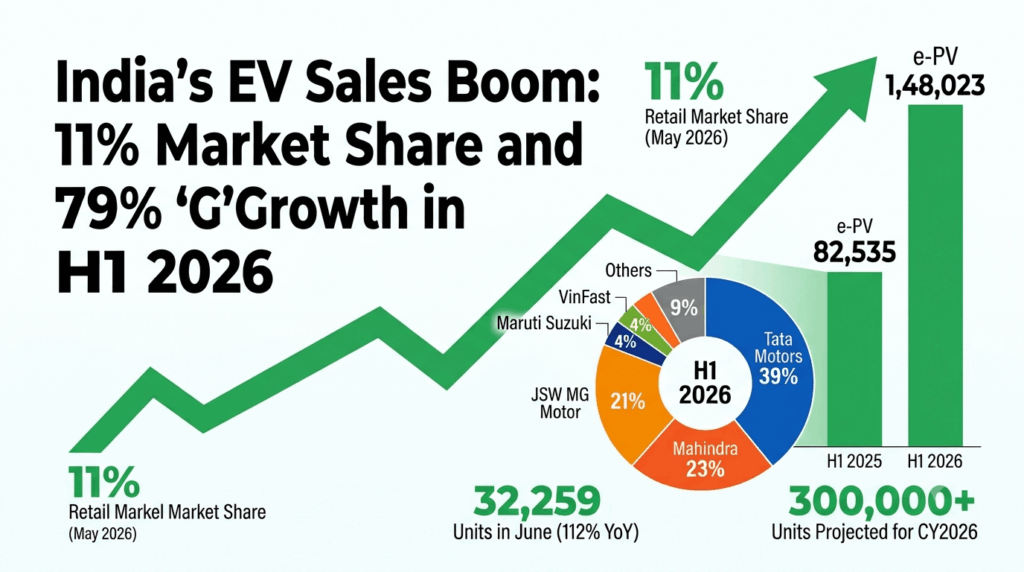
India's EV sales boom: crossing 11% market share and 79% growth in H1 2026 — infographic showing e-PV sales rising from 82,535 to 148,023 units, 11 percent retail market share, Tata Motors 39 percent share, Mahindra 23 percent, MG 21 percent, and new entrants Maruti, VinFast, and Tesla
EV charging

India’s EV Sales Boom: Crossing 11% Market Share and 79% Growth in H1 2026 — The Honest Complete Guide

India’s EV sales boom: crossing 11% market share and 79% growth in H1 2026 — and the data confirms that India’s electric vehicle market has crossed a decisive threshold. This complete guide breaks down the record H1 2026 sales (1,48,023 e-PVs, up 79% YoY, 11% retail market share), the top players (Tata Motors 57,370 units, 39% share; Mahindra 34,131 units, 147% growth; JSW MG Motor 31,819 units), the new entrants (Maruti Suzuki e Vitara at ₹10.99 lakh BaaS, VinFast 5,627 units, Tesla 450 units with 203% July surge), the best-selling models (MG Windsor 19,080, Mahindra XEV 9S 18,074, Tata Nexon EV 16,567), and what it means for buyers.

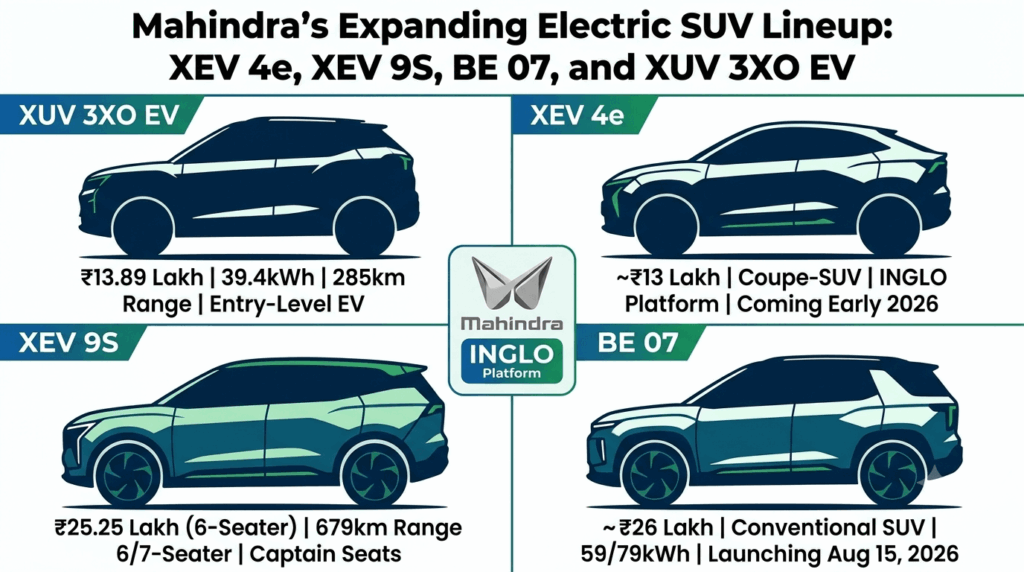
Mahindra's expanding electric SUV lineup: XEV 4e, XEV 9S, BE 07, and XUV 3XO EV — grid infographic showing XUV 3XO EV at ₹13.89 lakh, XEV 4e coming early 2026, XEV 9S 6-seater at ₹25.25 lakh with 679km range, and BE 07 launching August 15, 2026
EV charging

Mahindra’s Expanding Electric SUV Lineup: XEV 4e, XEV 9S, BE 07, and XUV 3XO EV — The Honest Complete Guide

Mahindra’s expanding electric SUV lineup: XEV 4e, XEV 9S, BE 07, and XUV 3XO EV — and the data confirms that Mahindra is executing one of the most aggressive electric SUV rollouts in India. This complete guide breaks down the XUV 3XO EV (₹13.89 lakh, 39.4 kWh battery, 285 km range, Level 2 ADAS), the XEV 9S 6-seater (₹25.25 lakh, captain seats, 679 km range), the upcoming BE 07 (August 15, 2026 launch, conventional SUV profile, INGLO platform, 59/79 kWh battery options), and the anticipated XEV 4e (early 2026 launch, coupe-SUV design).

Scroll to Top