Battery recycling has spent most of its existence as an environmental obligation. Automakers and battery manufacturers absorbed the cost because regulations required it, or because sustainability reports demanded it. The recycling itself was a cost line, not a revenue stream.
That framing is now being challenged from multiple directions. New techno-economic data shows that recycling can produce cathode materials at a lower cost than virgin mining and refining. Upcycling processes are converting low-value waste into high-value products. And companies that once focused solely on extracting metals are discovering that second-life applications and diversified business models generate better returns than recycling alone.
The economics of battery recycling: from cost centre to profit centre is not a prediction about the future. It is an assessment of where the industry stands in 2026, and what has changed to make profitability possible.
The Cost Advantage: Recycled Cathode at 48% Less
The single most important data point in the economics of battery recycling comes from a life-cycle assessment comparing cathode material produced from recycled batteries with cathode material produced from virgin materials.
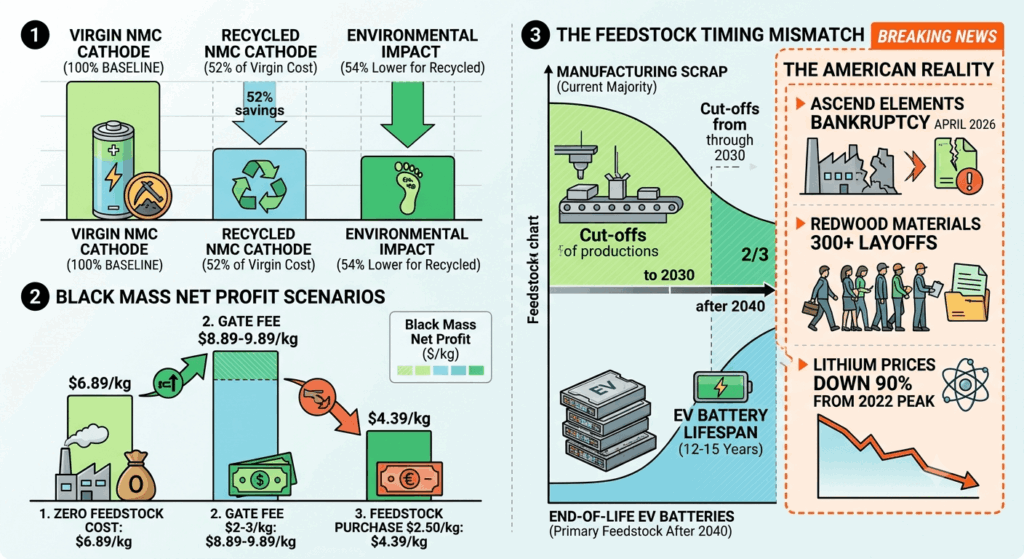
For NMC811 chemistry, the cost of producing lithium-ion battery cathode active material from recycled materials is 48% lower than from virgin materials . This is not a marginal saving. It is nearly half the cost of the most expensive component in a lithium-ion battery.
The environmental case reinforces the economic one. The environmental impacts of producing cathode active material from recycled battery materials are 54% lower than production from virgin materials . The energy consumption and greenhouse gas emissions associated with mining, refining, and synthesising virgin cathode material are substantially higher than the equivalent processes for recycled material.
The economic advantage exists because the metals are already concentrated in the battery. Mining lithium, nickel, cobalt, and manganese requires extracting dilute concentrations from the earth, transporting them, and refining them through energy-intensive processes. Recycling starts with a material that already contains those metals in a processed form. The energy required to separate and recover them is lower than the energy required to produce them from ore.
The Revenue Side: Black Mass and Net Profit
The profitability of recycling depends not just on cost but on the value of the output. A techno-economic assessment of black mass production, the intermediate product from mechanical shredding of batteries, provides a window into the revenue side.
For electric vehicle batteries, the baseline net profit from black mass production, assuming zero feedstock cost, was $6.89 per kilogram. The product revenue was $7.20 per kilogram, against a loaded cost of $0.31 per kilogram .
The assumption of zero feedstock cost is unrealistic for most recyclers, who must pay for end-of-life batteries or at least cover collection and transport. When a gate fee of $2 to $3 per kilogram is added, the net profit rises to $8.89 to $9.89 per kilogram. When feedstock is purchased at $2.50 per kilogram for NCM scrap, the net profit falls to $4.39 per kilogram .
The range is instructive. The profitability of black mass production swings significantly depending on whether the recycler is paid to take the material or must pay for it. The economics improve when recyclers can secure feedstock at low or negative cost, which is often the case for manufacturing scrap from gigafactories. It worsens when competing for post-consumer batteries in a market with limited supply.
The Upcycling Premium: From Low-Value Salts to High-Value Cathodes
The conventional recycling model recovers metals as salts and sells them as commodities. The upcycling model converts battery waste into cathode material directly, capturing a higher-value product.
Research from Worcester Polytechnic Institute and Argonne National Laboratory, published in May 2026, demonstrated a leaching-assisted upcycling process that converts mixed spent cathode materials into lithium manganese iron phosphate, a next-generation cathode material with higher energy density and better cycle life than the original LFP . The techno-economic analysis showed positive profitability across multiple scenarios.
The distinction matters. Selling lithium carbonate or mixed metal sulphates exposes the recycler to commodity price volatility. Selling cathode active material captures the value added by processing, and cathode material prices are more stable and higher than the underlying metal prices. The recycler moves from being a price taker in the commodity market to being a supplier of a specified, qualified product to battery manufacturers.
This is the shift that changes recycling from a cost centre to a profit centre. The recycler is no longer selling metals. It is selling the material that goes into a new battery.
The Sobering Counterpoint: Where Recycling Still Struggles
The positive economics are real but not universal. Several data points from 2026 illustrate where the profitability case remains fragile.
A circular economy assessment published by the European Commission found that, under realistic assumptions, recycling an NMC811 battery pack tends to generate a loss. The report identified the key cost drivers as dangerous-goods transport, pack-to-cell disassembly, and uncertainty in material content, recovery rates, and costs. Firms doing only battery recycling tend to perform worse financially than diversified companies .
The report also found that allocating recycler losses to regulated recycled materials under a 20% recycled-content requirement increases pack unit cost by around 6% . The cost of circularity is not absorbed by the recycler alone. It propagates through the value chain.
The American experience offers a cautionary tale. Ascend Elements, a company that raised over $1.1 billion in equity and received more than $600 million in Department of Energy grants, filed for bankruptcy in April 2026. Its Kentucky plant was halted due to funding exhaustion, and the DOE cancelled $164 million and $316 million in grants in 2025. Redwood Materials, the most prominent American recycler, conducted two rounds of layoffs within six months, with over 300 employees leaving .
The structural problem is a timing mismatch. Most current recycling feedstock comes from manufacturing scrap, not end-of-life batteries. The IEA projects that manufacturing scrap will still account for two-thirds of available feedstock in 2030. Electric vehicle batteries last 12 to 15 years, meaning the large volume of retired EV batteries will not become the primary feedstock until after 2040. Recyclers in the United States face a decade-long feedstock shortage, competing for limited material and driving up purchase costs .
The commodity price environment compounds the problem. Lithium prices fell nearly 90% from their late-2022 peak to mid-2025. When virgin materials are cheaper than recycled materials, the economic case for recycling weakens .
The Diversification Strategy: Second Life and Storage
The companies that are surviving and thriving are the ones that have diversified beyond recycling.
Redwood Materials, after its layoffs, launched an energy storage business in June 2025. The company now tests retired batteries and repackages them into storage systems for data centres, AI computing customers, and renewable energy developers . The storage business provides a revenue stream that is not dependent on commodity metal prices or the availability of end-of-life batteries.
The European Commission’s assessment found that a two-life battery model, where a battery is used first in electric mobility and then in stationary energy trading, generates a higher lifetime discounted cash flow than a single-life mobility scenario. For the modelled electric bus pack, the two-life pathway increased lifetime value by 64% .
The catch is that the value generated in the second life is not captured by the actors who pay the upstream circularity costs. The recycler, the transporter, and the disassembler bear the costs of collection and processing. The value from second-life storage accrues to the energy storage operator. The report proposes mechanisms such as battery asset management companies and carbon-credit trading to redistribute value upstream .
What Determines Profitability: The Variables That Matter
The data from 2026 allows the economics of battery recycling to be reduced to a set of variables that determine whether a project is profitable or not.
Feedstock cost and security. Recycling is profitable when feedstock is cheap or free. Manufacturing scrap from gigafactories is the best feedstock because it is high-purity, generated in predictable volumes, and often available at low cost. Post-consumer batteries are more expensive to collect and process. Projects without contracted feedstock from OEMs or large fleet operators are exposed to price competition .
Chemistry mix. NMC batteries contain nickel and cobalt, which have high value. LFP batteries contain lithium and iron, which have lower value. As LFP grows to dominate the volume segment, the revenue per tonne of recycled material declines. Recyclers must adapt processes to handle both chemistries, or focus on NMC where the value is higher .
Recovery yield and product specification. A recycler that recovers 90% of the metals and sells them as commodity salts earns less than a recycler that recovers 95% and sells cathode material to a battery manufacturer. The product specification determines the price. Battery-grade materials command a premium over technical-grade materials .
Scale and operating cost. Operating expenses range from $1,800 to $2,400 per tonne of input, driven by acid consumption and wastewater treatment . Smaller facilities with sub-scale throughput cannot absorb these costs. The European Commission report found that moving from pilot to industrial economies of scale is a transitional challenge that many projects fail to navigate .
Commodity price exposure. Recycling revenues are tied to metal prices. When lithium prices fall, the value of recovered lithium falls with them. Hedging, long-term offtake agreements, and product diversification reduce this exposure. Companies that sell cathode material rather than metal salts are less exposed than those that sell commodities .
The Honest Assessment
The economics of battery recycling: from cost centre to profit centre is a story that is true in specific circumstances and false in others.
It is true for recyclers that can secure low-cost feedstock, produce high-value cathode material, and operate at scale. The 48% cost advantage for recycled NMC cathode is real. The positive profitability of upcycling processes is real. The value of second-life applications is real.
It is false for recyclers that depend on post-consumer batteries in markets with limited supply, sell commodity salts in a low-price environment, and operate at sub-scale. The American bankruptcies and layoffs of 2026 are as real as the techno-economic analyses showing positive returns.
The industry is in a transition. The feedstock wave is coming, but it is not here yet. The upcycling technologies are proven, but they are not yet deployed at scale. The second-life value is real, but the mechanisms to capture it are still being developed.
The recycling industry of 2030 will look different from the recycling industry of 2026. The companies that survive will be those that navigate the feedstock gap, diversify their revenue streams, and move up the value chain from commodity recovery to material supply. The profit centre is emerging. It is not yet universal.