If you walked into a dealership on September 29, 2025, you could have driven home in a Tesla Model Y, a Ford F-150 Lightning, or a Chevy Equinox EV and sliced $7,500 off the price right at the counter. Walk in two days later, and that same credit vanished.
The federal clean vehicle credit—the cornerstone of U.S. EV policy for more than a decade—ended on September 30, 2025, seven years ahead of schedule. Now that the federal EV tax credit expired, shoppers, dealers, and accountants navigating 2026 face a completely new landscape. The post-sunset rules matter more than the credit ever did, because the recapture traps, binding contract exceptions, and state-level replacements are where most of the money is still won or lost.
So, is an EV still worth it now that the federal EV tax credit expired? The short answer is yes—but the math has changed. Here’s everything you need to know.
What Happened to the Federal EV Tax Credits?
The Inflation Reduction Act of 2022 created two key consumer credits that millions of Americans relied on to make the switch to electric:
- Section 30D provided up to $7,500 for new EVs, split into two halves of $3,750 based on critical mineral sourcing and battery component assembly in North America.
- Section 25E gave used EV buyers up to $4,000 (the lesser of $4,000 or 30 percent of the sale price).
Both were originally scheduled to run through December 31, 2032. But that all changed in 2025, and now the federal EV tax credit expired for good.
What Changed on July 4, 2025
The One Big Beautiful Bill Act (OBBBA), enacted as Public Law 119-21 on July 4, 2025, accelerated the expiration of the new, used, and commercial clean vehicle credits by more than seven years. Specifically:
- No credit is allowed under Section 30D for any vehicle acquired after September 30, 2025.
- No credit is allowed under Section 25E (used EVs) for any vehicle acquired after September 30, 2025.
- No credit is allowed under Section 45W (commercial/lease vehicles) for any vehicle acquired after September 30, 2025.
The IRA’s clean vehicle architecture—income caps, MSRP limits, North American final assembly, critical minerals tests, foreign-entity-of-concern restrictions, and the time-of-sale reporting infrastructure—was effectively switched off for vehicles acquired after that date. In short, the federal EV tax credit expired and left a massive gap in the EV incentive landscape.
The Binding Contract Exception
Here is the lifeline that has saved billions of dollars in credits: the “acquired” date is not the date you take delivery. It is the date you sign a written binding contract and make a payment.
A payment can be:
- A non-refundable cash deposit
- A vehicle trade-in
- Even a nominal down payment recorded by the dealer
If you signed a binding contract and made any qualifying payment on or before September 30, 2025, you are entitled to claim the credit when the vehicle is placed in service—even if delivery slips into 2026. This is one of the few ways to still benefit from the credit now that the federal EV tax credit expired. Talk to a tax professional to confirm your eligibility.
What Federal Incentives Are Still Available?
Even though the federal EV tax credit expired, the federal government still offers one EV-related credit for 2026. The Section 30C charger credit gives you 30% of the cost of buying and installing a home EV charger, up to $1,000. But there’s a catch: you only qualify if you live in a low-income community or a non-urban census tract. Equipment must be installed and in service by June 30, 2026.
There is also a new vehicle loan interest deduction. Eligible buyers can deduct up to $10,000 per year in interest on a qualifying new vehicle loan. This applies from 2025 through 2028 and covers EVs bought in the U.S. While the federal EV tax credit expired, these smaller incentives can still provide some relief.
The Real Story: State-Level Incentives
Now that the federal EV tax credit expired, state programs are the biggest public incentives available to EV shoppers. Following the repeal of federal EV tax credits under the OBBBA, policy responses have split into two tracks: traditionally Democratic states are filling the federal incentive and support gap, while Republican-led states are prioritizing freedom of choice protections and new taxes.
Here’s what some of the most generous states are offering in 2026:
| State | New EV Incentive | Used EV Incentive | Notes |
|---|---|---|---|
| Vermont | $5,000 tax credit (HB 863) | $2,500 tax credit | Nonrefundable tax credit; SNAP recipients can get up to $5,000 on used EVs through MileageSmart |
| California | $3,500 instant rebate (MyFirstEV) | $1,750 rebate | First-time buyers only; new EVs under $50,000 MSRP; used EVs under $25,000 |
| New Jersey | $1,500–$4,000 (Charge Up / Charge Up+) | — | Charge Up+ adds $2,500 for income-qualifying applicants |
| Colorado | $750–$3,500 state tax credit | — | $2,500 additional credit for vehicles under $35,000 MSRP |
| New York | Up to $2,000 (Drive Clean Rebate) | — | Program has issued over 228,000 rebates since 2017 |
Note: State programs change frequently and many are subject to funding availability. Always verify current terms with your state energy office before purchasing.
Vermont: A Closer Look
Vermont stands out as one of the most EV-friendly states in 2026, especially now that the federal EV tax credit expired. Under HB 863, the state provides a nonrefundable tax credit of $5,000 for new EVs** and **$2,500 for used EVs sold at retail.
But that’s not all. The MileageSmart program, administered by Capstone Community Action, covers 25 percent of the purchase price of a used EV, up to $2,500—and up to $5,000 for SNAP-eligible buyers.
Add utility incentives like Burlington Electric Department’s $5,000 rebate toward a new EV, and Vermont buyers can stack savings well beyond what the federal credit ever offered. While the federal EV tax credit expired, Vermont’s combination of state and utility incentives can actually exceed the lost federal benefit.
“Vermont’s own used-EV incentive — MileageSmart, administered by Capstone Community Action — covered 25 percent of the purchase price up to $2,500, and up to $5,000 for SNAP-eligible buyers.”
Utility Company Rebates
Your electric utility may offer its own rebate for buying an EV or installing a home EV charger. These are separate from state and federal programs and are often worth $200 to $2,500. Many people don’t know these rebates exist. Now that the federal EV tax credit expired, these utility rebates have become even more important. Check with your local utility provider before making a purchase.
The Market Reality: What’s Happening to EV Sales?
The impact of the federal EV tax credit expired has been immediate and dramatic.
Americans purchased just 212,600 new EVs in Q1 2026, down from 296,304 in Q1 2025—a 28% decline. EV market share fell to an estimated 5.8% of total new vehicle sales, well below the 7.5% peak reached in Q3 2025.
The culprit is obvious: the federal EV tax credit expired, and nothing has replaced it at the national level. The loss of the $7,500 incentive has hit EV adoption hard, particularly in states without their own robust incentive programs.
New EV Inventory Glut
New EV inventory has ballooned to 130 days’ supply—46% higher than the 89 days’ supply for combustion vehicles. That glut is forcing automakers to pile on incentives to compensate for the fact that the federal EV tax credit expired. EV prices fell to an average transaction price of $55,300, narrowing the gap with gas cars to a record-low $6,500.
GM—the No. 2 EV seller in the U.S. in 2026—sold 56,679 electric vehicles, which was 32.6% lower than last year. The Chevrolet Blazer EV fell 75.1%, and the GMC Hummer EV lineup dropped 54.9%. The fact that the federal EV tax credit expired hit low-priced models especially hard, as buyers in that segment were most reliant on the $7,500 discount.
Used EVs Tell the Opposite Story
While the new EV market struggles, the used side is booming. Used EV sales jumped 12% to near-record levels as buyers hunt for more affordable options, particularly now that the federal EV tax credit expired. Cox Automotive data shows 93,500 used EVs sold in Q1 2026, up 12% from Q1 2025.
The most striking data point is pricing. Used EVs now average $34,821**—within just **$1,300 of the $33,487 average for used gas vehicles. That near-parity is unprecedented; the used EV-to-ICE price gap was over $10,000 as recently as early 2023.
Used EV days’ supply sits at 42—just four days higher than the 38 days for combustion vehicles. That means used EVs are turning at nearly the same pace as gas cars on dealer lots, a sign of genuine consumer demand rather than a supply glut. The used EV market has proven resilient even after the federal EV tax credit expired.
The wave of EVs leased under the IRA’s so-called “leasing loophole” between 2023 and 2025 is now starting to hit dealer lots, which will accelerate this trend. While the federal EV tax credit expired for new purchases, the leasing loophole allowed many vehicles to enter the market, and those lease returns are now flooding the used market.
Is an EV Still Worth It Now That the Federal EV Tax Credit Expired?
The answer depends on four key factors:
1. Where You Live
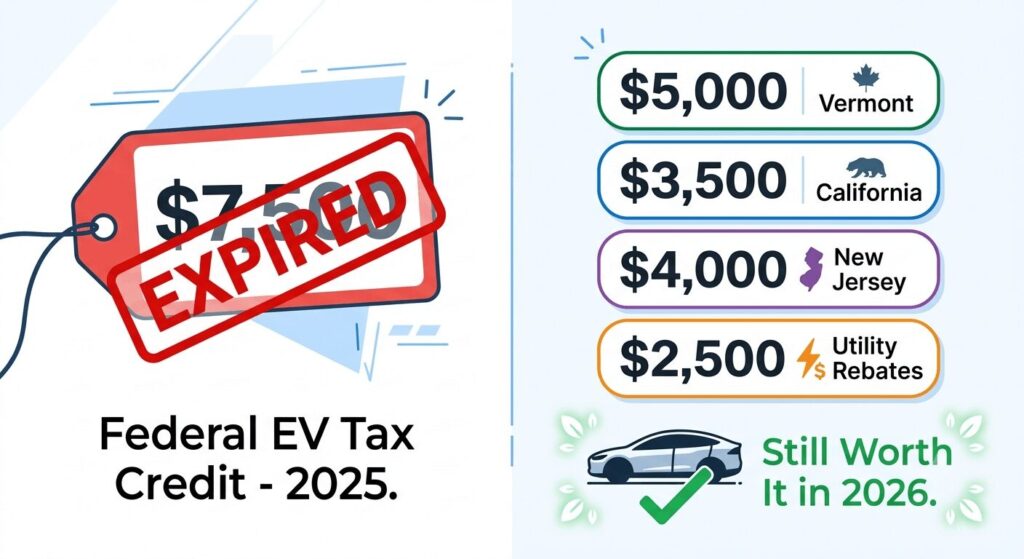
If you’re in Vermont ($5,000 new / $2,500 used plus utility rebates), California ($3,500 new / $1,750 used), or New Jersey (up to $4,000), state EV rebates can replace—or even exceed—the lost federal credit. In these states, the fact that the federal EV tax credit expired is less painful because state programs fill the gap.
If you’re in a state with no EV incentives, the math changes significantly. You’ll need to rely more on manufacturer discounts and long-term fuel savings to justify the purchase. For buyers in these states, the federal EV tax credit expired has made EVs considerably more expensive.
2. Fuel and Maintenance Savings
Even though the federal EV tax credit expired, an electric vehicle owner would still come out ahead on operating costs. EVs have lower fueling and maintenance costs, though they’re typically more expensive to purchase upfront.
With gas prices rising due to geopolitical tensions, the fuel savings equation is tilting further in favor of EVs. Over five years, EV owners save roughly **$200 per year in fuel costs** compared to gas vehicles, plus another **$500–$800 annually in maintenance savings**—that’s $3,500–$5,000 total. These savings can offset the loss now that the federal EV tax credit expired.
3. Automaker Price Adjustments and Dealer Incentives
Manufacturers and dealers have responded to the fact that the federal EV tax credit expired with steeper discounts. Many dealers are offering discounts of their own to help incentivize consumers to make the switch. The end of the federal EV tax credit does not mean all savings have disappeared.
Automakers are also adjusting pricing strategies. Ford recently announced it would “remain competitive” on pricing across its EV lineup, suggesting manufacturer-led incentives will continue. While the federal EV tax credit expired, dealer discounts and manufacturer rebates can still knock thousands off the price.
4. The Used EV Opportunity
Used EVs are becoming a strong value play, especially now that the federal EV tax credit expired. With prices now nearly on par with gas vehicles and a wave of lease returns flooding the market, used EVs may be the most practical and financially realistic option for buyers in 2026.
“Even though the federal EV tax credit expired, an electric vehicle owner would still come out ahead on operating costs.”
Bottom Line: Yes—But Do Your Homework
An EV is still worth it in 2026, but the calculus has changed. The days of a universal $7,500 federal discount are over because the federal EV tax credit expired. In its place is a patchwork of state programs, utility rebates, manufacturer discounts, and long-term ownership savings.
Even though the federal EV tax credit expired, the EV revolution isn’t over. It’s just become more local. With the right research and a bit of patience, you can still drive home an EV that makes financial sense in 2026.
Your Checklist Before Buying Now That the Federal EV Tax Credit Expired
- Check your state’s EV incentives — search by state energy office website; these are now more important than ever since the federal EV tax credit expired
- Check your utility company — many offer $200–$2,500 in additional rebates
- Ask about manufacturer discounts — dealers are competing aggressively now that the federal EV tax credit expired
- Calculate total cost of ownership — factor in fuel, maintenance, and the new interest deduction
- Act fast on the charger credit — the 30% federal home EV charger credit expires June 30, 2026
- Consider used EVs — prices are now near parity with gas cars; this is a great option since the federal EV tax credit expired
- Consult a tax professional — especially if you signed a binding contract before September 30, 2025
The federal EV tax credit expired, but that doesn’t mean you can’t find a great deal. With the right strategy, you can still drive electric affordably in 2026.
Related Articles
- [The Best Home EV Chargers in 2026: A Complete Comparison] — Find the perfect charger for your new EV
- [State EV Incentives: A State-by-State Guide for 2026] — Detailed breakdown of every state program
- [EV vs. Gas: 5-Year Cost of Ownership Comparison] — See the real numbers
- [Used EVs: The Hidden Gem of the 2026 Market] — Why used EVs are the best deal right now
- [How to Install a Home EV Charger: Step-by-Step Guide] — Everything you need to know before the credit expires
Tags
EV Tax Credit, Federal EV Incentives, State EV Rebates, Vermont EV Incentive, Used EV Market, EV Affordability, EV Buying Guide, federal EV tax credit expired 2026
Internal Links Summary
| Anchor Text | Target URL | Placement |
|---|---|---|
| home EV charger | /category/ev-charging/ | Section: “What Federal Incentives Are Still Available?” |
| state EV rebates | /category/ev-policy/ | Section: “Is an EV Still Worth It in 2026?” |
| used EVs | /category/ev-market-trends/ | Section: “The Used EV Opportunity” |
| home EV charger | /category/ev-charging/ | Checklist item #5 |
| state programs | /category/ev-policy/ | Bottom Line section |