Author name: kartikey.ajay@gmail.com

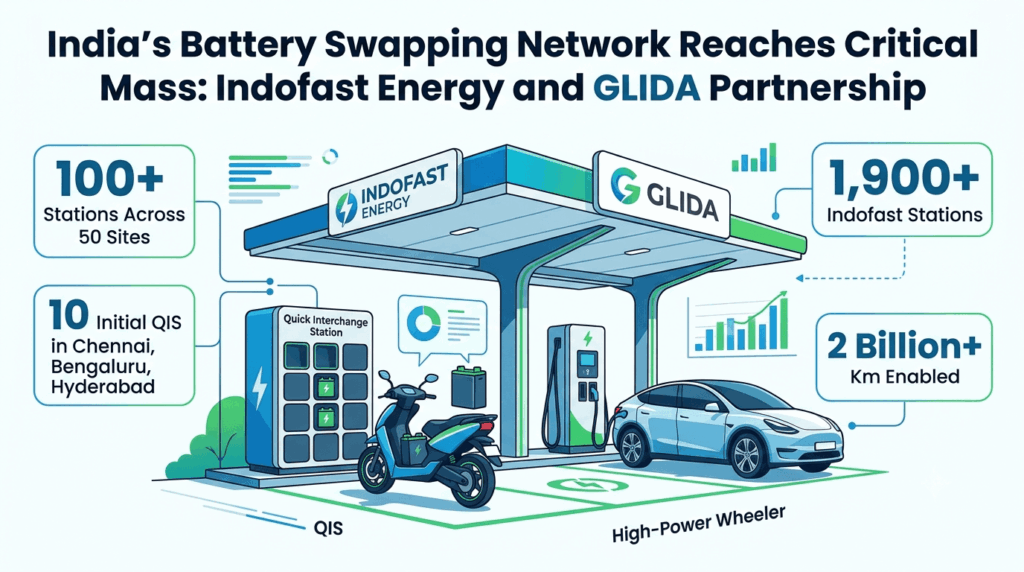
India's battery swapping network reaches critical mass: Indofast Energy and GLIDA partnership - infographic showing an integrated energy hub with battery swapping and high-power charging coexisting, targeting 100+ stations across 50 sites, building on Indofast's 1,900+ station network
EV charging

India’s Battery Swapping Network Reaches Critical Mass: Indofast Energy and GLIDA Partnership

India’s battery swapping network reaches critical mass: Indofast Energy and GLIDA partnership. The collaboration will co-locate 100-plus Quick Interchange Stations at GLIDA’s existing charging sites across 50 locations, solving the industry’s biggest constraint: finding sites with reliable grid connectivity. With Indofast’s 1,900-plus stations and 120,000 vehicles already on the network, the partnership represents a template for scaling battery swapping through infrastructure co-location rather than costly greenfield development.
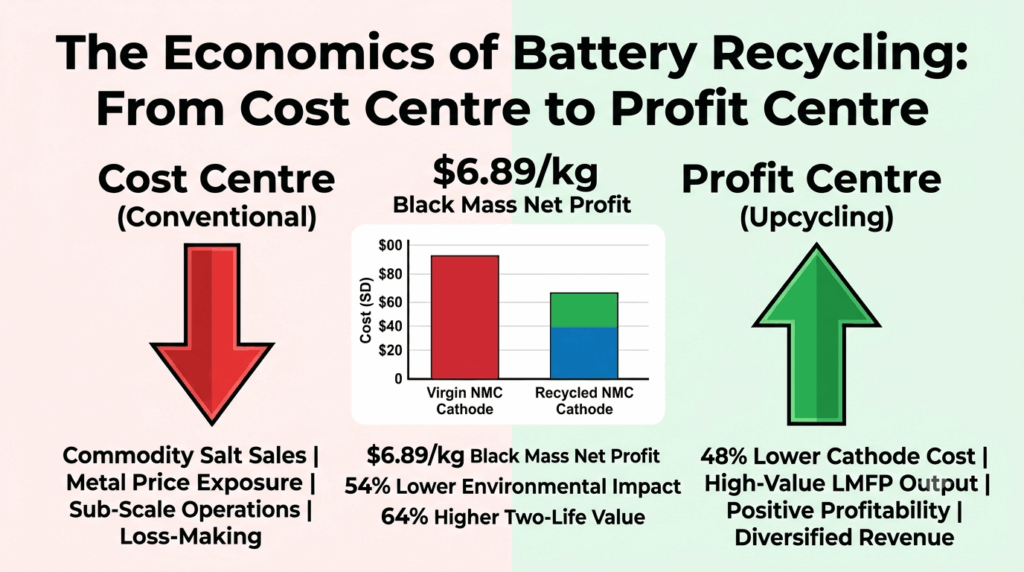
The economics of battery recycling: from cost centre to profit centre - infographic showing recycled NMC cathode costing 48 percent less than virgin material, black mass net profit of $6.89 per kilogram, and the shift from commodity salt sales to high-value upcycling
EV charging

The Economics of Battery Recycling: From Cost Centre to Profit Centre

The economics of battery recycling: from cost centre to profit centre. Recycled NMC cathode material costs 48% less to produce than virgin material, and upcycling processes are turning low-value waste into high-value cathode products. But the American recycling industry has seen bankruptcies and layoffs as feedstock shortages and low metal prices squeeze margins. This analysis breaks down the cost advantage, the revenue models, the feedstock timing mismatch, and the variables that determine whether a recycling project is profitable or not.

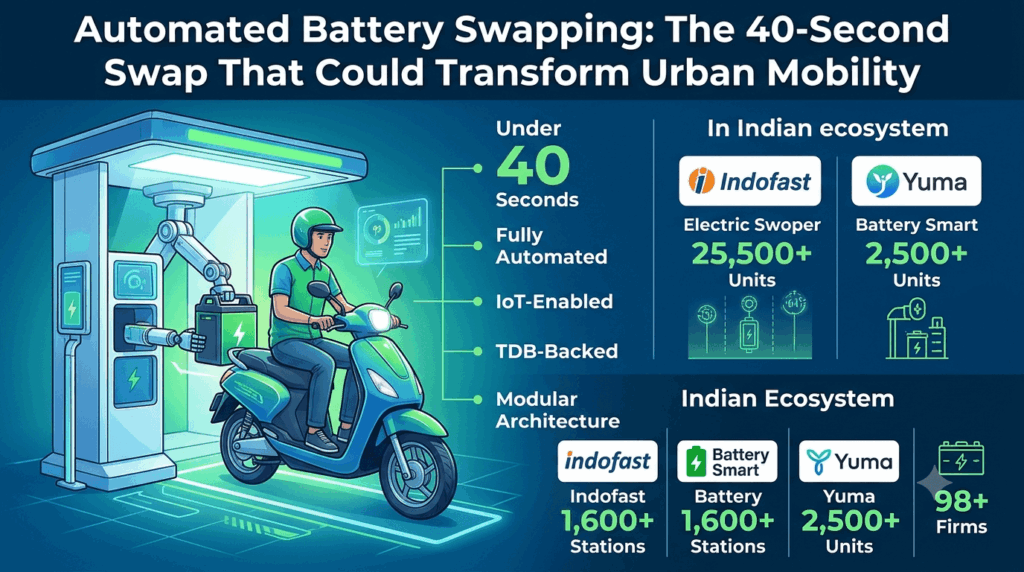
Automated battery swapping: the 40-second swap that could transform urban mobility - infographic showing InfinityX's automated swapping station completing a battery exchange in under 40 seconds, with India's ecosystem including Indofast at 1,600 stations and Battery Smart at 1,600 stations
EV charging

Automated Battery Swapping: The 40-Second Swap That Could Transform Urban Mobility

Automated battery swapping: the 40-second swap that could transform urban mobility. InfinityX Innovations, backed by India’s Technology Development Board, is commercialising an automated swapping system that completes a full battery exchange in under 40 seconds. In a market where Indofast Energy operates 1,600 stations and Battery Smart covers 50 cities, the technology targets the gig economy riders for whom downtime directly hits earnings. This analysis breaks down the technology, the economics, the interoperability challenge, and the financing model that makes it work.

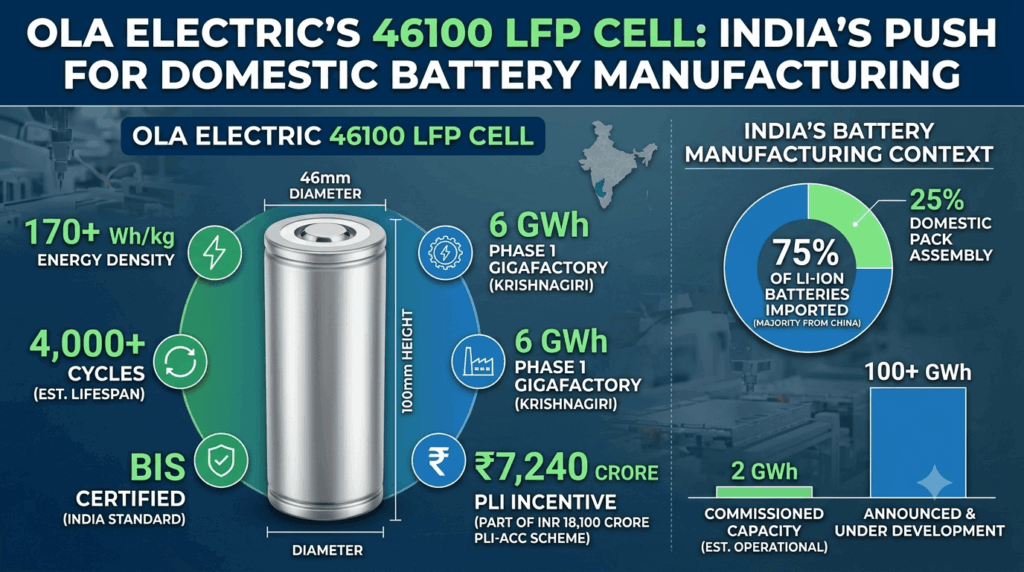
Ola Electric's 46100 LFP cell: India's push for domestic battery manufacturing - infographic showing the 46100 format cell with 170 Wh/kg energy density, 4,000 cycles, BIS certification, 6 GWh gigafactory, and ₹7,240 crore PLI window
EV charging

Ola Electric’s 46100 LFP Cell: India’s Push for Domestic Battery Manufacturing

Ola Electric’s 46100 LFP cell: India’s push for domestic battery manufacturing. The cell has received BIS certification, offers 170 Wh/kg and 4,000 cycles, and is being produced in a gigafactory scaling to 6 GWh. Ola has secured a revised PLI window worth up to ₹7,240 crore. But India still imports nearly 75% of its lithium-ion batteries, and domestic cell costs remain 25-40% higher than imports. This analysis breaks down the cell specifications, the gigafactory scale-up, the PLI economics, and the broader gap India must close.

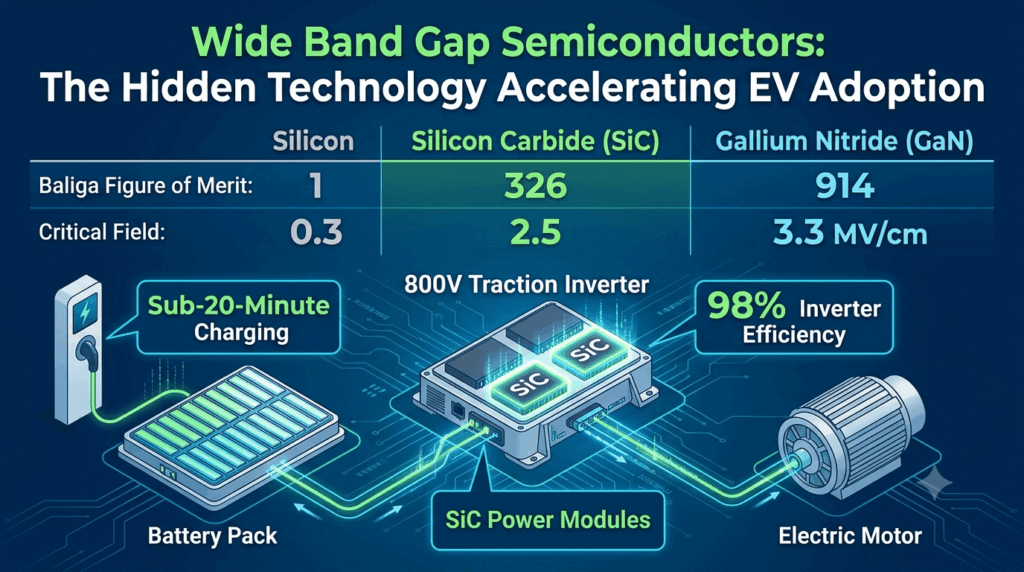
Wide band gap semiconductors: the hidden technology accelerating EV adoption - infographic showing silicon versus SiC and GaN with Baliga figures of merit of 1, 326, and 914, critical fields of 0.3, 2.5, and 3.3 MV per cm, and 98 percent inverter efficiency
EV charging

Wide Band Gap Semiconductors: The Hidden Technology Accelerating EV Adoption

Wide band gap semiconductors: the hidden technology accelerating EV adoption. Silicon carbide and gallium nitride enable 800V architectures, sub-20-minute charging, and 98% inverter efficiency. This analysis breaks down the material science, the SiC versus GaN trade-offs, the Wolfspeed-Geener partnership, India’s indigenous 30 kW drive system, and why these invisible components matter more than most drivers realize.

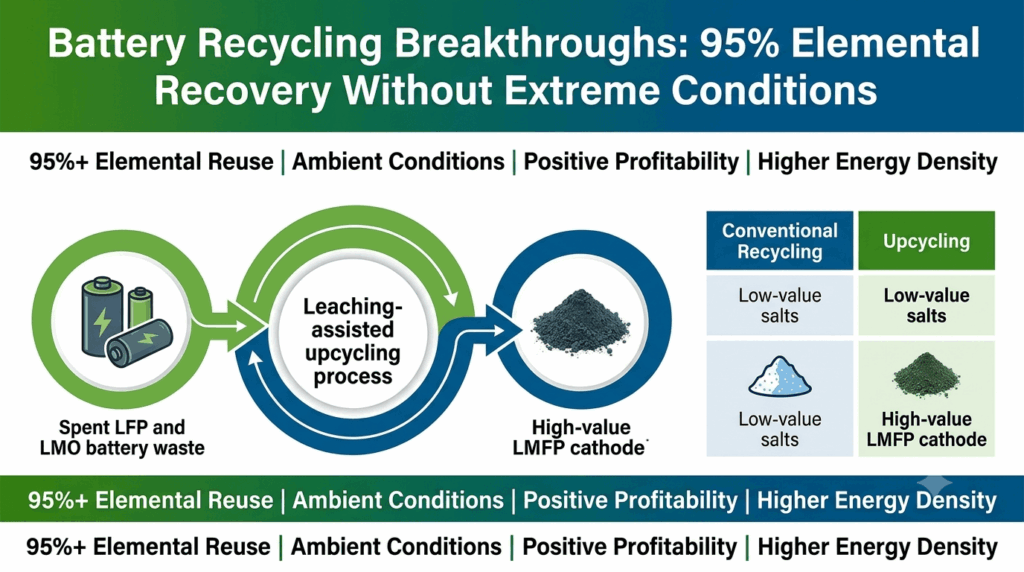
Battery recycling breakthroughs: 95% elemental recovery without extreme conditions - infographic showing spent LFP and LMO battery waste converted into high-value LMFP cathode material through leaching-assisted upcycling at ambient pressure with over 95 percent elemental reuse
EV charging

Battery Recycling Breakthroughs: 95% Elemental Recovery Without Extreme Conditions

Battery recycling breakthroughs: 95% elemental recovery without extreme conditions. Researchers at Worcester Polytechnic Institute and Argonne National Laboratory have developed a leaching-assisted upcycling strategy that converts low-value battery waste into high-value LMFP cathode material at ambient pressure, achieving more than 95% elemental reuse and positive profitability across multiple scenarios. This analysis breaks down the technology, the economics, the broader wave of low-temperature recycling innovations, and the challenges that remain before industrial scale.

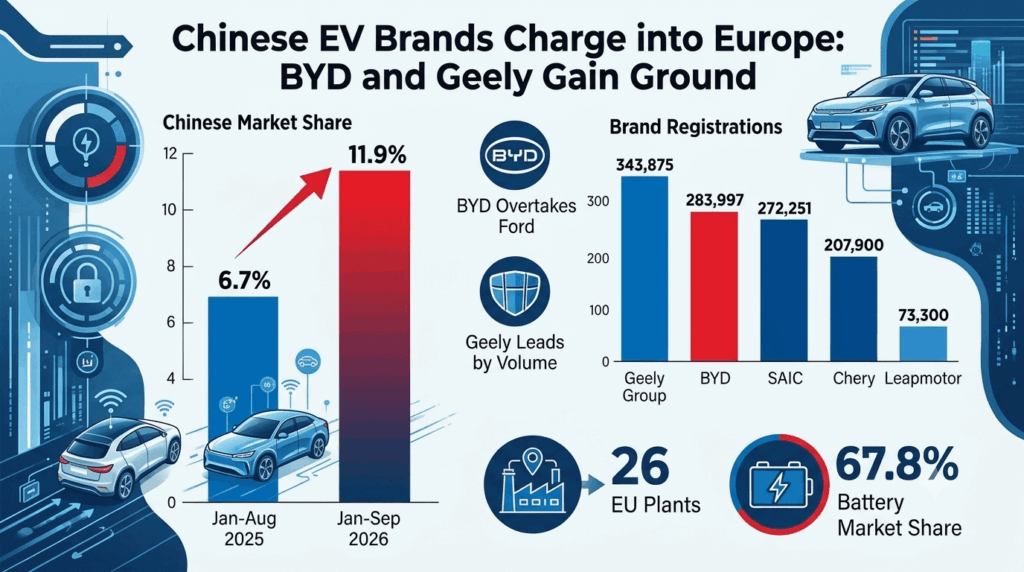
Chinese EV brands charge into Europe: BYD and Geely gain ground - infographic showing Chinese brands reaching 11.9 percent of European registrations in 2026, with Geely Group at 343,875 units, BYD at 283,997, and BYD overtaking Ford
EV charging

Chinese EV Brands Charge into Europe: BYD and Geely Gain Ground

Chinese EV brands charge into Europe: BYD and Geely gain ground. Chinese brands hit 11.9% of European registrations in 2026, nearly double their share a year earlier. BYD overtook Ford with 283,997 registrations, Geely Group led by volume through Volvo and Polestar, and Chery and Leapmotor posted the fastest growth rates. This data-driven analysis breaks down the market share numbers, the brand-level performance, the tariff response, and the localisation pivot that is reshaping the European automotive landscape.

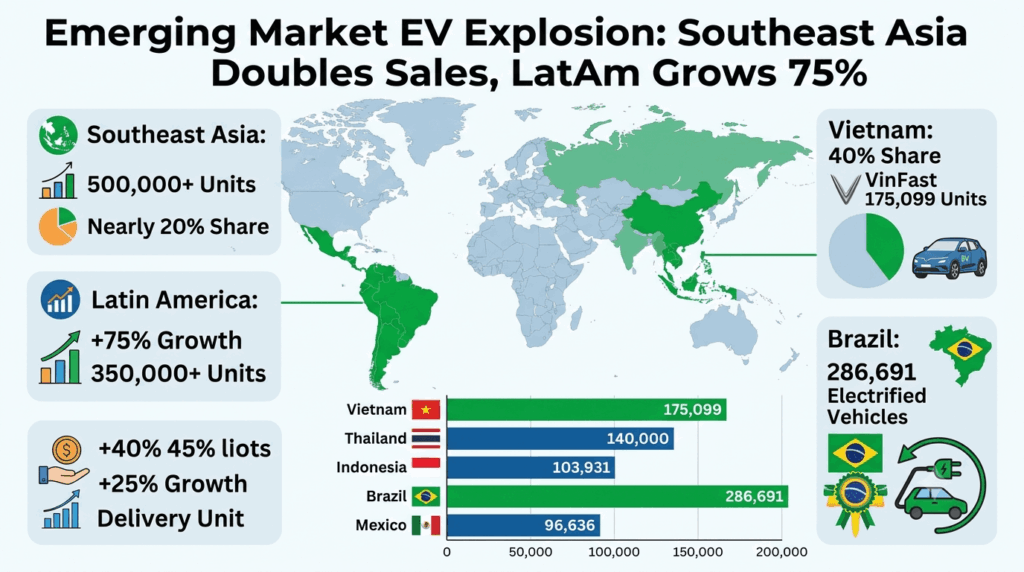
Emerging market EV explosion: Southeast Asia doubles sales, LatAm grows 75% - infographic showing Southeast Asia at 500,000+ units and nearly 20 percent share, Latin America at 75 percent growth, Vietnam at 40 percent share with 175,099 VinFast units, and Brazil at 286,691 electrified vehicles
Uncategorized

Emerging Market EV Explosion: Southeast Asia Doubles Sales, LatAm Grows 75%

Emerging market EV explosion: Southeast Asia doubles sales, LatAm grows 75%. The IEA confirms 500,000+ EV sales in Southeast Asia and 75% growth in Latin America. Vietnam reached nearly 40% market share, Thailand sold 140,000 EVs, Indonesia crossed 103,000 units, Brazil surpassed one million electrified vehicles, and Mexico reached 96,636 units in 2025. This data-driven analysis breaks down the country-level performance, the policy drivers, the role of Chinese models, the infrastructure challenges, and the 2026 outlook.

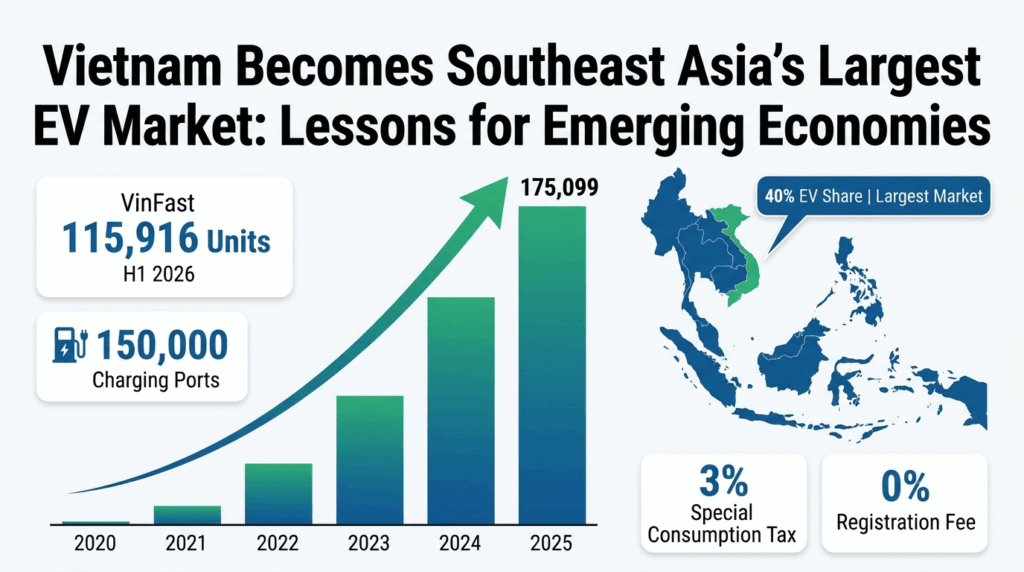
Vietnam becomes Southeast Asia's largest EV market: lessons for emerging economies - infographic showing Vietnam reaching nearly 40 percent EV share in 2025 with 175,099 VinFast deliveries, 150,000 charging ports, and zero registration fees
EV charging

Vietnam Becomes Southeast Asia’s Largest EV Market: Lessons for Emerging Economies

Vietnam becomes Southeast Asia’s largest EV market: lessons for emerging economies. Nearly 40% of new car sales were electric in 2025, with VinFast delivering 175,099 vehicles and capturing essentially the entire BEV market. Registration fee exemptions and a 3% special consumption tax reduced the upfront price of EVs. V-Green built 150,000 charging ports ahead of demand. This analysis breaks down the data, the policy framework, the affordability strategy, the charging network, and the lessons for other developing economies.

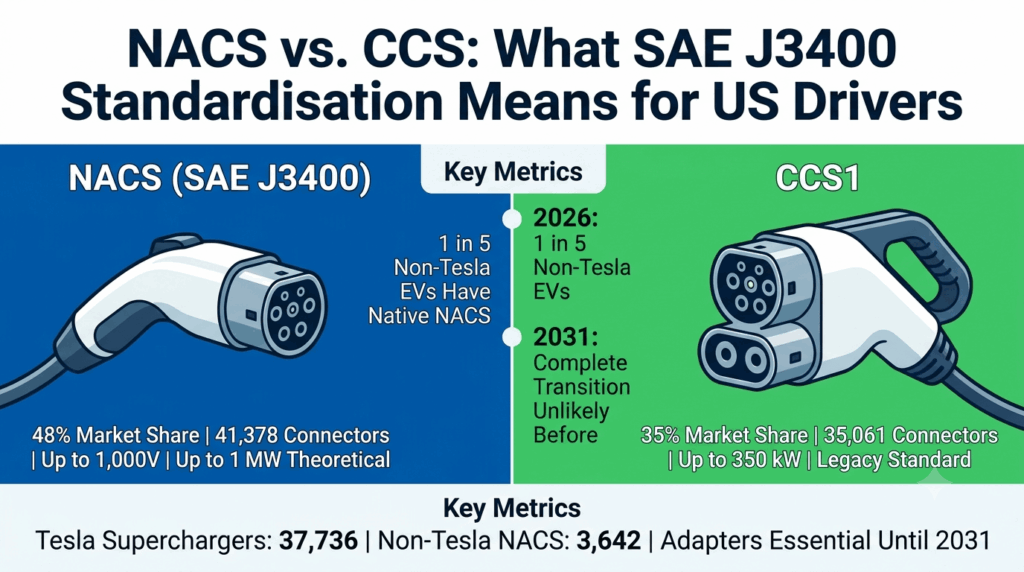
NACS vs. CCS: what SAE J3400 standardisation means for US drivers - comparison chart showing NACS 48 percent and CCS1 35 percent market share, automaker native NACS timelines through 2027, and the $660 million retrofit cost that makes adapters essential
EV charging

NACS vs. CCS: What SAE J3400 Standardisation Means for US Drivers

NACS vs. CCS: what SAE J3400 standardisation means for US drivers. NACS now holds 48% of US fast-charging connectors, but CCS remains 40% and adapters will be needed until at least 2031. This practical guide breaks down the J3400 standard, the 1,000-volt and 1 MW capability, the adapter economy, the automaker timelines, the NEVI dual-standard requirements, and what drivers actually need to know before buying their next EV

Scroll to Top