
Every Chinese EV owner who has used a home charger for more than a few months has experienced this moment: you connect the vehicle as usual, expect charging to begin, and instead the charger’s display or app shows a brief error code — sometimes a number, sometimes a combination of letters and numbers, sometimes accompanied by a flashing indicator light — with no charging current flowing and no immediately obvious explanation.
This guide on troubleshooting home EV chargers common error codes for GB/T standards exists because, despite GB/T 20234.2 and GB/T 20234.3 establishing standardised communication protocols between Chinese EV chargers and vehicles, the specific error codes that different manufacturers display, and the underlying causes those codes represent, vary considerably across brands while sharing a common underlying technical foundation rooted in the GB/T standard’s defined fault categories.
This guide covers the GB/T standard’s underlying fault detection categories that every compliant charger implements in some form, the specific error code presentations across the major brands covered throughout this guide series, the systematic troubleshooting approach that resolves the majority of home charging errors without requiring a service call, and the specific situations where attempting self-diagnosis should stop and professional assessment should begin.
Understanding the GB/T Standard’s Underlying Fault Categories
Why GB/T Charging Errors Follow a Common Logical Structure
The standardised communication foundation:
GB/T 20234.2 (AC charging) and GB/T 20234.3 (DC charging) establish standardised communication protocols (control pilot signalling for AC, and CAN bus communication for DC) between the vehicle and charging equipment, meaning that despite different manufacturers implementing different specific error code numbering and display conventions, the underlying fault categories these codes represent are substantially similar across compliant equipment, because they reflect the same standardised communication protocol’s defined fault states.
The general fault category structure that applies across brands:
While the specific numbering varies, GB/T-compliant chargers generally categorise faults into several recurring functional groups: connection and communication faults (problems with the physical connector engagement or the control pilot signalling between charger and vehicle), ground fault and electrical safety faults (issues detected by the RCCB/RCD protection systems covered extensively in our safety guides), overcurrent and overvoltage faults (protection responses to electrical conditions outside safe parameters), temperature-related faults (the cold and heat-related charging rate reduction and protection mechanisms covered in our winter and furnace city guides), and vehicle-side communication faults (situations where the vehicle itself, rather than the charger, is reporting a fault condition through the standardised communication channel).
Why Brand-Specific Error Codes Still Require Brand-Specific Reference
The practical reality despite standardisation:
Even with this common underlying structure, the specific numbers, letters, or symbols that appear on your particular charger’s display or app — and critically, the specific recommended remediation steps — are brand-specific implementation choices built on top of the shared GB/T foundation, meaning a “E03” code on one manufacturer’s charger may represent a different specific fault condition than “E03” on a different manufacturer’s product, even though both ultimately derive from the same underlying GB/T fault category framework.
Why this guide provides both general categories and brand-specific detail:
This structure allows you to first understand generally what type of problem you’re likely experiencing based on the broad fault category, then consult the brand-specific section relevant to your particular charger for the more precise diagnostic and remediation guidance.
Category 1: Connection and Communication Faults
What This Category Represents
This is the most commonly encountered error category for most Chinese EV owners, representing problems with either the physical connector engagement between the charging cable and the vehicle’s charging port, or the control pilot communication signal that the GB/T standard uses for the charger and vehicle to establish basic communication before any current flows.
Common Causes Within This Category
Incomplete connector engagement:
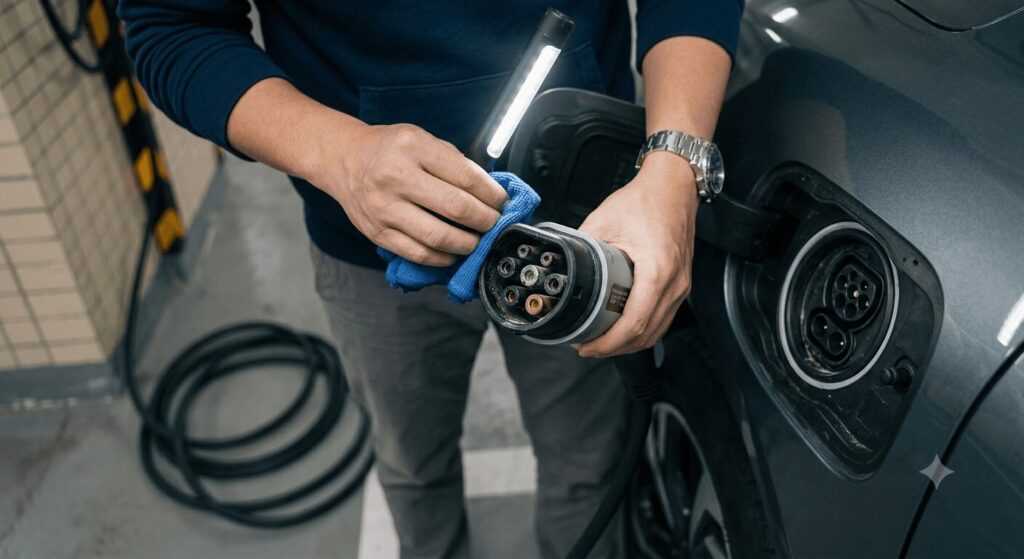
The single most common cause of connection faults is the connector not being fully inserted and mechanically locked into the vehicle’s charging port — the GB/T connector design includes a locking mechanism specifically to prevent disconnection during charging, and if this lock hasn’t fully engaged, the control pilot signal can’t establish properly even though the connector may appear superficially connected.
Connector or port debris:
As covered in our maintenance guide’s discussion of dust and humidity effects on connectors, accumulated dust, moisture, or minor corrosion at either the charger’s connector or the vehicle’s charging port can interfere with the physical and electrical contact required for proper control pilot communication, even when the connector is mechanically fully engaged.
Cable damage:
Physical damage to the charging cable itself — anything from minor insulation damage to more significant internal conductor damage from the cold-weather brittleness mechanism covered in our winter guide or general wear over the cable’s service life — can interrupt the control pilot signal path even when both ends of the connection appear properly engaged.
Brand-Specific Presentation
StarCharge S Series: Typically displays “E01” or “连接故障” (connection fault) on the app, often accompanied by a slow-flashing amber or red indicator light on the charger unit itself.
Autel MaxiCharger: Generally presents as “CP Error” or a specific connection fault icon within the Autel Charge app, with the physical unit typically showing a specific flashing pattern documented in the product’s quick-reference guide.
Xiaomi EV Charger: Often integrated into the broader Mi Home notification system as “充电连接异常” (abnormal charging connection), with HyperOS sometimes providing additional contextual detail about whether the issue appears to be at the charger or vehicle end based on the specific communication failure pattern detected.
Huawei FusionCharge: The AI-enhanced monitoring discussed in our maintenance guide sometimes provides more specific diagnostic detail for this category than simpler brands, potentially distinguishing between “connector engagement issue” and “communication signal degradation” as separate sub-categories within the broader connection fault group.
Troubleshooting Steps for Connection and Communication Faults
Step 1: Fully disconnect the connector from the vehicle, inspect both the connector and the vehicle’s charging port visually for any obvious debris, moisture, or damage, then reconnect ensuring the connector is pushed fully home until you feel and/or hear the locking mechanism engage.
Step 2: If the fault persists, check the cable’s full length for any visible damage, paying particular attention to the areas near both end connectors where flexing stress concentrates over repeated use.
Step 3: If using a portable EVSE as covered in our DIY charging guide, confirm the connection at the socket end is equally secure, as connection faults can originate from either end of the charging path.
Step 4: If the fault persists despite confirmed solid physical connection at both ends with no visible damage, this may indicate a developing issue with either the charger’s communication circuitry or the vehicle’s charging port communication interface, warranting the brand-specific customer service contact or, if the issue coincides with circumstances covered in our zombie pile guide, assessment of whether the manufacturer remains able to provide support.
Category 2: Ground Fault and Electrical Safety Faults
What This Category Represents
This category encompasses the RCCB/RCD protection system’s detection of any current leakage or ground fault condition — exactly the safety mechanism covered extensively throughout our safety-focused guides as the critical protection against electrical shock hazard, meaning faults in this category should always be treated with particular seriousness rather than simply reset and ignored.
Common Causes Within This Category
Genuine moisture ingress:
As covered in our weatherproof and maintenance guides, water or excessive humidity reaching electrical components can create the current leakage path that RCCB protection is specifically designed to detect, making this fault category particularly relevant following the specific monsoon and furnace city humidity exposure discussed throughout this guide series.
Vehicle-side ground fault:
Less commonly, the fault may originate from the vehicle’s own electrical system rather than the charger, particularly relevant if the fault occurs consistently with one specific vehicle but not with other vehicles using the same charger (relevant for households covered in our dual-EV case study guide, where comparing fault occurrence across multiple vehicles using the same charger provides useful diagnostic information).
Genuine equipment degradation:
As covered in our maintenance guide’s discussion of connector corrosion and seal degradation, accumulated long-term wear can eventually create conditions that trigger increasingly frequent ground fault detection even without any single dramatic moisture event, representing a gradual degradation pattern rather than a sudden failure.
Brand-Specific Presentation
StarCharge S Series: “E05” or “漏电保护” (leakage protection) typically with a distinct red indicator pattern differentiated from the connection fault category’s amber/red pattern.
Autel MaxiCharger: “RCD Trip” or “GFCI Fault” displayed prominently in the app with explicit safety-relevant language distinguishing it from less safety-critical fault categories.
Xiaomi EV Charger: “漏电故障,请检查连接” (leakage fault, please check connection) with the Mi Home app typically recommending the specific safety-conscious troubleshooting sequence covered below rather than simply suggesting an immediate reset.
Huawei FusionCharge: Generally provides the most detailed diagnostic context within this category, sometimes distinguishing between different leakage severity levels and providing AI-pattern-based assessment of whether the specific leakage signature suggests moisture-related versus equipment degradation-related origin.
Troubleshooting Steps for Ground Fault and Electrical Safety Faults
Step 1: Do not simply reset and immediately retry without inspection. Unlike connection faults, where reset-and-retry is often reasonable, ground fault detection represents the system correctly identifying a genuine safety-relevant electrical condition, making understanding the cause before continuing use the responsible approach.
Step 2: Visually inspect both the charger enclosure and connector, and the vehicle’s charging port area, for any visible moisture, particularly relevant if the fault occurred during or shortly after rainfall, high humidity conditions, or recent cleaning that might have introduced moisture.
Step 3: If visible moisture is present, allow the affected components to fully dry (ideally over several hours in a dry, ventilated environment) before attempting to reconnect and resume charging.
Step 4: If no visible moisture is apparent but the fault recurs, particularly if recurring with increasing frequency over subsequent days or weeks (suggesting the progressive degradation pattern covered in our maintenance guide rather than a single isolated moisture event), this warrants professional inspection rather than continued self-diagnosis, given the genuine safety implications of a developing ground fault condition.
Step 5: If the fault occurs specifically and consistently with one vehicle but not others using the same charger, this points toward investigating the specific vehicle’s charging port and onboard charging system rather than the home charger itself, potentially warranting contact with the vehicle manufacturer rather than the charger manufacturer.
Category 3: Overcurrent and Overvoltage Faults
What This Category Represents
This category covers the charger’s protective response to electrical current or voltage conditions outside the safe operating parameters the system is designed to handle, often connecting directly to the load balancing and electrical supply considerations covered extensively in our load balancing guide.
Common Causes Within This Category
Genuine circuit overload:
As covered in our load balancing guide’s detailed discussion of old Chinese apartment electrical capacity constraints, attempting to draw more current than the supply circuit can safely provide — whether from the EV charging circuit itself being undersized for the configured charging current, or from combined household and EV charging load exceeding panel capacity in installations without proper load management — triggers this fault category.
Rural grid voltage fluctuation:
As covered in our load balancing guide’s rural-specific section and reflected in Teacher Zhao’s experience in our user stories guide, rural Chinese grid voltage fluctuation beyond the charger’s designed input tolerance range can trigger overvoltage or undervoltage protective responses even when no genuine overload condition exists at the local circuit level.
Charger hardware degradation:
Less commonly, internal component degradation within the charger itself — relevant to the maintenance considerations covered throughout this guide series — can manifest as increasingly frequent overcurrent fault triggering even at electrical conditions the unit previously handled without issue.
Brand-Specific Presentation
StarCharge S Series: “E08” or “过流保护” (overcurrent protection), with the app sometimes providing specific guidance suggesting the household circuit capacity be assessed if this fault recurs.
Autel MaxiCharger: “Overcurrent Fault” or, for models with the load management capability covered in our load balancing guide, a more specific “Load Limit Exceeded” message that explicitly references the dynamic load management threshold rather than a generic overcurrent condition.
Xiaomi EV Charger: “电流过载,请检查电路” (current overload, please check circuit), with Mi Home’s broader smart home energy monitoring integration sometimes providing additional context about whether other household devices were drawing significant power simultaneously.
Huawei FusionCharge: The most sophisticated diagnostic presentation within this category, given Huawei’s emphasis on AI energy management discussed throughout our smart charger guide, often providing specific guidance about whether the fault pattern suggests a genuine circuit capacity issue versus a transient voltage fluctuation more consistent with grid-side rather than local circuit causation.
Troubleshooting Steps for Overcurrent and Overvoltage Faults
Step 1: If the fault occurred during a period when you know other high-draw household appliances were also operating (air conditioning, induction cooking, electric water heating — the specific combination discussed in our load balancing guide), this strongly suggests a genuine circuit capacity issue rather than a charger malfunction.
Step 2: If you have a load-balancing-capable charger as covered in our load balancing guide but haven’t configured the CT clamp monitoring, this fault pattern is a strong indication that retrofitting load management, exactly as detailed in that guide, would resolve the recurring issue.
Step 3: If you don’t have load balancing capability and the fault recurs specifically during predictable high-household-load periods, consider either the CT clamp retrofit option covered in our load balancing guide, or simply adjusting your charging schedule to avoid the specific hours when household load typically peaks.
Step 4: If you’re in a rural installation as covered in our load balancing guide’s rural section, and the fault occurs without any corresponding household load explanation, investigate whether local agricultural or other rural grid demand patterns correlate with the fault timing, potentially warranting the same scheduling adjustment strategy Teacher Zhao developed in our user stories guide.
Step 5: If none of the above explanations apply and the fault recurs without clear correlation to either household load or rural grid patterns, this suggests possible charger hardware degradation warranting professional assessment.
Category 4: Temperature-Related Faults
What This Category Represents
This category covers the charging rate reduction and, in more extreme cases, temporary charging suspension that both our winter and furnace city guides have covered extensively as the vehicle’s and charger’s protective response to operating outside optimal temperature ranges.
Common Causes Within This Category
Extreme cold conditions:
As covered in exhaustive detail in our winter EV charging guide, Harbin-level extreme cold (-25°C to -35°C) can trigger temperature-related charging rate reduction or, in genuinely extreme cases, temporary charging suspension until either ambient warming or active pre-conditioning brings the battery into a chemically safer charging temperature range.
Extreme heat conditions:
As covered in our furnace city thermal management guide, sustained Wuhan or Chongqing summer heat, particularly combined with the additional heat generated during DC fast charging specifically, can trigger the heat-related charging rate reduction or protective throttling discussed in that guide.
Charger enclosure overheating (distinct from battery temperature):
As also covered in our furnace city guide, this fault category can originate from the charger’s own internal electronics reaching their upper operating temperature threshold, independent of whatever temperature condition the vehicle’s battery itself is experiencing — a distinction worth understanding because the remediation differs (addressing charger positioning and ventilation versus addressing vehicle battery thermal management).
Brand-Specific Presentation
StarCharge S Series: “E10” or “温度保护” (temperature protection), generally without distinguishing whether the temperature condition relates to the charger itself or the vehicle’s reported battery temperature.
Autel MaxiCharger: Given Autel’s strong positioning across both extreme cold (-30°C rating) and adequate heat tolerance (55°C upper rating) covered throughout our weatherproof and maintenance guides, generally displays more specific “Low Temp Protection” or “High Temp Protection” messaging that distinguishes the direction of the temperature issue.
Xiaomi EV Charger: “温度异常,充电速度降低” (temperature abnormal, charging speed reduced), often presented as an informational notice rather than a true “fault” given that this represents normal protective behaviour rather than malfunction.
Huawei FusionCharge: Provides the most contextually rich presentation, often specifically noting whether the temperature condition originates from the charger’s own sensors versus the vehicle’s reported battery temperature via the communication protocol, directly relevant to the distinction discussed above.
Troubleshooting Steps for Temperature-Related Faults
Step 1: Recognise that, in the vast majority of cases within this category, the “fault” represents the system correctly protecting the battery or charger from genuine thermal stress rather than a malfunction requiring remediation — the appropriate response is typically patience and, where applicable, the pre-conditioning strategies covered in our winter guide rather than attempting to bypass or override the protective response.
Step 2: For cold-related instances, apply the battery pre-conditioning strategy detailed extensively in our winter guide, triggering battery warming while still connected to grid power before the charging session begins, which can meaningfully reduce or eliminate the temperature-related charging rate reduction for subsequent sessions even if the current session experienced it.
Step 3: For heat-related instances during DC fast charging specifically, as covered in our furnace city guide, consider whether shifting toward greater reliance on home AC charging during the most extreme summer periods, given AC charging’s considerably lower heat generation compared to DC fast charging, would reduce the frequency of this fault category’s occurrence.
Step 4: If the fault appears to relate to the charger’s own enclosure temperature rather than the vehicle’s battery (relevant brand-specific presentations noted above help distinguish this), review your charger’s installation positioning relative to direct sun exposure and ventilation, as covered in our furnace city guide’s specific positioning recommendations, since this may indicate an installation positioning issue rather than a genuine equipment limitation.
Category 5: Vehicle-Side Communication and Reported Faults
What This Category Represents
This category covers situations where the fault indication originates primarily from the vehicle’s own systems being communicated to the charger through the standardised GB/T communication protocol, rather than from a fault genuinely originating within the charger itself — an important distinction for understanding where to direct troubleshooting effort and, if necessary, which manufacturer’s customer service to contact.
Common Causes Within This Category
Vehicle battery management system restrictions:
The vehicle’s own BMS may decline to accept charging current for reasons entirely internal to the vehicle — a battery that has reached its programmed maximum SOC target (relevant to the SOC management strategies covered in our charge time calculator guide), a vehicle-side fault unrelated to the charging infrastructure, or a vehicle software issue.
Vehicle-side charging port issues:
As distinguished from charger-side connector issues covered in Category 1, the vehicle’s own charging port and its associated onboard charging system can develop faults independent of charger quality or condition, particularly relevant for older vehicles or those that have experienced any physical damage to the charging port area.
Manufacturer-specific vehicle software behaviour:
As covered throughout our vehicle-specific guides (BYD, NIO, Xpeng, Li Auto, Zeekr, Xiaomi), different manufacturers’ vehicle software sometimes implements specific charging behaviour restrictions or scheduling logic that can present as an apparent “fault” to an owner unfamiliar with that specific brand’s particular software behaviour, when in fact the vehicle is functioning exactly as designed.
Troubleshooting Steps for Vehicle-Side Faults
Step 1: If the same fault occurs consistently with one specific vehicle across multiple different charging locations (your home charger, a different home charger, public charging stations), this strongly suggests the issue originates with the vehicle rather than any specific charger, warranting contact with the vehicle manufacturer rather than continued charger-focused troubleshooting.
Step 2: Check your specific vehicle’s app or onboard display for any vehicle-specific error messages or notifications that might provide more direct insight than the charger’s more generic fault reporting, particularly relevant given the brand-specific software behaviour differences noted above.
Step 3: For households with multiple vehicles sharing charging infrastructure, as covered in our dual-EV case study guide, specifically test whether the fault occurs with both vehicles or only one, providing immediate diagnostic clarity about whether the issue is charger-side or vehicle-side.
Step 4: Consult your specific vehicle manufacturer’s owner community or customer service for guidance specific to your vehicle model, recognising that this fault category often requires manufacturer-specific knowledge that general charger troubleshooting guidance cannot fully address.
The Systematic First-Response Troubleshooting Sequence
A Practical Step-By-Step Approach for Any Unrecognised Error
For situations where you encounter an error code not clearly matching the categories above, or simply want a systematic approach before consulting brand-specific documentation, this sequence addresses the most common underlying issues in a logical, safety-conscious order.
Step 1: Note the exact error code and any accompanying indicator pattern before taking any action, as this information will be valuable whether you resolve the issue yourself or need to contact customer service, and some fault conditions clear their specific code display relatively quickly after the underlying condition resolves, potentially losing diagnostic information if not recorded promptly.
Step 2: Check for the most common simple explanations first — confirm the connector is fully and properly engaged, confirm no obvious household circuit overload condition exists (other high-draw appliances running simultaneously), and confirm no obvious weather-related factor (recent heavy rain, extreme temperature) coincides with the fault timing.
Step 3: If the simple explanations don’t apply, consult your specific charger brand’s documentation or app for the exact error code meaning, using the brand-specific sections throughout this guide as a starting reference point while recognising that your specific model’s manual or app documentation provides the most authoritative brand-specific detail.
Step 4: Attempt a single controlled reset — disconnecting power to the charger briefly (through its dedicated circuit breaker rather than simply unplugging the vehicle connector, for chargers where this is the documented reset procedure) before reconnecting, but only after having first ruled out genuine safety-relevant conditions (visible moisture, suspected overload, suspected ground fault) that a simple reset wouldn’t actually resolve and might mask rather than address.
Step 5: If the fault recurs after a single reset attempt, resist the temptation to repeatedly reset and retry without further diagnosis, as repeated cycling without addressing an underlying cause can, in some fault categories, potentially cause additional stress to either the charger or vehicle systems.
Step 6: Escalate to brand-specific customer service or professional electrician assessment based on the fault category — safety-relevant categories (ground fault, persistent overcurrent) warrant more urgent escalation than convenience-relevant categories (temperature-related rate reduction, which is often simply the system functioning as designed rather than a true fault).
When Error Codes Indicate a Brand Survival Risk Rather Than a Technical Issue
Connecting to Our Zombie Pile Crisis Guide
The specific scenario worth recognising:
As covered extensively in our zombie pile crisis guide, one specific troubleshooting scenario warrants particular attention: if your charger’s app has become entirely unresponsive, customer service is unreachable through any channel, and the manufacturer’s broader online presence (website, social media, app store listing) shows signs of inactivity or cessation, your troubleshooting effort should shift from “how do I fix this specific error” to “is this manufacturer still operating, and if not, what does my charger’s architecture allow me to do.”
The practical diagnostic distinction:
A charger experiencing a genuine technical fault, even an unresolved one, typically still allows app connectivity and customer service contact attempts, even if the underlying issue takes time to resolve. A charger experiencing the zombie pile scenario specifically shows the combination of complete cloud service unavailability alongside broader evidence of manufacturer inactivity — the distinction our dedicated guide covers in full detail, including the specific steps for assessing whether your charger’s cloud-optional or cloud-dependent architecture allows continued basic function despite this scenario.
Internal Links — Further Reading on Clean Energy Bazaar
The troubleshooting home EV chargers common error codes for GB/T standards guide is the diagnostic companion to the safety, maintenance, and brand-specific guidance covered throughout this content cluster.
For the maintenance guide that establishes the dust and humidity-related degradation patterns underlying many of the error categories covered in this troubleshooting guide, our EV charger maintenance 2026 dust protection vs humidity resistance brand comparison guide covers every brand’s specific maintenance characteristics. For the load balancing guide that provides the detailed remediation for overcurrent and overvoltage fault categories, our load balancing EV chargers 2026 avoid tripping breakers in old Chinese apartment blocks guide covers every load management solution. For the winter charging guide that explains the cold-weather temperature fault category in full technical depth, our winter EV charging guide 2026 cold weather performance for Harbin -30C vs wet Shanghai guide covers every cold-related charging behaviour. For the furnace city guide that explains the heat-related temperature fault category, our hot weather EV charger tips thermal management for furnace cities like Wuhan and Chongqing guide covers every heat-related consideration. For the zombie pile crisis guide relevant to distinguishing genuine technical faults from manufacturer-failure scenarios, our zombie pile crisis 2026 how to avoid dead chargers from liquidated Chinese brands guide covers the complete brand reliability assessment. And for the 3C certification guide establishing the safety standards relevant to understanding which fault categories warrant the most urgent professional attention, our 3C certification and EV chargers 2026 why buying non-certified chargers is dangerous in China guide covers every safety verification standard.
Final Thoughts
The troubleshooting home EV chargers common error codes for GB/T standards landscape, despite the genuine standardisation that GB/T 20234.2 and GB/T 20234.3 provide across the Chinese charging hardware market, still requires owners to navigate brand-specific presentation differences built on top of that shared technical foundation.
The five fault categories covered throughout this guide — connection and communication faults, ground fault and electrical safety faults, overcurrent and overvoltage faults, temperature-related faults, and vehicle-side communication faults — represent the overwhelming majority of error codes any Chinese EV owner will encounter across any GB/T-compliant charger brand, regardless of the specific numbering or wording your particular unit displays.
Connection faults typically resolve through careful reconnection and basic cleaning. Ground fault and electrical safety faults demand careful, safety-conscious investigation rather than simple reset-and-retry. Overcurrent faults often point directly toward the load balancing solutions covered in our dedicated guide. Temperature-related faults, in the great majority of cases, represent the system correctly protecting your battery and equipment rather than a true malfunction, best addressed through the pre-conditioning and seasonal strategies covered in our winter and furnace city guides. Vehicle-side faults require recognising when the charger itself isn’t actually the source of the problem.
The systematic troubleshooting sequence this guide provides — record the code, check simple explanations, consult brand-specific documentation, attempt one controlled reset, then escalate appropriately based on the fault category’s safety relevance — resolves the substantial majority of home charging errors without requiring an immediate service call, while still recognising the specific situations, particularly within the ground fault and persistent overcurrent categories, where professional assessment genuinely is the appropriate next step rather than continued self-diagnosis.
Understanding your charger’s specific error codes, building the habit of checking the straightforward explanations before assuming hardware failure, and maintaining the safety-conscious caution this guide has emphasised for the genuinely safety-relevant fault categories together represent the practical foundation for resolving the great majority of home EV charging interruptions efficiently, confidently, and safely.
Great content! Keep up the good work!
Thank you for your kind comment