Vehicle-to-Load (V2L) vs V2G: What Chinese Campers and Homeowners Actually Need — The Honest Complete Guide
Are you a Chinese EV owner confused by the flood of “bidirectional charging” information that lumps completely different technologies together? You’re not alone. A camping enthusiast powering a rice cooker at a mountain campsite has vastly different needs from a homeowner wanting to sell electricity back to the grid — yet both are often addressed with the same vague “V2X” language.
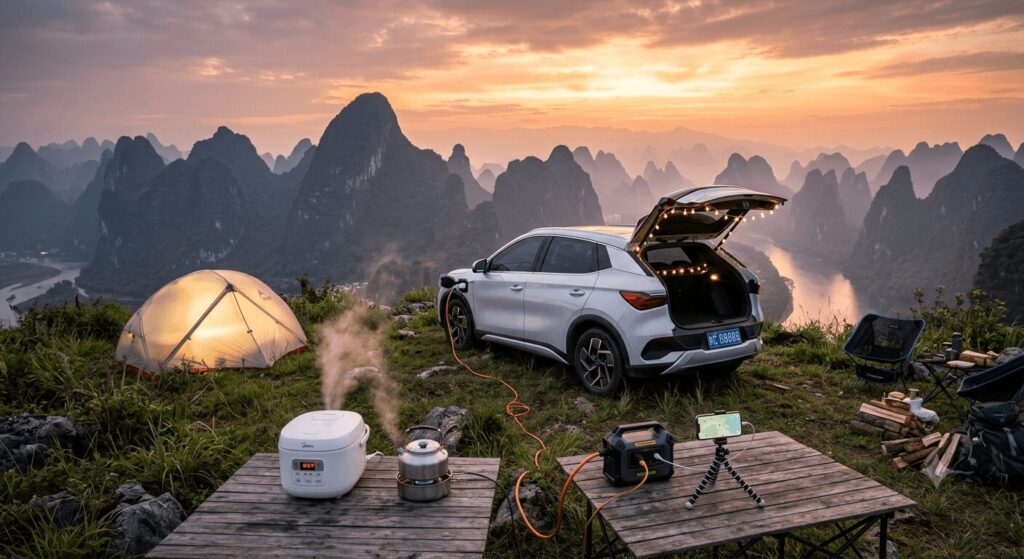
This complete guide on vehicle to load V2L vs V2G what Chinese campers and homeowners actually need draws the precise distinctions that actually matter for your lifestyle. Here’s the honest breakdown: V2L powers your camping gear, outdoor market stall, or essential appliances during a blackout — costing just a ¥280-¥600 adapter with zero installation. V2G earns you income by exporting to the grid — but requires OCPP-compliant hardware and demand response programme participation. V2H powers your home’s fixed circuits during extended outages — but requires ¥11,500-¥21,000 in installed hardware.
For the majority of Chinese EV owners in 2026 — especially those drawn to the country’s rapidly growing camping culture — V2L is the immediately available, practical answer. A weekend of camping cuisine consumes just 3-5 kWh from your battery (equivalent to 15-25 km of range), letting you power rice cookers, electric kettles, induction hotpots, and overnight fans with negligible impact on your driving range.
We compare V2L across every major Chinese EV brand — BYD (2.2-3.3 kW), NIO (2.2 kW boot socket), Zeekr (up to 6 kW), Xpeng (3.3 kW), Li Auto EREV (effectively unlimited with generator), and Xiaomi SU7 (3.5 kW) — plus provide the exact V2L starter kit and safety considerations so you can unlock your vehicle’s camping and emergency backup potential today.
Whether you’re a weekend camper, street food vendor, rural worker, or urban homeowner wanting blackout backup, this guide delivers the capability-to-use-case mapping that tells you exactly which bidirectional technology is relevant to you — and which isn’t.
Read the full guide to discover why V2L is ready now, what it costs, and which vehicles offer the best outdoor power capability for your specific needs in 2026.