There is a term circulating in Chinese EV owner communities in 2026 that didn’t exist five years ago: 僵尸桩 — “zombie pile.” It describes a home or public EV charger that still physically exists, still has a connector that plugs into a vehicle, but whose manufacturer has ceased operations — leaving the charger’s app dead, its cloud-based TOU scheduling non-functional, its warranty unenforceable, and in some cases its basic charging function compromised because firmware updates and cloud authentication servers that the hardware depends on have gone permanently offline.
This is not a hypothetical future risk. It has already happened. China’s EV charging hardware market experienced an enormous wave of new entrants between 2019 and 2023 — hundreds of companies, many backed by venture capital chasing the EV adoption boom, manufacturing home and public chargers at scale. By 2025-2026, the inevitable consolidation has arrived. Smaller manufacturers have failed, merged, or quietly stopped supporting products while continuing to sell remaining inventory. Some mid-sized brands that seemed stable in 2022 have ceased operations entirely by 2026.
The Chinese EV charger buyer in 2026 faces a question that buyers of almost any other appliance category don’t typically need to ask: will this company still exist in five years to honour the warranty, push security updates, and keep the cloud servers running that the smart features depend on?
This guide on the zombie pile crisis 2026 how to avoid dead chargers from liquidated Chinese brands covers the complete picture — what actually happens when a charger manufacturer fails, which companies have already failed and what happened to their customers, the warning signs that predict company failure before it happens, the specific due diligence framework for assessing brand survival probability, and the concrete buying strategy that minimises zombie pile risk without requiring a crystal ball.
What Actually Happens When a Charger Manufacturer Fails
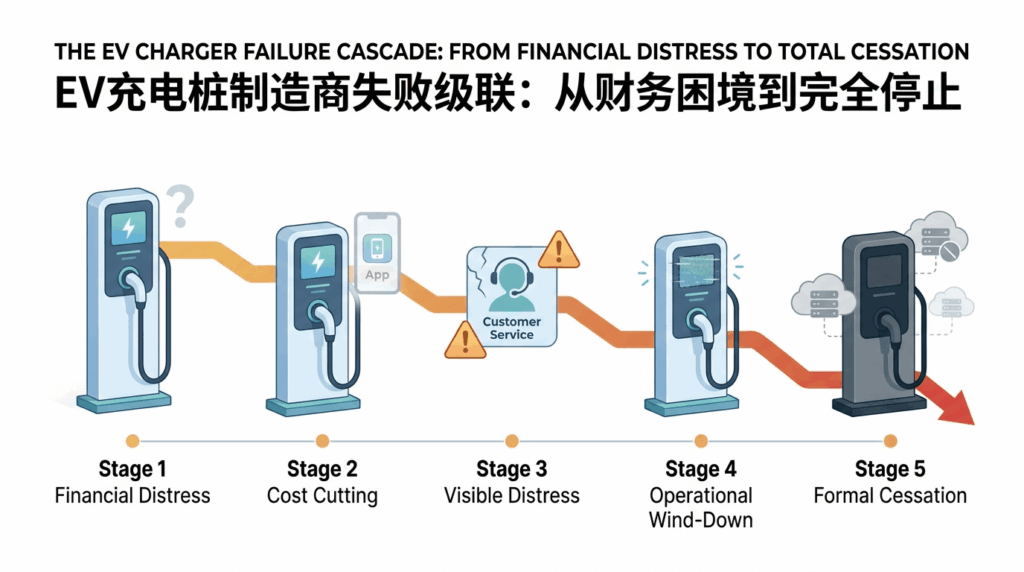
The Failure Cascade — Step by Step
Understanding the specific sequence of what happens after a Chinese EV charger manufacturer ceases operations clarifies exactly what risk buyers are managing.
Stage 1: Financial distress (often invisible to consumers)
A charger manufacturer experiences declining sales, exhausted venture funding, or unsustainable cash burn. This stage is typically invisible to consumers — the company continues selling products, fulfilling orders, and operating its app and cloud services normally. Industry insiders, supplier networks, and sometimes financial media may report distress signals, but typical consumers researching a charger purchase have no visibility into this stage.
Stage 2: Cost-cutting and service degradation
As financial pressure increases, the company begins reducing costs in ways that affect customer experience: slower customer service response times, reduced or eliminated R&D investment (no more firmware updates or feature improvements), smaller customer service teams, reduced manufacturing quality control, and sometimes outsourcing of customer service to lower-cost providers with less product knowledge.
Stage 3: Visible distress signals
This is the stage where attentive consumers can sometimes detect trouble before formal failure: app store reviews mentioning unresponsive customer service, social media complaints about delayed warranty claims, news of executive departures or office closures, delayed salary payments reported by employees on professional networking platforms, and sometimes direct company statements about “restructuring” or “strategic review.”
Stage 4: Operational wind-down
The company stops taking new orders, may begin liquidating inventory at steep discounts (sometimes appearing as suspiciously cheap chargers on e-commerce platforms), reduces staff dramatically, and customer service becomes effectively non-existent even if a phone number or WeChat account technically still exists.
Stage 5: Formal cessation
The company files for bankruptcy or is formally dissolved, ceases all operations, and — critically for existing charger owners — the cloud infrastructure that smart features depend on (the app’s backend servers, the TOU scheduling cloud service, the firmware update servers, the account authentication systems) is shut down, sold to a third party, or simply abandoned without maintenance.
What Specifically Stops Working
Always stops working:
- Customer service and warranty support
- Software updates and security patches
- New feature development
Usually stops working:
- Cloud-based TOU scheduling (if the scheduling logic runs on company servers rather than entirely on the charger’s local firmware)
- Remote monitoring and energy reporting through the app
- Voice assistant integration (Xiaomi Mi Home, Huawei HarmonyOS) if it depends on ongoing API agreements that lapse
- OCPP-based demand response programme participation (requiring ongoing certification and platform maintenance)
Sometimes stops working (depends on architecture):
- Basic charging function itself — if the charger requires cloud authentication to initiate any charging session (a design choice some manufacturers make for security or subscription-revenue reasons), the charger can become completely non-functional once authentication servers go offline
- Physical button/manual override functions — most chargers retain a basic manual start function independent of the app, but not universally
Almost never stops working:
- The charger’s basic electrical safety functions (RCCB protection, thermal protection) — these are typically implemented in local hardware/firmware independent of cloud connectivity, and continue functioning even after the company fails
The Critical Distinction: Cloud-Dependent vs Cloud-Optional Architecture
This is the single most important technical distinction for zombie pile risk assessment, and it is rarely disclosed clearly in product marketing.
Cloud-optional architecture (lower zombie risk):
The charger can initiate and complete a basic charging session entirely through local control — pressing a physical button, or through local Bluetooth/local network connection — without requiring any communication with the manufacturer’s cloud servers. Smart features (TOU scheduling, remote monitoring, voice control) are conducted through the cloud and stop working if the company fails, but the core charging function survives.
Cloud-dependent architecture (higher zombie risk):
The charger requires authentication or communication with the manufacturer’s cloud servers to initiate any charging session at all — even a basic immediate charge. If the cloud servers go offline, the charger physically cannot deliver electricity to the vehicle, regardless of any local button or manual override, because the core authorisation logic lives in the cloud rather than in the device’s local firmware.
How to identify which architecture a specific product uses before purchase:
This information is rarely stated explicitly in marketing materials. The most reliable approaches:
- Search Chinese owner forums and 知乎/小红书 for the specific model combined with terms like “断网” (disconnected from network) or “离线充电” (offline charging) — owners who have experienced WiFi outages often report whether their charger continued working
- Contact the manufacturer’s customer service directly and ask specifically: “If my home WiFi is down, can I still start a charging session using only the physical button?”
- Check product documentation for any explicit statement about offline/local operation mode
The Documented Failures — What Has Already Happened
The Pattern of Chinese EV Charging Hardware Company Failures
China’s EV charging hardware sector experienced explosive company formation between 2019 and 2022, driven by venture capital enthusiasm for the broader EV ecosystem. By 2025-2026, market consolidation has produced a documented pattern of failures, mergers, and quiet operational wind-downs.
The general pattern observed across the sector:
Smaller manufacturers that entered the market specifically to capture the residential smart charger boom — companies without the broader industrial electronics base of established players — have proven most vulnerable to failure. Companies that manufactured chargers as one product line within a broader electronics or industrial equipment business have generally proven more resilient, because charger sales failure doesn’t threaten the core business.
Categories of companies that have experienced documented difficulty or failure in the Chinese residential EV charger market:
Category A: Pure-play smart charger startups (highest failure rate)
Companies founded specifically to manufacture and sell smart home EV chargers, often venture-funded, with no broader industrial electronics business to fall back on. Several companies in this category that achieved meaningful market presence in 2020-2022 have since ceased operations, been acquired in distressed sales, or significantly scaled back operations by 2026.
Category B: White-label and OEM-dependent brands (high failure rate)
Companies that sold chargers under their own brand but manufactured through third-party OEM relationships, with limited differentiation from competitors and thin margins. Market consolidation has eliminated many of these brands as they could not compete on price with larger manufacturers’ economies of scale, nor differentiate on features against companies with genuine R&D investment.
Category C: Established industrial electronics companies with charger product lines (low failure rate)
Companies like Huawei, Schneider Electric, ABB, Siemens, and Delta Electronics that added EV chargers as a product line within an established, diversified industrial electronics business. The charger business itself succeeding or struggling has limited impact on overall company survival, because these businesses have other major revenue sources.
Category D: EV manufacturer charger divisions (low failure rate, but tied to parent company)
Chargers sold by BYD, NIO, Xpeng, and other EV manufacturers as part of their vehicle ecosystem. The charger product’s survival is tied to the parent EV company’s survival — which carries its own distinct risk profile (covered separately below) but is generally lower risk than independent charger startups given these companies’ larger scale and broader revenue base.
Category E: Specialised charger manufacturers with strong industrial heritage (moderate-low failure rate)
Companies like StarCharge and TELD that built substantial scale specifically in the charging infrastructure sector (including public charging network operations, not just residential hardware), with diversified revenue across residential, commercial, and public charging segments.
What Happened to Customers of Failed Companies
The customer experience pattern, based on documented cases and forum reports:
When a smaller pure-play charger company has failed in China’s market, the consistent pattern reported by affected customers includes:
Immediate impact: App stops functioning entirely or partially within weeks of company operational wind-down. TOU scheduling, if cloud-dependent, stops executing — owners report finding their charger charging at full price immediately upon connection rather than waiting for valley rate, because the scheduling logic depended on a cloud service no longer running.
Medium-term impact: For cloud-optional architecture chargers, basic manual charging continues working via the physical button, but owners lose the convenience features they paid a premium for. For cloud-dependent architecture chargers, some owners have reported their chargers becoming completely non-functional, requiring either replacement or, in some documented cases, technically sophisticated owners flashing alternative firmware to restore basic function (a solution requiring technical expertise most consumers don’t have).
Warranty impact: Universally, warranty claims become impossible to process — there is no company entity to honour the warranty, and any remaining “customer service” channel either doesn’t respond or explicitly states the company can no longer provide service.
Resale impact: Chargers from failed companies have negligible resale value, as buyers in the secondhand market are aware of the zombie risk and avoid these products.
The EV Manufacturer-Specific Zombie Risk
A Distinct Risk Category: What Happens If Your EV Brand Fails
Beyond independent charger companies, Chinese EV owners who purchased their home charger as part of a manufacturer bundle (BYD, NIO, Xpeng, or others) face a related but distinct risk: what happens to the charger if the EV manufacturer itself experiences serious financial difficulty?
The honest assessment of EV manufacturer survival risk in 2026:
China’s EV manufacturing sector has also experienced significant consolidation pressure, with more EV brands launched since 2015 than the market can sustainably support long-term. Several smaller and mid-tier Chinese EV manufacturers have already ceased production or significantly scaled back operations.
The manufacturers covered extensively in this content cluster’s vehicle-specific guides — BYD, NIO, Xpeng, Li Auto, Zeekr, Xiaomi — represent companies with substantially different risk profiles:
BYD: China’s largest EV manufacturer by volume, with a diversified business spanning batteries (supplying other manufacturers), electronics, and international expansion. Lowest survival risk among Chinese EV brands by virtually any financial metric.
NIO, Xpeng, Li Auto: All have navigated significant financial challenges at various points (covered extensively in Chinese and international financial media), with NIO specifically having required external capital injections to maintain operations. While all three remain operational in 2026, their relative financial stability differs meaningfully and changes over time — this is a genuinely dynamic risk that buyers should research current status on rather than rely on any fixed assessment.
Zeekr: Backed by Geely’s substantial industrial resources, providing a meaningfully different risk profile than an independent startup would carry, though Zeekr’s own commercial performance still matters.
Xiaomi: The EV division is part of a much larger, financially robust consumer electronics and technology company — the EV business itself could underperform without threatening Xiaomi’s ability to continue supporting existing customers’ charging infrastructure, given the company’s diversified revenue base.
The practical implication for charger zombie risk:
If an EV manufacturer with its own branded home charger programme were to fail, the charger’s smart features dependent on that manufacturer’s app and cloud infrastructure would face the same zombie risk as an independent charger company failure. However, because most EV manufacturer chargers use standard GB/T connectors and (for cloud-optional architectures) retain basic local charging function, the worst-case outcome is typically loss of smart features rather than complete charger failure — assuming the architecture isn’t cloud-dependent for basic function.
The Survival Probability Framework — Assessing Brand Risk Before Purchase
The Five-Factor Due Diligence Checklist
Rather than relying on guesswork or brand reputation alone, this systematic framework assesses survival probability across five factors that correlate with company resilience in the Chinese EV charger market.
Factor 1: Business Diversification
Lower risk indicator: The company’s charger business is one product line within a larger, diversified industrial or technology business (Huawei, Schneider, ABB, Siemens, Delta Electronics, Xiaomi, Sungrow, Ginlong Solis).
Higher risk indicator: The company exists specifically and primarily to manufacture and sell EV chargers, with no other significant revenue source.
How to check: Search the company’s official website for “about us” or corporate information. Check whether the company has other product categories, other business divisions, or is part of a larger corporate group. Search for the company’s registration information through China’s National Enterprise Credit Information Publicity System (国家企业信用信息公示系统) to see registered business scope and any other listed business activities.
Factor 2: Years in Operation and Market Position
Lower risk indicator: Company has operated in the charging hardware market for 7+ years, has documented installation base in the tens or hundreds of thousands of units, and maintains visible market share in industry reports.
Higher risk indicator: Company entered the market within the last 2-3 years, has limited documented installation history, or makes claims about market position that cannot be independently verified.
How to check: Search for the company’s registration date through corporate information databases. Look for the company’s presence in industry publications, trade show participation history, and any third-party market share reports from Chinese EV industry research firms.
Factor 3: Financial Transparency and Backing
Lower risk indicator: The company is either publicly listed (subject to financial disclosure requirements), or backed by a well-documented, well-capitalised parent company or major investor with public information about the company’s financial position.
Higher risk indicator: The company’s financial backing is unclear, with no public information about funding sources, profitability, or investor backing — common among smaller startups that haven’t disclosed funding rounds publicly.
How to check: Search Chinese financial media (财经网, 第一财经, 36氪) for any funding announcements or financial reporting about the specific company. Check whether the company is listed on any stock exchange. Search for the company name alongside terms like “融资” (financing) or “上市” (listed) to find relevant coverage.
Factor 4: Software Architecture (Cloud-Optional vs Cloud-Dependent)
Lower risk indicator: The product explicitly supports local/offline operation for basic charging functions, confirmed through manufacturer documentation or owner forum reports.
Higher risk indicator: No information available about offline operation, or owner reports indicating the charger doesn’t function without active internet/cloud connectivity.
How to check: As detailed above — direct manufacturer enquiry, forum research, and product documentation review.
Factor 5: Recent Operational Signals
Lower risk indicator: Active recent product releases or firmware updates (within the last 6-12 months), responsive and substantive customer service in recent reviews, consistent retail availability without unusual discounting patterns.
Higher risk indicator: No product updates in over a year, declining or unresponsive customer service reported in recent reviews (check dates specifically — distinguish recent complaints from older ones), unusual liquidation-style pricing discounts, executive or staff departures reported on professional networking platforms.
How to check: Check the company’s official app for “last updated” dates in app stores. Search recent (last 3-6 months) reviews and forum posts specifically, filtering out older content. Check professional networking platforms like 脉脉 or LinkedIn for any visible pattern of departures from the company.
The Brand-by-Brand Survival Assessment for Major Chinese Home Charger Brands
Based on the five-factor framework, here is an honest assessment of the major brands covered throughout this guide series — current as of 2026, with the explicit acknowledgment that this assessment should be re-verified at the time of any actual purchase, as circumstances change.
Tier 1: Lowest Zombie Risk — Diversified Industrial/Technology Parent Companies
Huawei Digital Power (FusionCharge):
Part of Huawei’s broader digital energy business, itself part of one of China’s largest technology conglomerates. Charger business failure would have negligible impact on Huawei’s ability to continue supporting the product, given the scale of the parent organisation. Risk assessment: Very low.
Xiaomi EV Charger:
Part of Xiaomi’s consumer electronics ecosystem, backed by one of China’s largest technology companies with diversified revenue across smartphones, smart home devices, and now vehicles. Risk assessment: Very low.
Schneider Electric, ABB, Siemens (China-market EV chargers):
All are large multinational industrial electronics companies with EV charging as one product line among many. European/global parent company financial stability provides strong backing for continued China market support. Risk assessment: Very low.
Delta Electronics:
Established Taiwanese industrial electronics manufacturer with diversified business across power supplies, industrial automation, and EV charging. Risk assessment: Low.
Sungrow, Ginlong Solis (EV chargers as solar ecosystem extension):
Both are major, established solar inverter manufacturers with substantial export business and diversified revenue, for whom EV chargers represent a complementary product line rather than core business. Risk assessment: Low.
Tier 2: Moderate-Low Zombie Risk — Established Specialised Charging Companies
StarCharge (星星充电):
One of China’s largest dedicated EV charging infrastructure companies, with substantial scale across residential, commercial, and public charging network operations — providing revenue diversification within the charging sector even without a broader unrelated industrial business. Long operational history and large installed base. Risk assessment: Low-moderate.
TELD (特来电):
Similarly established with substantial public charging network operations alongside residential products, providing meaningful scale and revenue diversification within the charging sector. Risk assessment: Low-moderate.
Autel (奥特迅/Autel):
Established automotive diagnostic and electronics company that expanded into EV charging — providing some diversification beyond pure charger sales, though the company’s primary historical business (automotive diagnostic tools) is a different market than EV charging specifically. Risk assessment: Moderate.
Tier 3: Moderate Zombie Risk — EV Manufacturer-Branded Chargers
BYD Smart Charger, NIO Home Charger, Xpeng Home Charger, Li Auto charging products:
Risk is tied to the respective EV manufacturer’s financial health rather than independent charger business risk. As discussed above, BYD carries lowest risk among Chinese EV manufacturers; NIO, Xpeng, and Li Auto carry risk profiles that should be independently researched and reassessed at time of purchase given the dynamic nature of EV manufacturer financial positions. Risk assessment: Variable — research current EV manufacturer financial status at time of purchase.
Tier 4: Higher Zombie Risk — Smaller Independent and Newer Entrants
CATL Ningle and other newer specialised entrants:
While CATL itself (the parent battery company) is one of the world’s largest and most financially robust battery manufacturers, the Ningle charger product specifically is a newer market entry without the multi-year track record of Tier 1-2 companies. The parent company’s strength provides some backing, but the specific product line’s long-term priority within CATL’s broader business should be monitored. Risk assessment: Moderate — backed by strong parent but newer product line.
Smaller/newer brands not extensively covered in this guide series:
Any charger brand not falling into the categories above — particularly those primarily sold through e-commerce platforms without strong brand recognition, without clear corporate backing information, and without multi-year operational history — should be assessed individually using the five-factor framework before purchase. Risk assessment: Requires individual due diligence; assume higher risk until proven otherwise.
The Buying Strategy That Minimises Zombie Risk
Strategy 1: Prioritise Cloud-Optional Architecture Regardless of Brand Tier
Even for Tier 1 lowest-risk brands, confirming cloud-optional (local function) architecture provides a meaningful additional layer of protection. No company is risk-free over a 10+ year ownership horizon, and confirming your specific charger retains basic function without cloud dependency protects against the worst-case scenario regardless of brand.
Action: Before purchasing any charger, explicitly confirm with the manufacturer or through owner forum research whether basic charging function (via physical button or local Bluetooth) works without internet connectivity.
Strategy 2: Weight Brand Selection Toward Diversified Parent Companies
When choosing between functionally similar chargers from a Tier 1/Tier 2 diversified company versus a smaller independent specialist, the diversified company’s broader business stability provides meaningful zombie risk reduction — even if the specialist’s product has marginally better specifications on paper.
Practical application from this guide series: Where this guide series has recommended both StarCharge S1 (Tier 2) and Autel MaxiCharger (Tier 2-3) for similar use cases, and Huawei FusionCharge or Xiaomi EV Charger (both Tier 1) are viable alternatives for the relevant ecosystem, the Tier 1 option carries lower zombie risk for buyers specifically prioritising this factor — even accounting for the price premium.
Strategy 3: Avoid Unusually Steep Discounts From Smaller Brands
A charger from a smaller or newer brand priced dramatically below comparable Tier 1/2 products (not a modest competitive discount, but a discount of 40%+ versus comparable specification products) should trigger specific due diligence about whether the pricing reflects genuine cost efficiency or distressed liquidation inventory.
Action: If considering an unusually cheap charger from a less-established brand, specifically search for recent news about the company’s financial status before purchasing, and check the company’s app store listing for recent update activity.
Strategy 4: Factor Warranty Length Against Realistic Company Survival Probability
A 5-year warranty from a company assessed as higher zombie risk provides less genuine protection than a 3-year warranty from a Tier 1 company, because the warranty’s value depends entirely on the company existing to honour it.
Action: When comparing warranty terms across brands, weight the warranty length against the five-factor survival assessment — a longer warranty from a higher-risk brand should not be treated as equivalent protection to a shorter warranty from a lower-risk brand.
Strategy 5: Maintain a Local Backup Plan Regardless of Brand Choice
Even with the most diligent brand selection, maintaining awareness of your specific charger’s basic manual operation procedure (how to start a charge using only the physical button, without the app) ensures continued basic function even in an unlikely worst-case scenario with any brand.
Action: On installation day, specifically test and confirm the manual/local charging start procedure, document it (photograph the relevant button or procedure), and don’t rely exclusively on app-based operation even for established brands.
What to Do If Your Current Charger’s Manufacturer Has Failed
Immediate Assessment
Step 1: Confirm whether basic charging function still works via physical button/manual operation, independent of the app. Test this directly.
Step 2: If basic function works: Continue using the charger for its core purpose. Configure TOU scheduling manually through your vehicle’s built-in timer (covered in our TOU savings guide) since the charger’s own cloud-based scheduling is likely non-functional.
Step 3: If basic function does not work: This is the genuine zombie pile scenario requiring either technical remediation (if you have relevant expertise, some forums document firmware workarounds for specific failed-company products) or charger replacement.
Replacement Decision
If replacement is necessary, this guide series’ broader recommendations apply directly — but with the zombie risk framework specifically informing the replacement brand choice. A charger that has become non-functional due to manufacturer failure is the clearest possible demonstration of why this guide’s brand survival framework matters, and the replacement decision should weight this factor more heavily than it might have been weighted in the original (failed) purchase decision.
Documenting the Experience for Insurance/Warranty Purposes
Even though the original manufacturer’s warranty is unenforceable once the company has failed, documenting the failure (photographs, app screenshots showing non-functionality, any communication attempts with the company) may be relevant if the charger’s failure caused any property damage that triggers home insurance claims, or if industry/regulatory bodies are tracking manufacturer failures for broader market oversight purposes.
The Broader Market Context — Why This Crisis Exists and Where It’s Heading
The Venture Capital Boom-Bust Cycle
China’s EV charging hardware sector attracted substantial venture capital investment during the 2019-2022 EV adoption boom, with investors betting that residential and commercial charging infrastructure would scale alongside EV sales growth. This produced rapid proliferation of new charger brands competing for market share, often through aggressive pricing that prioritised growth over profitability.
By 2024-2026, the structural reality of this market has become clear: residential EV charger hardware is not a business with the recurring revenue characteristics that justify the valuations many startups received. A home charger is typically a one-time purchase with a 7-10 year replacement cycle — fundamentally different from subscription-based technology businesses. Companies that scaled based on growth-stage venture funding without a clear path to sustainable unit economics have faced the inevitable reckoning as funding became more difficult to raise in the broader 2023-2025 venture capital environment.
The Expected Consolidation Trajectory
Industry analysts tracking China’s EV charging infrastructure sector generally expect continued consolidation through 2027-2028, with the market converging toward the diversified industrial players (Huawei, Xiaomi, Schneider, ABB, Siemens, Sungrow, Ginlong Solis) and the established specialised charging infrastructure companies (StarCharge, TELD) that have demonstrated durable business models, alongside EV manufacturer-branded chargers tied to the surviving EV brands.
The practical implication for buyers: The zombie pile risk this guide addresses is not a temporary 2026 phenomenon that will resolve itself — it reflects a structural market consolidation that will continue. Buyers should expect this risk factor to remain relevant for charger purchases through at least 2028, and the five-factor due diligence framework in this guide should be applied to any Chinese EV charger purchase during this consolidation period.
Internal Links — Further Reading on Clean Energy Bazaar
The zombie pile crisis 2026 how to avoid dead chargers from liquidated Chinese brands guide is the brand survival risk companion to every product recommendation guide in the Chinese market content cluster.
For the full home charger comparison covering the specification details of every brand assessed in this guide’s tier framework, our best home EV chargers 2026 top 7 comparison for Chinese homeowners Star Charge Autel guide covers every major brand’s full specifications. For the smart charger comparison covering Huawei and Xiaomi’s ecosystem depth that contributes to their Tier 1 zombie risk assessment, our best smart EV chargers China 2026 Huawei Digital Power vs Xiaomi vs local innovators guide covers every platform. For the 3C certification guide covering the safety verification that remains relevant regardless of brand survival risk, our 3C certification and EV chargers 2026 why buying non-certified chargers is dangerous in China guide covers every safety requirement. For the manufacturer bundle comparison covering the EV brand-specific charger risk tied to BYD, NIO, and Xpeng’s own financial stability, our BYD vs NIO vs Xpeng which EV maker sells the best home charging bundle in 2026 guide covers every programme. For the DIY charging guide covering portable EVSE alternatives that may carry different brand risk profiles than hardwired installations, our DIY EV charger installation 2026 easiest plug and play models for Chinese apartments 220V guide covers every self-install option. And for the technology trends guide covering how V2G and future technology adoption interacts with brand survival considerations, our upcoming EV charger trends 2026-2027 V2G solid-state batteries and what to buy now in China guide covers every emerging technology.
Final Thoughts
The zombie pile crisis 2026 how to avoid dead chargers from liquidated Chinese brands is a genuine and underappreciated risk factor in Chinese home EV charger purchasing decisions — one that specification comparisons, price comparisons, and even most product reviews fail to address.
The three things every Chinese EV charger buyer should take from this guide:
First: Brand survival probability is a legitimate purchasing criterion, distinct from product specification quality. A charger with marginally better specifications from a higher-risk brand is not automatically the better purchase when the realistic 7-10 year ownership horizon is considered.
Second: Cloud-optional architecture — confirmed basic function without internet dependency — is the single most important technical safeguard against the worst-case zombie pile outcome, and should be explicitly verified before any purchase regardless of brand tier.
Third: The diversified industrial and technology companies (Huawei, Xiaomi, Schneider, ABB, Siemens, Sungrow, Ginlong Solis) and the established specialised charging infrastructure companies (StarCharge, TELD) carry meaningfully lower zombie risk than smaller independent specialists or unestablished newer entrants — a factor worth weighting in the buying decision alongside the price and feature comparisons covered throughout this guide series.
The Chinese EV charger market’s consolidation is not finished. More brands will likely fail or quietly wind down operations between now and 2028. The buyer who applies the five-factor due diligence framework in this guide — business diversification, years in operation, financial transparency, software architecture, and recent operational signals — significantly reduces their probability of becoming the next zombie pile owner, regardless of which specific product they ultimately choose.
Buy from companies built to last. Confirm your charger works without the cloud. Keep a backup plan. That is the complete protection against a risk that, unlike most product purchasing decisions, has nothing to do with the product itself and everything to do with the company standing behind it.