Here’s a conversation that happens in EV owner forums more often than it should.
Someone posts a photo of their home EV charger. The connector housing has cracked. There’s visible corrosion on the mounting bracket. The display screen has developed condensation behind it that never clears. The charger still works — just about — but it looks like it’s aged five years in eighteen months.
The replies come in: “What IP rating did you buy?” “Did you install it in direct rain exposure?” “Did you check the operating temperature range?”
The original poster didn’t know IP ratings were a relevant consideration when they bought the charger. The product listing said “outdoor rated.” They assumed that meant it would handle outdoor conditions. It didn’t handle their outdoor conditions — because “outdoor rated” without a specific IP rating is almost meaningless, and the conditions that matter for a charger installed in Boston, Massachusetts are genuinely different from those that matter for one installed in Bristol, England.
This guide on weatherproof EV chargers 2026 IP ratings US UK gives you the complete picture — what IP ratings actually mean, what the real-world weather conditions are across US and UK climates, which IP rating you actually need for your specific installation, and which chargers deliver that rating reliably rather than just claiming it.
What IP Ratings Actually Mean — And What They Don’t
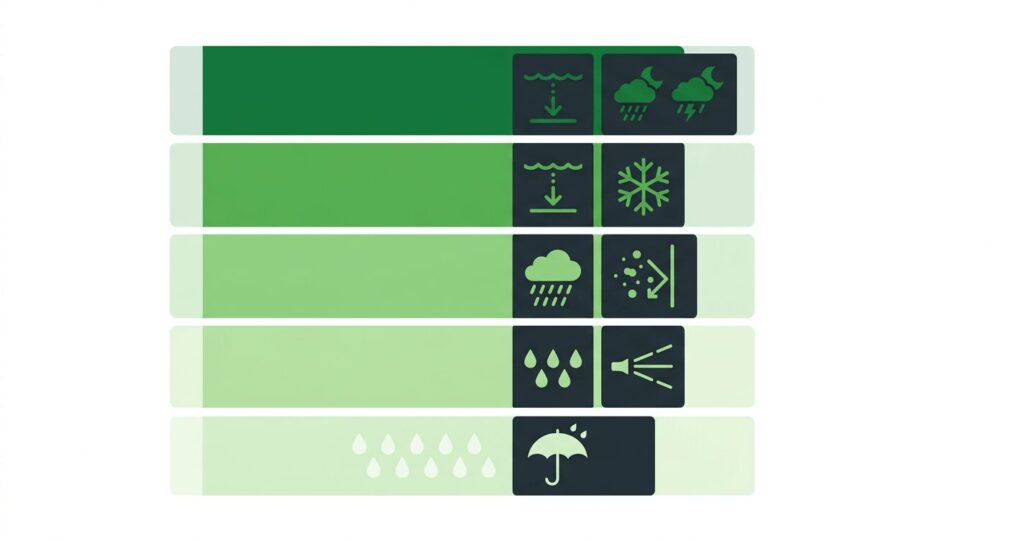
IP stands for Ingress Protection. It’s an IEC (International Electrotechnical Commission) standard — IEC 60529 — that classifies how well an electrical enclosure is protected against the intrusion of solid objects and liquids.
The IP rating appears as two digits after the letters IP. Each digit means something specific:
First Digit — Solid Object Protection (0-6)
- 0: No protection
- 1: Protected against solid objects over 50mm (large surfaces, hands)
- 2: Protected against solid objects over 12mm (fingers)
- 3: Protected against solid objects over 2.5mm (tools, thick wires)
- 4: Protected against solid objects over 1mm (thin wires, screws)
- 5: Dust protected — not fully dustproof but dust ingress doesn’t impair operation
- 6: Fully dustproof — no dust ingress under vacuum test
Second Digit — Liquid Protection (0-9)
- 0: No protection
- 1: Protected against vertically falling water drops
- 2: Protected against water drops at 15° angle
- 3: Protected against spraying water up to 60° from vertical
- 4: Protected against splashing water from any direction
- 5: Protected against low-pressure water jets from any direction
- 6: Protected against high-pressure water jets from any direction
- 7: Protected against temporary submersion up to 1 metre for 30 minutes
- 8: Protected against continuous submersion beyond 1 metre
- 9K: Protected against high-pressure, high-temperature water jets
What IP Ratings Don’t Tell You
This is the part most guides skip — and it matters for weatherproof EV chargers 2026 IP ratings US UK decisions.
IP ratings don’t cover temperature extremes. A charger rated IP67 may still fail at minus 30°C if its internal electronics aren’t rated for that temperature. IP and operating temperature are separate specifications that must both be checked.
IP ratings don’t cover UV degradation. A charger’s plastic housing may meet IP55 when new but degrade from UV exposure over 3-5 years of outdoor installation in sunny climates, allowing moisture ingress that the original rating didn’t anticipate.
IP ratings don’t cover thermal cycling. Repeated freeze-thaw cycles stress seals and housing materials in ways the IP test — conducted at a single point in time — doesn’t capture. A charger that passes IP55 on the day of testing may develop seal failures after three winters of repeated thermal cycling.
IP ratings don’t cover salt spray. Coastal installations face salt-laden air that corrodes metal components and degrades seals faster than standard IP tests predict. If you’re installing within 5 km of a coastline — whether in New England, California, or the UK — salt spray resistance is worth considering separately from the IP rating.
IP ratings are tested on the enclosure, not the connector. The IP rating applies to the charger body. The connector and cable are separate components with potentially different ingress protection. A charger body rated IP67 with a connector rated only IP44 has an IP44 weak point that affects real-world weather resistance.
The Real Weather Conditions — What Your Charger Actually Faces
Understanding the weatherproof EV chargers 2026 IP ratings US UK question requires being specific about what the weather actually does to an outdoor charger in different climates.
US Climate Zones and What They Mean for EV Charger Weather Resistance
Pacific Northwest (Seattle, Portland, Oregon coast): High annual rainfall (1,000-1,500mm), frequent drizzle, mild temperatures rarely below -5°C. Primary threat: sustained moisture exposure, condensation. Requirement: IP55 minimum, IP65 recommended for exposed installations. Temperature range: rarely challenges charger electronics.
Northern States — Great Lakes and Northeast (Minnesota, Wisconsin, Michigan, New York state, Maine): Cold winters reaching -20°C to -30°C, heavy snowfall (1,000-3,000mm annually in snowbelt areas), spring thaw with significant moisture. Primary threats: extreme cold, ice formation on connectors, freeze-thaw cycling, snow accumulation. Requirement: IP67 minimum, -40°C operating temperature rating, internal heating element strongly recommended. Temperature range: critical spec.
Northeast Coast (Boston, New York City, Philadelphia): Cold winters reaching -15°C to -20°C, moderate snowfall, significant rainfall (1,000-1,200mm). Salt air exposure in coastal areas. Primary threats: cold, moderate snow, salt spray near coast. Requirement: IP65 minimum, IP67 for exposed installations, -25°C operating temperature.
Mid-Atlantic and Southeast (DC, Charlotte, Atlanta): Moderate winters rarely below -10°C, significant rainfall, high summer humidity. Hurricane season brings extreme rain events. Primary threats: sustained rainfall, high humidity, occasional ice storms. Requirement: IP55 minimum, IP65 for exposed locations. Summer heat (35-42°C) also relevant for operating temperature upper limit.
Southwest (Phoenix, Las Vegas, Southern California desert): Minimal rainfall, extreme heat (45-50°C in summer), intense UV exposure, dust storms. Primary threats: UV degradation, extreme heat, dust ingress. Requirement: IP5X (dust protected) minimum, IP65 for monsoon regions. Operating temperature upper limit is the critical spec — not cold weather rating.
Mountain States (Colorado, Utah, Montana): Cold winters (-20°C to -30°C at elevation), significant snowfall, intense UV at altitude, rapid temperature swings. Primary threats: extreme cold, heavy snow, UV, thermal cycling. Requirement: IP67, -40°C operating temperature, UV-resistant housing.
Gulf Coast (Houston, New Orleans, Miami): Minimal cold but extreme rainfall, high humidity, hurricane-force rain events, salt air, intense summer heat. Primary threats: flooding risk, extreme rainfall intensity, salt corrosion, heat. Requirement: IP67 for flood-risk areas, IP65 minimum, heat-rated electronics.
UK and Northern European Climate Zones
England and Wales: Annual rainfall 600-1,500mm depending on region, temperatures rarely below -10°C (with exceptions), persistent drizzle and overcast conditions. Primary threats: sustained moisture exposure, occasional frost, condensation. Requirement: IP55 minimum for covered installations, IP65 for fully exposed driveways.
Scotland: Higher rainfall than England (particularly west coast — over 2,000mm annually in some areas), colder winters reaching -15°C to -20°C in Highlands, significant wind exposure. Primary threats: heavy rainfall, cold, wind-driven rain. Requirement: IP65 minimum, IP67 for Highland installations, -20°C operating temperature.
Northern Ireland: High rainfall (especially west), similar to western Scotland. Requirement: IP65.
Scandinavia (Norway, Sweden, Finland): Extreme cold (-20°C to -40°C in northern regions), heavy snowfall, freeze-thaw cycling, coastal salt exposure in western Norway. Primary threats: extreme cold, ice, snow. Requirement: IP67, -40°C operating temperature, internal heating for most of Norway and northern Sweden/Finland.
Netherlands and Belgium: Moderate maritime climate, significant rainfall (800-900mm), mild temperatures rarely below -10°C, coastal salt exposure. Requirement: IP55 minimum, IP65 for exposed coastal installations.
Germany: Varies significantly — mild maritime in northwest, cold continental in east and southeast reaching -20°C. Requirement: IP55 minimum for western Germany, IP65-IP67 for eastern and southern regions with significant cold winters.
The IP Rating You Actually Need — By Installation Type
Beyond climate, your specific installation configuration determines the relevant IP rating:
Covered Garage (Indoor or Semi-Indoor)
A charger installed inside a closed garage — protected from direct rain, snow, and sustained cold — has the most relaxed IP requirements. However “garage” covers a wide range of actual conditions:
Fully enclosed heated garage: IP44 is technically sufficient but IP55 is worth the minimal additional cost for long-term reliability. Temperature rarely challenges the electronics.
Attached unheated garage (US): Temperatures can reach -20°C in cold climates. IP55 for moisture protection, but operating temperature rating becomes relevant. A charger rated to -25°C or lower is worth specifying in northern states.
Detached open-fronted carport: Effectively semi-outdoor. Wind-driven rain and snow enter freely. IP65 minimum. Operating temperature relevant in cold climates.
Underground parking garage: Low temperature variation, minimal precipitation exposure, but condensation can be significant. IP55 adequate for most installations. Confirm connector IP rating specifically.
Exterior Wall — Covered by Overhang or Canopy
A charger mounted on an exterior wall with a roof overhang or canopy above it receives partial weather protection but not full protection:
- Direct rain: Protected if overhang extends adequately beyond the charger
- Wind-driven rain: Not protected — can approach from any angle
- Snow accumulation: Reduced but not eliminated
- Ice: Still forms on connector and cable
UK and mild US climates: IP55 adequate for most covered exterior wall installations. Northern US and Canada: IP65 minimum, IP67 preferred. Operating temperature rating critical.
Fully Exposed Exterior Wall — No Overhang
The most demanding installation scenario — a charger mounted directly on an exterior wall with no overhead protection:
- Direct rain: Full exposure
- Wind-driven rain: Full exposure from all angles
- Snow accumulation: Full accumulation on top surfaces
- Ice: Full ice formation risk on all surfaces
- UV: Full UV exposure
UK and Pacific Northwest US: IP65 minimum. IP67 strongly recommended for long-term reliability. Northern US, Canada, Scandinavia: IP67 mandatory. Operating temperature to -40°C for most of Canada and northern US states. Internal heating element highly recommended. Southwest US: IP65 for dust and monsoon protection. UV-resistant housing important.
Pedestal/Post-Mounted — Freestanding in Parking Area
Freestanding charger installations face all-direction weather exposure including ground-level splash from rain and snowmelt:
All climates: IP67 minimum. Ground-level moisture ingress is a genuine risk that IP55 and IP65 ratings don’t fully address — the seventh digit (submersion resistance) protects against ground-level water pooling during heavy rain or snowmelt that IP65 doesn’t cover.
The Best Weatherproof EV Chargers for Snowy US Winters — 2026
Grizzl-E Ultimate — The Benchmark for North American Cold Weather
IP Rating: IP67 Operating Temperature: -40°C to +50°C Internal Heating: Yes Cable Rating: -40°C cold-rated TPE compound Housing: Powder-coated aluminium Price: $399-$449 Connector: J1772 or NACS
The Grizzl-E Ultimate is the most comprehensively specified cold weather home EV charger available in North America at any price. The IP67 rating, -40°C operating temperature, internal heating element, cold-rated cable, and aluminium housing form a package that no competing home charger at this price point matches.
The internal heating element is the differentiating feature for extreme cold climates. When ambient temperature drops below a threshold, the heating element activates to keep internal electronics within their operating range. This is what allows the Grizzl-E Ultimate to initialise reliably at -40°C when a charger without this feature would fail to start.
For detailed cold weather performance analysis comparing the Grizzl-E Ultimate against European alternatives, our Grizzl-E Ultimate vs Hypervolt Home 3 Pro cold weather comparison covers every relevant specification.
Best for: Minnesota, Wisconsin, Montana, North Dakota, South Dakota, Michigan UP, Northern New England, all Canadian provinces
Tesla Universal Wall Connector — Solid IP55 for Moderate US Winters
IP Rating: IP55 Operating Temperature: -30°C to +50°C Internal Heating: No Cable Rating: Standard (not cold-rated) Housing: Polycarbonate Price: $595
The Tesla Universal Wall Connector’s IP55 rating and -30°C operating temperature cover the winter conditions of most of the continental US east of the Rockies — but not the extreme cold of the upper Midwest and Canadian border states where the Grizzl-E Ultimate’s -40°C rating and internal heating become relevant.
For covered or semi-covered installations in mid-Atlantic, southeast, and Pacific Northwest climates, the Tesla Universal Wall Connector’s IP55 is adequate. For fully exposed installations in Minnesota or Wisconsin winters, it’s underspecified.
Best for: Pacific Northwest, Northeast coast, Mid-Atlantic, Southeast — covered or semi-covered installations
ChargePoint Home Flex — IP55 for Versatile US Climate Installations
IP Rating: IP55 Operating Temperature: -30°C to +50°C Internal Heating: No Cable Rating: Standard Housing: Polycarbonate Price: $699
The ChargePoint Home Flex’s IP55 and -30°C rating covers similar territory to the Tesla Universal Wall Connector in terms of weather resistance. The adjustable amperage and NEMA 14-50 plug option add installation flexibility but don’t change the weather resistance picture.
For US buyers in moderate climates installing in covered or semi-covered positions, IP55 is adequate. For exposed installations in northern states, upgrade to the Grizzl-E Ultimate’s IP67.
Best for: Moderate US climates, covered or semi-covered installations, garage installations where IP55 is more than sufficient
Emporia Pro — IP66 That Beats Both Tesla and ChargePoint on Weather
IP Rating: IP66 Operating Temperature: -30°C to +50°C Internal Heating: No Cable Rating: Standard Housing: Polycarbonate Price: $399
The Emporia Pro’s IP66 rating is a genuine differentiator over the Tesla Universal Wall Connector and ChargePoint Home Flex — both rated IP55. IP66 provides protection against high-pressure water jets from any direction rather than just low-pressure jets, which matters for installations exposed to driving rain in storm conditions.
For buyers who want better-than-IP55 weather resistance without paying Grizzl-E Ultimate prices, the Emporia Pro offers IP66 at $399 — the same price as the Grizzl-E Ultimate but with better solar integration and smart features, slightly lower cold temperature rating (-30°C vs -40°C), and no internal heating element.
Best for: US buyers who want IP66 weather resistance plus smart features (solar integration, load management) and don’t require the extreme cold weather specification of the Grizzl-E Ultimate
The Best Weatherproof EV Chargers for Rainy UK Summers — 2026
Hypervolt Home 3 Pro — IP65 for British Weather
IP Rating: IP65 Operating Temperature: -25°C to +40°C Internal Heating: No Cable Rating: -25°C (Pro version) Housing: Polycarbonate Price: £899-£1,099
The Hypervolt Home 3 Pro’s IP65 rating is fully dustproof and protected against low-pressure water jets from any direction — adequate for UK weather including sustained rain, drizzle, and wind-driven precipitation. The -25°C operating temperature covers Scottish Highland winter conditions with a reasonable margin.
The fully dustproof IP65 first digit is more relevant in the UK than it might seem — construction dust, pollen, and fine particulates from road traffic accumulate on outdoor electronics over time and IP65’s full dust exclusion prevents the slow deterioration that IP5X (dust-protected) chargers can experience.
Best for: UK fully exposed driveway installations, Scottish properties, Northern European climates with sustained rainfall
Myenergi Zappi — IP65 With Industry-Leading Solar Integration
IP Rating: IP65 Operating Temperature: -20°C to +40°C Internal Heating: No Cable Rating: Standard Housing: Polycarbonate Price: £699-£849
The Myenergi Zappi’s IP65 rating matches the Hypervolt Home 3 Pro for weather resistance — fully dustproof, protected against low-pressure water jets. For UK outdoor installations where solar divert is the priority, the Zappi delivers IP65 weather resistance alongside the best solar integration in the market.
The -20°C operating temperature is adequate for most of England, Wales, and Northern Ireland but reaches its limit in Scottish Highland winters where temperatures regularly hit -15°C to -20°C. For Highland installations, the Hypervolt Home 3 Pro’s -25°C rating provides slightly more margin.
Best for: UK outdoor installations where solar panels are present, England, Wales, Northern Ireland
Wallbox Pulsar Plus — IP55 for Most UK Installations
IP Rating: IP55 Operating Temperature: -25°C to +50°C Internal Heating: No Cable Rating: Standard Housing: Polycarbonate Price: £649-£799
The Wallbox Pulsar Plus’s IP55 rating is adequate for most UK outdoor installations — covered driveways, wall-mounted positions with some overhead protection, and carport installations. For fully exposed driveway positions without any overhead cover, the IP65 of the Hypervolt or Zappi provides better long-term protection.
The -25°C operating temperature matches the Hypervolt and exceeds the Zappi for cold weather coverage — relevant for Scotland and northern England.
Best for: UK covered or semi-covered outdoor installations, garage and carport positions
Easee One — IP54 That Surprises on Price
IP Rating: IP54 Operating Temperature: -25°C to +40°C Internal Heating: No Cable Rating: Standard Housing: Polycarbonate Price: £549-£649
The Easee One’s IP54 is the lowest weather resistance rating of the chargers covered in this guide — protected against splashing water from any direction rather than the low-pressure jet protection of IP55. For most UK driveway installations with some overhead protection, IP54 is adequate. For fully exposed installations or coastal locations with driving rain, IP55 or above provides better protection.
The -25°C operating temperature is solid. The three-year warranty compensates partially for the lower IP rating by providing longer coverage if weather-related degradation does occur.
Best for: UK covered installations, carport positions, sheltered garage walls — not recommended for fully exposed coastal locations
The IP Rating Decision Framework — A Simple Guide
Here’s the honest framework for choosing the right IP rating for your specific installation:
Ask Four Questions
Question 1: Is the charger indoors, semi-outdoor, or fully outdoor?
- Fully enclosed indoor garage: IP44 minimum, IP55 for safety margin
- Carport or semi-covered: IP55 minimum
- Fully exposed exterior wall: IP65 minimum
- Post-mounted in open parking area: IP67 minimum
Question 2: What is the lowest winter temperature at your location?
- Above -10°C (most of UK, Pacific Northwest US): Standard operating temperature sufficient
- -10°C to -20°C (Scotland, Northeast US, Mid-Atlantic): -25°C operating temperature
- -20°C to -30°C (northern US states, Canada): -30°C to -40°C operating temperature, consider internal heating
- Below -30°C (upper Midwest US, most of Canada, northern Scandinavia): -40°C operating temperature, internal heating mandatory
Question 3: Are you within 5km of a coastline? If yes, salt spray accelerates corrosion beyond what standard IP ratings predict. Prioritise aluminium or stainless steel hardware over polycarbonate. IP67 for coastal installations regardless of climate.
Question 4: Is the installation in a high UV exposure location? If yes (Southwest US, high altitude, or any sunny climate), confirm UV resistance of the housing material. Standard polycarbonate degrades from UV over 5-7 years. UV-stabilised polycarbonate or powder-coated aluminium holds up better.
The Hidden IP Problem — Connector Ratings vs Body Ratings
This is the most overlooked aspect of weatherproof EV chargers 2026 IP ratings US UK and it catches out buyers who do their IP rating research carefully on the charger body but forget to check the connector.
The IP rating on the charger’s spec sheet applies to the charger enclosure — the box on the wall. The connector and cable are separate components that may have different, typically lower, ingress protection ratings.
A common pattern in mid-range home chargers: IP65 body rating, IP44 connector rating. In sustained rain, the IP44 connector is the weak point — water ingress at the connector over time causes corrosion of the electrical contacts, intermittent charging faults, and eventual connector failure.
How to check: Ask your installer or the manufacturer specifically for the connector IP rating, not just the unit IP rating. For premium chargers like the Grizzl-E Ultimate, connectors are rated to IP67 matching the body. For budget chargers, connector ratings are often lower and sometimes not published at all — which is itself a warning sign.
What to do about it: A hinged protective cover over the connector significantly extends connector life regardless of the rated IP protection. Several charger brands include these — the Grizzl-E Ultimate’s connector cover is a good example. If your charger doesn’t have one, aftermarket connector covers are available for J1772, NACS, and Type 2 connectors.
Installation Practices That Protect Any IP-Rated Charger
The IP rating your charger leaves the factory with is a starting point. Installation quality and practices affect how well that rating holds up over time.
Install the unit with the cable exit pointing downward. Water follows gravity. A cable exit pointing down means water that gets past the cable seal runs out rather than pooling inside the enclosure. A cable exit pointing up or sideways is an invitation for water ingress even on IP65-rated units.
Use self-amalgamating tape on external connections. Any conduit entry, cable gland, or external connection point is a potential ingress route. Professional installers use self-amalgamating tape on these connections to seal them against moisture — particularly important for installations in high-rainfall areas.
Mount on a backing plate rather than directly on porous masonry. Direct mounting on brick or rendered walls allows moisture to wick from the wall into the mounting points and potentially into the charger body over time. A backing plate creates a small air gap that prevents this.
Orient the display screen away from direct western sun. In the UK and much of the US, the prevailing rain direction is from the west. A display screen or status indicator facing west receives more direct rain exposure than one facing north or east — relevant for units with lower IP ratings.
Inspect connector seal annually. The rubber seal around the connector housing is a wearing part — UV exposure, physical handling, and temperature cycling cause it to harden and crack over time. Annual visual inspection and replacement when deterioration is visible prevents connector ingress failures before they cause charger faults.
Common IP Rating Myths That Cost EV Owners Money
Myth 1: “IP67 is always better than IP65 for UK outdoor installation” Not necessarily. UK residential installations rarely involve submersion risk — the extra protection of IP67 against 1-metre submersion isn’t relevant for most UK driveways. IP65’s protection against sustained water jets covers the actual weather threats UK installations face. Paying extra for IP67 over IP65 in a UK context is often unnecessary unless you’re in a flood-risk area or post-mounting in an exposed location.
Myth 2: “IP55 is fine for all outdoor UK installations” Not for fully exposed driveway positions. IP55’s protection against low-pressure water jets is less than IP65’s protection in sustained heavy rain conditions. For a charger mounted on a garage wall under a deep overhang, IP55 is fine. For a charger mounted on an exposed front-of-house wall in a West Country or Welsh location with 1,500mm annual rainfall, IP65 is worth the upgrade.
Myth 3: “Higher IP always means higher quality charger overall” IP rating is one specification among many. A charger with IP67 but poor smart features, weak warranty, and limited installer network isn’t necessarily better than one with IP65, excellent solar integration, and a 3-year warranty. The right IP rating for your installation matters — a higher rating than you need doesn’t improve your charging experience.
Myth 4: “IP rating is permanent” IP ratings are tested at manufacture. Seals degrade. Housings UV-deteriorate. Connector covers wear. After 5-7 years of outdoor exposure, an IP65 charger may effectively be performing at IP44 due to seal degradation. This is why warranty length matters alongside IP rating — a 3-year warranty covers the period of most rapid seal degradation.
Myth 5: “Indoor chargers don’t need an IP rating” Garages experience condensation, particularly in climates with significant temperature variation. A garage that reaches 35°C in summer and -10°C in winter creates condensation cycles that affect electrical components over time. IP44 minimum for all garage installations — even “indoor” ones.
Quick Reference — Matching IP Rating to Climate and Installation
| Installation Type | UK Mild | UK Scotland/Coast | Northeast US | Northern US/Canada | Southwest US |
|---|---|---|---|---|---|
| Enclosed garage | IP44 | IP44 | IP44 (-25°C) | IP55 (-40°C) | IP54 |
| Covered carport | IP55 | IP55 | IP55 (-25°C) | IP65 (-40°C) | IP55 |
| Exterior wall (some cover) | IP55 | IP65 | IP65 (-25°C) | IP67 (-40°C) | IP65 |
| Fully exposed exterior | IP65 | IP67 | IP67 (-25°C) | IP67 (-40°C +heat) | IP65 |
| Post-mounted open area | IP67 | IP67 | IP67 (-25°C) | IP67 (-40°C +heat) | IP67 |
Internal Links — Further Reading on Clean Energy Bazaar
Weatherproof EV chargers 2026 IP ratings US UK is the specification foundation. These guides cover the full charger decision.
For the cold weather performance comparison beyond IP ratings — operating temperature, cable compounds, internal heating — our Grizzl-E Ultimate vs Hypervolt Home 3 Pro cold weather comparison covers every relevant cold climate specification in detail. For the full US home charger comparison including all the chargers covered in this guide, our best home EV chargers 2026 US comparison covers ten options honestly. For the UK and European market, our best Level 2 EV chargers UK Europe 2026 guide covers every major option. For understanding all EV charger specs — not just IP — our guide to understanding EV charger specs 2026 is the plain language reference. Before finalising any purchase, our EV charger warranty comparison covers what warranty terms mean in practice — critical for outdoor installations where weather-related degradation is the most common long-term failure mode.
Final Thoughts
The weatherproof EV chargers 2026 IP ratings US UK question has a more nuanced answer than “buy the highest IP rating available.” The right IP rating depends on your specific climate, your specific installation position, and whether cold temperature or water ingress is your primary weather threat.
The honest summary:
- UK mild climate, covered installation: IP55 adequate — Wallbox Pulsar Plus or Easee One
- UK exposed driveway or Scotland: IP65 minimum — Hypervolt Home 3 Pro or Myenergi Zappi
- Northeast and Mid-Atlantic US, covered: IP55 with -25°C rating — Tesla Universal Wall Connector or ChargePoint Home Flex
- Northern US states and Canada, any installation: IP67 with -40°C and internal heating — Grizzl-E Ultimate
- US buyers wanting IP66 plus smart features: Emporia Pro
- Any coastal installation: IP67 regardless of climate
Buy the IP rating your installation actually needs — not the highest available. Make sure the connector IP rating matches the body rating. Install correctly to maintain the rating over time. And check the warranty length alongside the IP number — a well-warranted IP65 charger is more valuable than an IP67 charger with a 1-year warranty that runs out before the seals do.