The electric vehicle industry has spent years promising that charging will eventually become as fast as refuelling. For passenger cars, the promise is edging closer to reality with 350 kW and 1 MW chargers. For the commercial two- and three-wheelers that dominate India’s urban mobility landscape, a different solution has emerged that does not wait for the grid to catch up.
Automated battery swapping: the 40-second swap that could transform urban mobility is not a future concept. It is a funded, government-backed technology being commercialised in Bengaluru, and it addresses the single most important constraint for the riders who depend on their vehicles for their daily income: downtime.
The Technology: Under 40 Seconds, Fully Automated
In March 2026, the Technology Development Board under India’s Department of Science and Technology signed an agreement with InfinityX Innovations Private Limited, a Bengaluru-based company, to support the commercialisation and scale-up of an indigenous battery swapping ecosystem .
The core of the project is a network of automated, IoT-enabled battery swapping stations designed to complete a full battery exchange in under 40 seconds . This is not a manual swap where a rider wrestles with a connector and lifts a heavy pack. It is an automated process, meaning the station itself handles the mechanical exchange with minimal human intervention.
The system integrates advanced battery packs with automated swapping infrastructure, designed for thermal stability and operational reliability across diverse Indian climatic conditions . Its modular battery architecture is intended to be compatible across multiple vehicle platforms, enabling interoperability and scalability in deployment .
The project also includes plans to establish a dedicated manufacturing facility in Bengaluru to scale production of next-generation battery packs and automated swapping stations . The explicit goal is to reduce reliance on imported technologies and strengthen India’s domestic EV infrastructure .
Why 40 Seconds Matters: The Gig Economy Math
The significance of a 40-second swap is not about matching the convenience of a petrol station. It is about the economics of the people who ride these vehicles for a living.
For a delivery rider on a two-wheeler, every minute spent waiting for a charge is a minute not spent earning. Fixed charging, even fast charging, imposes downtime that directly reduces daily income. The Technology Development Board’s announcement explicitly frames the technology as addressing “one of the key barriers to EV adoption—charging time—particularly for commercial fleets and last-mile delivery segments” .
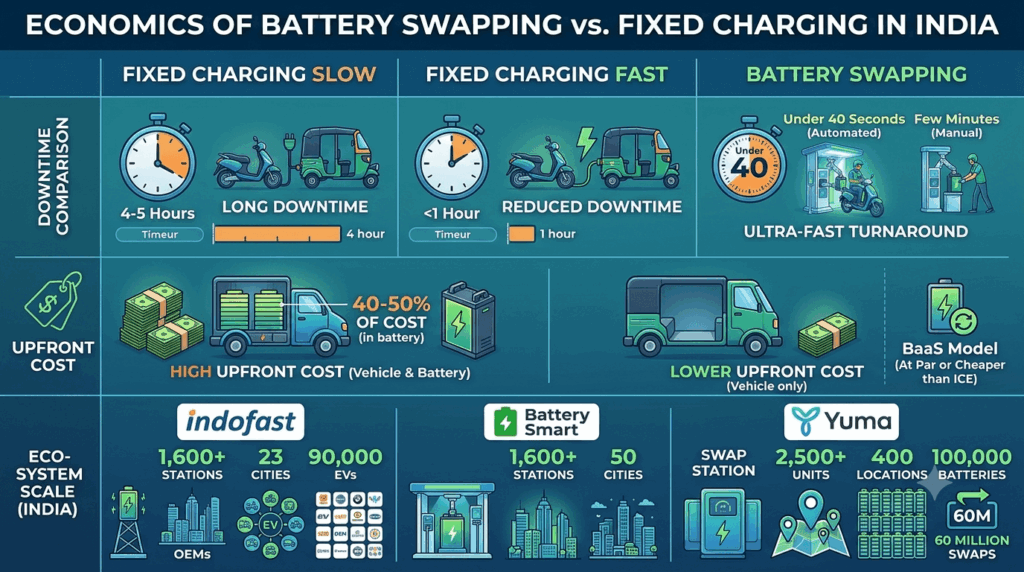
The CEEW has quantified the difference. Fixed charging involves a minimum of four to five hours for slow charging and under an hour for fast charging. Battery swapping, by contrast, offers near-zero downtime, with swaps taking just a few minutes . The InfinityX system compresses that to under 40 seconds.
The financial impact is substantial. Battery swapping reduces the upfront cost of the vehicle by decoupling battery ownership from the vehicle itself. Since the battery pack accounts for 40 to 50 percent of the total upfront cost, swapping can make an EV at par or cheaper than its internal combustion engine counterpart . For a commercial rider, the combination of lower upfront cost and near-zero downtime changes the economics of switching to electric.
The Indian Battery Swapping Ecosystem: Already at Scale
InfinityX is entering a market that has already achieved significant scale. The battery swapping sector in India is not a pilot project. It is a functioning industry with thousands of stations and hundreds of thousands of vehicles.
Indofast Energy, one of the leading networks, closed FY26 with over 1,600 battery swap stations across 23 cities, onboarding more than 90,000 electric vehicles and partnering with 32 original equipment manufacturers . Its network enabled over 1.6 billion kilometres of electric mobility travel and contributed to an estimated reduction of around 80,000 tonnes of CO2 emissions . The company plans to expand to 3,500 stations and support over 230,000 electric vehicles by FY27 .
Battery Smart operates more than 1,600 stations across 50 cities, with a focus on the two- and three-wheeler segment . Yuma Energy, backed by Magna, operates more than 2,500 charging and swapping units across over 400 physical locations, with more than 100,000 batteries deployed across 18 cities and over 60 million swaps completed . India now has at least 98 battery-swapping firms .
The scale matters because it demonstrates that the model works commercially. The question is not whether battery swapping can succeed in India. It is how automated technology can improve the economics further.
The Interoperability Challenge
The most significant barrier to the next phase of battery swapping growth is not technology. It is standardisation.
The CEEW’s analysis is direct: batteries from different car manufacturers and models have different chemistries, power and energy densities, form factors, and drivetrains that require specific energy and power ratios. These variations lead to compatibility issues, limiting the interoperability of batteries among vehicles from different OEMs, which consequently restricts the potential for widespread adoption of battery swapping .
The InfinityX modular battery architecture is explicitly designed to address this. Its modular design allows compatibility across multiple vehicle platforms, enabling interoperability and scalability . If it works as intended, a rider could swap a battery at any InfinityX station regardless of which vehicle brand they ride.
The government is aware of the gap. The Ministry of Power has issued guidelines for charging and swapping infrastructure, and there is ongoing work on standardised connector designs and communication protocols to allow a single battery pack to operate across multiple vehicle OEMs . But the CEEW notes that the nascent nature of battery swapping and the limited development of interoperability standards globally make this a potential that could be explored in the future .
The Financing Dimension: Battery-as-a-Service and Risk
The battery swapping model is not just a technology proposition. It is a financial one.
By separating the battery from the vehicle, the upfront cost of the vehicle drops significantly. For an electric three-wheeler loan, the principal amount can drop from ₹3.5 lakh to under ₹2 lakh . The battery becomes a subscription-based operational expense rather than a capital cost.
This restructuring changes the risk profile for lenders. Battery degradation risk, which is the primary source of residual value uncertainty for EVs, shifts from the vehicle owner to the battery service provider . The service provider is responsible for maintaining battery health and replacing packs when they degrade. The vehicle owner simply pays for access to a charged battery.
The policy framework is evolving to support this. The GST on standalone EV battery subscription services has been aligned with the lower 5% GST charged on complete electric vehicles, equalising costs . There is also a mandate for unique identification numbers and advanced battery management systems for every swapped battery pack, providing real-time data on state of charge and cell health .
For the riders and fleet operators who are the target market for InfinityX’s technology, the combination of lower upfront cost, near-zero downtime, and predictable operational expenses is the proposition that makes electric mobility viable.
What the 40-Second Swap Means for Urban Mobility
The transformation that automated battery swapping could deliver is not about passenger cars. It is about the millions of two- and three-wheelers that move people and goods in India’s cities.
A delivery rider who currently spends an hour a day waiting for a charge can reclaim that hour for deliveries. A fleet operator who loses revenue every time a vehicle is parked at a charger can keep the vehicle on the road. The economics of electrification improve for precisely the segment where the upfront cost barrier has been highest and the downtime penalty has been most acute.
The Technology Development Board’s support for InfinityX is a signal that the government sees automated swapping as part of the solution. The Secretary of the TDB noted that “indigenous innovations such as automated battery swapping systems can play a transformative role in enabling faster EV adoption, particularly in high-demand commercial segments, while advancing the objectives of self-reliance in clean mobility technologies” .
The honest assessment is that the technology is promising but the scale is still small relative to the size of India’s two- and three-wheeler fleet. InfinityX is building a manufacturing facility in Bengaluru. The existing networks operate thousands of stations, not tens of thousands. The interoperability standards are still being developed. And the commercial viability of automated swapping versus manual swapping at scale has not been proven.
But the direction is clear. The 40-second swap addresses the one metric that matters most to the riders who are electrifying first: time. And in urban mobility, time is money.