Every guide in this Chinese EV charging content cluster has approached the subject through specification, calculation, and methodology. This guide approaches it through people.
The user stories real EV charger setups from Chinese drivers from Shenzhen taxis to Hainan tourists collected here represent eight genuinely different Chinese EV charging realities — a Shenzhen taxi driver whose entire livelihood depends on charging logistics, a Hainan tourism operator managing a fleet of rental EVs for visitors, a Harbin delivery rider navigating -30°C charging, a Chengdu food delivery platform’s EV fleet manager, a rural Yunnan teacher who became her village’s unlikely charging advocate, a Beijing tech worker who automated everything, a Guangzhou grandmother who charges her grandson’s EV while he’s at work, and a Wuhan university student running a peer-to-peer charging arrangement with classmates.
None of these stories appeared in the product-focused guides elsewhere on this site. They represent the parts of Chinese EV charging that specifications and calculators don’t capture — the professional pressure of commercial charging logistics, the cultural dynamics of intergenerational EV ownership, the genuine ingenuity that emerges when formal solutions don’t quite fit a specific life.
Story 1: Mr Chen, Shenzhen EV Taxi Driver — Charging as a Business Operation
Mr Chen has driven a BYD e6 taxi in Shenzhen for six years, transitioning from a petrol taxi when Shenzhen’s taxi fleet electrification mandate made the switch effectively compulsory for new vehicle registrations in his fleet company.
“For a private EV owner, charging is about saving money on your commute. For me, charging is my entire business model. Every minute my car is charging instead of carrying passengers is money I’m not making. Every yuan I spend on electricity instead of valley rate is money out of my pocket directly.”
Mr Chen’s charging reality:
He drives approximately 280-320 km per shift, working 11-hour shifts, six days per week. His BYD e6 has a 71.7 kWh battery with approximately 400 km CLTC range — but taxi driving patterns (frequent stops, air conditioning constantly running, urban traffic) reduce real-world range significantly below CLTC figures.
“I need at least one substantial charge during my shift, sometimes two on busy days. I cannot wait for home valley rates — I’m working when valley rates are happening overnight, and I need the car charged and ready when my shift starts at 6am.”
His actual setup:
Mr Chen lives in a Shenzhen taxi company dormitory with shared parking — no individual designated space, no possibility of a personal dedicated circuit installation.
“My charging happens almost entirely at the taxi company’s depot. We have a bank of StarCharge DC fast chargers — 24 charging points for approximately 180 taxis on rotating shifts. I charge for 35-40 minutes during my lunch break, using the depot’s commercial DC rate, which is lower than public retail DC rates because the company negotiates bulk pricing with StarCharge.”
The financial reality:
“My depot charging costs the company approximately ¥0.95 per kWh — this is passed through to drivers as part of our lease arrangement, blended into a daily lease fee rather than itemised per charging session. I don’t directly see a per-kWh number, but the company’s fleet manager has told us the bulk commercial rate they negotiate is roughly 30-35% below standard public DC pricing.”
What Mr Chen wishes he’d known earlier:
“In my first year, I was charging at public stations near my routes whenever the battery got low, paying full retail DC rates because I didn’t understand the depot charging schedule properly. I was probably spending an extra ¥15-¥20 per day unnecessarily. Once a more experienced driver explained the depot’s quieter charging windows — avoiding the 12pm-1pm rush when every driver wants to charge during lunch simultaneously — I started timing my breaks 30 minutes earlier or later than the crowd, getting a free charging point immediately instead of waiting 15-20 minutes for one to open up.”
The specific lesson for other commercial EV drivers:
“Talk to drivers who’ve been doing this longer than you. The official training from the taxi company covers safety and basic operation. It doesn’t cover the practical economics of charging timing that actually affects your daily income. That knowledge only exists informally, among drivers.”
The connection to broader Chinese EV charging guidance:
Mr Chen’s situation — commercial high-mileage charging dependent on depot DC fast charging rather than home TOU — represents a genuinely different economic calculation from the residential TOU savings covered throughout this guide series. For commercial EV operators, the equivalent of “TOU optimisation” is timing charging sessions to avoid peak depot congestion and to access whatever bulk commercial rate arrangement the fleet operator has negotiated.
Story 2: Ms Huang, Hainan EV Rental Tourism Operator — Managing Visitor Charging Expectations
Ms Huang operates a small EV rental business in Sanya, Hainan, serving mainland Chinese tourists who want to drive an EV during their tropical island holiday — often their first time driving any EV, having flown to Hainan from cities where they don’t yet own one.
“My customers are tourists, mostly from northern and central China, who have heard about EVs but never driven one. Many have never charged a vehicle in their life. My job is not just renting cars — it’s teaching basic EV charging literacy to someone for the duration of a one-week holiday.”
Ms Huang’s fleet:
12 vehicles — a mix of BYD Atto 3, BYD Dolphin, and two NIO ET5 units for premium bookings.
Her charging infrastructure:
“I have four StarCharge home-style 7kW AC chargers at my rental office car park, plus access to two public DC fast charging stations within 500 metres for emergency top-ups. Most of my fleet charges overnight at my own dedicated chargers, configured for Hainan’s TOU valley rate.”
The specific Hainan tourism challenge:
“Sanya’s TOU valley rate is similar to Guangzhou — approximately ¥0.32-0.35/kWh overnight. But my business model depends on vehicles being available and charged every single morning, regardless of what state the previous renter returned them in. I cannot risk a vehicle arriving back at 30% battery at 9pm and not being ready for a 7am pickup the next day.”
Her operational solution:
“I configured all four chargers with smart scheduling, but I override the standard TOU-only approach. If a vehicle comes back below 40% battery, my charger app is set to begin charging immediately rather than waiting for the 11pm valley window — I’d rather pay the slightly higher flat rate for a few hours than risk the vehicle not being ready. For vehicles returning above 40%, the valley rate window is sufficient.”
The customer education challenge:
“The single biggest issue I deal with isn’t charging infrastructure — it’s customer behaviour. Mainland tourists who’ve never driven an EV often don’t understand regenerative braking, range anxiety management, or basic charging etiquette. I had one customer try to unplug a charging vehicle at a public DC station because they ‘needed’ that spot for their petrol thinking — they didn’t realise EV charging takes longer than a petrol fill-up and public spaces need to be used appropriately.”
The weather-specific lesson:
“Hainan’s humidity is intense, especially during the wet season from May to October. I learned the hard way that the cheaper IP54-rated chargers I initially installed weren’t adequate. After eighteen months, one developed a fault that I’m confident was related to humidity ingress — it would intermittently fail to communicate with the app during the wettest months. I replaced all four with IP65-rated units two years ago and haven’t had a single weather-related issue since.”
Ms Huang’s advice for anyone running EV charging infrastructure in tropical or sub-tropical Chinese locations:
“Don’t economise on weatherproofing to save ¥300-¥400 per charger. I learned this lesson at the cost of a service disruption during my business’s busiest season — Spring Festival week, when a charger failure meant I had one fewer vehicle available during my highest-demand period of the year. The IP65 charger costs more upfront but the business cost of a failure during peak season was far higher than the price difference.”
The connection to broader Chinese EV charging guidance:
Ms Huang’s experience directly validates the IP rating guidance covered in our weatherproof charger guide — specifically that South China’s humid, monsoon-prone climate genuinely requires IP65 specification rather than the IP54 that might be adequate in drier northern Chinese climates.
Story 3: Wang Lei, Harbin Food Delivery Rider — Winter Charging Survival
Wang Lei delivers food via a small electric scooter and, since early 2025, a Wuling Hongguang Mini EV for larger or further-distance delivery orders in Harbin — a city with genuinely extreme winter conditions that test every aspect of EV charging infrastructure covered in this guide series’ weatherproof and cold-weather content.
“People in Shanghai or Shenzhen complain about charging speed in winter when it’s 5 degrees Celsius. I want to tell them: come to Harbin in January when it’s minus 25, and then tell me about your charging problems.”
The specific Harbin winter challenge:
“My Mini EV’s range drops by nearly half in deep winter. The 13.8 kWh battery that gives me close to 170 km in summer gives me maybe 90-100 km on a cold January day, between the battery’s reduced capacity in cold and the cabin heating constantly running. For my delivery work, range anxiety in winter is real and constant.”
His charging setup:
“I live in a 1990s residential building — what people on these guide websites call 老旧小区. No designated parking, no possibility of a dedicated circuit. I charge from a standard socket that the building’s 物业 allowed me to access in a covered area near the building entrance, using a portable charger I bought specifically rated for cold weather.”
The specific cold-weather equipment lesson:
“My first portable charger — a budget unit I bought without doing much research — developed problems within the first winter. The plastic housing became brittle and one of the connector latches cracked from the cold. I replaced it with an Autel portable unit rated to minus 30, and I haven’t had a single cold-weather hardware issue in the two winters since.”
The battery management routine he’s developed:
“I’ve learned to never let the battery get below about 15% in winter, because cold makes the final charging more unpredictable and I need every bit of margin. I also learned to precondition the battery — there’s a setting in the car’s app that warms the battery before I start driving, which the car’s manual barely mentioned but which makes a real difference to how much range I get on the coldest mornings.”
The financial reality of winter delivery work:
“Winter is when delivery demand is highest — people don’t want to go out in the cold, so they order more food delivery. But winter is also when my vehicle costs more to run, because of reduced range and the charging speed reduction in extreme cold that these guide websites explain technically. I have to factor a 20-25% efficiency reduction into my winter earnings calculations.”
Wang Lei’s advice for other Chinese EV owners and gig workers in extreme cold climates:
“Don’t buy the cheapest charging equipment if you live somewhere genuinely cold. The price difference between a budget charger and a properly cold-rated one is small compared to what you lose if your equipment fails during the coldest week of winter — which is exactly when you need it working most reliably, both for your own transport and, for people like me, for our income.”
The connection to broader Chinese EV charging guidance:
Wang Lei’s experience directly validates the temperature specification guidance covered in our weatherproof charger and northeast China climate content — confirming that the -30°C specification recommended for Harbin and similar northeast Chinese cities reflects genuine operational necessity rather than excessive caution.
Story 4: Mr Liu, Chengdu Food Delivery Platform EV Fleet Manager — Managing 200+ Vehicles
Mr Liu manages EV charging infrastructure for a regional food delivery platform’s company-owned fleet in Chengdu — approximately 220 electric scooters and 40 Wuling Mini EVs used by delivery riders who don’t own their own vehicles.
“Managing charging for one car is a personal decision. Managing charging for 260 vehicles across multiple depot locations is a logistics and engineering problem.”
The specific fleet management challenge:
“Our riders work staggered shifts across nearly 18 hours of daily operation. There’s no single ‘overnight valley window’ that works for the whole fleet, because vehicles are coming and going constantly. We need charging infrastructure that can handle continuous, rolling demand rather than a single nightly charging event.”
His infrastructure solution:
“We installed a StarCharge multi-unit load balancing system across our three Chengdu depots — the same fundamental technology covered in the load balancing guides on this website, but scaled for commercial fleet use rather than a single household. Forty charging points per depot, with the load management system distributing available capacity dynamically as vehicles arrive and depart throughout the day.”
The financial scale:
“Chengdu’s low electricity rates — the hydropower advantage that these guides describe for residential users — apply to our commercial rate as well, though our commercial tariff structure is different from residential TOU. We still benefit from Sichuan’s generally lower electricity costs compared to coastal cities, which matters significantly at our scale. A ¥0.05/kWh difference across our fleet’s monthly consumption adds up to a meaningful sum.”
The specific operational lesson about Chengdu’s climate:
“The persistent humidity that this website’s guides describe for Chengdu is something I learned about the hard way in my first year managing this fleet. We had several charging point failures in our first eighteen months that I now understand were humidity-related, because we’d installed lower-spec equipment to save on upfront capital costs. After replacing failed units with IP65-rated equipment, our failure rate dropped dramatically.”
The maintenance routine he developed:
“At fleet scale, you can’t just deal with problems reactively. We do quarterly inspections of every charging point, checking specifically for the kind of corrosion and connector degradation that the safety guides on this website describe. Catching a degrading connector before it fails completely, rather than after, has saved us significant unplanned downtime.”
Mr Liu’s advice for anyone managing EV charging at any scale beyond a single household:
“Everything that matters for a single home charger — proper IP rating for your climate, proper cable specification, RCCB protection, the right temperature rating — matters more at scale, not less. A failure that’s an inconvenience for one EV owner becomes a fleet availability problem and a direct revenue impact when you’re managing dozens or hundreds of vehicles.”
The connection to broader Chinese EV charging guidance:
Mr Liu’s experience scales up the individual load balancing and weatherproofing guidance covered throughout this content cluster, confirming that the same fundamental principles — correct IP rating for climate, load management for shared infrastructure, proper maintenance — apply identically whether managing one home charger or hundreds of fleet charging points.
Story 5: Teacher Zhao, Rural Yunnan Village — Becoming an Accidental Charging Advocate
Zhao Min teaches at a primary school in a rural township in Yunnan province. She purchased a BYD Dolphin in 2024 — one of the first private EVs in her village — and found herself navigating territory that none of her village neighbours had experience with.
“When I bought my EV, nobody in my village had ever installed a home charger before. There was no 物业 to apply to — we don’t have that kind of management structure in a rural village. I had to figure out the entire process myself, mostly by calling the rural electricity supply bureau repeatedly until I found someone who could explain what I needed to do.”
Her specific rural charging challenge:
“My house has a yard where I park, but there was no electrical supply running to that part of the property — just the household supply going into the house itself. I needed to create new infrastructure where none existed, which is different from the urban experience these guides describe, where infrastructure usually exists and the question is how to access it.”
Her solution:
“I worked with an electrician from the nearest town, about 40 minutes away, who had some experience with rural EV installations from a different township. We ran a dedicated circuit from my household meter to the yard — about 18 metres of cable — with a basic 7kW charger. Total cost, including the electrician’s travel time, was around ¥1,400.”
The specific rural grid challenge she discovered:
“About two months after installation, I noticed my charger would sometimes reduce its charging speed for no obvious reason, or occasionally stop entirely and restart. I called the manufacturer’s customer service, who eventually explained this was likely related to voltage fluctuation on our rural grid — apparently agricultural equipment usage in our area causes voltage dips that my charger’s protection systems were responding to.”
Her solution to the voltage problem:
“I didn’t replace the charger — that would have been expensive and I wasn’t certain it would solve the problem. Instead, I started avoiding charging during the hours when I knew local irrigation pumps were most active, based on talking to neighbouring farmers about their pumping schedules. It’s a low-tech solution, but it’s worked. My charging is more reliable when I avoid those specific hours.”
Becoming the village’s accidental charging advisor:
“Within a year, three other households in my village had purchased EVs, partly because they saw my BYD working well and partly because rural EV subsidies made the purchase decision easier. All three came to me asking how I’d set up my charging, because there was no one else in the area who’d done it before. I became the unofficial local expert simply because I went through the process first and was willing to share what I learned.”
Teacher Zhao’s advice for rural Chinese EV owners pioneering charging infrastructure in their area:
“Don’t assume the urban guidance applies perfectly to your situation — much of it does, but rural electrical infrastructure has its own specific quirks, like the voltage fluctuation I experienced, that you won’t find detailed in most general guides. Talk to your rural electricity supply bureau directly and repeatedly until you find someone knowledgeable, and expect to be the one educating your neighbours once you’ve solved your own situation, because rural EV adoption is happening faster than rural charging knowledge is spreading.”
The connection to broader Chinese EV charging guidance:
Teacher Zhao’s experience directly validates the rural-specific guidance covered in our tier 1 vs tier 2 vs rural cities guide and the load balancing guide’s coverage of rural grid voltage fluctuation — confirming these are genuine, frequently encountered issues rather than theoretical edge cases.
Story 6: Mr Sun, Beijing Tech Worker — The Fully Automated Setup
Mr Sun works in software development in Beijing and approached his home EV charging setup with the same systematic mindset he applies professionally.
“I read probably fifteen different guides, including most of the ones on this website, before making any purchasing decision. I wanted to understand not just what to buy, but why — the underlying logic of TOU pricing, load balancing, IP ratings, all of it.”
His setup:
Xiaomi SU7 Max paired with a Huawei FusionCharge unit installed in his Beijing apartment’s underground parking, with full HarmonyOS smart home integration across his apartment.
“I specifically chose Huawei’s charger because I wanted the AI scheduling and the integration with my existing HarmonyOS smart home setup — I have Huawei’s smart plugs, smart lighting, and a HarmonyOS-compatible air conditioning system already, and I wanted my EV charging to be part of that unified ecosystem rather than a separate app I had to think about.”
His specific automation:
“I’ve configured a scene that triggers when I set my phone’s alarm for the next morning. If my alarm is set for before 7am, the system automatically checks my car’s current battery level and, if needed, overrides the standard valley-rate-only schedule to ensure the car reaches 80% by my wake-up time, even if that means using some non-valley electricity. If my alarm is later, it sticks to pure valley-rate charging for maximum savings.”
The specific value he’s found:
“The AI departure learning that Huawei’s system provides has genuinely adapted to my actual schedule over about four months of use. It now anticipates my Friday evening pattern, where I often go out after work and come home later with a lower battery than my typical weekday pattern, and it adjusts the charging schedule proactively rather than reactively.”
His honest assessment of whether the premium was worth it:
“I paid roughly ¥1,500 more for the Huawei charger compared to a basic StarCharge unit that would have delivered the same core TOU savings. Purely on the electricity cost calculation, that premium doesn’t pay for itself quickly — the guides on this site are honest that the core TOU saving is identical regardless of charger brand. But the ecosystem integration and the genuine reduction in daily mental overhead, not having to think about charging at all because it’s fully automated within a system I already use for everything else, is worth the premium to me personally.”
The lesson he’d pass on:
“Be honest with yourself about whether you’re paying for genuine functional value or just enjoying the process of building an elaborate setup because you find it intellectually satisfying. I think I’m paying for both, if I’m being completely honest, and I’ve made peace with that. But someone who just wants reliable TOU savings without any interest in the technical details should absolutely just buy the cheapest charger that meets their basic specification needs, exactly as these guides recommend.”
The connection to broader Chinese EV charging guidance:
Mr Sun’s experience directly illustrates the AI energy management and ecosystem integration value discussed in our smart charger comparison and connectivity guides — providing a genuine first-person account of where the premium ecosystem value proposition delivers real (if modest) functional benefit beyond the core TOU saving available from any charger.
Story 7: Mrs Liang, Guangzhou Grandmother — Intergenerational Charging Management
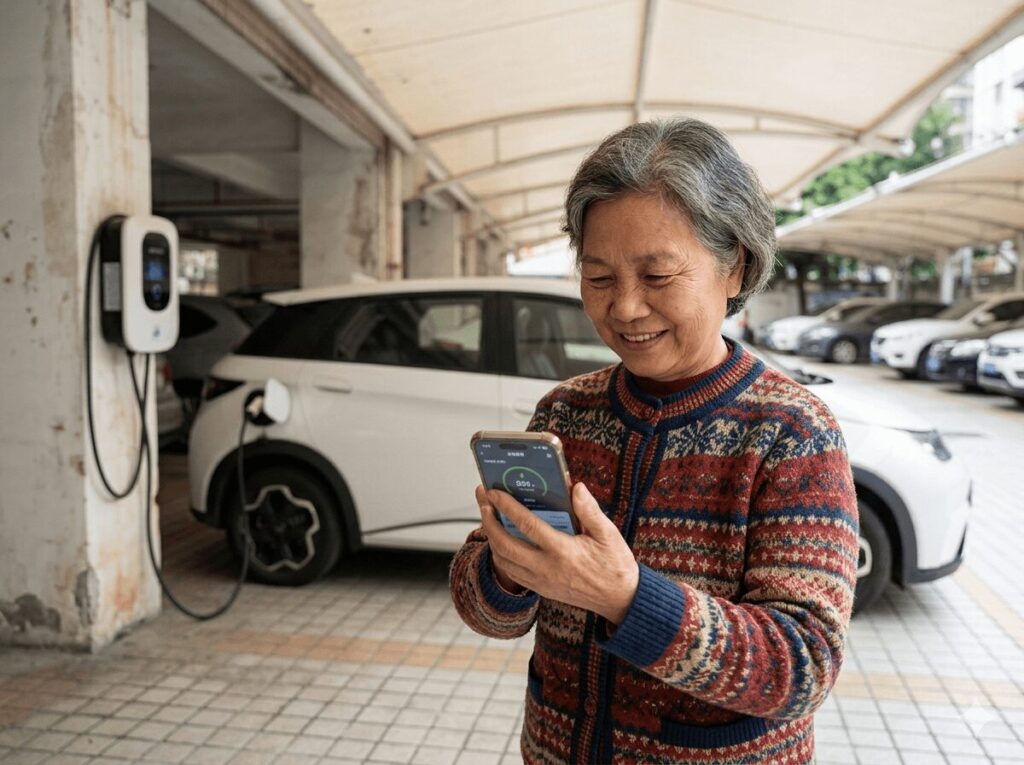
Mrs Liang, 67, manages the home charging for her grandson’s BYD Seal while he works long hours at a Guangzhou technology company, having effectively taken over day-to-day charging management for a vehicle she doesn’t herself drive.
“My grandson bought this car and asked me to help manage the charging because his work schedule is unpredictable — sometimes he leaves at 7am, sometimes not until 10am, and he often forgets to think about charging amid everything else in his life. I am retired and at home most days, so it made sense for me to take this on.”
Her specific role:
“Every evening when he comes home, I check the car’s battery level using an app he set up for me on my own phone, separate from his. If the battery is low, I make sure the charger is properly connected — he sometimes doesn’t connect it fully when he’s tired, and I learned to check this carefully after one night where I assumed it was charging and discovered the next morning the connector hadn’t engaged properly.”
The specific cross-generational learning challenge:
“I am from a generation that did not grow up with smartphones, so learning to use the charging app took genuine effort and patience for both me and my grandson. He set everything up initially and showed me the same three steps perhaps ten times before I felt confident. Now I manage it without any help.”
Her practical system:
“I don’t try to understand the technical details these guides describe about valley rates and TOU scheduling — my grandson configured the schedule once and I have never changed it. My job is simpler: make sure the cable is properly connected every single evening, and check the app each morning to confirm charging actually happened overnight as expected.”
The specific incident that taught her vigilance:
“About three months after we started this arrangement, I checked the app one morning and saw the battery hadn’t increased at all overnight, despite the cable appearing connected. I called my grandson, worried, and he came down before work to check. It turned out the connector had developed a problem — not something either of us caused, but something with the charger itself, what he later told me was a connector fault. We called the manufacturer and they sent someone to fix it within two days. If I hadn’t checked the app that morning, he might have driven to work with much less battery than he expected.”
Mrs Liang’s advice for other families managing EV charging across generations:
“Don’t assume that just because someone is older or less comfortable with technology, they cannot meaningfully help with EV charging. The actual daily task — checking a connection, glancing at an app, knowing when something looks wrong — is not complicated once someone takes the time to teach it properly and patiently. My grandson and I have a system now that works well for both of us, and I feel useful contributing to his daily life in a concrete way.”
The connection to broader Chinese EV charging guidance:
Mrs Liang’s story illustrates a genuinely under-discussed dimension of Chinese EV ownership — the role of extended family members in daily charging management, particularly in multi-generational Chinese households where grandparents often play active caregiving and household management roles. The basic connector-check vigilance she describes also reinforces the safety guidance throughout this content cluster about confirming proper connector engagement.
Story 8: Xiao Wei, Wuhan University Student — The Peer-to-Peer Charging Network
Xiao Wei is a graduate student at a university in Wuhan who, along with three classmates, jointly purchased and shares a used BYD Dolphin for the group’s combined commuting and personal use, creating an informal charging-sharing arrangement among people who don’t live together.
“None of us individually needed a car badly enough to justify the cost, but collectively, splitting the purchase and running costs four ways, it made sense. The complicated part has been figuring out charging, because we live in three different student housing arrangements, none of which have any kind of dedicated parking infrastructure.”
Their solution:
“One of our group, Li Fang, lives in off-campus housing with access to a single shared parking area that has a standard socket the landlord allowed us to use, after some negotiation and an agreement to pay a small monthly contribution toward the landlord’s electricity bill. We use a portable charger — one of the certified models discussed on these kinds of guide websites, not just any random extension cord — and the car is mostly kept at Li Fang’s place.”
Their cost-sharing system:
“We built a simple shared spreadsheet, updated through our group chat, tracking who used the car, for how many kilometres, and we estimate the electricity cost based on roughly how much the battery dropped during their use. Whoever used the car contributes their proportional share to Li Fang each month, who pays the landlord.”
The specific challenge of shared scheduling:
“The biggest practical issue isn’t the charging technology — the portable charger itself works fine. It’s coordinating who has the car when, and making sure whoever returns it plugs it in properly for the next person. We had one incident where someone returned the car at 40% and didn’t connect the charger at all, assuming someone else would handle it, and the next person who needed the car found it nearly empty the next morning.”
Their solution to the coordination problem:
“We made a simple rule: whoever returns the car is responsible for connecting the charger, full stop, no assumptions about someone else doing it. We also added a step to our group chat routine — a quick photo of the charging connector properly attached, sent to the group, every time someone returns the car. It sounds excessive, but it has eliminated the problem completely since we started.”
Xiao Wei’s honest assessment of whether a shared EV with shared charging makes sense for students:
“It works for us because we are disciplined about the system and because none of us has a daily, fixed commute that would create constant competition for the car. If any of us needed the car every single day at a fixed time, this arrangement would fall apart immediately. For occasional and flexible use among trusted friends, it has genuinely saved all four of us money compared to any of us owning individually or relying entirely on ride-hailing.”
The lesson for other Chinese students or young people considering shared EV ownership:
“Get the basic charging equipment right — don’t try to save money with an uncertified cheap cable, because that is exactly the kind of corner-cutting that creates real safety risk, especially when multiple people are using equipment they didn’t personally select or fully understand. Beyond that, the technology is the easy part. The coordination and trust among the people sharing the car is the actual challenge.”
The connection to broader Chinese EV charging guidance:
Xiao Wei’s story illustrates the legitimate portable EVSE solution covered in our DIY charging and no-fixed-spot guides, applied to a genuinely novel use case — informal shared ownership among students without individual designated parking — demonstrating that the certified portable charging equipment recommended throughout this content cluster serves real, varied use cases beyond the standard single-owner scenario.
What These Eight Stories Reveal Collectively
The Common Thread Across Radically Different Situations
Despite spanning a Shenzhen commercial taxi driver, a Hainan tourism business, a Harbin gig worker, a Chengdu fleet manager, a rural Yunnan teacher, a Beijing technologist, a Guangzhou grandmother, and a group of Wuhan students, several themes recur across every story:
Theme 1: The fundamentals matter regardless of how unusual the situation is
Whether managing 260 fleet vehicles or a single shared student car, proper IP rating, correct cable specification, RCCB protection, and basic connector vigilance appear as recurring concerns. The specific guidance throughout this content cluster about weatherproofing, certified equipment, and safety fundamentals applies with remarkable consistency across every story, regardless of scale or context.
Theme 2: Real Chinese climate and infrastructure diversity creates genuinely different problems
Wang Lei’s Harbin cold-weather equipment failures, Ms Huang’s Hainan humidity issues, and Teacher Zhao’s rural voltage fluctuation are not theoretical concerns raised by guide-writers trying to be comprehensive — they are lived experiences that directly validate why this content cluster’s climate-specific and infrastructure-specific guidance exists.
Theme 3: People build solutions that formal guides don’t anticipate
The peer-to-peer student arrangement, the intergenerational grandmother-managed system, and the village teacher’s accidental advocacy role all represent genuine innovation in response to circumstances that standard installation guidance doesn’t directly address. These solutions work because the people involved understood the underlying principles — safety, proper equipment, basic financial logic — well enough to adapt them creatively.
Theme 4: The financial logic scales but the optimisation target changes
Mr Chen’s taxi economics, Mr Liu’s fleet management, and the residential TOU optimisation covered throughout this guide series are fundamentally different financial calculations — but all are recognisably the same underlying logic of minimising electricity cost relative to operational needs, applied to dramatically different contexts.
Theme 5: Knowledge transfer happens informally and matters enormously
Mr Chen learning from experienced drivers, Teacher Zhao becoming her village’s expert, Mrs Liang learning from her grandson — Chinese EV charging knowledge spreads substantially through personal relationships and informal mentorship, not just through formal guides and manufacturer documentation. This content cluster aims to supplement that informal knowledge transfer, not replace it.
Internal Links — Further Reading on Clean Energy Bazaar
The user stories real EV charger setups from Chinese drivers from Shenzhen taxis to Hainan tourists collected here connect to the technical and financial guidance covered throughout this content cluster.
For the weatherproof charger guide that explains the IP rating principles Ms Huang and Wang Lei learned through direct experience, our weatherproof EV chargers 2026 IP ratings for humid southern China vs dusty northern China guide covers every climate scenario in technical detail. For the load balancing guide that underlies Mr Liu’s fleet management approach, our load balancing EV chargers 2026 avoid tripping breakers in old Chinese apartment blocks guide covers the same principles at residential scale. For the rural and tier-2/3 city guide that contextualises Teacher Zhao’s voltage fluctuation experience, our tier 1 vs tier 2 city charging solutions for Beijing high-rises vs Chengdu villas vs rural villages guide covers every geographic scenario. For the DIY portable charging guide that supports Xiao Wei’s student-sharing arrangement, our DIY EV charger installation 2026 easiest plug and play models for Chinese apartments 220V guide covers every certified self-install option. For the smart charger and AI ecosystem guide that explains Mr Sun’s Huawei automation in technical depth, our best smart EV chargers China 2026 Huawei Digital Power vs Xiaomi vs local innovators guide covers every platform. And for the no-fixed-spot guide that addresses charging arrangements like Wang Lei’s and Xiao Wei’s without designated parking, our urban parking vs rural garages how Chinese homeowners install EV chargers without a fixed spot guide covers every alternative approach.
Final Thoughts
The user stories real EV charger setups from Chinese drivers from Shenzhen taxis to Hainan tourists collected in this guide demonstrate something that specification tables and cost calculators, however accurate, cannot fully convey: Chinese EV charging in 2026 is not one experience. It is a Shenzhen taxi driver’s careful lunch-break timing to avoid depot congestion. It is a Hainan tourism operator’s hard-earned lesson about humidity and IP ratings. It is a Harbin delivery rider’s cold-weather equipment upgrade that became essential to his livelihood. It is a Chengdu fleet manager’s quarterly maintenance discipline. It is a rural Yunnan teacher becoming her village’s unlikely charging pioneer. It is a Beijing technologist’s satisfying but admittedly indulgent automation project. It is a Guangzhou grandmother’s quiet, careful vigilance over her grandson’s daily charging. It is four Wuhan students building a trust-based system around a shared car and a single portable charger.
Every one of these eight people solved a genuinely different problem, in a genuinely different context, with genuinely different resources and constraints. And every one of them, in their own way, arrived at solutions that reflect the same underlying principles covered throughout this guide series — proper equipment specification for the actual operating environment, financial logic appropriate to the actual use case, and enough basic safety vigilance to prevent the failures that cut corners invite.
If there is one thing these eight real Chinese EV charging stories suggest above any single technical recommendation, it is this: the right charging solution is the one that fits your actual life, your actual climate, your actual infrastructure, and your actual relationships with the people around you — informed by the same fundamentals that apply whether you are charging one car overnight in a quiet apartment or managing two hundred and sixty vehicles across a delivery fleet.