India’s electric vehicle subsidy framework has undergone a fundamental transformation. The FAME-II scheme, which ran from April 2019 to March 2024 with a total outlay of ₹11,500 crore, established the foundation of India’s EV market. Its successor, the PM E-DRIVE scheme, launched in April 2024 with an allocation of ₹10,900 crore, has built on that foundation with a different approach: lower per-vehicle subsidies, broader vehicle coverage, and a deliberate shift towards mass mobility.
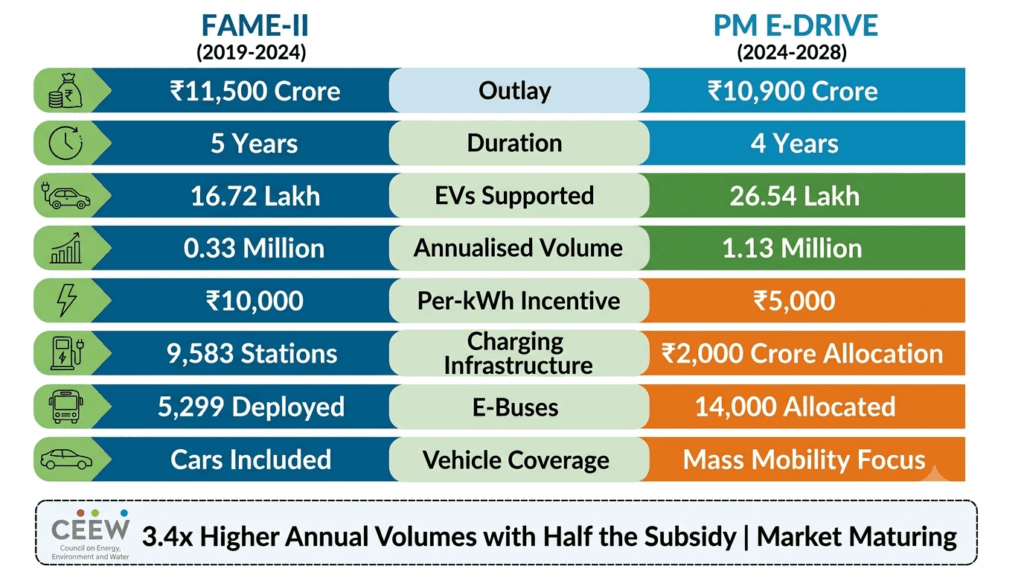
The results have been striking. According to a study by the Council on Energy, Environment and Water (CEEW), PM E-DRIVE achieved an annualised sales volume of 11.3 lakh electric vehicles, more than three times the 3.3 lakh vehicles recorded under FAME-II. This was accomplished even as the per-unit incentive was halved from ₹10,000 per kWh under FAME-II to ₹5,000 per kWh under PM E-DRIVE.
As of July 22, 2026, the PM E-DRIVE scheme has supported the sale of 26.54 lakh electric vehicles. FAME-II supported 16.72 lakh EVs over its five-year period. The data suggests that India’s EV market is maturing, with demand rising even as government support per vehicle declines.
This guide on FAME-II to PM E-DRIVE: India’s evolving EV subsidy landscape provides the complete, honest comparison. It covers the design and objectives of both schemes, the incentive structures, the impact on EV sales, the state-wise adoption patterns, the charging infrastructure components, and what this evolution means for India’s EV future.
The Two Schemes: Design and Objectives
FAME-II: Building the Foundation
The structure:
The Faster Adoption and Manufacturing of (Hybrid &) Electric Vehicles in India (FAME India) Scheme Phase-II was implemented for five years from April 1, 2019, to March 31, 2024, with a total budgetary outlay of ₹11,500 crore. The scheme provided demand incentives for electric two-wheelers, three-wheelers, and four-wheelers, along with grants for electric buses and the setting up of EV public charging stations.
The approach:
FAME-II cast a wider net, including private passenger cars in its coverage. It was designed to activate the market, build consumer awareness, and establish the initial charging infrastructure. The scheme was critical in establishing India’s EV market, creating the foundation on which subsequent policies could build.
The outcomes:
FAME-II concluded with 16.72 lakh EVs supported across e-2Ws, e-3Ws, and e-4Ws. It deployed 5,299 electric buses and installed 9,583 public charging stations nationwide. Under FAME-I, 2.80 lakh EVs were supported.
PM E-DRIVE: Scaling with Efficiency
The structure:
The PM Electric Drive Revolution in Innovative Vehicle Enhancement (PM E-DRIVE) scheme is being implemented from April 1, 2024, to March 31, 2028. Its original outlay was ₹10,900 crore, which was subsequently increased to ₹11,900 crore when the scheme was extended to March 2028.
The approach:
PM E-DRIVE deliberately shifts focus toward mass mobility, covering electric two-wheelers, three-wheelers, buses, ambulances, and trucks. It moves beyond private passenger cars to prioritise vehicles that serve broader public and commercial transportation needs. The scheme also includes a dedicated ₹2,000 crore allocation for public EV charging infrastructure.
The outcomes:
As of July 22, 2026, PM E-DRIVE has supported the sale of 26.54 lakh EVs. This includes 23.79 lakh electric two-wheelers, 2.68 lakh electric three-wheelers in the L5 category, 6,547 e-rickshaws and e-carts, and 55 electric trucks. The scheme has allocated 14,000 e-buses. An overall allocation of ₹10,900 crore has been made, of which ₹2,322 crore had been released and utilised as of July 22, 2026.
The key distinction:
As CEEW noted, the transition from FAME-II to PM E-DRIVE represents an important inflection point in India’s EV policy. Delivering higher volumes with lower incentives shows that some market segments are beginning to scale independently.
The Incentive Structure: Lower Subsidies, Higher Volumes
Comparing the Per-Vehicle Support
FAME-II incentives:
Under FAME-II, the demand incentive for electric two-wheelers and three-wheelers was ₹10,000 per kilowatt-hour. The scheme provided upfront reduction in purchase price, making EVs more affordable for consumers.
PM E-DRIVE incentives:
Under PM E-DRIVE, the incentive was halved to ₹5,000 per kWh in FY 2024-25, and reduced further to ₹2,500 per kWh for FY 2025-26 onwards. For electric two-wheelers, the incentive is capped at ₹5,000 per vehicle from FY 2025-26. For registered e-rickshaws and e-carts, the incentive is capped at ₹12,500 per vehicle. For L5 category three-wheelers, the cap is ₹25,000 per vehicle.
The e-bus and e-truck incentives:
PM E-DRIVE provides specific incentives for electric buses and trucks. Electric buses receive ₹10,000 per kWh, capped at 20% of the cost of the vehicle, with a maximum of ₹35 lakh per e-bus for buses between 10 and 12 metres in length. Electric trucks receive ₹5,000 per kWh, capped at 10% of ex-factory price, with the maximum incentive varying by gross vehicle weight from ₹2.7 lakh for trucks between 3.5 and 7.5 tonnes to ₹9.6 lakh for trucks between 18.5 and 35 tonnes.
The e-ambulance incentive:
Electric ambulances receive ₹30,000 per kWh, capped at 35% of ex-factory price. This reflects the scheme’s focus on essential public services.
The efficiency argument:
The CEEW study found that despite halving the per-unit demand incentive, PM E-DRIVE enabled 3.4 times higher annual EV volumes than FAME-II. This rapid growth with fewer subsidies shows that India’s EV space is maturing, resilient, and ready for long-term integration into the economy.
The Impact on EV Sales: From 3.3 Lakh to 11.3 Lakh Annually
How the Market Responded
The annualised comparison:
FAME-II was implemented over five years with a total outlay of ₹11,500 crore. During this period, the scheme supported around 15.6 lakh vehicles, translating into an annualised volume of 0.33 million units. PM E-DRIVE, in its first year, delivered 1.13 million EVs with half the per-vehicle subsidy.
The sales composition shift:
Under FAME-II, electric three-wheelers, particularly e-rickshaws, dominated the market in the early years. By FY25, electric two-wheelers had emerged as the largest segment with over 1.15 million units sold under PM E-DRIVE. This transition signals a move from informal and commercial use towards broader household and enterprise uptake.
Commercial electric four-wheelers also saw a clear uptick by FY25, pointing to growing fleet electrification in urban logistics and shared mobility. Electric buses, though still a small share, showed steady growth, signalling early institutional adoption.
The FY25 performance:
India’s EV sales grew fifteen-fold since FY20, rising from just over 2,000 units in FY15 to around 1.96 million units in FY25, taking overall EV penetration to 7.49%.
The PLI scheme contribution:
Around 21.30 lakh EVs were sold under the Production Linked Incentive (PLI) scheme for auto and auto components as of March 31, 2026. The PLI scheme has 71 approved applicants, with investments of ₹39,081 crore as of December 31, 2025.
The broader policy framework:
The Centre’s EV policy goes beyond purchase incentives. The GST on electric vehicles and their chargers/charging stations has been reduced to 5%. Green licence plates for battery-operated vehicles are exempt from permit requirements. These structural measures complement the demand-side incentives provided under FAME-II and PM E-DRIVE.
State-Wise Adoption: Uneven but Broadening
The Pattern of EV Uptake Across India
Maharashtra leads:
Maharashtra recorded the highest number of EVs supported under PM E-DRIVE at 4.28 lakh, followed by Uttar Pradesh at 2.78 lakh and Karnataka at 2.67 lakh. Tamil Nadu and Madhya Pradesh followed with 2.59 lakh and 1.73 lakh EVs, respectively.
Karnataka’s dual performance:
Karnataka accounted for 2.58 lakh EVs supported and 1,221 e-buses under FAME-II. Under PM E-DRIVE, the state received approval for the largest number of chargers at 1,571, with ₹153.10 crore approved for their deployment.
The income divide:
The CEEW study pointed out significant differences in EV adoption across states. Higher-income states such as Delhi, Goa, and Karnataka have shown more diversified adoption across electric cars, buses, and two-wheelers. In contrast, lower-income states such as Bihar and Tripura remain heavily reliant on electric three-wheelers, which account for over 52% of EV penetration in these regions.
The e-two-wheeler penetration gap:
E-two-wheeler penetration in higher-income states is nearly five times higher than in lower-income states. This reflects the role of income, infrastructure, and consumer awareness in driving adoption.
The policy implication:
As CEEW recommended, the next phase of India’s EV transition will depend on clear, consistent policy signals. Formalising a national 2030 EV target, aligning state-level goals, improving data transparency, and recalibrating incentives based on actual uptake are critical to ensuring adoption expands beyond a few segments and states.
The Charging Infrastructure Component
Building the Network That Supports EV Adoption
FAME-II charging infrastructure:
Under FAME-II, 9,583 EV public charging stations were installed nationwide. The scheme allocated ₹912.50 crore for setting up EV public charging stations across the country.
PM E-DRIVE charging infrastructure:
PM E-DRIVE has allocated ₹2,000 crore for supporting EV public charging stations in cities and along highways on a pan-India basis. As of July 22, 2026, proposals for 5,871 EV chargers across nine states had been approved. Karnataka received approval for the largest number at 1,571 chargers, followed by Delhi with 1,146 and Rajasthan with 805. Separately, 691 chargers of three oil marketing companies have also been approved.
The deployment gap:
However, no chargers had been installed under PM E-DRIVE as of July 22, 2026. The charging infrastructure component remains at the approval and deployment stage. This represents a significant gap between approvals and actual deployment.
The operational guidelines:
Operational guidelines for the deployment of EV public charging stations under PM E-DRIVE have been issued. Battery swapping or charging stations set up at any location are eligible for 80% support on upstream costs, reflecting the policy’s recognition of battery swapping as a complementary infrastructure solution.
The overall charger count:
India had 67,657 EV chargers across states and union territories as of August 7, 2026, including 1,139 battery-swapping station chargers.
The E-Bus Programme: A Key Differentiator
How Both Schemes Supported Public Transport Electrification
FAME-II e-bus deployment:
Under FAME-II, 6,862 e-buses were sanctioned, with 5,299 electric buses deployed as of July 31, 2026. Karnataka accounted for 1,221 e-buses, while Maharashtra recorded 830 e-buses.
PM E-DRIVE e-bus allocation:
Under PM E-DRIVE, support is available for deployment of 14,028 e-buses in nine cities with a population of four million or more: Mumbai, Delhi, Bengaluru, Hyderabad, Ahmedabad, Chennai, Kolkata, Surat, and Pune. As of March 10, 2026, 13,800 e-buses had been allocated.
The city-wise allocation:
Bengaluru received the largest allocation at 4,500 e-buses, followed by Delhi at 2,800, Hyderabad at 2,200, Mumbai at 1,500, Ahmedabad at 1,200, Pune at 1,000, and Surat at 600. No proposals were received from Chennai and Kolkata under the scheme.
The PM e-Bus Sewa scheme:
Tier-2 and Tier-3 cities are being covered under the PM e-Bus Sewa Scheme implemented by the Ministry of Housing and Urban Affairs for deployment of 10,000 electric buses. As of July 10, 2026, the PM-eBus Sewa-Payment Security Mechanism Scheme covered 27,555 electric buses.
The deployment status:
As of March 12, 2026, no e-buses had been deployed under PM E-DRIVE. The tender for Phase-I (10,900 e-buses) has been concluded and the tender for Phase-II (2,900 e-buses) has been floated. Deployment will be undertaken by State Transport Undertakings after signing concession agreements and receiving buses from manufacturers.
What This Means for India’s EV Future
The Honest Assessment
The market is maturing:
The shift from FAME-II to PM E-DRIVE demonstrates that India’s EV market is maturing. Delivering 1.13 million EVs with lower per-unit incentives shows that parts of the market are beginning to stand on their own. The reduction in per-vehicle subsidy was absorbed by the market, with volumes increasing rather than declining.
The focus has shifted:
PM E-DRIVE deliberately shifts focus toward mass mobility, covering electric two-wheelers, three-wheelers, buses, ambulances, and trucks. This represents a broader policy focus that prioritises vehicles serving public and commercial transportation needs over private passenger cars.
The charging infrastructure gap:
While both schemes allocated significant funds for charging infrastructure, the deployment of approved chargers under PM E-DRIVE has not yet begun. This represents a risk to the scheme’s overall impact, as charging infrastructure is essential for sustaining EV adoption growth.
The state-wise variation:
Adoption remains uneven across states. Higher-income states and union territories show diversified adoption, while lower-income states remain concentrated in specific segments. Policy coordination and infrastructure readiness will be critical to ensuring a balanced and inclusive transition.
The honest verdict:
The evolution from FAME-II to PM E-DRIVE represents a successful transition from market activation to market consolidation. The foundation established by FAME-II enabled PM E-DRIVE to achieve higher volumes with lower subsidies. The challenge ahead is to ensure that this growth continues, particularly in segments and states that have not yet experienced significant EV adoption. The next phase will depend on clear, consistent policy signals, improved infrastructure, and targeted interventions.
Internal Links: Further Reading on Clean Energy Bazaar
The FAME-II to PM E-DRIVE: India’s evolving EV subsidy landscape guide connects to the EV market and policy guides on cleanenergybazaar.com.
For the India EV charging network guide covering the 67,657 chargers installed nationwide, our India’s EV charging network expands to 67,657 chargers: what it means for EV adoption guide covers the infrastructure that both schemes supported. For the Delhi EV Policy 2026 guide covering the dealership charging mandate, our Delhi’s new EV policy 2026: mandatory charging stations at dealerships and new rules guide covers the state-level policy framework. For the battery swapping guide covering the Indofast Energy and GLIDA partnership, our battery swapping gains traction in India: Indofast Energy and GLIDA’s 100-station expansion guide covers the battery swapping ecosystem that PM E-DRIVE supports. For the India EV sales boom guide covering the record H1 2026 sales, our India’s EV sales boom: crossing 11% market share and 79% growth in H1 2026 guide covers the market growth that these schemes have enabled.
Final Thoughts
FAME-II to PM E-DRIVE: India’s evolving EV subsidy landscape — and the data confirms that India’s EV subsidy framework has successfully transitioned from market activation to market consolidation.
FAME-II, with its ₹11,500 crore outlay over five years, supported 16.72 lakh EVs and installed 9,583 charging stations. It established the foundation of India’s EV market. PM E-DRIVE, with its ₹10,900 crore allocation (later increased to ₹11,900 crore), has already supported 26.54 lakh EVs, more than tripling the annualised volume despite halving the per-vehicle subsidy.
The shift in approach is deliberate. PM E-DRIVE focuses on mass mobility, covering two-wheelers, three-wheelers, buses, ambulances, and trucks. It moves beyond private passenger cars to prioritise vehicles that serve broader public and commercial transportation needs. The scheme’s ₹2,000 crore allocation for charging infrastructure and its 80% upstream cost support for battery swapping reflect a comprehensive approach to building the EV ecosystem.
The challenges are real. Charging infrastructure deployment under PM E-DRIVE has not yet begun. Adoption remains uneven across states. Lower-income states remain concentrated in specific vehicle segments. The next phase of India’s EV transition will depend on clear, consistent policy signals and targeted interventions to ensure inclusive growth.
The honest verdict: the evolution from FAME-II to PM E-DRIVE represents a significant achievement in India’s EV policy. The market is maturing, demand is rising, and government support per vehicle is declining. For today’s EV buyers, the incentive structure is less generous than it was under FAME-II, but the market is more competitive, the product range is wider, and the charging infrastructure is improving. The foundation has been built. The next phase is about scaling it.