The global electric vehicle transition has entered a new phase. While headlines focus on policy reversals in the United States and slowing growth in Europe, a different story is unfolding across the Global South. Emerging markets are no longer catching up in EV adoption. They are leading the shift.
In 2025, Southeast Asia saw one of the world’s largest increases in electric car deployment, with sales more than doubling year-on-year to more than half a million vehicles. In Latin America, EV sales climbed 75%, led by record growth in Brazil and Mexico. More than 100 countries reported growth in electric vehicle sales during 2025, and in one-third of these, EVs already account for at least 10% of new car sales.
This guide on emerging market EV explosion: Southeast Asia doubles sales, LatAm grows 75% provides the complete, honest analysis. It covers the data behind the surge, the countries leading the charge, the policy frameworks enabling adoption, the role of Chinese manufacturers and affordable models, the challenges that remain, and what this means for the future of global electric mobility.
The Global Context: A Tipping Point for Emerging Markets
One in Four Cars Sold Globally Was Electric in 2025
Global electric car sales grew 20% in 2025, surpassing the 20 million unit mark for the first time. By the end of the year, one out of every four new cars sold globally was electric. More than 100 countries recorded growth in EV sales during 2025, and in one-third of these countries, EVs represented at least 10% of new car sales — a threshold many analysts consider the tipping point toward mass adoption.
The global EV fleet avoided the consumption of approximately 1.7 million barrels of oil per day in 2025. Electric cars displaced about 1.7 million barrels per day, up from 0.4 million barrels per day in 2020.
The momentum was not limited to developed nations. The International Energy Agency’s Global EV Outlook 2026 reported that emerging markets across Southeast Asia, Latin America, and India recorded some of the fastest growth rates in the world. The energy crisis resulting from the conflict in the Middle East, which sent oil prices above $100 per barrel, has highlighted oil dependence and accelerated this shift.
As the Ember energy think tank noted: “Emerging markets are no longer catching up; they are leading the shift to electric mobility.” These countries see the strategic advantages of EVs, from cleaner air to reduced fossil fuel imports.
Southeast Asia: Sales More Than Double
Vietnam Leads with Nearly 40% Market Share
Southeast Asia delivered one of the most dramatic EV transitions in 2025. Sales more than doubled year-on-year to more than half a million vehicles, reaching approximately 15% of new car sales. The first quarter of 2026 saw an 80% increase compared with the same period a year earlier, indicating that momentum is accelerating.
Vietnam: The Regional Standout
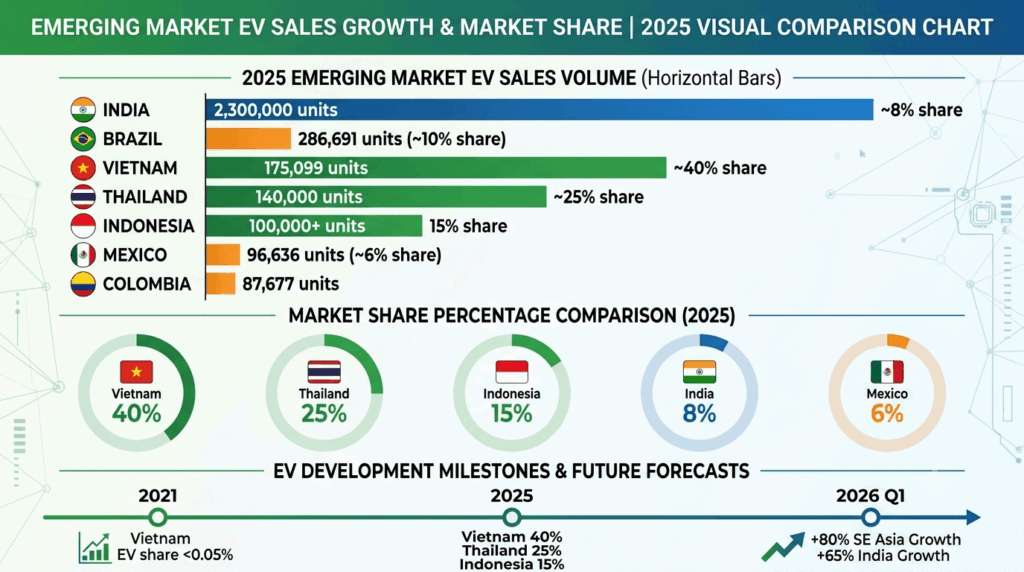
Vietnam emerged as Southeast Asia’s largest electric car market, with nearly 40% of new car sales being electric. This places Vietnam above levels seen in most European countries, including the United Kingdom and the European Union average. Electric car sales in Vietnam more than doubled in 2025.
The domestic EV maker VinFast captured nearly the entire market, delivering 175,099 electric vehicles in 2025, a record for the Vietnamese automotive industry. VinFast’s small affordable models, the VF3 and VF5, have been key enablers of mass-market adoption. The price competitiveness of these models helped them outsell conventional rivals in similar size segments. Policy support has primarily been provided through registration fee exemptions for BEVs since 2022.
Thailand: 70% Growth, 140,000 Sales
In Thailand, electric car sales increased by 70% from 2024 levels, reaching roughly 140,000 units, nearly one-quarter of total new car sales. Thailand represented the second-largest electric car market in the region.
The EV3.5 scheme that came into force in January 2024 continued to boost adoption through purchase subsidies, excise tax breaks, and import duty reliefs. The earlier EV3.0 scheme drove an increase in Thai-made electric car sales by requiring manufacturers to register their domestic electric car production before January 2026 in exchange for import duty exemptions. Thai-made electric cars represented 20% of the market in 2025, up from about 5% the year before. Despite policy settings shifting to support domestic production, Chinese-made electric cars still represented three-quarters of the Thai market in 2025.
Indonesia: Sales More Than Double to 15% Share
In Indonesia, electric car sales more than doubled in 2025, reaching 15% of new car sales. Key policy support measures were VAT and import duty exemptions for battery electric cars. In anticipation of the tariff exemption for battery electric car imports coming to an end in December 2025, manufacturers ramped up imports towards the end of the year, resulting in about half of 2025 sales taking place in the last quarter.
About 75% of 2025 sales were imports from China, while the rest were cars produced domestically by Chinese carmakers, mostly by Wuling, supported by a wide range of manufacturing incentives. Indonesia’s EV market grew 49% in 2025, making up 18% of all new vehicle sales, according to PwC’s ASEAN-6 Electric Vehicle Readiness Survey 2025.
Malaysia and the Philippines
While electric car sales also doubled in Malaysia in 2025, uptake was lower than in other neighbouring markets, with the share of electric cars in new car sales standing at about 7%. Malaysia’s largest car market has been supporting electric car adoption primarily through excise tax and import duty exemptions, resulting in Chinese imports accounting for as much as 80% of the market in 2025.
Electric car sales leapt up in the Philippines in 2025, reaching almost 10% of new car sales, up from a negligible level the year before. Policy support takes the form of excise tax relief and import duty exemptions for electric cars. Chinese imports, particularly from BYD, made up most of the country’s electric car sales in 2025.
Southeast Asia EV Sales Summary (2025)
| Country | EV Sales | Market Share | Key Driver |
|---|---|---|---|
| Vietnam | ~175,000 | ~40% | VinFast, registration fee exemptions |
| Thailand | ~140,000 | ~25% | EV3.5 subsidies, excise tax breaks |
| Indonesia | ~100,000+ | 15% | VAT and import duty exemptions |
| Malaysia | ~50,000+ | ~7% | Excise tax and import duty exemptions |
| Philippines | ~30,000+ | ~10% | Excise tax relief, import duty exemptions |
Latin America: 75% Growth Led by Brazil and Mexico
Record Growth Far Exceeding Mature Markets
Latin America saw record growth in the adoption of electrified vehicles during 2025, with a 75% increase in sales led by the dynamism of the Brazilian and Mexican markets. This performance far exceeds the growth recorded in mature economies like the United States, where electric car sales remained relatively flat.
Brazil: 286,691 Electrified Vehicles Sold
Brazil led the Latin American market with 286,691 electrified vehicles sold in 2025, a figure that exceeds the previous year’s sales by more than 108,000 units. The broader electrified market, including hybrids, showed even greater dynamism. Sales of electrified vehicles in Brazil grew 61% in 2025.
BYD was a dominant force in the Brazilian market, selling half of all new electric and hybrid cars in the country in 2025. The company’s affordable models have made EVs accessible to a broader range of consumers.
Mexico: 96,636 Electrified Vehicles, 38.5% Growth
Mexico had an outstanding performance in 2025. Sales of electrified vehicles, including battery electric, plug-in hybrid, and range-extended vehicles, grew 38.5% during 2025, reaching 96,636 units sold, bringing Mexico close to the 100,000 electrified vehicles sold in a single year milestone.
The market share of these vehicles in Mexico already exceeds 6% of total sales. The country’s charging network reached 56,726 ports, a 26% annual increase. The Electro Mobility Association, made up of more than 24 ecosystem companies including BYD, Tesla, JAC, Volvo, and Zeekr, has been instrumental in tracking and promoting the market’s growth.
Colombia: The Third-Largest Market
Colombia emerged as the third-largest EV market in Latin America, reaching 87,677 units sold and an expansion of 69%. The country’s growth reflects the broader regional trend of accelerating electrification.
Latin America EV Sales Summary (2025)
| Country | Electrified Vehicle Sales | Growth | Market Share |
|---|---|---|---|
| Brazil | 286,691 | ~61% | ~10% |
| Mexico | 96,636 | 38.5% | ~6% |
| Colombia | 87,677 | 69% | – |
India: The Sleeping Giant Awakens
2.3 Million EVs Sold, 75% Growth
India’s EV market reached a significant milestone in 2025. The country sold a record 2.3 million electric vehicles, representing growth of over 75%. Electric vehicles accounted for approximately 8% of all new vehicle registrations.
In the passenger car segment specifically, EV sales rose 75% year-on-year to reach about 165,000 units, representing nearly 4% of total car sales. The ICCT reported that around 202,000 electric vehicles were sold in India in 2025, over 99% of which were battery-electric vehicles.
India is the world’s largest electric three-wheeler market for the third year in a row. Momentum in electric three-wheeler sales continued to build, with sales rising 15% from 2024 to almost 800,000 vehicles.
The Indian government’s PM E-DRIVE scheme has supported the sale of 26.54 lakh electric vehicles as of July 2026. The scheme focuses on mass mobility, covering electric two-wheelers, three-wheelers, buses, ambulances, and trucks. India’s EV sales in the first half of 2026 rose 79% year-on-year to 148,023 units, with EVs crossing 11% retail market share for the first time in May 2026.
Why Emerging Markets Are Leading
Policy, Price, and Strategic Advantage
Supportive government policies. Emerging markets have introduced a range of fiscal and non-fiscal incentives to accelerate EV adoption. Vietnam provides registration fee exemptions for BEVs. Thailand’s EV3.5 scheme offers purchase subsidies, excise tax breaks, and import duty reliefs. Indonesia provides VAT and import duty exemptions. Brazil, Mexico, and India have all implemented targeted policies to reduce the cost of EV ownership.
Affordable Chinese models. The availability of cost-competitive Chinese EVs has been a critical enabler. In Thailand, Chinese-made electric cars represented three-quarters of the market in 2025. In Indonesia, about 75% of 2025 sales were imports from China. In Malaysia, Chinese imports accounted for as much as 80% of the market. BYD sold half of all new electric and hybrid cars in Brazil in 2025.
The energy crisis as catalyst. The conflict in the Middle East, which sent oil prices above $100 per barrel, highlighted the vulnerability of oil-importing nations. For countries in Southeast Asia and Latin America, reducing oil dependence is both an economic and strategic priority. The global EV fleet avoided the consumption of approximately 1.7 million barrels of oil per day in 2025.
Domestic manufacturing ambitions. Countries are not simply importing EVs; they are building domestic industries. Thailand’s EV3.0 scheme drove Thai-made electric car sales from 5% of the market in 2024 to 20% in 2025. VinFast has made Vietnam a manufacturing hub, delivering 175,099 vehicles in 2025. Indonesia is shifting its focus towards local production as import tariff exemptions come to an end.
Leapfrogging legacy infrastructure. Unlike mature markets that must transition from extensive internal combustion infrastructure, emerging markets can leapfrog directly to electric mobility. Vietnam went from less than 0.05% EV sales share in 2021 to nearly 40% in 2025. Thailand reached 20% market share, surpassing EU frontrunner Denmark in the first 10 months of 2025. Indonesia’s EV share of 15% topped the United States for the first time.
The Challenges: What Could Slow the Momentum
Infrastructure, Policy Consistency, and Affordability
Charging infrastructure gaps. While charging networks are expanding, they remain uneven. Mexico reached 56,726 ports, a 26% annual increase, but coverage in other markets remains limited. For EVs to achieve widespread adoption, robust charging infrastructure is essential, particularly for consumers without access to home charging.
Policy uncertainty. The rapid growth in emerging markets has been driven by supportive policies. If these policies are withdrawn or scaled back, adoption could slow. Indonesia’s experience with electric motorcycle subsidies is instructive: when support was withdrawn in 2025, electric motorcycle sales declined 29%. The country later announced fresh incentives of around $173 per electric motorcycle in August 2026.
Affordability barriers. While Chinese EVs have lowered the entry point, EVs remain more expensive than conventional vehicles in many emerging markets. Financing constraints and limited access to credit continue to hinder adoption, particularly among lower-income consumers.
Supply chain concentration. The dominance of Chinese manufacturers in emerging market EV sales creates a dependency that could become a vulnerability. If trade policies shift or supply chains are disrupted, these markets could face challenges in maintaining momentum.
The slowdown in new policy adoption. Between September 2024 and August 2025, no new major supply-side regulations were adopted globally, compared with seven new major regulations in the prior year. While a robust pipeline of policies is under development in emerging markets like Vietnam, Thailand, Mexico, and India, the pace of new policy adoption has slowed.
The Outlook: What Comes Next
Continued Growth and Structural Shifts
The IEA anticipates that during 2026, around 23 million electric vehicles will be sold worldwide, representing nearly 30% of all new car sales. The momentum in emerging markets is expected to continue.
In Southeast Asia, the first quarter of 2026 saw an 80% increase in EV sales compared with the same period a year earlier. In India, EV sales between January and April 2026 jumped 65% to over 86,000 units, already 44% of the record 195,179 e-PVs sold in CY2025.
In Latin America, Brazil is projected to continue its upward trend with a projected growth of 45% during 2026.
The structural shift is clear. As the ADB’s SEADS noted: “The assumption that EV growth will stall outside Europe and China is already outdated.” Emerging markets will shape the future of the global car market. The choices made now on charging infrastructure and early support will determine how fast this momentum continues.
The honest verdict: The emerging market EV explosion is real, and it is accelerating. Southeast Asia’s sales more than doubled in 2025. Latin America grew 75%. India sold 2.3 million EVs. These are not marginal developments. They represent a fundamental shift in the geography of electric mobility. While mature markets grapple with policy uncertainty and slowing growth, emerging markets are embracing EVs as a strategic imperative. The Global South is no longer following. It is leading.