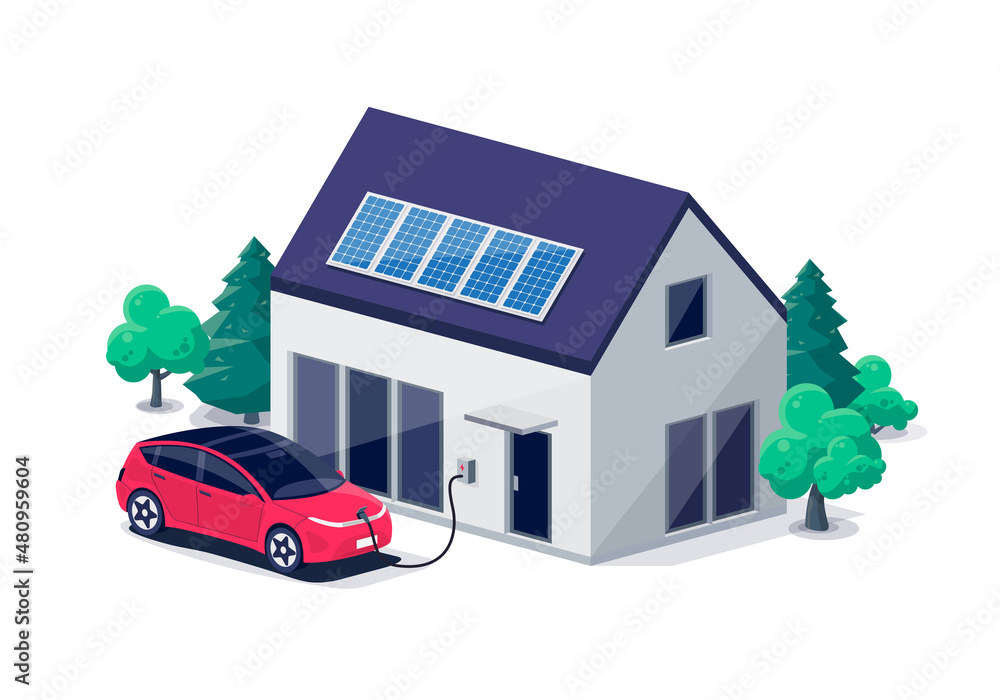
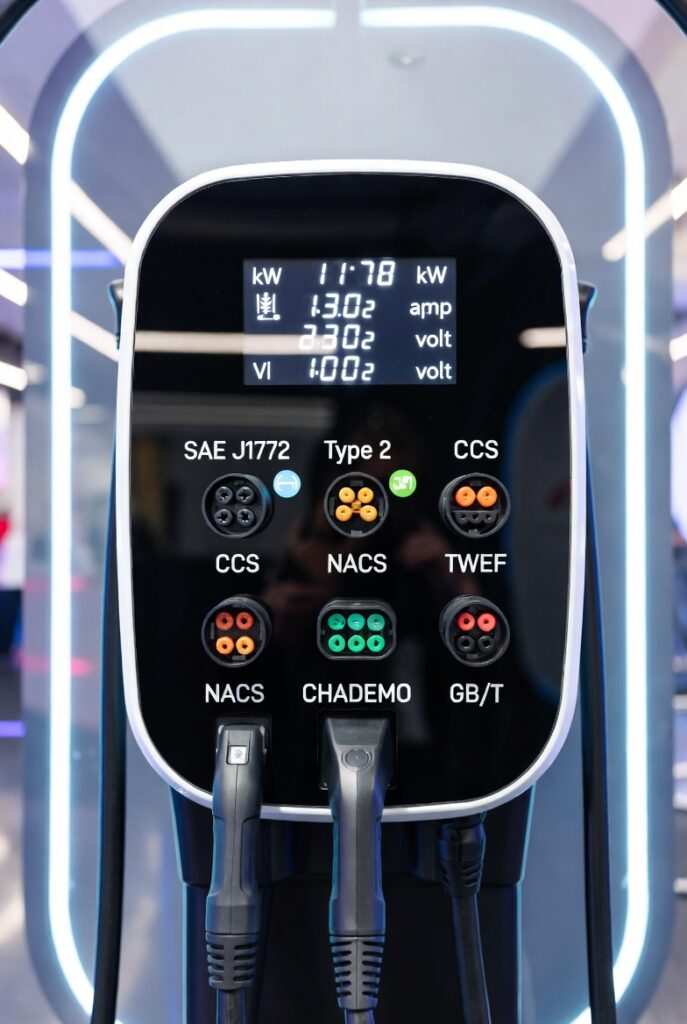
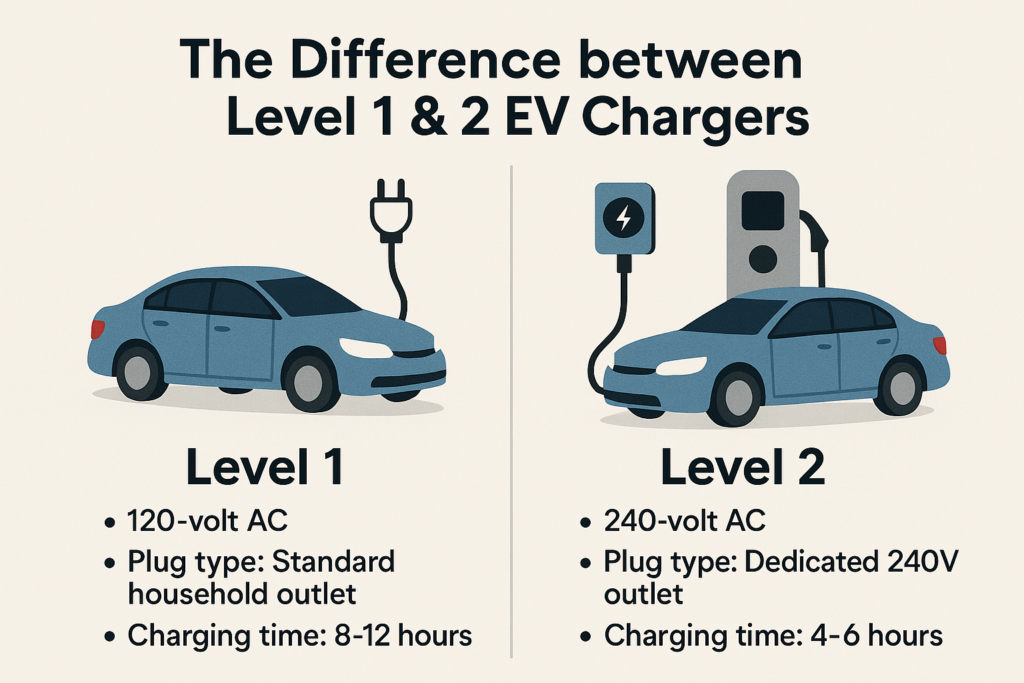
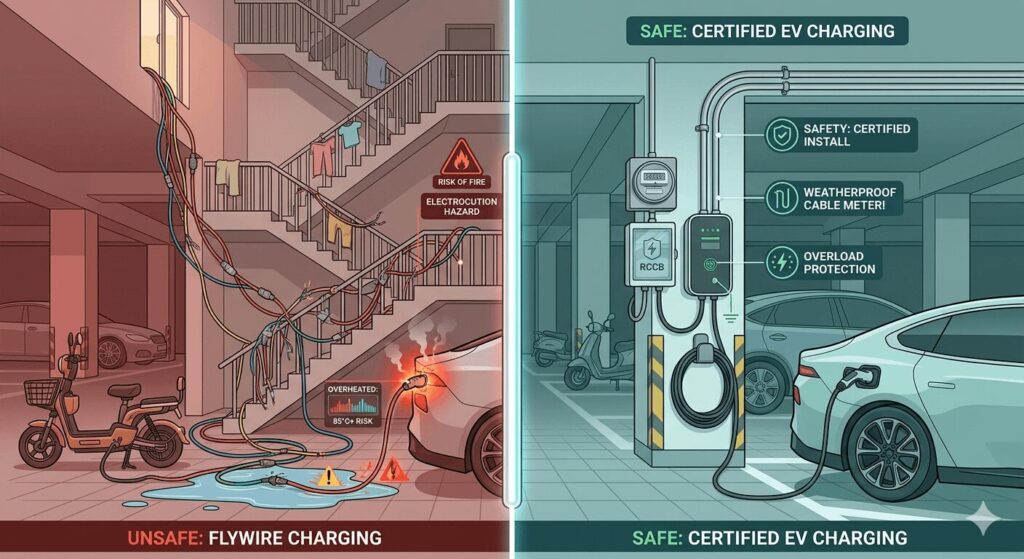
Walk through almost any older Chinese residential compound’s basement or ground-level car park and you will see it: a cable running from a window or balcony several floors up, descending through open air or along a building exterior, terminating at a parking space where an electric vehicle is plugged in. Sometimes the cable is neatly bundled and labelled. More often it is a tangle of extension cords, joined with electrical tape, running across walkways, draped over railings, occasionally submerged in puddles after rain.
This is 飞线充电 — literally “flying wire charging,” commonly translated as “flywire charging” in English-language discussion of the practice. It describes any EV charging setup where electricity is run from an apartment or building supply point to a parking space through unofficial, unpermitted cable routing — bypassing the formal dedicated meter and licensed electrician installation process covered throughout this guide series.
Flywire charging exists because the formal process — 物业 approval, State Grid meter application, licensed electrician installation — is sometimes genuinely unavailable, excessively slow, or financially difficult for specific Chinese EV owners. For residents in older compounds without dedicated parking, residents whose 物业 has refused applications, or residents facing months-long waiting periods, flywire charging looks like the only practical option.
This guide on China apartment flywire charging is it safe legal solutions for lower ground parking provides the complete, honest assessment: what flywire charging actually is, the specific safety risks (not exaggerated, not dismissed), the legal status under Chinese regulations, the real fire incident data, and — most usefully — the legitimate alternative solutions that achieve similar practical outcomes without the safety and legal exposure that flywire charging creates.
What Flywire Charging Actually Is
The Defining Characteristics
Flywire charging (飞线充电) is not a single specific setup — it is a category of unofficial charging arrangements sharing common characteristics:
Characteristic 1: No dedicated electrical circuit
The electricity comes from an existing household circuit — typically run through a window, balcony door, or external wall penetration — rather than a purpose-built dedicated EV charging circuit with its own meter and protection devices.
Characteristic 2: Extended cable runs through non-designed pathways
The cable travels through spaces not designed for electrical cable routing — along building exteriors, through stairwells, across walkways, sometimes spanning multiple floors via window-to-window or balcony-to-ground routing.
Characteristic 3: Absence of formal approval
No 物业 application was submitted or approved. No State Grid dedicated meter assessment occurred. No licensed electrician certified the installation.
Characteristic 4: Use of standard domestic cable and connectors
The cable used is typically standard domestic extension cord, sometimes multiple extension cords joined together, rather than purpose-built EV charging cable rated for sustained high current.
The Range of Flywire Setups
Flywire charging exists on a spectrum from minimally risky to severely dangerous:
Lower-risk end of the spectrum:
A resident on the ground floor runs a single, good-quality, purpose-rated extension cable (16A rated, weatherproof, single continuous length) from their own apartment’s socket directly to their vehicle parked immediately outside, a distance of 5-8 metres, used occasionally rather than nightly.
Higher-risk end of the spectrum:
A resident on the 6th floor runs a cable down through a stairwell window, joined with two or three standard household extension cords of unknown rating, draped across a fire escape route, terminating at a basement parking space 40+ metres away, used for nightly 8-hour charging sessions, with the joins exposed to weather.
The critical point: Most flywire setups documented in Chinese media coverage and 物业 complaints are closer to the higher-risk end. The setups that generate fire incidents, 物业 complaints, and regulatory crackdowns are characteristically long-distance, multi-cable-join, unprotected installations used for sustained nightly charging.
The Safety Reality — What Actually Goes Wrong
The Specific Failure Mechanisms
Understanding precisely how flywire charging causes fires and electrical hazards — rather than treating “it’s dangerous” as a vague warning — helps clarify which specific elements create risk.
Failure Mechanism 1: Cumulative Resistance Heating in Joined Cables
Standard domestic extension cords have connector joints rated for their designed current — typically 10A intermittent use. When multiple extension cords are joined to span a longer distance (a common flywire characteristic), each joint becomes a point of increased electrical resistance.
The physics: Electrical resistance generates heat proportional to current squared multiplied by resistance (P = I²R). A loose or corroded joint has higher resistance than a continuous cable. At sustained 8-10A current over a 6-8 hour overnight charging session, even moderate resistance at a joint generates continuous heat.
The progression: A joint that is marginally loose generates heat. Heat causes thermal expansion of the metal contacts, which can loosen the joint further. The loosened joint has higher resistance, generating more heat. This is a self-reinforcing cycle that, left unaddressed over weeks or months of nightly use, can reach temperatures sufficient to ignite the cable’s plastic insulation or surrounding combustible material.
Failure Mechanism 2: Undersized Cable for Sustained Current
Standard Chinese domestic extension cords typically use 0.75mm² to 1.0mm² conductor cross-section — adequate for intermittent loads like a kettle or vacuum cleaner used for minutes at a time, inadequate for 6-8 hours of continuous 10A+ EV charging current.
The specific risk: At 10A continuous current through 0.75mm² copper conductor, the cable’s safe continuous current rating is exceeded. The cable’s PVC insulation, rated for a maximum continuous operating temperature, can exceed this rating over a sustained charging session — particularly when the cable is coiled (reducing heat dissipation) or covered (preventing airflow).
Failure Mechanism 3: Absence of RCCB/RCD Protection
The dedicated EV charging circuit installation process — covered throughout this guide series — mandates RCCB or RCD ground fault protection specifically because EV charging cables and connectors are handled in environments where moisture, ground contact, and physical damage create elevated risk of ground fault (current leaking to an unintended path, potentially through a person).
The flywire absence: Most flywire setups draw from a standard household socket that may have basic circuit-level RCD protection at the consumer unit (required in many Chinese building codes for general household circuits) but lacks the dedicated, EV-specific ground fault protection that a proper installation includes. In some older buildings, even basic RCD protection at the household level may be absent or non-functional.
Failure Mechanism 4: Weather Exposure
Cables routed through open-air pathways — down building exteriors, across uncovered walkways, through windows left ajar — are exposed to rain, humidity, and temperature cycling that indoor-rated domestic cable is not designed to withstand.
The specific risk: Water ingress into a cable joint or connector creates a conductive path that can cause short-circuit arcing — a high-temperature electrical discharge that can ignite nearby combustible material in milliseconds, independent of the gradual heating mechanisms above.
Failure Mechanism 5: Physical Damage from Routing Through Traffic Areas
Cables routed across walkways, through doorways, or near vehicle traffic areas are subject to physical stress — being stepped on, run over by other vehicles, caught in doors, or abraded against sharp edges over repeated use.
The specific risk: Physical damage to cable insulation exposes conductors. Combined with the sustained current of EV charging, exposed conductors create direct shock hazard to anyone who contacts the damaged section, and potential short-circuit fire risk if the exposed conductor contacts a grounded metal surface or another conductor.
The Documented Incident Record
What Chinese Fire and Safety Authorities Have Reported
Chinese fire departments and residential safety authorities have documented EV charging-related fire incidents with increasing frequency as EV adoption has grown — and flywire charging setups are disproportionately represented in these incidents relative to properly installed dedicated circuits.
The pattern in documented incidents:
Reports from Chinese fire safety bureaus (消防安全) in multiple cities have identified common characteristics in EV charging fire incidents:
- Disproportionate representation of unofficial cable routing (the flywire pattern) versus properly certified dedicated circuit installations
- Higher incidence in older residential compounds (老旧小区) where formal installation infrastructure is less available
- Correlation with extension cord daisy-chaining (multiple cords joined together)
- Correlation with cables routed through stairwells and fire escape routes — creating the dual hazard of fire risk and obstruction of emergency egress
Why this pattern exists:
The fires are not occurring because EV charging is inherently dangerous — millions of Chinese EV owners charge safely every night through properly installed dedicated circuits with certified hardware. The fires are concentrated in flywire setups because flywire setups specifically lack the safety features (proper cable rating, RCCB protection, weather protection, secure installation) that prevent the failure mechanisms described above.
The fire escape obstruction issue:
Beyond the direct fire risk from the cable itself, Chinese fire safety authorities have specifically flagged flywire cables routed through stairwells and building corridors as creating fire escape obstruction hazards — a cable strung across a stairwell landing becomes a trip hazard during an emergency evacuation, independent of whether the cable itself causes any electrical incident.
This is why many Chinese 物业 management companies and local fire safety bureaus have specifically targeted flywire charging for removal — not from generalised opposition to EV charging, but from specific concern about fire escape route obstruction and the documented fire risk pattern.
The Legal Status of Flywire Charging in China
Is Flywire Charging Illegal?
This question requires a nuanced answer because flywire charging intersects multiple Chinese regulatory frameworks — and the legal status depends on the specific characteristics of the setup.
Building and fire safety codes:
Chinese fire safety regulations (消防法) prohibit obstruction of fire escape routes and emergency egress paths. A flywire cable routed through a stairwell, corridor, or fire escape route is in direct violation of fire safety code — regardless of the electrical safety of the cable itself.
This is the clearest and most consistently enforced legal violation associated with flywire charging. Multiple Chinese cities have issued specific municipal notices prohibiting EV charging cables in stairwells and corridors, with fire safety bureaus empowered to require immediate removal and, in some cases, issue fines to the resident.
Building electrical safety codes:
Chinese electrical installation standards (GB 50303 and related codes) require that electrical installations affecting shared building infrastructure be performed by certified electricians. A flywire setup that taps into building electrical infrastructure without certified installation is technically non-compliant with these standards — though enforcement in practice varies significantly by city and by 物业 diligence.
物业 management regulations:
Most Chinese residential compound management regulations (物业管理条例), whether at the building-specific or municipal level, prohibit residents from making unauthorised modifications to shared building infrastructure or common areas. Running a cable through common corridors or building exteriors without 物业 authorisation violates these regulations in virtually every Chinese residential compound’s management rules.
Insurance implications:
This is the practical legal consequence that affects flywire charging users most directly, even when criminal or regulatory enforcement doesn’t occur. Chinese home and vehicle insurance policies typically include provisions excluding coverage for damage arising from illegal or unauthorised electrical installations. If a flywire charging setup causes a fire that damages the resident’s own property, neighbouring property, or the vehicle itself, the insurance claim may be denied on the grounds that the electrical installation was unauthorised and non-compliant with safety codes.
The honest legal summary:
Flywire charging that routes through fire escape routes (stairwells, corridors, designated emergency egress paths) is clearly illegal under Chinese fire safety regulations and subject to enforcement action. Flywire charging that doesn’t obstruct fire escape routes occupies a greyer legal area — technically non-compliant with electrical installation standards and almost certainly in violation of compound management regulations, but enforcement varies and prosecution for the electrical non-compliance alone is uncommon. The insurance exposure, however, applies regardless of whether direct legal enforcement occurs.
Why Chinese EV Owners Resort to Flywire Charging — Understanding the Root Causes
Before presenting alternatives, honestly acknowledging why flywire charging persists despite its risks is necessary — because the alternatives must address these root causes to be genuinely useful.
Root Cause 1: No Designated Parking Space
As covered extensively in our guide on charging without a fixed spot, a significant proportion of Chinese urban residents — particularly in pre-2000 residential compounds — lack designated parking. Without a designated space, the formal dedicated circuit installation process (which requires a specific space for the dedicated meter and charger) is not available through standard channels.
Root Cause 2: 物业 Refusal or Excessive Delay
Some 物业 management companies refuse EV charging applications outright, or create such extensive delay (6+ months, repeated documentation requests, unresponsive communication) that residents conclude the formal process is not viable.
Root Cause 3: Financial Constraint
The formal installation process costs ¥2,500-¥5,000 even after subsidies in many cases. For some Chinese EV owners — particularly those who have stretched their budget to purchase the vehicle itself — this additional cost feels prohibitive, especially when a flywire setup using equipment already owned (an extension cord, the vehicle’s included Mode 2 cable) appears to cost nothing.
Root Cause 4: Urgency
A new EV owner wants to charge their vehicle the day it arrives. The formal process takes weeks to months. Flywire charging provides an immediate, if unsafe, solution to this timing gap.
Root Cause 5: Lower Ground and Basement Parking Specific Challenges
This guide’s focus on lower ground parking reflects a specific sub-problem: basement and semi-basement parking levels in Chinese residential compounds frequently have the most limited electrical infrastructure of any parking type, combined with being furthest from any apartment’s own electrical supply — making flywire’s “run a cable from my apartment” approach seem like the only option when the basement itself has no charging infrastructure and no 物业-approved path to create it.
The Legal and Safe Alternatives for Lower Ground Parking
This is the section that matters most: legitimate solutions that address the same underlying problems that drive flywire charging, without the safety and legal exposure.
Alternative 1: The Proper Dedicated Circuit Application — Pursuing What Initially Seemed Unavailable
Re-examining the 物业 refusal:
As covered in our apartment rights guide, Chinese national and many municipal regulations establish a presumptive right to EV charging installation for residents with designated parking, subject only to safety-based objections that 物业 must substantiate. A 物业 refusal that doesn’t cite a specific, substantiated safety or capacity concern is often not a final answer — it can be escalated.
The escalation path:
- Request the refusal in writing with specific reasons
- If reasons are vague or unsubstantiated, request a formal meeting with documentation of the relevant municipal regulation supporting installation rights
- If refusal persists without substantiation, file a complaint through the 12345 government services hotline or the local housing authority
- For basement/lower ground parking specifically, request that the 物业 specify exactly what infrastructure limitation prevents installation — this often reveals that a collective infrastructure upgrade (addressed in Alternative 3) is the actual solution rather than a permanent refusal
Alternative 2: The Legitimate Extension Cable Solution — For Genuine Short-Distance Cases
For residents whose actual situation is a short distance between an authorised socket (their own ground-floor apartment, or a 物业-sanctioned access point) and their parking space — not the long, multi-floor flywire routing that creates the most severe risks — a properly specified, certified extension solution exists within the legitimate product category covered in our DIY charging guide.
The critical distinction from flywire:
This is not “any extension cord that reaches” — it is a specific category of purpose-built EV charging cable extension (充电延长线), rated for 32A continuous current, with proper outdoor-rated insulation, sold specifically for EV charging applications, used with explicit 物业 awareness rather than concealed routing.
Specification requirements for a legitimate extension solution:
- Purpose-built EV charging extension cable (not generic domestic extension cord)
- Minimum 2.5mm² conductor cross-section, rated for 32A continuous
- IP55 minimum weather rating for any outdoor section
- Maximum single continuous run — no daisy-chained joins
- Built-in RCCB protection at the EVSE end (using a portable EVSE like the BESEN or Pilot-EV products covered in our DIY guide, not a bare extension cable connecting directly to a Mode 2 charger)
- 物业 awareness and, ideally, written acknowledgment of the specific routing
Why this is fundamentally different from flywire:
The risk profile of flywire charging comes from the combination of undersized cable, daisy-chained joins, absence of RCCB protection, weather exposure, and unauthorised routing through fire escape paths. A single, properly rated, weather-protected extension cable with RCCB-equipped EVSE, used with 物业 awareness and not routed through fire escapes, addresses every one of these risk factors.
This solution is appropriate only for genuinely short distances (under 15-20 metres) from an authorised socket. It is not a substitute for the dedicated circuit installation for longer distances or for sustained nightly use over years — at that point, the cost and complexity of a proper dedicated installation become justified, and the extension solution should be viewed as a bridge, not a permanent solution.
Alternative 3: Collective Lower Ground Infrastructure — The Structural Solution
For lower ground and basement parking specifically, the structural reason flywire charging is common is that the basement level itself often lacks any electrical distribution infrastructure suitable for individual EV charging circuits — making individual dedicated circuit applications technically infeasible regardless of 物业 willingness.
The collective infrastructure solution:
As covered in our urban parking and apartment rights guides, organising a collective application for basement-level charging infrastructure — rather than pursuing individual circuits — addresses the structural electrical capacity problem directly.
How this specifically solves the flywire problem:
Instead of multiple residents each running individual flywire cables down from their apartments to the basement (the pattern that creates the most severe flywire risk — multiple long-distance cables, multiple fire escape obstructions, multiple uncoordinated electrical loads), a single collective infrastructure project:
- Establishes proper electrical distribution to the basement level (new supply cable from the building’s main distribution point, sized for the collective EV charging demand)
- Installs a bank of properly certified charging points (StarCharge, TELD, or similar collective charging infrastructure) with individual metering for each participating resident
- Eliminates the need for any individual flywire cable — every resident charges from a properly installed point at the basement level itself
The financial case for collective infrastructure over multiple flywire setups:
For a basement with 8-10 residents currently using individual flywire setups:
- Collective infrastructure cost: ¥40,000-¥80,000 total (shared across participants: ¥4,000-¥10,000 per resident, often partially subsidised through local government collective charging infrastructure programmes)
- Per-resident ongoing electricity cost: identical to individual dedicated circuits (TOU rates apply)
- Eliminated risk: every flywire-associated fire and legal risk factor
How to initiate this:
Survey other residents using flywire or seeking charging access in the same basement area. Present a collective proposal to 物业 — referencing the specific government programmes that subsidise collective charging infrastructure covered in our rebates guide. Frame the proposal specifically as a fire safety improvement (eliminating existing flywire hazards) rather than purely as a new amenity request — this framing has historically been more persuasive to 物业 management companies and local fire safety authorities who are independently motivated to eliminate flywire fire risks in their buildings.
Alternative 4: The Monthly Subscription Bridge — While Pursuing Permanent Solutions
As covered in our no-fixed-spot guide, monthly subscription charging at a nearby public car park provides a legitimate, immediate alternative while pursuing either an individual dedicated circuit or collective infrastructure solution.
For lower ground parking residents specifically:
If your specific basement or lower ground parking situation has no viable path to either individual or collective charging infrastructure in the near term, a monthly subscription at a nearby public facility — while genuinely less convenient than charging at your own parking space — provides safe, legal, TOU-adjacent charging access without any of the flywire risk profile.
The cost comparison:
Monthly subscription unlimited AC charging: ¥150-¥250/month = ¥1,800-¥3,000/year
This compares to home TOU charging at approximately ¥1,300-¥1,700/year for typical Chinese EV consumption — a real but modest premium for the safety and legality of a proper charging arrangement, while the permanent solution (individual or collective infrastructure) is pursued.
Alternative 5: The Portable Battery/Power Bank Solution — For Genuine Edge Cases
For situations where none of the above alternatives are immediately viable — extremely remote basement parking with no nearby public charging infrastructure, ongoing 物业 disputes with no resolution timeline — portable EV charging power banks (移动充电宝/储能充电车) represent an emerging but genuinely viable interim solution.
How they work:
A large-capacity battery unit (typically 30-60 kWh) is charged from a standard household supply at the resident’s convenience — potentially during daytime hours using their own apartment’s existing supply, well within standard household circuit capacity — and then wheeled or transported to the vehicle’s parking location to deliver a charge through its own AC or DC output, with built-in protection devices.
Honest limitations:
- Significant capital cost: ¥15,000-¥40,000 for a quality unit
- Charging the power bank itself takes considerable time at standard household rates
- Practical for occasional supplementary charging, not primary daily charging for high-mileage drivers
- Requires physical effort to transport regularly
Where this genuinely fits: Low-mileage drivers (under 50 km/day) in basement parking situations with no other viable path, where the capital cost is justified by the complete elimination of cable-routing risk and the flexibility of not depending on any specific electrical infrastructure at the parking space itself.
The Risk Comparison Table — Flywire vs Every Alternative
| Solution | Fire risk | Legal status | Cost | Suitable for |
|---|---|---|---|---|
| Flywire (long distance, daisy-chained) | Severe | Illegal if obstructs egress; non-compliant otherwise | ¥0 (apparent) | Never recommended |
| Flywire (short, single cable, no RCCB) | High | Non-compliant, uninsured | ¥0 (apparent) | Never recommended |
| Proper dedicated circuit | Low | Fully compliant | ¥2,500-¥5,000 (after subsidy) | Standard solution, designated space |
| Certified extension + RCCB EVSE (short distance, 物业 aware) | Low-moderate | Compliant if 物业-acknowledged | ¥800-¥1,500 | Bridge solution, genuine short distance |
| Collective basement infrastructure | Low | Fully compliant | ¥4,000-¥10,000/resident (shared) | Structural solution for basement parking |
| Monthly subscription | None (off-property) | Fully compliant | ¥1,800-¥3,000/year | Bridge while pursuing permanent solution |
| Portable power bank | Low | Fully compliant | ¥15,000-¥40,000 | Edge cases, low mileage |
If You Already Have a Flywire Setup — The Remediation Path
For readers who currently use a flywire arrangement and are now assessing whether to change it, this section provides the practical remediation steps.
Step 1: Immediate Risk Assessment
Check today:
- Does the cable route through any stairwell, corridor, or designated fire escape path? If yes, this requires immediate remediation regardless of any other factor — both for genuine safety and because this is the most actively enforced violation.
- Are there any joins in the cable (multiple extension cords connected together)? Each join is a risk point.
- Does any section of the cable run through an area exposed to rain or standing water?
- Has the cable, plug, or any joint ever felt warm to the touch during use?
- Is there any RCCB/RCD protection device anywhere in the charging path?
If any of these conditions exist: Stop using the setup immediately while pursuing one of the legitimate alternatives above. The specific combination of factors that creates severe fire risk (long distance, joins, no RCCB, weather exposure) accumulates risk multiplicatively, not additively — each additional risk factor compounds the others.
Step 2: Immediate Interim Improvement (If Stopping Entirely Isn’t Possible Today)
If completely stopping flywire use isn’t immediately possible while a proper solution is arranged:
- Remove any cable routing through stairwells or fire escape paths immediately, even if this means temporarily not charging
- Replace any daisy-chained multiple extension cords with the shortest possible single continuous run
- If any RCCB-equipped portable EVSE is available, insert it into the charging path even temporarily
- Perform the warm-hand test (covered in our DIY charging guide) before every single charging session, not occasionally
- Never leave the setup charging unattended overnight without addressing the above
Step 3: Pursue a Permanent Legitimate Solution
Use the decision framework above — formal dedicated circuit application, certified extension with 物业 awareness, collective infrastructure advocacy, or monthly subscription bridge — based on your specific parking situation, timeline, and budget.
The most important message of this remediation section: A temporary flywire setup that has “worked fine for months” provides no assurance about future safety. The failure mechanisms described in this guide — resistance heating at joints, insulation degradation, weather-related corrosion — are cumulative and progressive. A setup that was safe in month one becomes progressively riskier through month six, month twelve, and beyond, even with no change to the physical setup itself.
Internal Links — Further Reading on Clean Energy Bazaar
The China apartment flywire charging is it safe legal solutions for lower ground parking guide is the safety and legal clarification companion to every installation alternative covered in this content cluster.
For the apartment rights guide covering how to escalate 物业 refusals that may be driving residents toward flywire alternatives, our apartment EV charging solutions 2026 China HOA rules property manager permissions and fixed parking rights guide covers every regulatory escalation path. For the no-fixed-spot guide covering every legitimate creative solution for residents without designated parking, our urban parking vs rural garages how Chinese homeowners install EV chargers without a fixed spot guide covers every alternative approach. For the DIY charging guide covering the legitimate certified portable EVSE products that provide a safer alternative to flywire setups, our DIY EV charger installation 2026 easiest plug and play models for Chinese apartments 220V guide covers every safe self-install option. For the safety certification guide covering the RCCB protection and certified hardware requirements referenced throughout this guide, our 3C certification and EV chargers 2026 why buying non-certified chargers is dangerous in China guide covers every safety requirement. For the rebates guide covering the government subsidies that can reduce the cost of pursuing a proper installation instead of flywire, our local utility rebates for EV charging 2026 Shenzhen Shanghai Beijing guide covers every available programme. And for the professional installation costs guide confirming the real cost of the proper alternative to flywire charging, our professional EV charger installation costs 2026 what State Grid chargers vs private companies charge guide covers every cost component.
Final Thoughts
The China apartment flywire charging is it safe legal solutions for lower ground parking assessment produces an honest and direct conclusion: flywire charging in its commonly observed form — long-distance cable runs, multiple daisy-chained extension cords, no ground fault protection, routing through stairwells and fire escapes — is genuinely dangerous and is correctly the subject of fire safety enforcement in Chinese cities.
This is not an exaggerated safety warning. The specific failure mechanisms — resistance heating at cable joints, undersized conductor cross-section for sustained current, absence of RCCB protection, weather-related insulation degradation, fire escape obstruction — are well-documented, physically explicable, and consistent with the pattern of EV charging fire incidents that Chinese fire safety authorities have identified.
At the same time, dismissing flywire charging as simply “illegal, don’t do it” without addressing why Chinese EV owners resort to it — lack of designated parking, 物业 refusal, financial constraint, basement infrastructure limitations — fails to provide the genuinely useful guidance that residents in these situations need.
The legitimate alternatives exist and are accessible:
For residents with designated parking facing 物业 obstruction: escalate through the regulatory channels that establish your installation rights.
For residents needing genuine short-distance solutions: certified extension cable with RCCB-equipped EVSE, used with 物业 awareness, addresses the legitimate need without the flywire risk profile.
For basement and lower ground parking with structural infrastructure limitations: collective infrastructure investment is the correct structural solution, transforming a building’s worth of individual flywire risks into one properly engineered, properly metered charging facility.
For residents needing an immediate bridge while pursuing a permanent solution: monthly subscription charging at a nearby facility provides safety and legality at a modest cost premium.
If you currently have a flywire setup: assess it today against the specific risk factors in this guide. If it routes through any fire escape path, stop immediately. If it has any of the other severe risk factors — daisy-chained cords, no RCCB, weather exposure — treat that as an urgent problem requiring resolution, not a minor inconvenience to address eventually.
The goal of every guide in this content cluster has been to make safe, legal, financially sound home EV charging accessible to Chinese EV owners in every circumstance — apartment, villa, rural property, with designated parking or without. Flywire charging exists in the gap where that accessibility has failed specific residents. The alternatives in this guide close that gap without requiring anyone to accept the genuine risks that flywire charging carries.