For forty years, the battery industry has had one answer to the question of how to store energy for electric vehicles: lithium. The chemistry has powered everything from the first commercial cells in the early 1990s to the 20 million electric cars sold globally in 2025. It has become so dominant that “lithium-ion” and “battery” are used almost interchangeably in everyday conversation.
That dominance is now being challenged from an unexpected direction. Sodium, the sixth most abundant element on Earth, is on the verge of becoming a commercial battery material for electric vehicles at scale. The year 2026 is the moment the laboratory work of the past decade collides with the realities of mass production, and the results are reshaping what the industry thought was possible.
This is the sodium-ion versus lithium commercialisation race, explained.
What Sodium-Ion Actually Is, and Why It Took So Long
Sodium-ion batteries operate on the same fundamental principle as lithium-ion batteries. Both are “rocking-chair” batteries, where ions shuttle back and forth between an anode and a cathode during charging and discharging. The difference is the ion. Lithium is the lightest metal on the periodic table. Sodium is heavier, larger, and sits directly below lithium on the periodic table.
That size difference is why sodium-ion took so long to become viable. A larger ion is harder to move through a battery’s internal structure. It does not fit as neatly into electrode materials. Early sodium-ion cells suffered from low energy density, poor cycle life, and sluggish performance. The research was conducted in laboratories from the early 1980s, but the technology could not compete with lithium-ion’s rapid commercialisation.
The turning point came from two converging pressures. First, lithium prices proved volatile. The price of lithium in China rose 190% between mid-2025 and mid-2026 alone, exposing battery manufacturers and automakers to supply shocks. Second, sodium-ion’s inherent advantages became more attractive as the limitations of lithium-ion became clearer. Sodium-ion performs significantly better in cold weather, is less prone to thermal runaway, and uses materials that are abundant and geographically distributed rather than concentrated in a handful of countries.
CATL began sodium-ion research in 2016, investing nearly 10 billion RMB and developing close to 300,000 test cells. The company’s research and development team comprises more than 300 personnel, including 20 PhDs. That decade of investment is now producing commercial results.
CATL’s Naxtra: The Benchmark for Mass Production
The single most important product in the sodium-ion commercialisation story is CATL’s Naxtra battery. Introduced as a dedicated sodium-ion brand in April 2025 and presented in its mass-production form at CATL’s Super Technology Day in April 2026, Naxtra sets the current benchmark for what sodium-ion can achieve in a mass-produced cell.
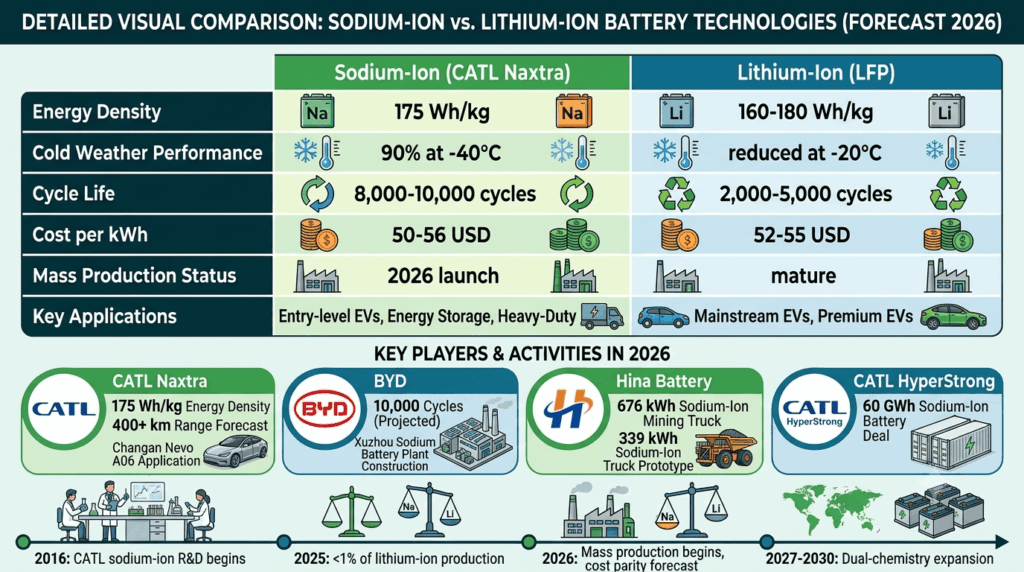
The specifications are competitive with lithium iron phosphate (LFP), the dominant chemistry for mainstream electric vehicles. Naxtra achieves an energy density of up to 175 Wh/kg, placing it close to LFP batteries currently used in many mainstream electric vehicles. That figure matters because energy density has historically been sodium-ion’s greatest weakness. The gap with LFP has now narrowed to the point where sodium-ion is a viable alternative for the majority of use cases.
Range figures follow from the energy density. CATL’s Cell-to-Pack system and intelligent battery management system enable a pure-electric range exceeding 400 kilometres in current form. As the sodium-ion supply chain advances, CATL projects ranges of 500 to 600 kilometres for pure-electric variants and 300 to 400 kilometres for range-extended and hybrid configurations. That coverage addresses over 50% of the range requirements in the new energy vehicle market.
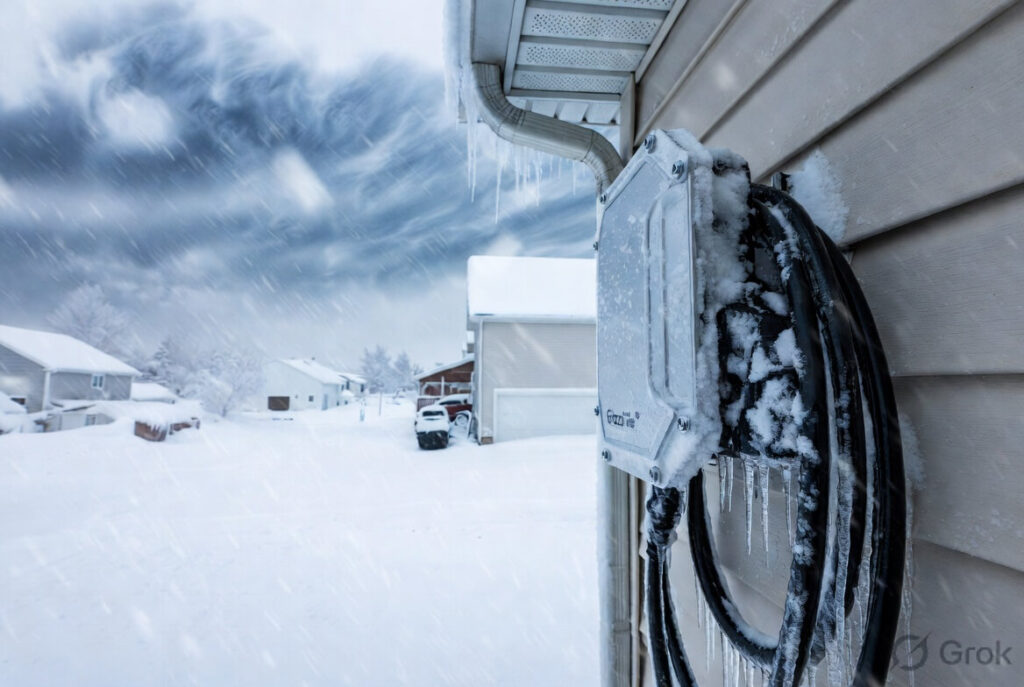
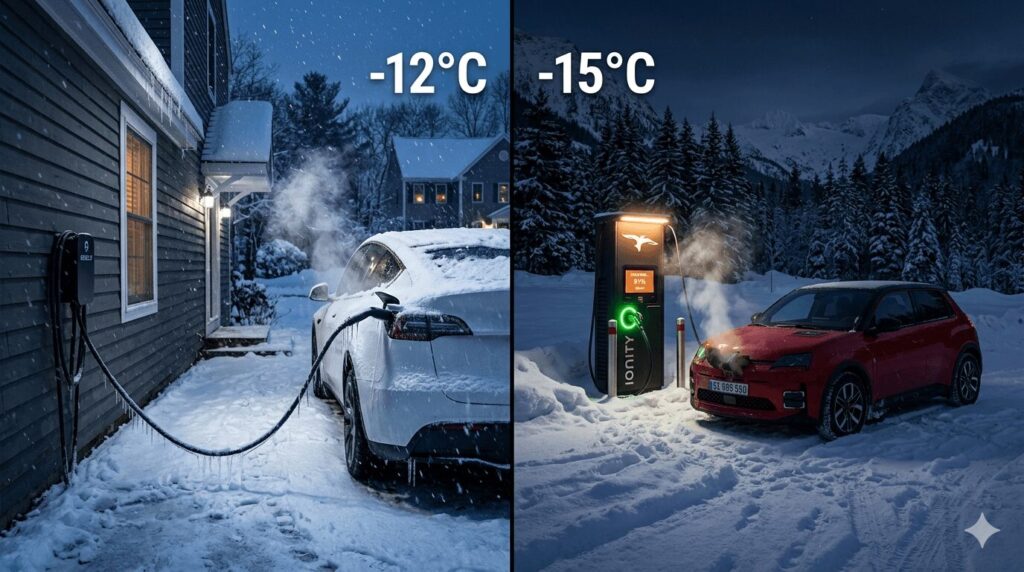
But energy density is not why automakers are paying attention to Naxtra. The battery’s cold-weather performance is the headline feature. According to CATL, Naxtra delivers nearly three times the discharge power of equivalent LFP batteries at minus 30 degrees Celsius. It retains over 90% capacity at minus 40 degrees Celsius and maintains stable power delivery at temperatures as low as minus 50 degrees Celsius. For drivers in northern China, Scandinavia, Canada, and the northern United States, this is not a marginal improvement. It is the difference between an EV being usable in winter and being a liability.
Safety testing has produced equally striking results. Under crush, drill, and saw testing, the Naxtra battery remains smoke and fire free and continues to provide power. Gao Huan, CTO of CATL’s China E-car Business, described the arrival of sodium-ion technology as “the beginning of a dual-chemistry era.”
The First Mass-Production Sodium-Ion Passenger Vehicle
Specifications and laboratory results matter, but the commercialisation race is won or lost in production vehicles. On that front, 2026 has delivered a milestone that would have seemed implausible five years ago.
In February 2026, Changan Automobile and CATL unveiled what they describe as the world’s first mass-production passenger vehicle equipped with sodium-ion batteries. The vehicle, the Changan Nevo A06, is expected to reach the market by mid-2026. CATL will supply Naxtra sodium-ion batteries across Changan’s full brand portfolio, including AVATR, Deepal, Qiyuan, and UNI.
This is not a concept car or a limited pilot. It is a production vehicle, sold through Changan’s existing dealer network, using a battery chemistry that was considered commercially unviable just a few years ago. The Nevo A06 uses a 45 kWh sodium-ion pack, positioning it as an affordable, mid-range option for buyers who prioritise cold-weather reliability and cost over maximum range.
The scale of the rollout remains modest. CATL’s head of production, Ni Jun, stated in June 2026 that the company expects to equip between 10,000 and 20,000 electric vehicles with sodium-ion batteries in 2026. That is a fraction of the millions of EVs CATL supplies with lithium-ion cells each year. But it is a start, and it establishes the manufacturing base and supply chain that will support larger volumes in 2027 and beyond.
CATL’s founder and CEO, Robin Zeng, has set an ambitious target for that expansion. He stated that the company is capable of producing sodium-ion batteries with an annual capacity of 100 GWh within the next three to five years. “We can produce a large-scale sodium battery for energy storage, so we get rid of the lithium dependence,” Zeng said.
The Cost Question: When Does Sodium-Ion Become Cheaper?
The central question in the sodium-ion versus lithium race is cost. Sodium is abundant and cheap, but abundance of raw material does not automatically translate into a cheaper finished battery. Manufacturing scale, process efficiency, and supply chain maturity all determine the final cost per kilowatt-hour.
CATL’s forecast is that sodium-ion batteries will reach cost parity with LFP batteries by the end of 2026. The company’s CTO of domestic energy storage solutions, Lin Jiubiao, confirmed that sodium-ion batteries have entered an era of comprehensive product development, with the first batch of sodium-ion battery-based energy storage systems delivered in September 2026 and annual production reaching gigawatt-hour scale.
The economics are moving in sodium-ion’s favour for several reasons. Sodium resources are abundant and widely distributed, so raw material costs are low and stable. Manufacturing scale is improving as production lines come online. And CATL has developed sodium-ion products with the same form factor as its lithium-ion cells, allowing integration with existing manufacturing lines and supply chains. That compatibility reduces the capital investment required to scale sodium-ion production, which in turn accelerates cost reduction.
Industry forecasts suggest sodium-ion battery prices will reach approximately $50 to $56 per kWh by the end of 2026, compared with $52 to $55 per kWh for LFP batteries. The margin is thin, but it is expected to widen. Analysts predict that by the end of 2027, sodium-ion’s cost advantage over lithium will become more pronounced.
It is worth noting that sodium-ion is not competing solely with LFP. It is competing with a moving target. Lithium-ion costs are also declining as manufacturing scale increases and new production capacity comes online. The question is not whether sodium-ion can reach LFP’s current cost. It is whether sodium-ion can maintain a cost advantage as LFP continues to improve.
BYD and the Second Front
CATL is not alone in the sodium-ion race. BYD, the world’s second-largest battery manufacturer and the largest electric vehicle manufacturer by volume, has been developing its own sodium-ion platform in parallel.
BYD’s most striking claim is cycle life. The company has developed sodium-ion battery products with a cycle life of up to 10,000, far exceeding the typical 2,000 to 5,000 cycles of conventional lithium-ion cells. That figure matters for commercial vehicles and energy storage, where battery lifetime is a primary determinant of total cost of ownership. A battery that lasts 10,000 cycles could outlast the vehicle it powers.
BYD began construction of its first sodium-ion battery plant in Xuzhou in January 2024, targeting applications in electric vehicles, grid-scale storage, and industry. The company’s sodium-ion R&D has reached the development stage of its third-generation product technology platform. Mass production timing will be determined based on market and customer demand.
BYD’s strategic approach differs from CATL’s. While CATL has focused first on passenger vehicles and energy storage, BYD is targeting commercial applications including two- and three-wheelers, start-stop power systems, and energy storage. The company has stated that sodium-ion technology has already achieved industrialisation in the energy storage sector. BYD, together with CATL, holds over half of the global EV market, and its involvement in sodium-ion development signals that the chemistry is being taken seriously by the industry’s largest players.
Sodium-Ion in Heavy-Duty Applications: The Mining Truck and the Highway Truck
One of the most revealing developments in the sodium-ion commercialisation race has nothing to do with passenger cars. It involves mining trucks and heavy-duty haulage, applications where the unique characteristics of sodium-ion batteries align almost perfectly with operational requirements.
In August 2026, Hina Battery and Shaanxi Tonly Heavy Industries delivered what they describe as the world’s first sodium-ion battery mining truck. The vehicle, based on Tonly’s 120E series platform, carries Hina Battery’s Haixing series battery system with a total capacity of 676 kWh. The mining truck was delivered in July to Sanyou Mining, a unit of Tangshan-based Sanyou Group.
The rationale for sodium-ion in mining is straightforward. Mines are heavy diesel consumers, and their dusty operating environments and wide temperature swings place higher demands on battery cycle life and low-temperature performance. Hina Battery said its sodium-ion solution will speed up the replacement of diesel engines with electric powertrains. The company’s Haixing series battery maintains a cycle life of over 8,000 cycles even in fast-charging mode, and can be fully charged in 20 to 25 minutes.
The heavy-duty story extends to highway trucks. In June 2026, FAW Jiefang completed systematic road testing of a sodium-ion battery heavy truck developed with Hina Battery. The test vehicle, a Jiefang J6P all-electric tractor carrying a 339 kWh sodium-ion battery, covered more than 15,000 kilometres over nearly seven months. FAW Jiefang said the battery retained more than 90% of its usable capacity at minus 40 degrees Celsius, with a cycle life of over 8,000 cycles under fast-charging conditions.
These are not laboratory demonstrations. They are real vehicles operating in real conditions. For fleet operators in cold regions and high-use logistics operations, sodium-ion batteries may have a role that lithium-ion cannot fill as effectively.
Energy Storage: The Quiet Giant of the Sodium-Ion Market
While passenger vehicles generate the headlines, the largest near-term market for sodium-ion batteries may be stationary energy storage. This is where the economics are most compelling and the scale is most significant.
In April 2026, CATL and HyperStrong signed a strategic cooperation agreement covering 60 GWh of sodium-ion battery supply over three years. This is the largest sodium-ion battery supply agreement in the world to date, and CATL described it as marking a significant milestone for the industrialisation of sodium-ion battery technology. HyperStrong will work closely with CATL on technology R&D, product applications, and project deployment.
The energy storage application plays to sodium-ion’s strengths. In long-duration energy storage, system integration can be simplified, auxiliary energy losses reduced, and overall plant efficiency improved. Sodium-ion batteries offer excellent adaptability across a wide temperature range, generate less heat during operation, and experience lower cell expansion stress, resulting in superior safety and stability compared to lithium-ion in stationary applications.
CATL introduced its first sodium-ion battery energy storage system, the Tener Sodium Energy Storage System, in 2026. It is reportedly the world’s first field-tested sodium-ion energy storage solution, offering a capacity of more than 30 MWh based on a fully modular architecture. William Wu, Director of CATL’s Energy Storage Technology Centre, stated: “We believe that sodium and lithium together will form the twin foundations of the future energy storage system.”
The energy storage market may be where sodium-ion achieves scale first. Stationary batteries do not need to be lightweight. They do not need to fit into a vehicle chassis. They do not need to withstand the vibration and shock of road use. The requirements are simpler, the volumes are larger, and the cost sensitivity is higher. For grid operators and renewable energy developers, sodium-ion’s combination of low cost, long cycle life, and thermal stability is compelling.
Where Sodium-Ion Still Falls Short
The commercialisation race is not a story of sodium-ion replacing lithium-ion across the board. It is a story of sodium-ion finding its niche and expanding from there. Several limitations remain.
Energy density is the most significant. At 175 Wh/kg, Naxtra is competitive with LFP but well below the 250 to 300 Wh/kg of high-nickel NMC chemistries. This means sodium-ion is not suitable for premium long-range electric vehicles, where every kilogram of battery weight matters. CATL’s own projections of 500 to 600 kilometres for future sodium-ion packs are impressive but still below what NMC batteries can achieve. For buyers who want a 700-kilometre range electric sedan, sodium-ion is not the answer.
Cycle life at high charge rates requires further validation. While BYD claims 10,000 cycles and Hina Battery’s mining truck battery maintains over 8,000 cycles in fast-charging mode, these figures are for specific cell designs and operating conditions. Real-world cycle life across the full range of automotive operating conditions will take years to validate.
Cold-weather performance, while excellent, is not absolute. Research published in 2026 on 18650 sodium-ion cells found that decreasing temperature leads to severe capacity fading, narrowed working voltage range, and significant increases in resistance. CATL’s Naxtra performs far better than conventional sodium-ion cells, but the fundamental physics of low-temperature operation still impose limits.
Manufacturing scale remains the primary constraint. Global sodium-ion production in 2025 was less than 1% of lithium-ion production. Even with CATL’s planned 40 GWh expansion in Fujian and BYD’s Xuzhou plant, sodium-ion manufacturing capacity in 2026 will be measured in tens of gigawatt-hours, not hundreds. The transition from a niche chemistry to a mainstream one will take years, not months.
The Dual-Chemistry Future
The most accurate way to understand the sodium-ion versus lithium race is not as a competition where one chemistry wins and the other loses. It is as the emergence of a dual-chemistry ecosystem where each technology serves the applications it is best suited to.
CATL’s Gao Huan framed it precisely: “The arrival of sodium-ion technology marks the beginning of a dual-chemistry era. CHANGAN’s vision shows both its responsibility for energy security and its strategic foresight.”
In this future, lithium-ion batteries continue to power the majority of electric vehicles, particularly those that require maximum range and energy density. Sodium-ion batteries power entry-level and mid-range vehicles where cost and cold-weather performance matter more than maximum range. Sodium-ion batteries also power stationary energy storage, heavy-duty commercial vehicles operating in extreme conditions, and two- and three-wheelers where cycle life and cost are the dominant considerations.
The dual-chemistry model is already visible in practice. CATL will supply Naxtra sodium-ion batteries across Changan’s full brand portfolio, alongside its lithium-ion products. The Changan Nevo A06 does not replace a lithium-ion vehicle. It adds a new option for buyers who prioritise different characteristics.
Robin Zeng has suggested that low-cost sodium-ion batteries could eventually displace 30% to 40% of the current battery market. That is a substantial share, but it also implies that 60% to 70% of the market remains lithium-ion. The question is not which chemistry wins. It is how the market splits.
What 2026 Actually Proved
The year 2026 demonstrated that sodium-ion batteries are no longer a laboratory curiosity. They are a commercial product. CATL’s Naxtra battery is in mass production with an energy density of 175 Wh/kg. The Changan Nevo A06 is the first mass-production passenger vehicle equipped with sodium-ion batteries, reaching the market in mid-2026. CATL expects 10,000 to 20,000 vehicles to be equipped with sodium-ion packs this year. The 60 GWh supply agreement with HyperStrong is the largest sodium-ion order in history. Hina Battery’s mining truck and FAW Jiefang’s heavy truck testing demonstrate that sodium-ion has applications far beyond passenger cars.
The cost question remains unresolved. CATL forecasts parity with LFP by the end of 2026. Independent forecasts suggest sodium-ion prices of $50 to $56 per kWh compared with $52 to $55 per kWh for LFP. The margin is thin. Whether sodium-ion achieves a durable cost advantage will depend on manufacturing scale, supply chain maturity, and the pace of lithium-ion cost reduction.
The most important development of 2026 is not a single product or a single announcement. It is the establishment of a manufacturing base. CATL’s planned 40 GWh sodium-ion facility in Fujian, BYD’s Xuzhou plant, and the network of cathode material suppliers expanding sodium-ion capacity are the infrastructure that will determine how quickly the dual-chemistry future arrives.
The sodium-ion versus lithium race is not a sprint. It is a long-distance transition from a single-chemistry world to a multi-chemistry one. 2026 is the year that transition began in earnest.