2026 was the year the electric vehicle industry stopped talking about the future and started shipping it. Solid-state batteries moved from laboratory promises to factory floors. Vehicle-to-grid graduated from pilot projects to commercial contracts. Sodium-ion chemistry emerged as a genuine alternative to lithium. Battery recycling transformed from an environmental obligation into a value-generating industry.
This is the year in review: top 10 EV tech breakthroughs of 2026. Not a list of press releases. A list of technologies that actually shipped, scaled, or fundamentally changed what is possible.
1. Solid-State Batteries Enter Mass Production
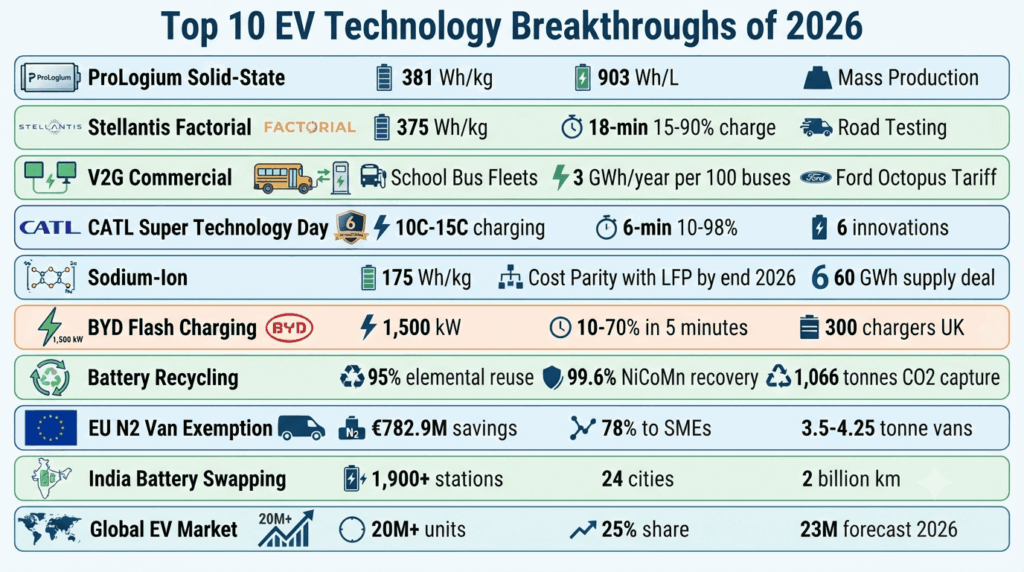
The most anticipated battery technology of the past decade finally crossed the line from demonstration to production. In September 2026, ProLogium Technology began mass production of its Gen 3.5 Lithium Ceramic Battery at its Giga-level facility in Taiwan. Third-party testing by TÜV confirmed the 185.4 Ah cell achieved 381 Wh/kg gravimetric energy density and 903 Wh/L volumetric energy density. UL Solutions testing under China’s GB/T 43568-2026 standard recorded weight loss of less than 0.05% after six hours under vacuum at 120°C, well below the 0.5% threshold for all-solid-state classification.
This is not a pilot line. ProLogium has shipped more than 2.4 million cells on its LCB platform since commercial production began in 2013, building a manufacturing track record that spans consumer electronics, wearables, medical devices, and automotive applications. The company is also constructing a factory in Dunkerque, northern France, with the first phase scheduled for completion in 2028.
The significance is straightforward. Solid-state batteries have been the “holy grail” of EV technology for years. In 2026, they became a product.
2. Stellantis and Factorial Launch North America’s First Solid-State Road Test
Mass production of solid-state cells in Taiwan was matched by a historic milestone on the other side of the world. On June 11, 2026, Stellantis and Factorial Inc. announced the integration of Factorial’s FEST solid-state battery technology into a Dodge Charger Daytona development vehicle and the launch of a road-testing program.
The FEST cells demonstrated 375 Wh/kg energy density, ultra-fast charging from 15% to 90% in 18 minutes, and robust reliability from minus 30°C to 45°C. The integration used a patented mechanical architecture designed by Stellantis to accommodate solid-state cells within the existing battery pack format, along with adapted control systems and pack design to meet automotive safety and durability requirements.
Ned Curic, Stellantis Chief Engineering and Technology Officer, framed the achievement in practical terms: “This milestone shows we are bringing solid-state batteries closer to our customers with the potential for longer range, faster charging and lower costs”. This was the first automotive integration of solid-state technology in North America. The road-testing program is now validating performance under real-world charging and driving conditions.
3. V2G Goes Commercial
Vehicle-to-grid spent years as a technology permanently five years away from deployment. In 2026, it arrived.
The honest beachhead was not the private car. It was the electric school bus. School buses have everything V2G needs: large battery packs, utterly predictable schedules, long idle afternoons and whole idle summers, parked precisely when the grid faces peak demand. US school districts are now deploying bidirectional fleets by the hundred. One operator’s projection puts a single hundred-bus fleet returning around three gigawatt-hours a year to its local grid at peak times.
Commercial vehicle makers announced that bidirectional capability is rolling across entire product lines. Valeo and Nissan signed a contract for the commercialisation of bidirectional V2G charging stations across Europe, beginning in the United Kingdom, with products unveiled at Power2Drive Europe in Munich in June 2026. Ford announced plans to launch a V2G tariff with Octopus Energy for its Explorer and Capri models from summer 2026. Hyundai selected 40 customers using the Ioniq 9 and Kia EV9 for a V2G pilot on Jeju Island, providing bidirectional charging systems free of charge.
The pattern is clear. Fleets first, households later. Where vehicles are professionally managed and predictably parked, V2G became a line item in 2026. Where they are personally owned and unpredictably driven, it remains a pilot. But the direction is no longer in question.
4. CATL’s Super Technology Day Redefines What a Battery Can Do
On April 21, 2026, CATL hosted its Super Technology Day in Beijing and unveiled six innovations that collectively reshaped the performance envelope of electric vehicle batteries.
The third-generation Shenxing Superfast Charging Battery achieved what CATL describes as the industry’s strongest capability: an equivalent 10C and a peak 15C charging rate. Charging from 10% to 35% SOC takes just one minute. From 10% to 80% takes three minutes and 44 seconds. From 10% to 98% takes six minutes and 27 seconds. Even at minus 30°C, charging from 20% to 98% takes approximately nine minutes.
The third-generation Qilin Battery, the Qilin Condensed Battery, the second-generation Freevoy Super Hybrid Battery, and the Naxtra Sodium-ion Battery completed the portfolio. Dr. Wu Kai, CATL’s Chief Scientist, articulated the strategic logic: LFP is nearing its theoretical energy density limit and is better suited to a roadmap centred on extreme fast charging. NCM’s high energy density keeps it at the forefront of global competition. Sodium-ion batteries offer broad potential for extreme temperatures and energy storage applications.
Robin Zeng, Chairman and CEO, emphasised that industrial innovation must be driven by a rigorous scientific spirit. For Chinese technology to go global, it relies not just on speed and scale, but on the quality of innovation, the ability to validate, and the credibility of the brand.
5. Sodium-Ion Batteries Reach Commercial Scale
Sodium-ion chemistry has been discussed as a potential low-cost alternative to lithium for years. In 2026, it became a commercial product.
CATL unveiled its Naxtra sodium-ion battery at Super Technology Day, offering energy density of up to 175 Wh/kg and scheduled to enter mass production later in the year. The company expects sodium-ion production costs to reach parity with lithium iron phosphate (LFP) batteries by the end of 2026. CATL also signed a three-year strategic cooperation agreement with HyperStrong covering 60GWh of sodium-ion battery supply for energy storage, marking a significant milestone for the industrialisation of the technology.
The commercial rollout began in September 2026, with CATL expecting sodium-ion battery shipments to reach gigawatt-hour scale during the year. The Changan Nevo A06 was expected to enter the market in mid-2026 as one of the first vehicles powered by sodium-ion batteries.
Sodium-ion matters because it removes the lithium supply constraint from the equation. Sodium is abundant, inexpensive, and geographically distributed. For entry-level EVs and stationary storage, it offers a compelling combination of cost and performance.
6. BYD’s Five-Minute Flash Charging Goes Global
BYD introduced its FLASH Charging technology in 2026, capable of delivering up to 1,500 kW through a single connector. The system can take a compatible EV from 10% to 70% charge in five minutes, with a near-full charge taking around nine minutes.
The technology was showcased in the UK in June 2026, with BYD planning to install 300 FLASH chargers by the end of 2026 at Denza retail locations and other sites. The second-generation Blade Battery and FLASH Charging system together represent what BYD calls the “Super e-Platform”, boasting peak speeds of 1,000 kW and allowing cars to travel up to 470 kilometres after just five minutes of charging.
For context, BYD’s FLASH chargers are capable of charging an EV’s battery three times faster than Tesla’s V4 Supercharger. The technology addresses the single most persistent consumer objection to electric vehicles: charging time. Five minutes is the psychological threshold at which EV charging becomes functionally equivalent to refuelling a petrol car.
7. Battery Recycling Becomes a Value Industry
Battery recycling in 2026 transformed from a cost centre into a profit centre. The breakthroughs came from multiple directions.
Researchers at Worcester Polytechnic Institute, in collaboration with Argonne National Laboratory, developed a leaching-assisted upcycling strategy that transforms low-value battery waste into high-value lithium manganese iron phosphate (LMFP) cathode material under mild processing conditions. The process preserves the original particle morphology of battery materials while achieving more than 95% elemental reuse under ambient conditions. Techno-economic analysis showed positive profitability across multiple scenarios, supporting the potential for recycling facilities to evolve into value-generating hubs within a circular battery supply chain.
Chinese inventors Yu Haijun and Xie Yinghao won the European Inventor Award 2026 for a smart battery recycling method that achieves recovery rates of 99.6% for nickel, cobalt and manganese and 96.5% for lithium, while reducing acid and alkali consumption by 73%.
A separate breakthrough published in Nature Communications demonstrated a self-driven recycling process that simultaneously generates electricity. Coupled redox-mediated oxidative and reductive leaching generates theoretically 246 MWh per annum for 10,000 tonnes of black mass while driving lithium-ion migration into the catholyte. Leaching efficiencies exceed 95% for critical metals, accompanied by a calculated carbon dioxide capture rate of 1,066 tonnes per annum.
The economic logic of recycling has fundamentally changed. Instead of recovering low-value salts, the new generation of processes upgrades waste into next-generation cathode materials. Recycling is no longer an obligation. It is an opportunity.
8. The EU’s N2 Van Rule Corrects a Regulatory Anomaly
In December 2025, the European Commission proposed amending Directive 92/6/EEC to exempt N2 category electric vans with a maximum mass between 3.5 and 4.25 tonnes from the requirement to install and use speed limitation devices. The exemption addresses a regulatory anomaly: electric vans are heavier than diesel vans because of their batteries, and that extra weight pushed them into N2 classification, where they faced speed limiter requirements that diesel vans with identical payloads did not.
The Commission’s impact assessment estimated cumulative savings of €223.7 million to €782.9 million from 2027 to 2029, with 78% accruing to SMEs. The proposal also removes the tachograph installation requirement for battery-electric light commercial vehicles below 4.25 tonnes.
The European Economic and Social Committee adopted its opinion with 205 votes in favour, 1 against, and 3 abstentions. It called for the exemption to be conditional and subject to evaluation. The Commission argues that safety remains robust due to cab impact and electric safety tests, along with widespread ADAS deployment in modern electric vans.
The exemption matters because it levels the playing field between electric and diesel commercial vehicles. Electric vans should not be penalised for being electric.
9. India’s Battery Swapping Network Reaches Critical Mass
On August 11, 2026, Indofast Energy announced a partnership with GLIDA to co-locate battery swapping stations at GLIDA’s charging sites across India. The collaboration aims to establish 50 sites with over 100 swapping stations over the next 12 months, beginning with 10 Quick Interchange Stations across Chennai, Bengaluru, and Hyderabad.
Indofast Energy operates 1,900-plus swap stations across 24 cities, enabling more than 2 billion kilometres of clean mobility. In FY26, the company onboarded over 90,000 vehicles and forged partnerships with 32 OEMs. The network has helped save 80,000 tonnes of CO₂ emissions.
The strategic model is instructive. GLIDA brings strategically located sites with reliable power infrastructure. Indofast contributes its battery swapping network and technology platform. The partnership creates integrated energy destinations where high-power charging and rapid battery swapping coexist at a single location, serving multiple vehicle categories.
India’s battery swapping ecosystem now has more than 3,000 swapping stations serving more than 250,000 EVs with more than 350,000 batteries in circulation. The operational battery swapping market is expected to grow from $48 million in 2025 to $518 million by 2034, a compound annual growth rate of 30.21%.
10. The Global EV Market Crosses 20 Million Units
The technology breakthroughs of 2026 would be meaningless without a market to deploy them in. The global electric vehicle market delivered.
Global electric car sales surpassed 20 million units in 2025 for the first time, growing 20% and reaching 25% of all new car sales. The International Energy Agency projects 23 million units in 2026, accounting for 28% of global car sales.
But the headline number masks a more complex story. The United States contracted after the expiration of the federal tax credit. Europe surged on regulatory momentum and energy economics. China approached saturation with more than 60% of new car sales already electric. And the most dynamic growth occurred in emerging markets: Southeast Asia doubled its EV sales in 2025, Latin America grew 75%, and India sold 2.3 million EVs.
The energy crisis that sent oil prices above $100 per barrel in 2026 accelerated adoption in ways that no policy analyst predicted. The global EV fleet avoided approximately 1.7 million barrels of oil per day in 2025, up from 0.4 million barrels per day in 2020. The IEA projects that figure could reach 5 million barrels per day by 2030.
The technology and the market are now reinforcing each other. Better batteries sell more cars. More cars fund more battery research. The flywheel is turning.
What 2026 Actually Proved
The year in review: top 10 EV tech breakthroughs of 2026 is not a list of isolated achievements. It is a coherent story about an industry that has crossed a threshold.
Solid-state batteries are in production. V2G is generating revenue. Sodium-ion is shipping. Five-minute charging is real. Recycling is profitable. Battery swapping is scaling. The regulatory environment is evolving to correct its own mistakes.
The breakthroughs that matter most are not the ones with the highest energy density or the fastest charging speeds. They are the ones that remove barriers. Solid-state removes the safety and density barrier. Sodium-ion removes the lithium supply barrier. Five-minute charging removes the time barrier. Recycling removes the materials barrier. V2G removes the grid integration barrier. Battery swapping removes the upfront cost barrier.
2026 was the year the electric vehicle industry stopped asking permission and started solving problems. The technologies that will define the next decade are no longer in the laboratory. They are on the road.