India’s electric vehicle market has reached two milestones that, taken together, signal a structural shift rather than a cyclical uptick. In May 2026, electric vehicles crossed 11% of all vehicle retail sales for the first time. In the first half of the year, electric passenger vehicle sales rose 79% year-on-year to 148,023 units.
The two data points tell different but connected stories. The 11% retail share, reported by the Federation of Automobile Dealers Associations, reflects the entire EV market including two-wheelers, three-wheelers, and commercial vehicles . The 79% growth figure, based on Vahan registration data, reflects the passenger car segment specifically, where the competitive dynamics have shifted dramatically .
This is India’s EV sales boom: crossing 11% market share and 79% growth in H1 2026, and the numbers behind it reveal a market that is maturing, diversifying, and becoming more competitive at the same time.
The 11% Milestone: A First for India’s EV Market
The May 2026 retail data from FADA marked the first time that electric vehicles accounted for more than 11% of all vehicle retail sales in India. Total EV retail sales during the month stood at 271,682 units, a 45% year-on-year increase .
The growth was broad-based across segments. Electric two-wheelers registered 170,733 units, up 63% year-on-year, with EV penetration rising to 9.25% from 6.11% a year earlier. Electric three-wheelers remained the most electrified category, with 64.45% of all three-wheelers sold being electric. Electric passenger vehicles grew 81% to 26,682 units, with penetration rising to 6.63% from 4.51% .
FADA President C S Vigneshwar attributed the surge to rising fuel prices. Petrol prices rose by approximately ₹7.5 per litre since May 15, 2026, as global crude oil prices surged due to the conflict in West Asia and supply concerns around the Strait of Hormuz. “Because of higher fuel prices, the shift towards EVs increased to over 11 per cent in May compared to 7 per cent in FY26,” Vigneshwar said .
The fuel price factor is not incidental. It is the single most powerful driver of EV adoption in a price-sensitive market like India, where the total cost of ownership calculation is the primary purchase consideration for most buyers. When petrol prices rise, the operating cost advantage of EVs becomes more visible and more compelling.
The 79% Growth: Passenger EVs Hit 148,023 Units
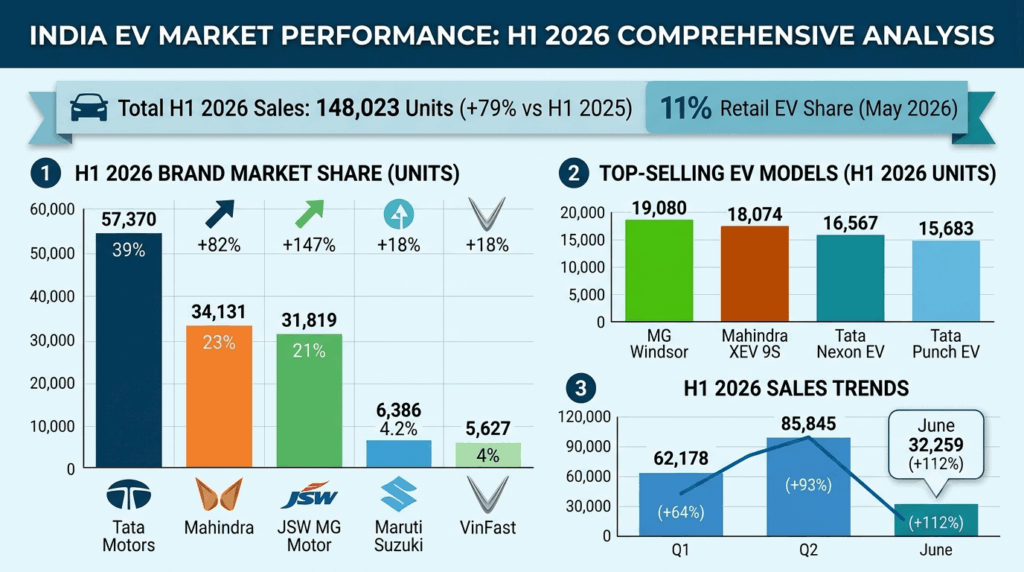
The passenger vehicle segment delivered the most dramatic growth. Electric car and SUV sales rose 79% year-on-year to 148,023 units in H1 2026, up from 82,535 units in the same period of 2025 .
The momentum accelerated through the half. Q1 registrations rose 64% to 62,178 units, while Q2 jumped 93% to 85,845 units. June 2026 became the first month in which electric passenger vehicle sales crossed 30,000 units, reaching 32,259 units, more than double the 15,203 units recorded in June 2025 .
The growth trajectory suggests that India’s electric passenger vehicle market is on track to cross 300,000 units in calendar year 2026. The first half alone delivered 148,023 units. If the second half maintains the Q2 pace, the full-year figure could approach or exceed the 300,000 mark .
The Competitive Reshuffle: Mahindra Overtakes MG
The most significant competitive development of H1 2026 was Mahindra’s rise to second place, overtaking JSW MG Motor.
Tata Motors retained its leadership with 57,370 units, an 82% increase, and a 39% market share, up marginally from 38%. The Nexon EV remained the volume driver, supported by the Punch EV and the updated Tiago EV. The Sierra EV, launched in June 2026, added a new model to the portfolio .
Mahindra recorded the highest growth among the three largest manufacturers, with sales rising 147% to 34,131 units from 13,801 units. Its market share increased from 17% to 23%. The company moved ahead of MG in March and retained second place through the half. The XEV 9S, Mahindra’s three-row electric SUV launched in November 2025, was a significant contributor, becoming the second-best-selling electric model in the country with 18,167 units in H1 .
JSW MG Motor sold 31,819 units, an 18% increase, but its market share fell from 33% to 21% as Tata and Mahindra grew faster. The Windsor remained MG’s bestselling model, with approximately 19,000 units in H1 .
The combined market share of the top three manufacturers declined to 81.7% in H1 2026 from 87% a year earlier, indicating that the market is broadening as new entrants gain traction .
The New Entrants: Maruti, VinFast, and Tesla
The entry of new brands has been a defining feature of H1 2026. Maruti Suzuki, VinFast, and Tesla together registered 12,244 vehicles, capturing an 8.1% share of the segment and accounting for 18% of incremental registrations .
Maruti Suzuki registered 6,386 electric vehicles in H1 2026, giving it a 4.2% market share. The e Vitara, launched in February 2026, started slowly with 1,460 units in Q1 but accelerated to 4,926 units in Q2. India’s largest carmaker by volume is expected to gain further traction as its dealer network and brand trust drive adoption .
VinFast registered 5,627 units, capturing 4% of the market. The Vietnamese manufacturer entered India with the VF6 and VF7, assembled locally, and has been expanding its dealer network. Its volumes rose from 1,630 units in Q1 to 3,992 units in Q2 .
Tesla registered 236 vehicles in H1 2026, a modest figure that reflects its limited model range and premium positioning. The company sold 29 Model Y cars in February alone, taking an 8% share of the EV segment that month, but its overall volume remains small relative to the mass-market players .
The Model Leaders: Windsor, XEV 9S, and Nexon EV
The model-level data reveals which vehicles are driving the boom.
The MG Windsor led H1 2026 with 19,080 units, remaining the best-selling electric car in India. The Mahindra XEV 9S followed with 18,074 units, a remarkable performance for a vehicle launched only in November 2025. The Tata Nexon EV recorded 16,567 units, and the Tata Punch EV recorded 15,683 units .
The diversity of the top-selling models is significant. The Windsor is a fleet-oriented MPV. The XEV 9S is a three-row family SUV. The Nexon EV and Punch EV are mass-market compact SUVs. The market is no longer dominated by a single body style or price point. Buyers across segments are finding electric options that meet their needs.
What the Boom Means for India’s EV Future
The H1 2026 data confirms several trends that will shape India’s EV market for the remainder of the decade.
The market is broadening. The combined share of the top three manufacturers fell from 87% to 81.7% as new entrants gained ground. Maruti’s entry, in particular, is significant because of its scale and dealer network. If Maruti can achieve the same level of EV penetration as Tata and Mahindra, the market will expand substantially.
Fuel prices remain the most powerful lever. The May 2026 surge in EV adoption was directly linked to the petrol price hikes driven by the West Asia crisis. This suggests that EV adoption in India is highly sensitive to running cost differentials. Any sustained increase in fuel prices will accelerate adoption. Any sustained decrease will slow it.
The charging infrastructure gap remains a constraint. India had 67,657 EV chargers as of August 2026, with 73% rated below 30 kW. The network is growing, but it is not yet sufficient to support mass adoption, particularly for buyers without access to home charging. The PM E-DRIVE scheme’s ₹2,000 crore allocation for charging infrastructure is a start, but deployment has lagged approvals .
The 300,000-unit milestone is within reach. With 148,023 units in H1 and Q2 momentum of 85,845 units, the full-year figure could approach 300,000 units if the second half maintains its pace. That would represent a significant acceleration from 2025 and would establish India as one of the fastest-growing EV markets in the world.
India’s EV sales boom is real. The 11% retail share and 79% growth are not anomalies. They are the result of rising fuel prices, expanding model choices, new entrants, and a market that is finally beginning to scale. The question is no longer whether India will transition to electric mobility. It is how quickly the transition will accelerate.