The United States electric vehicle market has entered a new and uncomfortable phase. For the first time in at least a decade, annual EV sales declined in 2025. The $7,500 federal tax credit expired on September 30, 2025. The fourth quarter delivered a sharp correction that erased the gains of the preceding nine months. And as EV sales fell, hybrids surged to nearly one in five new vehicle sales.
This is not a story about electric vehicles failing. It is a story about what happens when the policy scaffolding that supported a market is removed, and consumers respond by choosing the option that best fits their needs without a subsidy. The US EV sales slump 25%: policy uncertainty and the hybrid pivot is the data-driven account of how that shift unfolded.
The Annual Numbers: A Decade-Long Streak Ends
The full-year figures confirm the reversal. US EV registrations fell 0.4% to approximately 1.3 million vehicles in 2025, the first annual decline in at least a decade . EV market share slipped to 7.8% from 8.1% in 2024 . Total vehicle registrations rose 2.2% to 16.25 million units, meaning Americans kept buying cars. They just bought fewer electric ones .
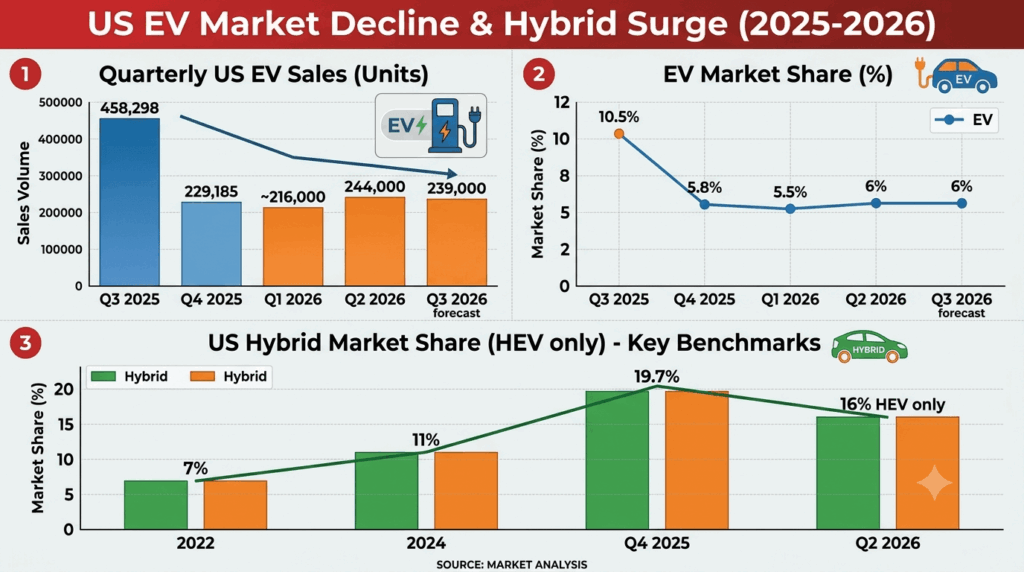
The quarterly data tells a more dramatic story. Q3 2025 was the strongest quarter on record, with EV sales reaching 458,298 units as buyers rushed to claim the tax credit before it expired . Q4 collapsed to 229,185 units, down substantially from 399,594 in Q4 2024 . The fourth-quarter decline compared to the same period a year earlier was approximately 45%, a figure confirmed by the IEA and multiple market trackers .
The pull-forward dynamic was unmistakable. Buyers accelerated purchases into Q3 to capture the $7,500 credit. When the credit disappeared on September 30, the market that had been artificially inflated was immediately deflated. December offered a partial recovery, rising about 26% from November, but the monthly total of 79,531 units was still the lowest since mid-2022 .
The 25% Figure: Where It Comes From
The headline figure of a 25% slump requires careful interpretation because it depends on the period being measured.
For the full year, the decline was modest, at 0.4% to 2% depending on the data source . The 25% figure emerges when comparing the post-credit market to the pre-credit baseline, or when examining specific quarters. In April 2026, new US EV sales were down 23% year-over-year according to Cox Automotive, with EVs representing 5.6% of new-car sales . The first quarter of 2026 saw new EV sales fall to near 216,000 units, a significant decline from the credit-supported quarters of 2025 .
The market has found a new, lower baseline. Cox Automotive expected Q3 2026 to deliver 239,000 EV sales and nearly a 6% share . That is the post-credit normal: a market that is smaller than it was with the credit, but not collapsed. Stephanie Valdez Streaty, Cox’s Director of Industry Insights, described the situation: “The market is starting to find that natural demand. Manufacturers have adjusted production to match that demand” .
The Policy Trigger: What Actually Changed
The expiration of the $7,500 federal Clean Vehicle credit was the single most important policy change, but it was not the only one.
The One Big Beautiful Bill Act, signed in 2025, eliminated the credit for vehicles acquired after September 30, 2025 . It also removed penalties for automakers that failed to meet fuel efficiency standards, reducing the incentive to sell EVs for compliance purposes . The EPA rescinded the Endangerment Finding in February 2026, eliminating the legal basis for vehicle greenhouse gas emissions standards . California’s Advanced Clean Cars II waiver was revoked, though litigation continues .
The cumulative effect was to dismantle the regulatory architecture that had supported EV adoption. Legacy automakers, particularly the Detroit Three, no longer face financial penalties for not selling EVs at scale . The market was left to find its own level.
The Hybrid Pivot: Where the Buyers Went
As EV sales fell, hybrid sales surged. This is the other half of the story, and it explains where many of the buyers who might have chosen an EV actually went.
Hybrids accounted for nearly 20% of new vehicle sales by late 2025, nearly triple their share from three years earlier . In Q4 2025, hybrid market share reached 19.7%, up from 11-12% a year earlier . By the second quarter of 2026, hybrid electric vehicles contributed a record 16% of light-duty vehicle sales .
The reasons are straightforward. Hybrids were not eligible for the federal tax credits that expired, so their economics did not change when the credit disappeared . They are often less expensive than EVs. They offer a wider range of models. And owners are not required to learn a new technology or remember to plug their cars in at night . For buyers who wanted fuel efficiency without the charging commitment, hybrids became the rational choice.
Toyota capitalized on the shift. Electrified vehicles represented 46.9% of Toyota’s retail sales, and the company forecast 4.7 million hybrids in fiscal 2026 . Ford led in hybrid pickups with the F-150 and Maverick, though it continued to face significant EV losses .
The Price Story: EVs Became More Competitive After the Credit
One of the counterintuitive outcomes of the credit expiration is that EV prices actually became more competitive relative to gasoline vehicles, even without the subsidy.
The price premium for EVs over ICE narrowed from 16.5% to 9.7% according to Cox data, with a difference of almost $5,000. JD Power data showed an even narrower gap of $1,100 in September 2026 . The average transaction price for EVs fell to $54,754 in August 2026 according to Cox, and below $47,000 according to JD Power .
The explanation is partly about incentives and partly about product mix. Tyson Jominy, SVP at JD Power, explained: “The federal tax credit is gone, and automakers are spending fewer incentive dollars, but the mix of EVs that we’re now selling is much more affordable vehicles and segments” . The Chevrolet Equinox EV, priced below $35,000, sold 60,052 units in 2025, making it the first EV to rank third in annual sales with an estimated price below $35,000 .
The market that remains is smaller but more sustainable. The distortion created by federal policy is being replaced by competitive vehicles at competitive prices .
The Automaker Response: Retrenchment and Reassessment
The policy shift forced automakers to reassess their EV strategies. Some discontinued or delayed models. Others shifted focus back to hybrids and internal combustion engines.
Tesla remained the dominant player with 589,160 US sales in 2025, but that represented a 7% decline from 2024, the second consecutive annual decline . The Model Y and Model 3 remained the best-selling EVs, with 357,453 and 161,915 registrations respectively .
General Motors accelerated, selling more than 150,000 EVs in 2025, up 48% year over year and accounting for 13% of total US EV sales . The Chevrolet Equinox EV was the standout, but Cadillac also contributed with 49,152 units . Hyundai and Kia combined for 99,553 units, placing the Hyundai Motor Group second behind Tesla .
The days’ supply figure revealed the scale of the adjustment. EV inventory reached 180 days in early 2026 before falling to 78 days in August as manufacturers cut production to match demand . The industry was recalibrating to a smaller market.
What This Means for the US EV Market
The US EV market has not collapsed. It has reset.
The post-credit baseline of roughly 6% market share is lower than the 8% recorded in 2025 and well below the 10.5% peak in Q3 2025 . But it is a market that exists without subsidies, driven by consumer choice rather than policy mandates. The buyers who remain are those for whom an EV makes economic and practical sense: high-mileage drivers, homeowners with charging access, and buyers in states with their own incentive programs.
The hybrid pivot is likely to persist. Hybrids offer a practical middle ground for buyers who want fuel efficiency without the charging commitment, and their sales are growing without any policy support. That is a market signal that automakers are responding to.
The long-term trajectory of EV adoption in the US remains upward, but the pace has slowed. Morningstar noted that battery costs continue to decline and charging infrastructure continues to expand, which should create higher demand over time regardless of policy . But the near-term outlook is for a smaller, more competitive, and more price-sensitive EV market than the one that existed before September 30, 2025.
The US EV sales slump 25%: policy uncertainty and the hybrid pivot is not a story of failure. It is a story of a market adjusting to the removal of artificial support, and of consumers choosing the option that best fits their lives without a subsidy. The adjustment has been painful for automakers and for the EV supply chain. But the market that emerges from it will be more durable because it is built on genuine demand rather than policy incentives.