Here is something that surprises most people the first time they research EV charging in China.
China is not behind the rest of the world on EV charging infrastructure. It is significantly ahead — in station count, in charging speed deployment, in ultra-fast charging technology, and in the sheer scale of daily charging sessions. The world’s largest EV charging network, the most advanced ultra-fast charging hardware currently in commercial deployment, and the highest daily EV charging session volume all exist in China.
What makes the Chinese charging landscape confusing for English-reading users — whether you are a Chinese expat researching home charging setups, a Chinese buyer evaluating international versus domestic EVs, or a global reader trying to understand where EV charging technology is actually heading — is that China uses completely different connector standards, different network operators, and different terminology from Europe and the United States.
This EV charging guide 2026 slow vs fast vs ultra-fast differences in the Chinese market covers everything you need to understand the complete Chinese EV charging landscape. The connector standards that determine what charges where. The speed categories from slow overnight home charging to 900 kW ultra-fast charging that adds 400 km in five minutes. The major network operators and what they offer. The charging specifications of every major Chinese EV. And the specific situations — charging in China as a returning expat, charging a Chinese-spec EV abroad, understanding the technology gap between Chinese and Western charging infrastructure — that English-reading Chinese users most commonly need answered.
The Chinese EV Charging Connector Standards — The Foundation
Before understanding charging speeds, understanding connectors is essential — because in China, the connector standard determines which networks, which chargers, and which speeds your vehicle can access.
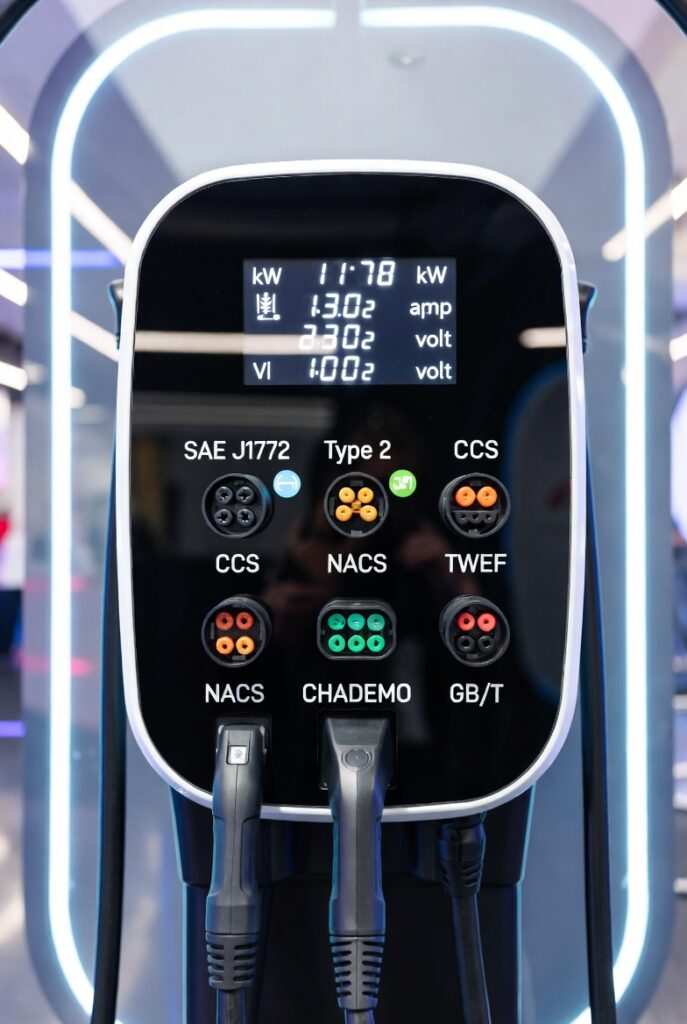
GB/T 20234.2 — The Chinese AC Charging Standard
GB/T 20234.2 is China’s mandatory AC charging connector standard. Every EV sold in China for domestic use has a GB/T AC inlet — there are no exceptions for Chinese-market vehicles. This includes Chinese-market versions of international brands: Chinese-spec Tesla, BMW, Mercedes, Volkswagen, and Toyota all use GB/T AC rather than their global connector standards.
Physical appearance: The GB/T AC connector is a seven-pin connector with a distinctive square outline. It is not compatible with European Type 2, US J1772, or NACS without an adapter.
Power capability:
- Single-phase: up to 7 kW (32A at 220V)
- Three-phase: up to 22 kW (32A per phase at 380V)
Where you use it:
- Home charging units (慢充桩) installed in residential parking
- AC public charging stations in car parks, commercial buildings, residential compounds
- Workplace charging installations
Compatibility with European/US chargers: GB/T AC is not directly compatible with European Type 2 or US J1772. Adapters exist — GB/T to Type 2 adapters allow Chinese-spec vehicles to use European charging infrastructure, and Type 2 to GB/T adapters allow European-spec vehicles to use Chinese AC chargers. Adapter quality varies significantly — use only certified adapters from established suppliers.
GB/T 20234.3 — The Chinese DC Fast Charging Standard
GB/T 20234.3 is China’s DC fast charging connector standard — the equivalent of CCS2 in Europe or CCS1 in the United States. All EVs sold in China for domestic use have a GB/T DC inlet for fast charging.
Physical appearance: The GB/T DC connector is a nine-pin connector, larger than the AC connector, typically housed alongside the AC inlet in a dual-port charging setup.
Power capability:
- Current deployment: up to 250 kW (rated standard)
- Upgraded stations: up to 480 kW (Xpeng S4, various premium installations)
- ChaoJi next-generation: up to 900 kW
Where you use it:
- DC fast charging stations (快充桩) on motorways, at service stations, in major car parks
- Dedicated fast charging hubs in urban areas
- Brand-specific fast charging networks (NIO, Xpeng, BYD, Huawei)
Compatibility with European/US fast chargers: GB/T DC is not compatible with European CCS2 or US CCS1/NACS without an adapter. The power electronics and communication protocols differ significantly between standards — reliable high-power cross-standard adapters for DC fast charging are complex and not widely available for consumer use. This is the most significant compatibility barrier for Chinese EV owners travelling between China and international markets.
ChaoJi — China’s Next-Generation Ultra-Fast Standard
ChaoJi (超级充电接口, also written as CHAdeMO 3.0 in some international contexts though developed independently) is China’s next-generation charging standard, jointly developed by State Grid Corporation of China and the China Electricity Council.
ChaoJi specifications:
- Maximum power: 900 kW (DC)
- Maximum current: 600A
- Voltage range: 200V-1500V
- Communication: High-speed PLC (Power Line Communication)
- Backward compatibility: ChaoJi connectors can charge existing GB/T vehicles using an adapter mode
Current deployment status (2026): ChaoJi is in commercial deployment phase — not yet widely available but being installed at new premium charging locations, motorway service areas, and in conjunction with new ultra-high-capacity EVs. By 2027-2028, ChaoJi is expected to be the standard at premium Chinese charging locations.
What ChaoJi means practically: At 900 kW, a 100 kWh EV battery can theoretically be charged from 10% to 80% in under 5 minutes. In practice, no current production vehicle can accept 900 kW — the constraint is the vehicle’s onboard acceptance rate rather than the charger’s output. But as vehicle battery and thermal management technology advances, ChaoJi’s headroom becomes increasingly usable.
The current fastest production vehicles charging on ChaoJi-compatible ultra-fast infrastructure:
- BYD Yangwang U9: supports up to 500 kW DC charging
- Xpeng G9 (ultra-fast version): up to 480 kW on Xpeng S4 network
- CATL Shenxing-equipped vehicles: up to 400 kW
NIO Battery Swap — A Fundamentally Different Approach
NIO’s battery swap system is not a charging standard in the conventional sense — it’s a completely different paradigm for EV energy replenishment. Rather than charging the battery, a robotic system replaces the depleted battery with a fully charged one in approximately 3-5 minutes.
NIO Power Swap Stations (换电站):
- 3rd generation swap station: exchanges battery in 3 minutes
- Available 24/7, fully automated
- NIO network has over 2,300 swap stations in China as of 2026, expanding toward 4,000+
- Swap stations are strategically located on major motorway routes across China
Battery subscription model: NIO offers a Battery as a Service (BaaS) model — you purchase the vehicle without the battery, pay a monthly subscription for battery access, and swap at any NIO station. This reduces vehicle purchase price by approximately ¥70,000-¥100,000 and eliminates battery degradation concern for the owner.
Who this is relevant for: NIO owners and prospective NIO buyers evaluating the swap vs charging decision. Battery swap addresses range anxiety more effectively than ultra-fast charging for long-distance motorway travel — a 3-minute swap versus even a 10-minute ultra-fast charge is a meaningful time difference on a 500 km drive.
The limitation: Battery swap only works with NIO vehicles at NIO swap stations. It is a proprietary ecosystem — not an open standard. When NIO owners need to charge (at home, or away from swap stations), they use standard GB/T charging at reduced speeds compared to the swap convenience.
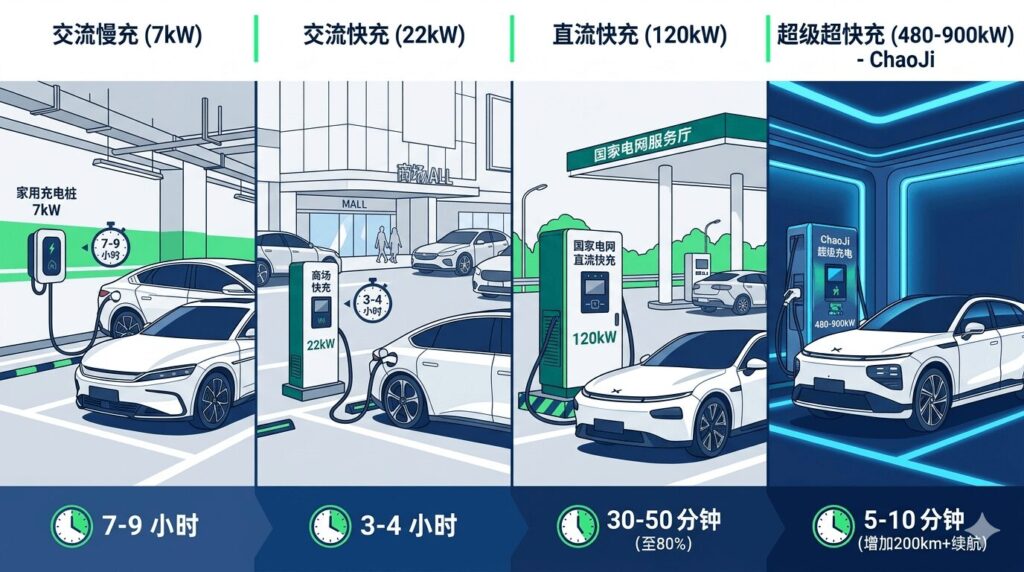
The Five Chinese Charging Speed Categories — What They Mean in Practice
This is the core of the EV charging guide 2026 slow vs fast vs ultra-fast differences in the Chinese market — understanding what each speed category actually delivers in real-world daily and long-distance driving scenarios.
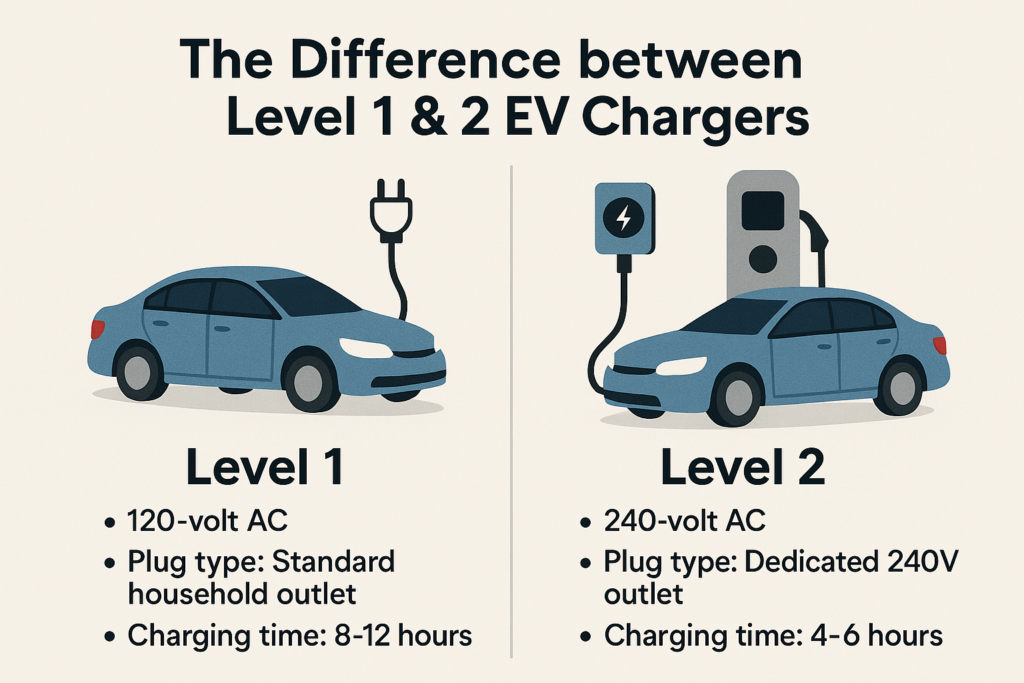
Category 1: Slow AC Home Charging (慢充 / 交流慢充)
Power range: 3.5 kW – 7 kW (residential single-phase 220V, 16A-32A)
Where this happens:
- Home charging units installed in residential underground car parks
- Overnight charging at the vehicle’s parking space
- Workplace charging during working hours
Who installs home charging in China: Home charging installation in China follows a similar process to the UK and Europe — the vehicle owner applies to their residential property management company (物业) for permission to install a charging unit in their assigned parking space. The electrical supply is typically metered separately from the household supply.
The Chinese residential charging permission challenge: Similar to European apartment charging, Chinese residential charging faces building management approval requirements. The rapid adoption of EVs has created significant demand pressure on residential building management companies — many have implemented collective charging infrastructure programmes funded partly by government subsidy and partly by resident contribution.
Charging times at slow AC (7 kW):
| Vehicle | Battery (usable) | 20-80% Time | Full Charge Time |
|---|---|---|---|
| BYD Qin Plus DM-i | 10 kWh (PHEV) | 1.4 hours | 1.9 hours |
| BYD Dolphin | 44 kWh | 5.7 hours | 7.2 hours |
| BYD Han EV | 76.9 kWh | 9.9 hours | 12.6 hours |
| NIO ET5 | 75 kWh | 9.7 hours | 12.2 hours |
| Xpeng P7 | 80.9 kWh | 10.5 hours | 13.3 hours |
| Li Auto L9 (PHEV) | 42.8 kWh | 5.5 hours | 7.0 hours |
| Tesla Model 3 (China-spec) | 60 kWh | 7.8 hours | 9.8 hours |
The practical reality of slow home charging in China: For Chinese EV owners in tier-1 cities with assigned parking and home charging access, overnight slow charging at 7 kW covers daily commuting needs — the typical Shanghai or Beijing commute of 30-50 km consumes approximately 5-8 kWh, easily replaced overnight. Slow home charging is the backbone of daily EV ownership in China exactly as it is in the UK and Europe.
Category 2: Fast AC Public Charging (交流快充)
Power range: 11 kW – 22 kW (three-phase 380V)
Where this happens:
- Commercial car park charging stations
- Shopping centre charging areas
- Hotel and destination charging
- Some residential compound shared charging
Three-phase in China: Unlike the UK (predominantly single-phase residential) and the US (single-phase 240V standard), China’s urban residential and commercial electrical infrastructure is predominantly three-phase 380V — meaning 22 kW AC charging is more widely accessible in China than in the UK.
Key vehicles that accept 22 kW three-phase AC:
- BYD Han EV: 11 kW AC (some variants 22 kW)
- NIO ET7: 11 kW AC
- Xpeng G9: 11 kW AC
- Huawei Aito M9: 11 kW AC
- Zeekr 001: 11 kW AC
Charging times at 22 kW:
| Vehicle | Battery (usable) | 20-80% at 22 kW |
|---|---|---|
| BYD Han EV (11 kW max) | 76.9 kWh | 3.8 hours (limited by car) |
| NIO ET5 (11 kW max) | 75 kWh | 3.7 hours (limited by car) |
| BYD Seal (11 kW max) | 82.5 kWh | 4.1 hours (limited by car) |
The insight: Most current Chinese EVs accept a maximum of 11 kW AC — buying a 22 kW three-phase charger delivers no additional speed benefit for these vehicles. The vehicle’s onboard AC charger ceiling is the effective speed limit, regardless of what the public charger offers.
Category 3: DC Fast Charging (直流快充)
Power range: 30 kW – 120 kW
Where this happens:
- Standard DC fast charging stations at motorway service areas
- Urban fast charging hubs operated by TELD, StarCharge, State Grid
- Shopping centre fast charging areas
- Brand-specific charging networks
The workhorse of Chinese public charging: 50-120 kW DC fast charging is the standard for most public charging locations in China. At 120 kW, a BYD Han EV charges 10-80% in approximately 35 minutes — comparable to European CCS2 charging at similar power levels.
Charging times at 120 kW DC:
| Vehicle | Battery (usable) | 10-80% at 120 kW | Real-world note |
|---|---|---|---|
| BYD Dolphin | 44 kWh | 22 minutes | 60 kW peak actual |
| BYD Han EV | 76.9 kWh | 34 minutes | 120 kW peak |
| BYD Seal | 82.5 kWh | 37 minutes | 120 kW peak |
| NIO ET5 | 75 kWh | 33 minutes | 126 kW peak |
| Xpeng P7 | 80.9 kWh | 36 minutes | 100 kW peak |
| Tesla Model 3 China-spec | 60 kWh | 27 minutes | 170 kW peak (V3) |
| Li Auto L9 | 42.8 kWh | 19 minutes | 100 kW peak |
Category 4: Super Fast Charging (超快充)
Power range: 120 kW – 350 kW
Where this happens:
- Premium motorway service area charging hubs
- BYD Diamond Level charging stations
- Xpeng S4 supercharging network
- State Grid premium charging hubs in tier-1 cities
- New urban charging destinations
The rapidly expanding category: Super fast charging is where China is advancing fastest — 200-350 kW charging is increasingly available at premium locations, and new vehicle models are being specifically designed to accept these speeds.
The 800V architecture advantage: Like the Hyundai Ioniq 5 and Porsche Taycan in Europe, a growing number of Chinese EVs use 800V battery architecture that enables super-fast charging rates. Key 800V Chinese vehicles in 2026:
- BYD Yangwang U9: 500 kW peak DC (the highest of any current production vehicle)
- Xpeng G9 Ultra: 480 kW peak on Xpeng S4 network
- ZEEKR 001 Performance: up to 400 kW
- Huawei Aito M9 Performance: up to 400 kW
- GAC Aion Hyper GT: 480 kW peak
Charging times at 350 kW DC:
| Vehicle | Battery (usable) | 10-80% at 350 kW (if supported) |
|---|---|---|
| Xpeng G9 Ultra (480 kW max) | 98 kWh | 11 minutes |
| ZEEKR 001 (400 kW max) | 100 kWh | 12 minutes |
| BYD Han EV (120 kW max) | 76.9 kWh | 34 minutes (limited by car) |
The critical insight on super-fast charging: The vehicle’s maximum DC acceptance rate is always the ceiling — a BYD Han EV at a 350 kW station charges no faster than at a 120 kW station. Super-fast charging benefit accrues only to vehicles specifically designed for high-power acceptance. This is the same principle as the European compact EV AC charging ceiling discussed in our existing guides.
Category 5: Ultra-Fast Charging (超级快充 / 闪充)
Power range: 350 kW – 900 kW
Where this happens (2026):
- ChaoJi-compatible charging stations at premium motorway locations
- BYD’s next-generation charging hubs
- State Grid’s “super charging corridor” motorway installations
- CATL Shenxing-compatible charging stations
The current ultra-fast charging reality: True ultra-fast charging above 400 kW is not yet widely deployed in 2026 — it exists at specific premium locations and with specific compatible vehicles. But the trajectory is clear: China’s investment in ultra-fast charging infrastructure is the fastest deployment anywhere in the world.
CATL Shenxing Technology: CATL (Contemporary Amperex Technology) — the world’s largest EV battery manufacturer — has developed Shenxing (神行) battery technology specifically for ultra-fast charging:
- Supports 4C charging (4× the battery capacity rate)
- A 100 kWh Shenxing battery can accept 400 kW charging
- 10-80% in approximately 10 minutes at 400 kW
- CATL claims 400 km of range added in 10 minutes with Shenxing batteries at ultra-fast chargers
Vehicles with Shenxing or equivalent ultra-fast capability in 2026:
- BYD Yangwang U9: 500 kW peak
- Various 2025-2026 model year premium Chinese EVs launching with CATL Shenxing cells
- Multiple upcoming models announced for 2026-2027 with 400 kW+ capability
The charging time at ultra-fast (where vehicle supports it):
| Vehicle | Battery | 10-80% at Supported Ultra-Fast Rate |
|---|---|---|
| BYD Yangwang U9 | 83 kWh | 8 minutes at 500 kW |
| CATL Shenxing vehicle (100 kWh) | 100 kWh | 10 minutes at 400 kW |
| Xpeng G9 Ultra | 98 kWh | 11 minutes at 480 kW |
The Major Chinese Charging Networks — Who Operates What
State Grid EV Charging (国家电网 / e充电)
Scale: Largest single charging network operator in the world Coverage: All 31 provinces, municipalities, and autonomous regions Station count: Over 500,000 charging points Speed range: 7 kW AC slow to 350 kW DC fast App: e充电 (e-Charge) — mandatory for accessing State Grid stations Payment: Alipay, WeChat Pay, State Grid app
Strengths: Unmatched geographic coverage including rural areas and smaller cities. Motorway coverage on all major national motorways.
Weaknesses: Pricing is not always the cheapest in urban areas where private operators compete. App interface has been criticised for poor user experience in some regions.
TELD (特来电)
Scale: Largest private EV charging network operator in China Station count: Over 400,000 charging points Speed range: AC slow to 180 kW DC fast App: 特来电 app Payment: Alipay, WeChat Pay, TELD app
Strengths: Strong presence in commercial car parks, shopping centres, and urban locations. Generally competitive pricing. Good app reliability.
Weaknesses: Less motorway corridor coverage than State Grid.
StarCharge (星星充电)
Scale: Second largest private charging network Station count: Over 300,000 charging points Speed range: AC slow to 180 kW DC fast App: 星星充电 app
Strengths: Strong in residential compound charging infrastructure. Often the operator of choice for new residential development EV charging installations.
NIO Power (蔚来能源)
Unique feature: Battery swap + charging hybrid network Swap stations: Over 2,300 across China, expanding Fast charging stations: Integrated with swap network App: NIO app — exclusive to NIO owners
The NIO Power advantage: NIO’s swap station network covers all major motorway routes in China — a NIO owner driving from Shanghai to Beijing can complete the 1,200 km journey with swap stops rather than charging stops, dramatically reducing journey time compared to any charging approach.
Who this is for: NIO vehicle owners only. Not accessible to other brand vehicles.
Xpeng Supercharging (小鹏超充)
Network: Xpeng’s proprietary S4 supercharging network Speed: Up to 480 kW (S4 stations) Coverage: Major motorway corridors and tier-1 cities App: Xpeng app — Xpeng owners have priority; some stations accessible to other vehicles
The S4 distinction: Xpeng’s S4 stations are among the fastest publicly accessible charging points in the world — 480 kW at compatible Xpeng G9 vehicles delivers 10-80% in approximately 11 minutes. This is genuinely ahead of what Ionity’s 350 kW European network offers.
BYD Charging (比亚迪充电)
Network: BYD’s own charging infrastructure plus third-party network integration Speed: BYD DiLink charging hubs up to 480 kW (Yangwang) Coverage: Integrated with State Grid and multiple private operators through BYD’s vehicle app
BYD’s approach: Unlike NIO or Xpeng, BYD doesn’t primarily operate proprietary charging stations — BYD vehicles use the shared GB/T network. BYD’s charging strategy is interoperability with all major networks through the BYD app, rather than building a captive proprietary network.
Huawei/AITO Charging (问界充电)
Network: Huawei’s charging infrastructure for Aito vehicles Speed: Up to 400 kW for compatible Aito M9 variants App: Huawei intelligent charging ecosystem
Charging Costs in China — What You Actually Pay
EV charging costs in China vary significantly by network, location, and time of day. Understanding the cost structure helps optimise charging decisions.
Residential Home Charging Costs
Residential electricity rate in China: The residential electricity rate in China is tiered by province and consumption level. Typical residential rates:
- Base tier: ¥0.45-¥0.55/kWh (approximately £0.05-£0.06/kWh)
- Second tier: ¥0.50-¥0.65/kWh
- Third tier (high consumption): ¥0.80-¥1.00/kWh
The cost advantage of home charging: At ¥0.50/kWh for home charging versus ¥1.20-¥2.00/kWh at public DC fast chargers, home charging is 60-75% cheaper per kWh in China — a larger proportional saving than in the UK or Europe where the home/public cost ratio is smaller.
Annual home charging cost (Shanghai typical commuter, BYD Han EV, 20,000 km/year): 20,000 km ÷ 5.5 km/kWh × ¥0.50/kWh = approximately ¥1,818/year (approximately £200/year)
Comparison with petrol equivalent: 20,000 km in a comparable petrol vehicle at 8L/100 km and ¥7.5/L = approximately ¥12,000/year (approximately £1,320/year)
Annual fuel saving from EV: approximately ¥10,182/year (approximately £1,120/year) — a compelling financial case driving China’s EV adoption.
Public Fast Charging Costs
Typical DC fast charging prices (2026):
- State Grid: ¥1.20-¥1.60/kWh + service fee ¥0.20-¥0.40/kWh = ¥1.40-¥2.00/kWh total
- Private operators (TELD, StarCharge): ¥1.00-¥1.80/kWh + service fee = ¥1.20-¥2.20/kWh total
- Premium ultra-fast (Xpeng S4, BYD Diamond): ¥1.80-¥2.50/kWh + service fee = ¥2.00-¥3.00/kWh total
- NIO swap: approximately ¥25-¥35 per swap (fixed fee regardless of battery size) for BaaS subscribers
Time-of-use pricing in China: Chinese charging networks increasingly offer TOU pricing — lower rates at night (11pm-7am) and higher rates during peak demand (typically 8am-11am and 6pm-10pm). Smart charging from home at off-peak rates is the most cost-effective approach.
Off-peak home charging rate: ¥0.35-¥0.45/kWh (谷电 valley electricity rate) — available in most provinces with smart metering
Specific Vehicle Charging Guides
BYD Han EV
Battery options:
- Standard (76.9 kWh usable): 120 kW DC max, 11 kW AC max
- Long Range (85.4 kWh usable): 120 kW DC max, 11 kW AC max
Charging times:
| Method | Power | 10-80% | Notes |
|---|---|---|---|
| Home slow (7 kW) | 7 kW | 7.5 hours | Overnight standard |
| Public AC (11 kW) | 11 kW | 4.8 hours | Car limits at 11 kW |
| DC fast (120 kW) | 120 kW | 35 minutes | Full 120 kW |
| DC fast (50 kW) | 50 kW | 85 minutes | Common public station |
Best home charger for BYD Han EV: A 7 kW GB/T AC home unit is the correct match. Buying an 11 kW or 22 kW home charger delivers no additional speed — the Han EV accepts only 11 kW maximum, and standard Chinese residential supply is single-phase 220V capped at 7 kW for residential connections.
BYD Seal
Battery options:
- Standard (60.48 kWh usable): 100 kW DC max, 11 kW AC max
- Long Range (82.56 kWh usable): 150 kW DC max, 11 kW AC max
- Performance AWD (82.56 kWh usable): 150 kW DC max, 11 kW AC max
Charging times (Long Range):
| Method | Power | 10-80% |
|---|---|---|
| Home slow (7 kW) | 7 kW | 8.5 hours |
| DC fast (150 kW) | 150 kW | 28 minutes |
| DC fast (50 kW) | 50 kW | 85 minutes |
NIO ET5
Battery options (BaaS swappable):
- Standard (75 kWh): 126 kW DC max, 11 kW AC max
- Long Range (100 kWh): 126 kW DC max, 11 kW AC max
- Ultra Long Range (150 kWh): 126 kW DC max, 11 kW AC max
The NIO charging decision — swap vs charge:
For daily use: Home AC charging at 7 kW covers daily consumption overnight.
For long-distance motorway driving: NIO swap stations (3-5 minutes) vs DC fast charging (30-40 minutes) — the swap advantage is dramatic for long-distance travel.
The Ultra Long Range 150 kWh battery: NIO’s 150 kWh semi-solid-state battery extends range to approximately 900+ km CLTC — with this range, many inter-city journeys are completed on a single charge without any public charging required. For NIO ET5 owners with the 150 kWh battery, public charging infrastructure becomes relevant only for the longest journeys.
Xpeng P7
Battery options:
- Standard (70.8 kWh usable): 100 kW DC max, 11 kW AC max
- Long Range (80.9 kWh usable): 100 kW DC max, 11 kW AC max
- Performance (80.9 kWh usable): 100 kW DC max, 11 kW AC max
Charging times (Long Range):
| Method | Power | 10-80% |
|---|---|---|
| Home slow (7 kW) | 7 kW | 8.3 hours |
| DC fast (100 kW) | 100 kW | 33 minutes |
Li Auto L9 (Extended Range PHEV)
The PHEV charging context: Li Auto uses an extended-range electric vehicle (EREV) architecture — a small petrol engine acts as a generator to charge the battery rather than driving the wheels directly. This creates a different charging profile from pure BEVs.
Battery: 42.8 kWh usable electric battery Electric-only range: approximately 215 km CLTC Total range (petrol + electric): 1,300+ km
Charging times:
| Method | Power | 0-100% |
|---|---|---|
| Home slow (7 kW) | 7 kW | 6.5 hours |
| DC fast (100 kW) | 100 kW | 30 minutes |
| Petrol refuel | N/A | 3-5 minutes |
The Li Auto charging insight: For Li Auto owners, the petrol generator eliminates range anxiety entirely — public charging is a cost optimisation tool rather than a necessity. Home charging overnight keeps the battery topped up for electric-only daily driving. Petrol refuelling covers long-distance travel without planning charging stops.
Tesla Model 3 and Model Y (China-spec)
The China-spec difference: Tesla vehicles sold in China are manufactured at the Tesla Gigafactory Shanghai and use GB/T connectors rather than NACS (US) or CCS2 (Europe). China-spec Teslas are not NACS-compatible without significant modification.
Tesla Model 3 China-spec (Long Range RWD):
- Battery: approximately 60 kWh usable
- AC charging: 11 kW (GB/T)
- DC fast charging: 170 kW (V3 Supercharger), 250 kW on V4 Supercharger
Tesla Supercharger in China: Tesla operates its Supercharger network in China using GB/T V3 and V4 Superchargers — fully compatible with China-spec Teslas. V4 Superchargers in China deliver up to 250 kW.
Charging times (Model 3 Long Range China-spec):
| Method | Power | 10-80% |
|---|---|---|
| Home slow (7 kW) | 7 kW | 6.2 hours |
| AC public (11 kW) | 11 kW | 3.9 hours |
| Supercharger V3 (170 kW) | 170 kW | 22 minutes |
| Supercharger V4 (250 kW) | 250 kW | 16 minutes |
Comparing Chinese and Global Charging Infrastructure
For English-reading Chinese users who divide time between China and international locations, understanding how Chinese and global charging infrastructure compare shapes which vehicle choices and charging strategies make most sense.
Where China Is Ahead
Ultra-fast charging deployment speed: China is deploying 350 kW+ charging infrastructure faster than any other market. While Europe’s Ionity network targets 350 kW and is gradually expanding, China’s premium charging locations already offer 480-500 kW with ChaoJi expansion pushing toward 900 kW.
Station count density: China has the highest density of public EV charging stations of any market — both in urban areas and along motorway corridors. The sheer number of charging options in tier-1 and tier-2 Chinese cities exceeds what any European or North American city offers.
Battery swap technology: NIO’s battery swap network represents a charging speed achievement that no western country has deployed at scale — 3-5 minutes for a full energy replenishment has no equivalent in Europe or the US.
Cost per kWh: Chinese public charging costs (¥1.20-¥2.00/kWh at DC fast) are significantly lower than European equivalents (£0.65-£0.85/kWh at Ionity) in absolute terms and even more so relative to local income levels.
Where Global Markets Are Ahead
Connector standardisation across brands: Europe’s universal Type 2/CCS2 standard means any European EV can use any European charging station without brand-specific considerations. China’s market has more fragmentation — some brand-specific networks (NIO swap, Xpeng S4) are not accessible to other vehicles.
Cross-border compatibility: European EVs travel freely across EU member states using the same CCS2 infrastructure. Chinese EVs using GB/T face compatibility challenges in Europe without adapters. The international expansion of Chinese EV brands (BYD, MG, NIO in Europe) is creating China-spec adapter solutions but cross-market charging remains complex.
Smart tariff integration: The UK’s Octopus Energy smart tariff ecosystem and the Myenergi Zappi/Ohme Home Pro integration represents a level of home charging intelligence that Chinese home charging hardware has not yet matched. Chinese smart charging is advancing rapidly but the specific tariff API integration that UK owners benefit from is more developed in the UK market.
Home Charging Setup in China — Practical Guide
Installing a Home Charger in China
Step 1: Confirm parking space ownership or assignment Home charging in China requires an assigned parking space — either owned or long-term leased. Street parking and shared visitor spaces are not suitable for permanent charger installation.
Step 2: Apply to your 物业 (property management company) Submit a written application to your building’s 物业 for permission to install an EV charging unit. Include:
- Vehicle registration documents
- Proposed charger specification
- Proposed installation location and cable route
- Electrician credentials (most 物业 require a certified installer)
The 物业 approval challenge: As with European apartment building management, Chinese 物业 vary widely in their responsiveness to home charging requests. Urban residential compounds in tier-1 cities typically have established procedures — many have collective charging solutions already installed. Older residential compounds in tier-2 and tier-3 cities may be more challenging.
Step 3: Electricity meter application In most Chinese residential buildings, home EV charging requires a separate electricity meter for the charging circuit — separate from your household electricity meter. Apply to your local electricity supply bureau (供电局) for a dedicated charging meter.
Step 4: Choose and install the charger For single-phase 220V residential supply: a 7 kW GB/T home charging unit is the correct specification for all current Chinese EVs with up to 7 kW AC acceptance rate.
For three-phase 380V supply (available in some newer residential developments): 11 kW or 22 kW three-phase units are available and appropriate for vehicles with 11 kW+ AC capability.
Major Chinese home charger brands:
- 星星充电 (StarCharge): Most widely used residential brand
- 特来电 (TELD): Strong residential and commercial presence
- 万帮 (WallBox China): Not related to European Wallbox — a domestic brand
- 比亚迪 (BYD) home charger: Sold with BYD vehicles
- 小鹏 (Xpeng) home charger: Sold with Xpeng vehicles
- 蔚来 (NIO) home charger: Provided to NIO owners through the NIO home charging programme
Home charger cost in China: Basic 7 kW GB/T home charger: ¥600-¥1,500 (approximately £65-£165) Smart 7 kW home charger with app: ¥800-¥2,500 (approximately £90-£275) Installation cost: ¥500-¥2,000 depending on cable routing complexity
For Chinese EV Owners Abroad — Charging in UK and Europe
This section specifically serves Chinese expats and overseas Chinese students and professionals with Chinese-spec EVs or planning to buy EVs in the UK and Europe.
If You Have a Chinese-Spec EV (GB/T) in Europe
The challenge: Your GB/T vehicle cannot directly use European Type 2 or CCS2 charging infrastructure.
AC charging solution: A GB/T to Type 2 adapter allows your Chinese-spec vehicle to use European Type 2 AC charging stations. Available from specialist EV accessory suppliers. Verify the adapter is certified and rated for the amperage you intend to use.
DC fast charging solution: Cross-standard DC fast charging adapters (GB/T DC to CCS2) are significantly more complex — the communication protocols differ and high-power adapters are not widely available for consumer use. For DC fast charging in Europe with a Chinese-spec EV, options are limited.
Practical recommendation: If you plan to live and drive in Europe for more than 6 months, a European-spec vehicle (with Type 2/CCS2) is more practical than adapting a Chinese-spec vehicle.
If You Are Buying an EV in the UK or Europe
Chinese EV brands sold in Europe — BYD Atto 3, BYD Seal, BYD Han, MG4, MG5, NIO ET5 (European spec) — come with European-spec Type 2 and CCS2 connectors rather than GB/T. They are fully compatible with all UK and European charging infrastructure.
For complete guides on charging these vehicles in the UK and Europe, our charging guide Renault 5 Skoda Enyaq compact EVs Europe 2026 covers compact EV charging in Europe including MG4. For the full UK and European home charger comparison applicable to BYD, MG, and NIO European-spec vehicles, our best Level 2 EV chargers UK Europe 2026 guide covers every major option.
Internal Links — Further Reading on Clean Energy Bazaar
The EV charging guide 2026 slow vs fast vs ultra-fast differences in the Chinese market is the foundation article for cleanenergybazaar.com’s Chinese market content. As additional Chinese market articles are published, this article will link to each.
For readers interested in how Chinese EV brands charge in the UK and European market specifically, our best Level 2 EV chargers UK Europe 2026 guide covers the European charging infrastructure fully. For understanding how the European CCS2 standard compares to the Chinese GB/T standard covered in this guide, our J1772 vs Type 2 EV charger connectors guide explains the European and US connector landscape. For the upcoming EV technology trends including bidirectional and ultra-fast that are first being deployed in China before reaching Western markets, our upcoming EV charger trends 2026-2027 V2G bidirectional guide covers the global technology direction. And for understanding EV charger specifications in plain language — the same kW, kWh, and amperage concepts that apply equally in China as in Europe and the US — our EV charger specs 2026 guide covers every term.
Final Thoughts
The EV charging guide 2026 slow vs fast vs ultra-fast differences in the Chinese market covers a charging landscape that is genuinely different from — and in some dimensions ahead of — Western markets.
The key conclusions:
On standards: GB/T is universal for Chinese domestic vehicles. ChaoJi is the coming ultra-fast standard. Neither is compatible with Western connectors without adapters — a practical consideration for anyone who drives in both Chinese and international markets.
On speed categories: Chinese charging spans from 7 kW slow home charging through to 500+ kW ultra-fast in a way that no other single national market currently matches at the top end. But most daily charging for most Chinese EV owners remains 7 kW overnight home charging — the same as in the UK and Europe.
On networks: State Grid provides universal coverage. TELD and StarCharge provide competitive urban coverage. NIO’s battery swap is the most distinctive Chinese-specific approach — genuinely transforming long-distance travel for NIO owners. Xpeng and BYD’s proprietary super-fast networks are setting global benchmarks for charging speed.
On costs: Home charging in China is approximately £0.05-£0.06/kWh — among the cheapest home charging electricity costs of any major EV market globally. The financial case for home charging over public charging is even stronger in China than in the UK or Europe.
For Chinese EV owners in Europe: European-spec Chinese brand vehicles (BYD Atto 3, MG4, NIO European spec) are fully compatible with European charging infrastructure — no adapters, no compatibility concerns, full access to Type 2 and CCS2 networks.
The Chinese charging market is worth understanding not just for drivers in China — but because the technology being deployed at scale in China today represents what the global EV charging landscape will look like in 3-5 years.