Here is a conversation that happens in EV owner communities every week in 2026.
Someone bought a home EV charger in 2020 or 2021. It works. It charges their car. It has never given them a serious problem. But they’ve been reading about NACS, about bidirectional charging, about smart tariff integration, about load management. Their neighbour just got a new Emporia Pro with solar divert. Their colleague mentions saving £700 a year on Octopus Go with automatic scheduling. Their car’s manufacturer just sent an update that adds features the old charger can’t access.
They ask: should I upgrade?
The honest answer is that most people asking this question are in one of three situations. Some genuinely benefit from upgrading right now — the financial or practical return justifies the cost immediately. Some would benefit from upgrading but not yet — the right trigger hasn’t arrived and waiting costs them nothing. And some don’t need to upgrade at all — their existing setup serves their actual needs adequately and the upgrade would be solving a problem they don’t have.
This guide on when to upgrade your EV charger signs in 2026 for US and Europe users gives you the framework to identify which category you’re in — with specific financial calculations, specific trigger events, and specific upgrade recommendations for each scenario.
The Upgrade Question — Why It’s More Nuanced Than It Appears
Before identifying upgrade signs, establishing why the upgrade question is nuanced prevents the two most common mistakes:
Mistake 1: Upgrading unnecessarily — replacing a functioning charger with a newer model primarily because newer models exist. This generates hardware costs and installation disruption without proportional benefit.
Mistake 2: Not upgrading when the financial case is compelling — staying with a Level 1 cable or a dumb charger on a standard rate tariff while smart chargers with TOU scheduling would save £700-£900 annually. The cost of not upgrading is real and ongoing.
The decision framework is built around a single question: does the annual benefit of upgrading exceed the annualised cost of the upgrade?
Annualised upgrade cost: (Net new charger cost + installation cost – value of existing charger salvage) ÷ expected additional years of service
Annual benefit of upgrading: Electricity savings from smart features + avoided public charging costs + avoided maintenance costs on ageing hardware
When the annual benefit exceeds the annualised cost, the upgrade makes financial sense. When it doesn’t, waiting is the right decision.
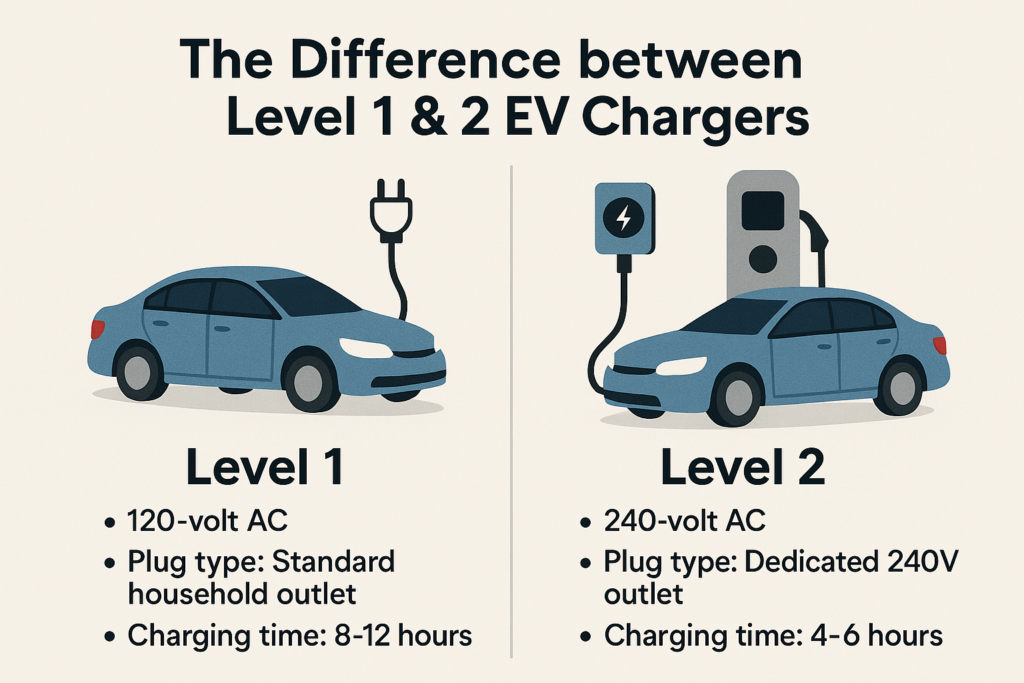
Sign 1: You Are Still Using Level 1 Charging (120V US / Standard Socket Europe)
This is the highest-priority upgrade sign in this entire guide. If you are charging your EV exclusively from a standard household socket — 120V in the US or 230V/13A in the UK/Europe — you are leaving more money on the table than any other single action in home EV ownership could recover.
Why Level 1 Is a Costly Non-Decision
The time cost: A Tesla Model Y Long Range charging from a 120V outlet adds approximately 4-5 miles per hour. A full charge from 20% takes 40+ hours. For most EV owners this means the car is perpetually partially charged — never quite full, always with a slight range anxiety edge.
A Level 2 home charger adds the same Model Y Long Range 20-80% charge in 4.5 hours at 48A. The car is always full in the morning.
The financial cost: Level 1 charging from a standard socket typically means charging whenever convenient rather than during off-peak pricing windows. For a UK EV owner on a standard 28p/kWh tariff charging during evening peak hours versus Octopus Go at 7.5p/kWh overnight:
Annual cost difference (10,000 miles UK):
- Level 1 at 28p/kWh: 3,594 kWh × £0.28 = £1,006/year
- Level 2 smart charger on Octopus Go at 7.5p/kWh: 3,594 kWh × £0.075 = £270/year
- Annual saving from upgrading: £736/year
For a US owner (15,000 miles):
- Level 1 at standard rate $0.16/kWh: 4,929 kWh × $0.16 = $789/year
- Level 2 smart charger at TOU off-peak $0.08/kWh: 4,929 kWh × $0.08 = $394/year
- Annual saving from upgrading: $395/year
The upgrade ROI: A UK flat owner buying a Wallbox Pulsar Plus (£749 net after OZEV grant) + standard installation (£350) = £1,099 net. Annual saving: £736. Payback period: under 18 months.
A US owner buying an Emporia Pro NACS ($399) + installation ($500) – federal credit ($270) – utility rebate ($300) = $329 net. Annual saving: $395. Payback period: under 10 months.
The verdict: If you are still using Level 1 charging and you have parking access that would support a Level 2 installation, upgrade immediately. No other action in this guide delivers comparable financial return. The payback is measured in months, not years.
Sign 2: You Have a Dumb Charger and Are Not on a Smart Tariff
The second most financially significant upgrade trigger in 2026 — you have a Level 2 charger installed (you’ve solved Sign 1) but it’s a non-smart dumb charger and you’re charging at standard electricity rates.
The Annual Cost of a Dumb Charger on Standard Rates
UK example (Rolec WallPod, standard 28p/kWh):
- Annual charging cost: 3,594 kWh × £0.28 = £1,006/year
UK with smart charger on Octopus Go:
- Annual charging cost: 3,594 kWh × £0.075 = £270/year
- Annual saving: £736/year
The upgrade cost: Rolec WallPod to Myenergi Zappi (for solar) or Wallbox Pulsar Plus (for non-solar):
- New charger cost (Wallbox): £649-£799
- Old Rolec WallPod value (resale on eBay): £50-£100
- New installation (replace hardwired unit): £200-£350
- OZEV grant (flat owners): -£350
- Net upgrade cost (flat owner): £149-£449
Payback period: under 8 months even at the higher net cost.
The important caveat — tariff switch first: You don’t necessarily need a new smart charger to access TOU savings if your existing car has a built-in charging timer. For Octopus Go’s fixed overnight window, your car’s timer captures most of the saving without a charger upgrade.
Upgrade is clearly justified if:
- Your car doesn’t have a built-in charging timer
- You want Octopus Agile dynamic scheduling (requires charger API integration)
- You have solar panels (requires solar divert capability)
- Your 100-amp panel needs load management
Upgrade may not be necessary if:
- Your car has a reliable built-in timer
- You’re on a simple fixed overnight TOU tariff
- You don’t have solar panels
Even if your car’s timer handles TOU scheduling, upgrading to a smart charger with monitoring gives you visibility into charging costs and consumption that identifies further optimisation opportunities. But pure financial justification requires calculating the specific additional saving the smart charger delivers over and above what your car’s timer already provides.
Sign 3: Your Connector Standard No Longer Matches Your Vehicle
This is the most distinctly 2026 upgrade trigger — the connector transition from J1772 to NACS in the US has created a specific upgrade scenario that didn’t exist three years ago.
The J1772-to-NACS Upgrade Scenario (US)
The situation: You have a J1772 home charger installed (ChargePoint Home Flex, Emporia Pro J1772, Grizzl-E Classic J1772). You’ve just taken delivery of a 2025+ Ford Mustang Mach-E, a 2025+ GM Ultium vehicle, a 2025+ Rivian, or any other new NACS-native vehicle.
What this means for your existing charger: Your J1772 charger can charge your new NACS vehicle — via a NACS-to-J1772 adapter. This is functional but adds the adapter as a daily connection point: extra wear, occasional forgetting, adapter left in the car when you need it at the house.
Is it worth upgrading the charger for connector reasons alone?
Financially, the adapter solution costs approximately $25-$50 and works indefinitely. The daily inconvenience is minor. The upgrade cost for a new NACS charger ranges from $229-$699 plus installation.
Upgrade is worth it if:
- The adapter is genuinely inconvenient in your specific setup
- You’re also upgrading for smart feature reasons (Sign 2) — at which point you should specify NACS rather than J1772 for the new unit at no additional cost
- Your existing J1772 charger is ageing and approaching replacement anyway (see Sign 6)
Upgrade is not necessary if:
- The adapter solution is working fine
- Your existing charger still serves your actual needs
- No other upgrade sign applies
The European connector scenario: European EV owners face no equivalent connector transition — Type 2 is and will remain universal. No European EV owner needs to upgrade their charger for connector compatibility reasons in 2026 or the foreseeable future.
Sign 4: You Have Solar Panels and No Solar Divert Capability
The solar panel + non-solar-integrated charger combination is a significant ongoing financial opportunity cost that justifies the upgrade calculation.
The Annual Solar Divert Opportunity Cost
UK homeowner with 4 kWp solar, Rollec WallPod (no solar divert):
Solar surplus available for EV charging: approximately 600-700 kWh annually (based on 4 kWp UK generation less home consumption)
Cost of buying this electricity from grid at Octopus Go instead of using solar: 700 kWh × £0.075/kWh = £52.50 annually in avoidable grid electricity costs
Value of using surplus solar for EV charging: 700 kWh × £0.075 = £52.50 saved vs grid + 700 kWh × £0.065 (foregone SEG export) = £45.50 cost Net saving from solar divert over exporting: £52.50 – £45.50 = £7/year
Wait — that’s much smaller than expected. The solar divert saving calculation for UK solar owners on the Smart Export Guarantee is more nuanced than most guides present. The financial case for upgrading solely for solar divert depends heavily on:
- Your SEG export rate (if low: 3-5p/kWh, solar divert saves more vs exporting)
- Your grid import rate (if high: 28p/kWh standard vs 7.5p Go, grid import at Go rate reduces solar divert value)
- Your solar system size (larger systems generate larger surpluses with more divert value)
The correct UK solar divert calculation:
True saving = kWh diverted × (grid import rate – SEG export rate)
At Octopus Go (7.5p import) and 4p SEG export: 700 kWh × (7.5p – 4p) = 700 × 3.5p = £24.50/year
At standard rate (28p import) and 4p SEG export: 700 kWh × (28p – 4p) = 700 × 24p = £168/year
The critical solar divert insight: Solar divert saves the most for owners NOT on a smart tariff. At standard 28p/kWh import rates, using surplus solar for EV charging saves £168/year on a 4 kWp system. But switching to Octopus Go (7.5p overnight) and simply charging overnight at the cheap rate saves £736/year (as calculated earlier) — far more than solar divert.
For a UK owner with solar:
- Switch to Octopus Go first — saves £736/year
- Add Myenergi Zappi solar divert on top of Octopus Go — saves an additional £24.50/year at Go rates
The combined annual saving: £760/year. Upgrade cost (Rolec to Zappi, flat owner with OZEV): net approximately £250-£450. Payback: under 8 months.
US solar owner calculation: At PG&E EV2-A super off-peak rates ($0.07/kWh) vs net metering export ($0.03/kWh): 1,500 kWh solar surplus × ($0.07 – $0.03) = $60/year additional saving from solar divert over exporting
At standard rate ($0.25/kWh) vs net metering ($0.03/kWh): 1,500 kWh × ($0.25 – $0.03) = $330/year from solar divert
For US solar owners without smart charger: upgrading to Emporia Pro + Vue delivers both TOU savings AND solar divert — combined annual value of $400-$900 depending on solar system size and current tariff.
The verdict: If you have solar panels and a non-solar-integrated charger, the upgrade justification depends on your current electricity tariff. At standard rates, upgrade immediately — solar divert saves hundreds annually. At already-optimised TOU rates, the marginal solar divert value is smaller but still worth calculating for your specific system.
Sign 5: Your Home Has Changed in Ways Your Charger Wasn’t Designed For
Several changes to your home circumstances create specific upgrade triggers that have nothing to do with the charger itself ageing.
Sign 5A: You’ve Moved to a Property with Different Electrical Infrastructure
Scenario: You moved from a 200-amp panel house to a 100-amp panel house. Your ChargePoint Home Flex set to 48A trips the breaker regularly.
Upgrade action: Emporia Pro + Vue with dynamic load management — the most cost-effective solution for the new panel capacity constraint, avoiding a $1,500-$4,000 panel upgrade.
Scenario: You moved from a single-phase UK home to a continental European three-phase property. Your UK 7.4 kW single-phase Wallbox Pulsar Plus works but your ID.4 Pro Performance could charge at 11 kW on three-phase hardware.
Upgrade action: Three-phase Easee One or three-phase Wallbox Pulsar Plus to unlock your vehicle’s full AC charging capability. Payback: the 4-hour reduction in charging time (from 7.4 kW to 11 kW for a weekly 20-80% charge) has indirect value but not direct financial value unless you’re frequently time-constrained on charging.
Sign 5B: You’ve Added Solar Panels
If you installed solar panels after your EV charger, and your charger has no solar integration capability, this is Sign 4 applied retroactively. See Sign 4 above.
Sign 5C: You’ve Added a Second EV to the Household
Sign 5C is one of the most common upgrade triggers in 2026 as two-EV households proliferate.
The single-charger two-EV scenario: Your household has one 48A home charger and has just taken delivery of a second EV. One charger, two vehicles, panel capacity designed for one charging circuit.
Upgrade options:
Option A: Add a second charger
- If panel headroom exists: Install a second 48A dedicated circuit and charger
- If panel headroom is limited: Install Emporia Pro + Vue load management to coordinate both chargers within available capacity
- Our case study US family with two EVs Tesla plus Ford Mach-E charging setup covers this exact scenario with real costs
Option B: Upgrade to a load-managed charger system
- Two Easee One chargers with Easee Equalizer (Europe) — dynamic sharing between both vehicles
- Two Emporia Pro chargers with shared Vue (US) — coordinated load management
The specific connector complexity of second EV additions: If the second EV has a different connector standard from the first (NACS + J1772, or different European brands with same Type 2 but different smart charging protocols), hardware selection for the second charger needs to account for this.
Sign 5D: You’ve Moved to a Different Electricity Tariff That Your Charger Can’t Optimise For
Scenario: You’ve switched to Octopus Agile but your existing charger only supports static scheduling. You’re capturing most overnight savings but missing the dynamic window optimisation that Agile API integration provides.
Upgrade action (UK): Ohme Home Pro — the only charger with direct Octopus Agile API integration that captures the cheapest 30-minute pricing windows automatically.
Annual additional saving from Agile API upgrade: £50-£150/year (additional saving over static overnight scheduling) Upgrade cost (replacing existing charger): Net £300-£500 Payback: 2-4 years — justified but not urgent unless you’re also triggering other upgrade signs simultaneously.
Sign 6: Your Existing Charger Shows Hardware or Software Decline
Sign 6A: Physical Hardware Deterioration
Symptoms that indicate replacement is approaching:
- Connector locking mechanism requires multiple attempts to engage reliably
- Cable jacket showing significant cracking or stiffening, particularly near connector
- Enclosure showing UV degradation (yellowing, brittleness) with potential IP protection compromise
- Indicator lights showing inconsistent behaviour not resolved by firmware update
- Charging session initiation failures occurring more than once per month
The decision framework: Is repair cost justified versus replacement cost?
Repair justified: Single component failure (connector replacement, cable replacement) where repair cost is under 40% of replacement + installation cost, charger is otherwise fully functional, and you’re within warranty.
Replacement justified: Multiple component failures, out-of-warranty repairs exceeding 40% of replacement cost, or physical deterioration suggesting IP protection compromise.
Sign 6B: Software and Smart Feature Degradation
Symptoms of software decline:
- Manufacturer has stopped releasing firmware updates for your specific model
- App no longer supports your charger model in newer versions
- Smart features work inconsistently — TOU scheduling triggers randomly, solar divert stops responding
- The cloud service your charger relies on has been discontinued or consolidated
The most common 2026 software decline scenario: Older smart chargers from brands that have restructured, been acquired, or discontinued specific product lines. JuiceBox owners who experienced the Enel X Way corporate changes faced this in 2023-2024. Charger owners whose brands have exited the market face it more permanently.
If your charger’s app is no longer receiving updates: The charger’s core function (delivering electricity to your vehicle) continues. The smart features (scheduling, monitoring, tariff integration) degrade gradually as APIs change and app support lapses. The financial cost of losing TOU scheduling is £736/year in the UK and $395/year in the US — this is the annual cost of a non-functional smart charger relative to a functional one.
Replacement justified when: Smart feature degradation costs more annually than the replacement charger’s annualised cost.
Sign 6C: Out-of-Warranty Recurring Repairs
If your charger is generating recurring repair costs:
- Two or more out-of-warranty repairs within a 12-month period
- Any repair whose cost exceeds 30% of a new equivalent charger’s cost
- Repair requiring specialist parts that have long lead times or are becoming unavailable
At this point, the reliability uncertainty of continuing with a degrading charger — including the risk of complete failure on a critical morning — combined with ongoing repair costs makes replacement financially preferable to continued repair.
Sign 7: New Technology Creates Meaningful Financial Value You’re Missing
Sign 7A: Bidirectional V2H Capability
Is bidirectional charging a current upgrade trigger in 2026?
Honest answer: for most users, not yet.
V2H (vehicle-to-home) technology is real and deployable in limited scenarios in 2026 — Ford F-150 Lightning + Ford Pro Intelligent Backup Power, Nissan Leaf + CHAdeMO bidirectional setup, some European pilot programmes. But mainstream consumer V2H — where you buy a standard home charger, connect it to any modern EV, and earn meaningful money from grid arbitrage — is not yet commercially mature enough to justify upgrading specifically for bidirectional capability.
Upgrade for bidirectional is justified if:
- You have a Ford F-150 Lightning and the Ford Pro IBS system has become financially compelling in your market
- You have a Nissan Leaf and live in a market with active V2G programme participation opportunities
- You’re due to upgrade for other reasons (Signs 1-6) and bidirectional hardware readiness in the replacement charger costs nothing extra
Upgrade for bidirectional is not justified if:
- No compatible vehicle currently in your household
- The specific V2H programme for your vehicle and market is not commercially deployed
- You’re otherwise satisfied with your current charger
The right bidirectional preparation is: when upgrading for other legitimate reasons, choose a charger with bidirectional hardware readiness (Wallbox Pulsar Plus, Tesla Wall Connector roadmap) rather than paying a premium to upgrade specifically for bidirectional capability that isn’t yet delivering financial return.
Sign 7B: OCPP 2.0.1 for Emerging Smart Grid Programmes
Is OCPP 2.0.1 a current upgrade trigger?
For residential users in 2026: not yet for most buyers.
OCPP 2.0.1 becomes relevant when your utility offers demand response or virtual power plant programmes that specifically require OCPP 2.0.1 charger compatibility. Xcel Energy’s Colorado smart charging programme, some California utility VPP programmes, and emerging EU smart grid initiatives are moving in this direction — but residential OCPP 2.0.1 requirements are not yet widespread.
Upgrade for OCPP 2.0.1 is justified if:
- Your specific utility programme explicitly requires OCPP 2.0.1 and offers financial rewards that justify the upgrade cost
- You’re upgrading for other reasons and choosing between chargers at similar prices
Upgrade for OCPP 2.0.1 is not justified if:
- No specific financial programme requires it in your market
- You’d be paying a premium over OCPP 1.6 alternatives purely for future potential
Sign 7C: Higher Power AC Charging for a New Vehicle
The scenario: Your current charger is a 32A (7.4 kW) single-phase unit. You’ve just bought a Ford F-150 Lightning Extended Range with 19.2 kW (80A) AC capability or a Lucid Air Grand Touring with 22 kW (European) AC capability.
The charging time difference: F-150 Lightning Extended Range (123 kWh usable):
- At 32A (7.4 kW): 20-80% takes approximately 11.5 hours
- At 80A (19.2 kW): 20-80% takes approximately 4.5 hours
Is the 7-hour difference worth upgrading for?
For most daily charging scenarios — plug in when you arrive home, full by departure — the 11.5 hours is adequate if you arrive home by 8pm and depart at 7:30am. If your daily schedule allows this, the speed upgrade has convenience value but limited financial value.
Upgrade is justified if:
- You regularly arrive home late (after 10pm) with low charge (below 30%)
- You regularly need to depart early (before 7am)
- The combination of arrival time, departure time, and arrival SOC makes the 11.5-hour window genuinely insufficient
The installation requirement: Upgrading to 80A charging requires a 100A dedicated circuit — significantly more electrical work than a standard 50A circuit installation. US installation cost: $800-$1,500 additional. This changes the upgrade financial case significantly — the installation cost needs to be justified by the charging speed value.
Sign 8: Your Charger Is Approaching End of Expected Service Life
Understanding EV Charger Lifespan
Home EV chargers are typically designed for a 10-15 year service life, with the following component lifespan considerations:
Electronics (control board, WiFi module, display): 8-12 years in typical indoor conditions, 6-10 years in demanding outdoor conditions
Cable and connector: 5-10 years depending on usage intensity and environmental conditions
Enclosure: 10-15 years for metal, 8-12 years for polycarbonate (UV degradation dependent)
Contactor: Rated for 100,000-500,000 switching cycles — at daily use (365 cycles/year), this represents 274-1,370 years of theoretical life. In practice, contamination and arcing degrade contactors before the cycle count is reached: typically 10-15 years for well-protected units.
The Age-Based Upgrade Trigger
Charger installed 2018-2019 (6-7 years old in 2026): Approaching the range where smart electronics may begin showing degradation. Not yet requiring replacement but worth assessing:
- Has the charger received firmware updates in the past 12 months? If not, software support may be waning.
- Is the cable showing any stiffening or jacket cracking?
- Is the connector locking reliably on every connection?
If these assessments are positive, continue using. If any concerns arise, prioritise resolution.
Charger installed 2016-2017 (8-10 years old in 2026): The original generation of residential smart chargers is now 8-10 years old. These units were designed before NACS standardisation, before smart tariff API integration, before load management as a standard feature. They may still charge reliably but they lack every smart feature that delivers ongoing financial value.
Upgrade is almost certainly justified for 2016-2017 chargers — not because they’re broken but because the annual electricity savings from a modern smart charger on a modern tariff exceed the upgrade cost within 12-18 months.
Charger installed before 2015 (10+ years old in 2026): First-generation home EV chargers are genuinely approaching end of expected service life. Software support has almost certainly lapsed. Connector and cable wear is significant. Replacement is the appropriate action — the question is which replacement to choose rather than whether to replace.
The Upgrade Decision Matrix
Use this matrix to identify your upgrade priority:
| Sign | Situation | Annual Cost of NOT Upgrading | Upgrade Priority |
|---|---|---|---|
| Sign 1 | Level 1 charging only | £736-$789+/year | 🔴 Immediate |
| Sign 2 | Dumb charger, standard rate | £736-$395/year | 🔴 Immediate |
| Sign 3 | J1772 charger, NACS vehicle | Minor inconvenience | 🟡 Next upgrade cycle |
| Sign 4 | Solar panels, no solar divert | £24-£168/$60-$330/year | 🟠 Soon (within 12 months) |
| Sign 5A | Moved home, different infrastructure | Panel trips or speed loss | 🟠 Soon |
| Sign 5B | Added solar panels | Same as Sign 4 | 🟠 Soon |
| Sign 5C | Second EV added | Panel overload risk | 🟠 Soon |
| Sign 5D | Upgraded to Agile tariff | £50-£150/year additional | 🟡 Worth calculating |
| Sign 6A | Hardware deterioration | Reliability risk | 🟠 Plan replacement |
| Sign 6B | Software/app degraded | £395-£736/year (TOU lost) | 🔴 Immediate if TOU lost |
| Sign 6C | Recurring repairs | Repair costs + reliability | 🟠 Replacement justified |
| Sign 7A | V2H capability | None currently | 🟢 Wait |
| Sign 7B | OCPP 2.0.1 | None for most users | 🟢 Wait |
| Sign 7C | Higher power for new vehicle | Convenience (calculate) | 🟡 Calculate specific case |
| Sign 8 (2018-19) | 6-7 year old charger | Minimal if still functional | 🟡 Assess annually |
| Sign 8 (2016-17) | 8-10 year old charger | Significant smart feature gap | 🟠 Upgrade within 12 months |
| Sign 8 (pre-2015) | 10+ year old charger | Reliability + feature gap | 🔴 Replace now |
What to Upgrade To — Specific Recommendations by Scenario
US: Upgrading from Level 1 or Dumb J1772 Charger
Without solar, NACS vehicle: → Tesla Wall Connector Gen3 ($425) — 4-year warranty, NACS native, seamless integration
Without solar, J1772 vehicle: → ChargePoint Home Flex ($699) — most flexible J1772 option with OCPP
With solar, any connector: → Emporia Pro + Vue ($574) — solar divert + TOU + load management at best value
100-amp panel, any connector: → Emporia Pro + Vue ($574) — load management avoids panel upgrade
Cold climate (Minnesota, Montana, Alberta): → Grizzl-E Ultimate ($399-$449) — internal heating, -40°C, IP67
UK: Upgrading from Level 1 or Dumb Charger
With solar: → Myenergi Zappi (£699-£849) — best solar divert at any price
On Octopus Agile: → Ohme Home Pro (£699-£799) — direct Agile API integration
On Octopus Go or standard TOU: → Wallbox Pulsar Plus (£649-£799) — best overall + bidirectional roadmap
Flat owner, budget priority after OZEV grant: → Rolec WallPod (£99-£199 after grant) — lowest net cost smart charger
Europe: Upgrading from Level 1 or Dumb Charger
With three-phase supply, 11 kW vehicle: → Easee One Three-Phase (€499-€649) — best value three-phase
With solar: → Myenergi Zappi (€749-€899) — best solar divert
Norway/Scandinavia, Tibber user: → Easee One (€499-€649) — designed for Nordic conditions with Tibber integration
General European best overall: → Wallbox Pulsar Plus (€699-€849) — widest installer network, bidirectional roadmap
The Upgrade Process — What Happens to Your Old Charger
Resale Options
For chargers less than 5 years old in good working condition:
- Facebook Marketplace, eBay, and specialist EV owner community marketplaces
- Expected resale value: 25-45% of original purchase price
- Grizzl-E Classic in particular holds resale value well in North American markets due to its hardware reputation
- Smart chargers with functional apps command better resale than chargers with degraded software support
For chargers 5-10 years old:
- Resale value drops significantly — £20-£80 / $20-$80 for functional but dated units
- Charity donation to EV charging access organisations (some UK and US charities accept working hardware)
- Responsible electronics recycling — most local authority household waste recycling centres accept WEEE (Waste Electrical and Electronic Equipment)
Deinstallation Considerations
Hardwired charger removal (UK/Europe): Removal of a hardwired charger is notifiable work under Part P (UK) — requires an OZEV-registered electrician who will provide an Electrical Installation Certificate for the removal. The dedicated circuit from the consumer unit may be left capped and available for the new installation.
Hardwired charger removal (US): A licensed electrician should disconnect the hardwired unit from the dedicated circuit. The circuit itself can remain in place for the new installation. A permit may be required for the removal and reinstallation depending on local jurisdiction requirements.
NEMA 14-50 plug-in charger removal (US): No professional requirement — unplug and remove. The NEMA 14-50 outlet remains for the replacement unit (if also plug-in) or for other 240V applications.
The Total Upgrade Cost Calculator — Working Out Your Specific Numbers
Use this framework to calculate whether upgrading makes financial sense for your specific situation:
Step 1: Calculate Annual Cost of Staying
Annual electricity cost at current setup:
Annual kWh × current electricity rate = £/$/€ ___

Annual electricity cost with upgraded setup:
Annual kWh × optimal rate (TOU/solar) = £/$/€ ___

Annual cost of staying = Current cost - Upgraded cost = £/$/€ ___ per year
Step 2: Calculate Net Upgrade Cost
New charger cost: £/$/€ ___
Installation cost: £/$/€ ___
Companion devices (Vue, CT clamp): £/$/€ ___
Less: All applicable grants/credits: -£/$/€ ___
Less: Old charger resale value: -£/$/€ ___
Net upgrade cost = £/$/€ ___
Step 3: Calculate Payback Period
Net upgrade cost ÷ Annual saving = ___ years to break evenStep 4: Calculate 5-Year Return
Annual saving × 5 - Net upgrade cost = 5-year net returnDecision rule: If payback period is under 3 years and 5-year return is positive, upgrade makes clear financial sense. If payback period is 3-5 years, calculate whether the non-financial benefits (reliability, convenience, smart features) tip the decision. If payback period exceeds 5 years, upgrading is unlikely to be financially justified on electricity savings alone — other factors (hardware failure, connector incompatibility) need to drive the decision.
Internal Links — Further Reading on Clean Energy Bazaar
When to upgrade your EV charger signs in 2026 for US and Europe users connects to every dimension of the charging ecosystem covered across this site.
For the time-of-use savings calculation that drives the most compelling upgrade justification, our time-of-use EV charging savings smart chargers that cut bills in US and Europe guide gives specific numbers for every tariff. For the ROI calculator that formalises the financial framework in this article, our EV home charger ROI calculator 2026 provides exact payback periods. For the 5-year true cost analysis that puts upgrade costs in long-term context, our 5-year true cost of home EV charger ownership 2026 US vs Europe comparison covers every component. For the warranty comparison covering what you gain and lose when upgrading between brands, our EV charger warranty comparison 2026 best coverage from top brands guide covers every warranty term. For the maintenance comparison that identifies when hardware decline justifies replacement, our EV charger maintenance 2026 brand comparison US Grizzl-E vs Europe Wallbox guide covers every reliability dimension. For the troubleshooting guide covering whether your current charger’s faults are fixable or warrant replacement, our troubleshooting home EV chargers common fixes for US and European models guide covers the complete diagnostic picture. For the interactive selector tool that recommends the specific replacement charger for your situation, our interactive EV charger selector tool US NACS J1772 or Europe Type 2 edition narrows to your recommendation in seven questions. And for the US rebates that reduce the net upgrade cost in the financial calculation, our US EV charger rebates by state 2026 guide covers every major programme.
Final Thoughts
When to upgrade your EV charger signs in 2026 for US and Europe users comes down to one honest framework: calculate whether the annual cost of not upgrading exceeds the annualised cost of upgrading. When it does, upgrade. When it doesn’t, wait.
The clear upgrade cases:
- Level 1 charging: upgrade immediately, payback under 10-18 months
- Dumb charger on standard rate: upgrade immediately, payback under 18 months
- Smart charger with degraded software: upgrade when annual smart feature value lost exceeds annualised replacement cost
- Hardware deteriorating beyond economical repair: replace now
The wait cases:
- J1772 charger with functional NACS adapter: wait for next natural replacement cycle
- Functional smart charger, V2H as sole motivation: wait for mainstream V2H deployment
- 6-7 year old charger in good condition: annual assessment, no immediate action required
The calculate cases:
- Solar panels without solar divert: calculate specific annual saving for your system size and tariff
- Higher power for new vehicle: calculate whether charging time gap causes genuine daily inconvenience
- OCPP 2.0.1 for smart grid programmes: calculate whether your utility’s programme financial return justifies the upgrade premium
The cost of unnecessary upgrading is a few hundred pounds or dollars of avoidable expenditure. The cost of not upgrading when the financial case is clear is measured in hundreds of pounds or dollars every year — compounding silently until someone does the calculation and discovers what they’ve been leaving on the table.
Do the calculation. Then act accordingly.