You’ve just bought an EV. Or you’re about to. Either way, at some point in the near future you’re going to stand at a public charging station, look at the cable hanging from the unit, and wonder whether it fits your car.
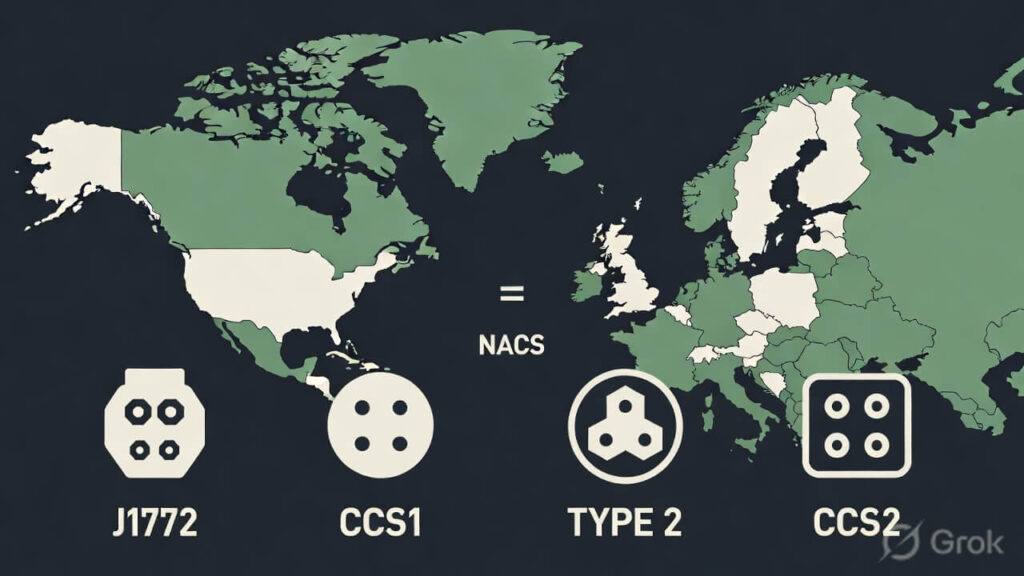
If you’re in the US, that cable is probably a J1772. If you’re in Europe, it’s almost certainly a Type 2. The J1772 vs Type 2 EV charger connector question is one of the first things every new EV owner needs to understand — and one of the last things most dealerships bother to explain properly.
If you’re travelling between the two continents — or buying a car that was originally sold in one market and is now being used in another — the confusion gets real fast. This guide breaks down everything you need to know about the J1772 vs Type 2 EV charger connector — what each one is, how they differ technically, which cars use which, how charging speeds compare, and what happens when you’re in the wrong country with the wrong plug.
What Is the J1772 Connector?
The J1772 — officially called the SAE J1772 — is the standard AC charging connector for electric vehicles in North America. It was developed by the Society of Automotive Engineers and became the dominant EV charging standard in the US and Canada from around 2010 onward.
If you own any non-Tesla EV bought in the US before 2023 — a Nissan Leaf, Chevrolet Bolt, Hyundai Ioniq 5, Ford Mustang Mach-E, Kia EV6 — your car’s AC charging port accepts a J1772 connector. Every Level 1 and Level 2 public charging station in the US uses J1772 for AC charging. Understanding the J1772 vs Type 2 EV charger connector difference starts here — with knowing which standard your car was built around.
What Does a J1772 Connector Look Like?
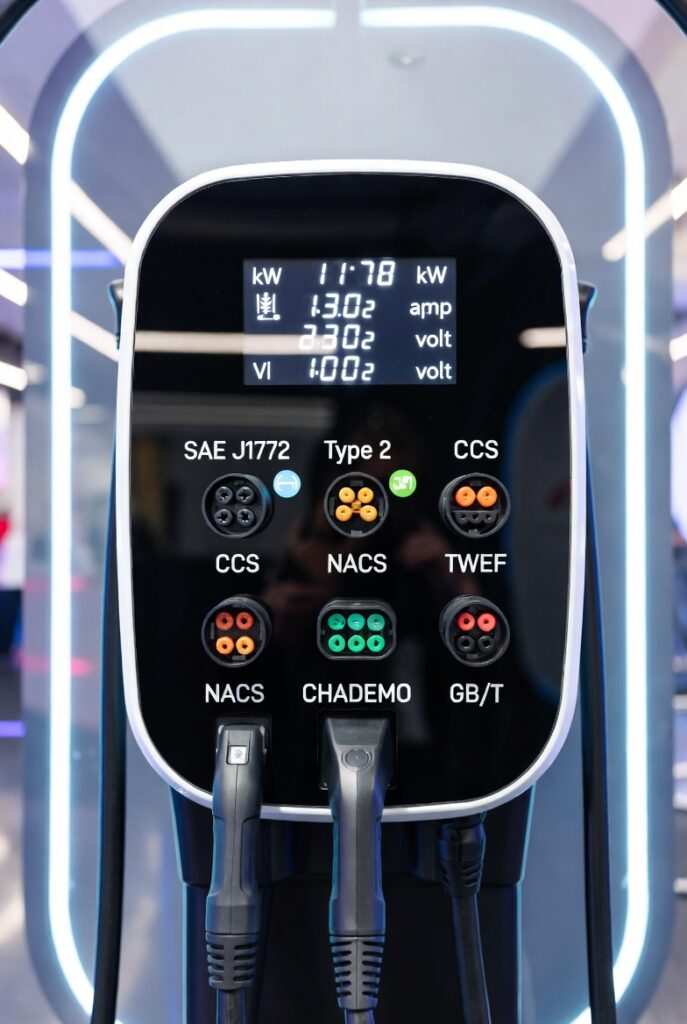
The J1772 is a round connector roughly the size of a large fist. It has five pins arranged in a specific pattern:
- Two large power pins (Line 1 and Neutral) for carrying the actual charging current
- One ground pin for safety earthing
- One pilot pin that handles communication between the charger and the car
- One proximity pin that tells the car a connector is plugged in
The connector clicks into the car’s charging port with a latch mechanism. To remove it, you press a button on the handle that releases the latch. It’s a robust design that has held up well across millions of daily charging sessions over 15 years.
J1772 Technical Specs
- Voltage: 120V (Level 1) or 240V (Level 2)
- Maximum current: 80 amps
- Maximum power: 19.2 kW (at 240V, 80A)
- Phases: Single phase only
- DC charging: Not supported — J1772 is AC only
That last point matters. J1772 handles AC charging only. For DC fast charging in the US, the older standard was CCS1 — which is essentially a J1772 connector with two additional DC pins added at the bottom. The newer NACS standard handles both AC and DC in a single smaller connector.
What Is the Type 2 Connector?
The Type 2 connector — officially IEC 62196 Type 2, sometimes called the Mennekes connector after the German manufacturer that originally designed it — is the standard AC charging connector for electric vehicles across Europe. It was adopted as the mandatory European EV charging standard by EU regulation in 2013.
If you own any EV sold in Europe — a Volkswagen ID.4, BMW iX, Renault Zoe, Tesla Model 3 (European version), Hyundai Ioniq 6, Peugeot e-208 — your car’s AC charging port accepts a Type 2 connector. Every public Level 2 charging station in Europe uses Type 2 for AC charging. In the J1772 vs Type 2 EV charger connector comparison, Type 2 is the European answer to what J1772 does in North America — but with some meaningful technical differences that give European EV owners a speed advantage at public stations.
What Does a Type 2 Connector Look Like?
The Type 2 is also a round connector, roughly similar in size to the J1772 but with a distinctly different pin arrangement. It has seven pins:
- Three power pins (L1, L2, L3) for single or three-phase power
- One neutral pin
- One ground pin
- One pilot pin for charger-to-car communication
- One proximity pin for connection detection
The Type 2 connector uses a flat-faced design with a slightly different locking mechanism from J1772. On most European public chargers, the cable is attached to the station and you plug into your car. On home chargers and some portable units, the cable is attached to the car and you plug the Type 2 end into the station’s socket.
Type 2 Technical Specs
- Voltage: 230V (single phase) or 400V (three phase)
- Maximum current: 63 amps per phase
- Maximum power: 43.5 kW (three phase, 63A) — though 22 kW is the practical standard at most public stations
- Phases: Single phase or three phase
- DC charging: Not supported natively — CCS2 adds DC pins below the Type 2 AC section
J1772 vs Type 2 EV Charger Connector — The Key Differences That Matter
Now that both connectors are defined, here’s how the J1772 vs Type 2 EV charger connector comparison plays out across the things that actually matter to EV owners day to day:
Charging Speed
This is where Type 2 has a genuine technical advantage over J1772.
J1772 is a single-phase connector. No matter how capable your car’s onboard charger is, a J1772 connection maxes out at 19.2 kW in the US (240V, 80A). In practice, most US home and public Level 2 chargers deliver 7.2 kW to 11.5 kW.
Type 2 supports three-phase power. This means a Type 2 connection can theoretically deliver up to 43.5 kW on AC — and practically, most European public stations deliver 22 kW as standard. For a car with a 22 kW onboard AC charger, a Type 2 connection at a 22 kW station adds roughly 120-150 km of range per hour.
For everyday home charging the difference is less dramatic — most European home chargers deliver 7.4 kW or 11 kW on Type 2, which is comparable to a good US Level 2 J1772 setup. But at public stations, the three-phase advantage gives European EV owners meaningfully faster AC charging than their US counterparts. This speed difference is one of the most important practical outcomes of the J1772 vs Type 2 EV charger connector comparison for anyone choosing between markets.
Physical Compatibility
J1772 and Type 2 are not physically compatible. You cannot plug a J1772 cable into a Type 2 socket or vice versa without an adapter. The pin arrangements, locking mechanisms, and connector shapes are all different.
This matters if you’re:
- Taking a US-spec EV to Europe or vice versa
- Buying a used EV that was originally sold in a different market
- Using a charging station that was installed for a different regional standard
Adapters exist for both directions — J1772-to-Type-2 and Type-2-to-J1772 — but they add complexity and are not always available at the station when you need them.
DC Fast Charging Compatibility
Neither J1772 nor Type 2 supports DC fast charging natively. Both standards were designed for AC charging only.
DC fast charging in the US uses CCS1 (J1772 base with DC pins added) or NACS. DC fast charging in Europe uses CCS2 (Type 2 base with DC pins added). Tesla’s Supercharger network uses NACS in the US and CCS2 in Europe.
The relationship between AC and DC connectors is worth understanding clearly:
US: J1772 (AC) → CCS1 (AC + DC) → NACS (AC + DC, newer standard) Europe: Type 2 (AC) → CCS2 (AC + DC)
Your car has separate ports for AC and DC charging in most cases — the J1772 or Type 2 port for everyday charging and a separate CCS or NACS port for fast charging. Some vehicles combine them.
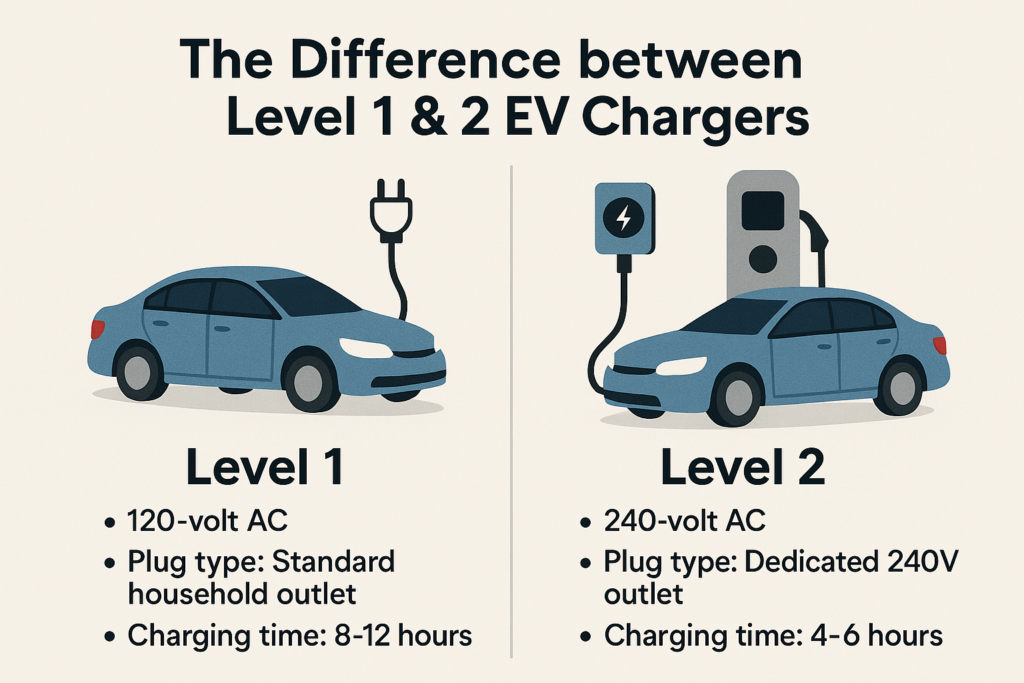
If you want to understand how these connectors fit into the bigger Level 1, Level 2 and DC Fast Charging framework, our EV charging guide 2026 covering Level 1 vs Level 2 vs DC Fast differences in the US and Europe explains the full picture clearly.
Locking Mechanism
Both connectors lock into the car’s charging port when plugged in — a safety feature that prevents the cable from being accidentally pulled out during charging.
J1772 uses a mechanical latch on the connector handle that you press to release. It’s simple and reliable.
Type 2 uses an electromagnetic lock on the car side — the car locks the connector in place electronically when charging starts and unlocks it when the session ends or when you press the unlock button in the app or on the car. This is a more sophisticated system that prevents theft of the cable during charging — relevant in Europe where charging cables are often left unattended for hours.
Vehicle Compatibility
J1772 vehicles (US market): Nissan Leaf, Chevrolet Bolt EV and EUV, older Ford Mustang Mach-E, older Hyundai Ioniq 5 and Kia EV6 (pre-NACS), Volkswagen ID.4 (US spec), BMW i4 and iX (US spec), Rivian R1T and R1S (older models), and most other non-Tesla EVs sold in the US before 2024.
NACS vehicles (US market, 2024 onward): Tesla (all models, always), Ford (2025 onward), GM/Chevrolet (2025 onward), Rivian (2025 onward), Honda, Nissan, Toyota, and most other manufacturers from 2025 model year. New NACS vehicles can still use J1772 stations with the included adapter.
Type 2 vehicles (European market): Essentially every EV sold in Europe — Volkswagen ID series, BMW i series, Mercedes EQ series, Renault, Peugeot, Citroën, Hyundai, Kia, Tesla (European spec), Audi e-tron series, Volvo, Skoda Enyaq, and all others.
The NACS Factor — How the J1772 vs Type 2 EV Charger Connector Landscape Has Shifted in 2026
The J1772 vs Type 2 EV charger connector comparison has a new dimension in 2026 that didn’t exist two years ago: NACS.
Tesla’s North American Charging Standard has effectively replaced J1772 as the dominant new-vehicle connector standard in the US. Most major manufacturers have committed to NACS for their 2025 and 2026 model year vehicles, and new public charging infrastructure in the US is increasingly NACS-native.
What does this mean practically?
If you’re buying a new EV in the US in 2026, your car almost certainly has a NACS port. You can still use J1772 Level 2 stations with the NACS-to-J1772 adapter that comes with most new vehicles. The J1772 network — which represents hundreds of thousands of Level 2 stations across the US — isn’t going anywhere. It’s just that new cars connect to it via an adapter rather than natively.
If you own an older US EV with a J1772 port, you can access Tesla Superchargers and new NACS-native stations with a J1772-to-NACS adapter. These are available from Tesla and third-party manufacturers.
In Europe, none of this applies. Type 2 remains the unified standard with no serious challenger and no transition underway. European EV buyers in 2026 have a simpler J1772 vs Type 2 EV charger connector story than their US counterparts — because in Europe the answer has been Type 2 for over a decade and nothing is changing.
Can You Use a J1772 Charger in Europe or a Type 2 Charger in the US?
This question comes up constantly and the honest answer is: yes, but with complications that most people underestimate.
Taking a US EV (J1772) to Europe: Your car’s AC charging port is J1772. European public stations use Type 2. You need a Type 2-to-J1772 adapter to use European public Level 2 stations. These adapters exist but are not universally available — buy one before you travel, not when you arrive.
Additionally, your car’s onboard charger is designed for 240V single-phase US power. European three-phase 22 kW stations will work with your car but only at the single-phase rate your onboard charger supports — typically 7.2 kW or 11 kW. You won’t get the three-phase speed advantage that makes Type 2 so attractive.
For DC fast charging in Europe with a US CCS1 vehicle: CCS1 and CCS2 are not directly compatible. You need a CCS1-to-CCS2 adapter, which is a more complex piece of hardware and not widely available. This is a genuine pain point for anyone using a US-spec EV in Europe long term.
Taking a European EV (Type 2) to the US: Your car’s AC charging port is Type 2. US public stations use J1772 or NACS. You need a J1772-to-Type-2 adapter for US Level 2 stations.
The voltage situation is reversed — US Level 2 is 240V single phase, which your European EV’s onboard charger handles fine. You just won’t access anything faster than the station’s single-phase rate.
For DC fast charging in the US with a European CCS2 vehicle: CCS2-to-CCS1 adapters are uncommon and CCS2-to-NACS adapters are emerging but not yet standardised.
The practical verdict: Cross-market EV use is possible but involves adapter complexity that most people underestimate. If you’re permanently relocating between the US and Europe with an EV, factor in the J1772 vs Type 2 EV charger connector adapter situation carefully — and for DC fast charging, the cross-compatibility story is genuinely messy in 2026.
J1772 vs Type 2 EV Charger Connector — Complete Side by Side Comparison
| Feature | J1772 | Type 2 |
|---|---|---|
| Region | US and Canada | Europe |
| Standard | SAE J1772 | IEC 62196-2 |
| Phases | Single phase only | Single or three phase |
| Max voltage | 240V | 400V (three phase) |
| Max current | 80A | 63A per phase |
| Max AC power | 19.2 kW | 43.5 kW (22 kW typical) |
| DC charging | No (CCS1 adds DC) | No (CCS2 adds DC) |
| Locking | Mechanical latch | Electromagnetic lock |
| Cable ownership | Usually attached to station | Attached to car or station |
| 2026 status | Being replaced by NACS | Active standard, no change |
| Cross compatibility | Adapter needed for Type 2 | Adapter needed for J1772 |
Home Charger Buying — What the J1772 vs Type 2 EV Charger Connector Difference Means for Your Installation
When buying a home EV charger, getting the connector right is one of the first decisions — and the J1772 vs Type 2 EV charger connector difference has direct implications for which home unit you buy.
In the US: Look for a charger with a J1772 connector for older EVs or a NACS connector for newer EVs. Many newer US home chargers ship with both or include an adapter. If you have a J1772 vehicle now but plan to upgrade to a NACS vehicle within a few years, some home charger brands offer connector swap programs. Hardwired home chargers in the US are sometimes installed without a connector — the cable plugs into the charger unit itself — which makes future connector upgrades easier.
In Europe: Type 2 is universal. Every home EV charger sold in Europe uses Type 2. The main decision is whether you want a tethered cable (attached to the charger) or an untethered socket (you plug your own cable in). Untethered is more flexible if you might change vehicles. Tethered is more convenient for daily use.
For a deeper look at which specific home charger models hold up best in real-world conditions — including what actual owners paid for installation and which units survived 12+ months of daily use — our honest guide to the best home EV chargers covers real user setups and costs in detail.
And before you finalise any home charger purchase, it’s worth reading our EV charger warranty comparison — because what a brand’s warranty actually covers in practice is often very different from what it says on the box. Voltage surge exclusions, firmware faults, and non-certified installation clauses have caught out more Indian and international EV owners than most people realise.
If something goes wrong at a public charging station — wrong connector engagement, error codes, session dropping after two minutes — our EV charger troubleshooting guide walks through every fix across Type 2, CCS2 and AC chargers with step-by-step diagnostics. And if you’re planning a long drive, our guide to managing EV charging during holidays covers highway corridor reliability, backup charging strategies, and what to do when your planned charger is offline.
Which Connector Do You Actually Need? A Simple Decision Framework
The J1772 vs Type 2 EV charger connector question has a clear answer once you know your car and your market:
You have J1772 if: You bought a non-Tesla EV in the US or Canada before approximately 2024. Every Level 1 and Level 2 public charger in North America works with your car natively. For DC fast charging, your car has a separate CCS1 port.
You have NACS if: You bought a Tesla at any point, or a non-Tesla EV in the US from 2024-2025 onward. You can access J1772 stations with the included adapter and have the best access to the US fast charging network going into 2026.
You have Type 2 if: You bought any EV in Europe. Every public Level 2 charging station in Europe works natively with your car. For DC fast charging, your car has a separate CCS2 port or a combined CCS2 inlet.
You need an adapter if: You’re crossing between US and European charging infrastructure for any reason. Buy the adapter before you need it — not when you’re standing at a charging station in an unfamiliar country staring at an incompatible plug.
Final Thoughts
The J1772 vs Type 2 EV charger connector question has a straightforward answer for most people: your car and your country determine your connector, and you don’t have much choice in the matter. What this guide gives you is the understanding behind that answer — why the two standards exist, how they differ technically, what the NACS transition means for US EV owners in 2026, and what to do when you’re in the wrong country with the wrong plug.
The connector landscape is more settled in 2026 than it’s been at any point in the last decade. Europe has had Type 2 as a unified standard since 2013 and nothing is changing. The US has largely converged on NACS for new vehicles while maintaining a massive J1772 installed base. Understanding where your car sits in that picture — and what adapters you need for edge cases — is the last piece of the EV charging knowledge puzzle most owners are missing.
The J1772 vs Type 2 EV charger connector debate is ultimately a regional one, not a technical competition. Both connectors do their job well in their respective markets. The problems only start when you try to use one where the other was designed to go.