The European Union’s original 2035 internal combustion engine ban — formally, the requirement that 100% of new passenger cars and light commercial vehicles sold in the EU from 2035 produce zero CO₂ emissions at the tailpipe — was, when it was adopted in 2023, one of the most ambitious regulatory commitments to transport decarbonisation in global policy history. It provided regulatory certainty for automotive manufacturers planning decade-long product development cycles, gave consumers a clear signal about the direction of travel, and positioned the EU as the definitive global regulatory leader on vehicle emissions.
The December 2025 proposal to soften this commitment to 90% — allowing up to 10% of new vehicle sales in 2035 to be non-zero-emission vehicles — is therefore not a minor technical adjustment. It is a consequential revision that reflects specific political and industrial pressures, has real implications for automotive manufacturer investment timelines, creates genuine uncertainty for European EV buyers about the stability of the policy environment they are navigating, and raises substantive questions about whether the EU’s revised target is an appropriate recalibration of ambitious but realistically challenging policy or a concerning capitulation to industry lobbying that undermines the regulatory certainty that long-term investment decisions require.
This guide on EU 2035 ICE ban softened to 90 percent what does the December 2025 proposal mean now provides the complete, honest analysis — what the December 2025 proposal specifically involves, why it emerged at this moment, what it means for different stakeholders, and the honest assessment of whether the 90% revision strengthens or weakens Europe’s EV transition.
What the December 2025 Proposal Actually Changes
The Specific Revision and What It Does and Doesn’t Do
The original 2023 regulation:
Regulation (EU) 2023/851 amended the CO₂ standards for cars and vans to require that all new passenger cars and light commercial vehicles sold from January 1, 2035 produce zero CO₂ emissions — effectively ending the sale of new internal combustion engine vehicles in the EU from that date.
This regulation included a specific review clause (Article 14) requiring the European Commission to assess the regulation’s progress and feasibility by 2026 — the clause that the December 2025 proposal is associated with, though the proposal’s timing somewhat anticipated the formal 2026 review.
The December 2025 proposal’s specific content:
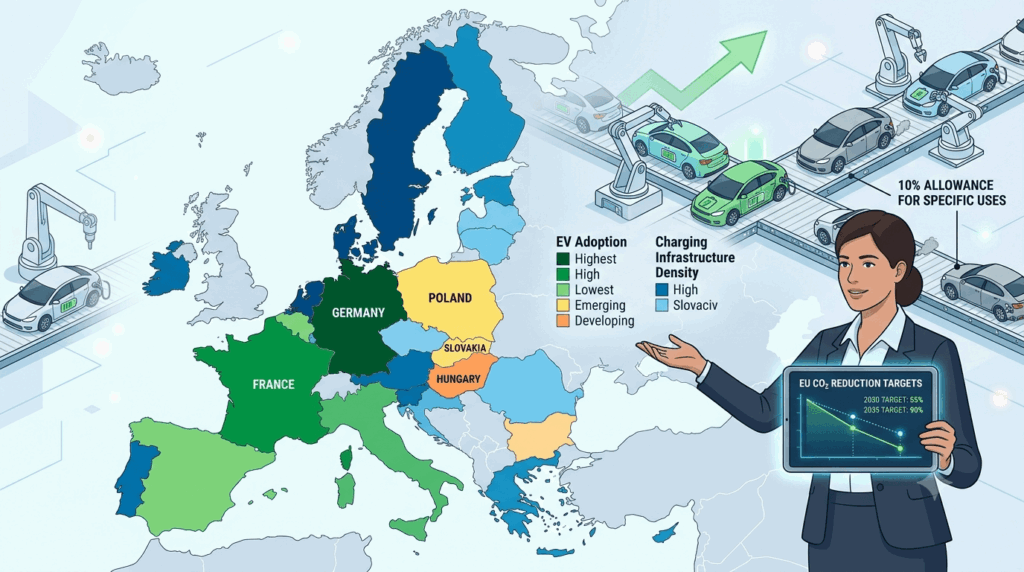
The December 2025 European Commission proposal introduces a 90% CO₂ reduction target for 2035 rather than the existing 100% requirement. The 10% allowance — representing approximately 1 million vehicles per year based on current European new car registration volumes of approximately 10 million annually — is not a blanket permission for any non-zero-emission vehicle. The specific framework for what qualifies for the 10% allowance includes:
Synthetic fuels (e-fuels) provision: Building on the precedent established in the 2023 compromise that allowed e-fuel-capable vehicles to continue to be sold after 2035 (the Germany-negotiated carve-out), the December 2025 proposal expands the synthetic fuel pathway recognition.
Specific small-volume manufacturer provisions: Manufacturers producing fewer than 10,000 vehicles per year retain modified obligations that have existed in previous EU CO₂ regulations — the December 2025 proposal extends and adjusts these provisions.
The rural and geographic accessibility provision: A specific recognition that geographic and infrastructure access inequalities across EU member states may justify differentiated implementation — though the specific mechanism for this differentiation remains under discussion.
What the proposal does NOT change:
The 2030 interim targets — requiring 55% CO₂ reduction from 2030 models compared to 2021 baseline — remain unchanged in the December 2025 proposal. These interim targets are the more immediately commercially relevant regulatory obligation for manufacturers currently making product investment decisions for vehicles entering production in the 2027-2030 window.
The overall direction of travel toward vehicle decarbonisation is not reversed — the proposal still targets 90% zero-emission vehicle sales by 2035, which would still represent a fundamental restructuring of European automotive markets.
The EU’s broader climate commitments — the European Green Deal, Fit for 55 package, and 2050 net-zero target — are not altered by the 2035 vehicle standard revision.
Why the December 2025 Proposal Emerged at This Moment
The Political, Industrial, and Economic Context
The European automotive industry’s political influence in 2024-2025:
The December 2025 proposal did not emerge in a policy vacuum. It reflected specific and documented political pressures from several directions simultaneously:
German automotive industry lobbying:
Germany’s automotive sector — Volkswagen Group (VW, Audi, Porsche, Skoda, Seat, Cupra, Lamborghini), BMW Group (BMW, Mini, Rolls-Royce), Mercedes-Benz — represents the largest national industrial constituency in the EU’s largest economy. The political significance of German automotive employment, combined with the industry’s genuine concerns about EV transition timeline feasibility given supply chain development, charging infrastructure adequacy, and consumer demand trajectories, produced sustained and ultimately partially successful political pressure for target revision.
Volkswagen Group’s specific 2024-2025 situation — which saw the company announce factory closures in Germany for the first time in its history, trigger unprecedented labour disputes with IG Metall, and report significant financial challenges in its Chinese market operations — gave the German automotive industry’s lobbying position political urgency that technical arguments about target feasibility alone would not have achieved.
The European Parliament composition shift:
The June 2024 European Parliament elections produced a political shift rightward that strengthened the European People’s Party (EPP) position — the center-right grouping that had been the most vocal about the 2035 100% mandate’s ambition being too aggressive. The new Parliament’s composition created a different political calculus for the European Commission’s policy proposals compared to the 2022-2023 Parliament that adopted the original regulation.
Chinese EV competition anxiety:
The EU’s parallel imposition of tariffs on Chinese EV imports (25-35% additional duties imposed in 2024) reflected European automotive industry concerns about Chinese manufacturers’ competitiveness. The tariff decision and the 2035 target revision are separate policy instruments, but they emerged from related political pressures: European automotive manufacturers arguing that the combination of aggressive decarbonisation mandates and Chinese competition threatened European automotive industry viability.
Real EV market demand challenges in 2024-2025:
The December 2025 proposal also reflected genuine market data concerns. European EV sales growth slowed significantly in 2024 after several years of strong growth, with multiple markets seeing year-on-year sales declines or flat growth as the early-adopter consumer segment was exhausted and the mass-market consumer segment showed higher price sensitivity and range anxiety than optimistic projections had anticipated.
Germany, France, and Italy each saw EV market share pull back in 2024-2025, with consumer surveys indicating that range anxiety, charging infrastructure adequacy concerns, and upfront cost premiums remained significant barriers to EV adoption beyond the affluent early adopter segment.
The Stakeholder Impact Analysis
What the December 2025 Proposal Means for Each Group
Impact on European Automotive Manufacturers
The short-term reaction:
European automotive manufacturers greeted the December 2025 proposal with cautious support — it provided some relief from what many characterised as an unrealistically aggressive 2035 timeline, but the 90% target still requires fundamental product portfolio transformation that leaves manufacturer investment uncertainty only modestly reduced.
The specific manufacturer situations:
Volkswagen Group: VW has committed to an EV-first product strategy with specific models (ID. series, Audi Q4 e-tron, Porsche Taycan) already generating significant EV revenue, but the group’s internal combustion engine manufacturing capacity across multiple European plants represents employment and capital that the 100% mandate would have stranded by 2035. The 90% revision provides modest additional time and volume flexibility for managing this transition.
Stellantis (Fiat, Peugeot, Citroën, Opel/Vauxhall, Jeep, Alfa Romeo): Stellantis has faced specific challenges in its core European small-car segment, where EV versions (Fiat 500e, e-208, e-2008) have been commercially successful but where price competitiveness remains challenging versus the ICE equivalents that still represent the majority of sales. The 10% flexibility potentially allows Stellantis to maintain some ICE small-car production beyond 2035 in niche markets.
Renault Group: Renault’s significant early EV commitment (the original Renault Zoe, the Renault 5 EV) and its Ampere EV-specific division have positioned Renault as perhaps the most committed European mass-market EV manufacturer. The revision is somewhat less financially significant for Renault than for competitors with larger ICE manufacturing commitments.
The investment certainty concern that the revision creates:
A specific concern raised by EV advocates and some automotive analysts is that the 90% revision, rather than providing helpful flexibility, may actually increase manufacturer uncertainty by raising questions about whether the 90% target itself is stable — if the EU revised the 100% target to 90%, will it revise the 90% to 80%? The regulatory uncertainty this revision introduces may be more damaging to long-term investment decisions than the specific 10% flexibility it provides.
Impact on European EV Buyers
The charging infrastructure implication:
The most direct implication for European EV buyers is the charging infrastructure investment signal. Charging infrastructure investment — by national governments, utilities, and private charging network operators — is calibrated to projected EV adoption trajectories. A softened 2035 mandate may reduce the urgency of charging infrastructure investment in markets that were using the 100% mandate as a planning assumption.
The model availability implication:
For European consumers specifically interested in small, affordable EVs — the segment where EV supply has been most challenging — the 10% flexibility may extend the availability of ICE small cars from manufacturers who might otherwise have been compelled to accelerate EV alternatives. Whether this is positive (maintaining affordable small-car choice) or negative (reducing pressure to produce affordable EV small cars) depends on whether one views the affordable EV supply challenge as a manufacturing investment problem or a fundamental EV economics problem.
The purchase decision confidence implication:
A European consumer considering an EV purchase in 2026 faces a policy environment that has now demonstrated revision capacity — the 2035 100% mandate was presented as a firm regulatory commitment and has been revised within three years of adoption. This revision history may reduce the policy certainty signal that prospective EV buyers use as a reason for EV purchase confidence, though the direction of travel toward EV markets remains clear even if the pace is somewhat moderated.
Impact on European Charging Network Operators
The demand trajectory uncertainty:
Charging network operators — IONITY, Allego, Fastned, BP Pulse, EnBW mobility+, and others — have made substantial capital commitments to European charging infrastructure based on EV adoption trajectories that assumed the 100% 2035 mandate. The December 2025 revision introduces a modest demand trajectory adjustment that may affect the unit economics of planned charging infrastructure investments.
The honest scale of the impact:
The 10% flexibility is unlikely to fundamentally alter the charging infrastructure investment case — even at 90% ZEV sales by 2035, the implied fleet transition still requires a vastly larger charging network than 2026’s infrastructure provides. The practical impact on charging network planning is likely modest, though the political signal about policy commitment has secondary effects on financing confidence for large charging infrastructure investments.
Impact on European Battery and EV Supply Chain Investment
The most significant longer-term stakeholder:
Perhaps the most consequential impact of the December 2025 revision is on the European battery and EV supply chain investment that the 100% mandate was specifically designed to accelerate. Gigafactory investments in Germany, France, Sweden, Hungary, and Poland — by Northvolt, ACC, Automotive Cells Company, CATL’s European facilities, and others — were calibrated to the demand trajectory implied by the 100% mandate.
The 10% revision’s impact on these investments is not through direct volume reduction — even 90% ZEV sales requires enormous battery supply — but through the regulatory certainty signal that these capital-intensive, long-payback investments require. A battery gigafactory investment decision made in 2025 for facilities opening in 2028-2029 depends on confidence that the regulatory environment it is built for will remain stable.
The Geographic Differentiation Within the EU
Why the December 2025 Proposal Affects EU Member States Differently
The Eastern European dimension:
The EU’s December 2025 proposal reflects specific political accommodations to Central and Eastern European member states — particularly Poland, Hungary, Slovakia, and Czech Republic — where:
Automotive manufacturing employment is proportionally large (automotive sector employment as a percentage of total manufacturing is significantly higher in Slovakia and Czech Republic than in Western European economies)
EV adoption rates are significantly lower than Western European average (Romania, Bulgaria, Poland, and Hungary have very low EV market shares relative to Western European markets)
Charging infrastructure is significantly less developed than Western European markets
Public charging density in these markets is a fraction of the density in Netherlands, Norway, or Germany — creating a genuine infrastructure readiness gap that the geographic accessibility provision in the December 2025 proposal addresses
The Scandinavian contrast:
Norway — not an EU member but participating in the European Economic Area — provides the starkest contrast to Eastern European market conditions: Norway achieved over 90% BEV new car sales share in 2024, demonstrating that even at 100% ZEV sales, markets with appropriate policy frameworks and charging infrastructure can achieve this outcome. Iceland, Sweden, Denmark, and Finland similarly show that Western European climate and geography do not prevent high EV adoption rates.
The intra-EU variation between Norway-adjacent Scandinavian levels of EV readiness and Eastern European market conditions is itself an argument for the differentiated approach the December 2025 proposal partially accommodates — though the specific mechanism for differentiation remains contested.
The French e-fuel dimension:
France has developed a specific nuclear power-derived synthetic fuel research programme, and French automotive manufacturers (Renault, Stellantis’s French brands) have engaged in the e-fuel debate with particular interest. The December 2025 proposal’s synthetic fuel provision interacts with French energy policy in ways that are politically distinctive from the German automotive manufacturing angle that dominated the lobbying narrative.
The Comparison With Global 2035 EV Policy Trajectories
How Europe’s Revision Looks in the Global Context
The UK comparison:
The United Kingdom — having left the EU but having adopted a 2030 ZEV transition target even more ambitious than the original EU 2035 mandate — has faced its own target revision discussions. The UK’s 2030 mandate was revised to a 2035 phased implementation under the previous government, but the current government has signalled recommitment to ambitious EV transition timelines. The UK’s ZEV mandate (requiring specific percentages of manufacturer sales to be zero-emission, starting from 22% in 2024 and rising to 80% by 2030) provides a different legislative structure from the EU’s fleet average CO₂ approach.
The US contrast:
As documented in our US state EV policy scorecard and federal EV fee guides, the United States federal approach to EV policy in 2026 has moved in the opposite direction from the EU’s 2023 mandate — with the expiry of the $7,500 federal EV tax credit and no federal ZEV mandate in place. The contrast between the EU’s high-ambition (even at 90%) regulatory approach and the US’s market-led (with state variation) approach represents the clearest global EV policy divergence.
The China comparison:
China’s dual credit system — requiring manufacturers to accumulate New Energy Vehicle credits based on EV sales proportions — operates as a de facto escalating ZEV mandate that has driven China’s dominant global EV position. China’s approach, described extensively in this guide series’ Chinese market content, has produced the world’s highest EV market share in absolute sales terms without a specific 2035 ICE ban equivalent. The EU’s approach of a specific sales date mandate contrasts with China’s credit-accumulation mechanism but the direction — toward majority or universal ZEV sales — is shared.
The Honest Policy Assessment
What the December 2025 Revision Actually Represents
The case for the revision:
Honest engagement with the arguments for the December 2025 revision acknowledges genuine policy substance:
The 10% flexibility, properly designed, could accommodate genuine geographic and use-case inequalities across the EU’s diverse member states without fundamentally altering the transition’s direction
The EU’s regulatory framework for vehicle emissions has historically included flexibility mechanisms (supercredits, derogations for small manufacturers) that acknowledge that 100% mandates applied uniformly can produce perverse outcomes at the margins
The e-fuel pathway, whatever one’s view of its scalability and climate impact, represents a technology choice that some member states and manufacturers have made significant investments in, and some regulatory recognition of those investments reduces stranded asset risks without necessarily slowing EV deployment
The case against the revision:
Equally honest engagement with the arguments against acknowledges genuine policy concerns:
The regulatory certainty that the 100% mandate provided was precisely its most valuable feature for long-term investment decisions. The revision, regardless of its specific content, demonstrates that the mandate is not as firm as presented — and this uncertainty may have more chilling effect on investment than the specific 10% volume flexibility is worth
The timing of the revision — responding to automotive industry lobbying at a moment of EV market demand softness — sets a concerning precedent for regulatory revision in response to commercial pressure rather than technological limitation
The 10% allowance, distributed across 10 million annual European new car sales, represents approximately 1 million non-zero-emission vehicles per year in 2035 — not a marginal quantity but a continued material ICE vehicle market that maintains consumer alternative choice at exactly the moment when 100% mandates would have eliminated that choice and accelerated infrastructure investment
What European EV Buyers Should Actually Do With This Information
Practical Guidance for EV Purchase Decisions in 2026
The purchase case remains strong despite the revision:
The economic case for EV ownership in Europe in 2026 — driven by significantly lower per-kilometre fuel costs, lower maintenance costs, and the availability of home charging TOU optimisation comparable to what this guide series has documented for Chinese markets — is not materially affected by the 2035 target revision.
European electricity prices, while higher than Chinese residential rates, still produce meaningful cost advantages for home-charged EVs versus equivalent gasoline vehicles over a full ownership period.
The charging infrastructure investment continues:
NEVI-equivalent European charging infrastructure investment through the AFIR (Alternative Fuels Infrastructure Regulation) continues regardless of the 2035 target revision — AFIR establishes charging infrastructure density requirements along TEN-T corridors that are driven by EU policy independent of the vehicle sales mandate.
The model range expansion continues:
Automotive manufacturers who have committed to EV product portfolio expansion — Volkswagen Group’s ID. series expansion, BMW’s NEUE KLASSE platform, Renault’s EV-first strategy — are not reversing these commitments based on the December 2025 revision. The product range available to European EV buyers in 2026-2030 will be significantly broader and more competitively priced than the 2022-2024 range.
Internal Links — Further Reading on Clean Energy Bazaar
The EU 2035 ICE ban softened to 90 percent what does the December 2025 proposal mean now guide connects to the global EV policy and market guides on cleanenergybazaar.com.
For the US state EV policy scorecard that provides the American policy contrast to Europe’s regulatory approach documented in this guide, our US state EV policy scorecard is your state a green light or red light guide covers American state-level EV policy in detail. For the federal EV fee proposal guide that covers US federal EV policy in the contrasting American context, our $130 federal EV fee proposal guide covers the American road use fee discussion. For the NACS vs ChaoJi connector standards guide covering the global charging standard competition that European infrastructure investment intersects with, our Tesla NACS vs ChaoJi super-standard battle guide covers the global standards landscape. For the EV total cost of ownership guide that contextualises the purchase decision economics for European EV buyers navigating this policy environment, our EV vs ICE cost comparison guide covers the complete ownership economics. And for the CHAdeMO vs GB/T guide covering the European CCS2 standard’s competitive position relative to global alternatives, our CHAdeMO vs GB/T Japanese standard guide covers the charging standards competition.
Final Thoughts
The EU 2035 ICE ban softened to 90 percent what does the December 2025 proposal mean now question deserves an honest answer that resists both the alarm of those who characterise the revision as a fundamental climate policy betrayal and the equanimity of those who characterise it as an inconsequential technical adjustment.
The revision is consequential. A 100% mandate that is revised to 90% within three years of adoption demonstrates regulatory revision capacity that cannot be dismissed as a policy signal. The automotive manufacturers, charging infrastructure investors, and battery supply chain investors who made decisions based on the 100% mandate’s firmness now operate in a policy environment that has shown willingness to revise — and this uncertainty has real effects on the investment decisions currently being made for 2028-2035 product cycles and infrastructure commitments.
The revision is also not catastrophic. Even at 90%, the European ZEV target remains among the most ambitious in the world, the 2030 interim targets remain unchanged, and the direction of travel toward dominant EV sales is not reversed. A European automotive market that is 90% zero-emission new vehicle sales by 2035 would still represent a fundamental transformation from 2026’s levels.
The specific concerns that deserve continued monitoring — whether the 10% allowance creates perverse incentives for manufacturers to maintain ICE capacity rather than investing fully in EV product development, whether the regulatory revision precedent encourages further target softening in the 2028-2030 review windows, and whether the investment certainty signal damage exceeds the commercial flexibility benefit — are legitimate and will be determinable by the evidence of manufacturer behaviour and infrastructure investment in the 2026-2029 period.
For European EV buyers making purchase decisions in 2026, the practical guidance is clear: the economic case for EV ownership is not materially affected by the 2035 target revision, the product range available is better than ever and improving, and the charging infrastructure investment — driven by AFIR mandates independent of the vehicle sales target — continues regardless of the December 2025 proposal’s outcome. Buy the EV if the economics work for your situation. The policy direction, despite the revision, remains toward the EV market that your purchase decision is part of building.