European consumers have long faced a frustrating gap in the electric vehicle market. While premium EVs from Tesla, BMW, and Mercedes-Benz have proliferated, genuinely affordable small electric cars — the kind that could replace the Fiat 500, Renault Clio, or Volkswagen Polo for average European households — have remained conspicuously absent. The average EV price in Europe in 2025-2026 remains substantially higher than the average ICE equivalent, with the most affordable battery-electric models still hovering around €25,000-€30,000 in most markets.
The European Commission’s December 2025 Automotive Omnibus proposal aims to close this gap. At the heart of this regulatory package is the creation of a new vehicle category specifically designed to accelerate the development and sale of small, affordable electric vehicles built in Europe. This is not a minor technical adjustment to existing regulations. It is a deliberate industrial policy intervention that recognises the EV market’s structural weakness in the affordable segment and seeks to address it through targeted regulatory incentives.
The EU Omnibus automotive proposal small affordable EV category represents one of the most significant EV policy developments since the original 2035 ICE ban — and it deserves the same thorough, honest analysis that this guide series has applied to every major European EV policy shift. This guide covers what the new M1E category actually involves, why it emerged at this moment, what the super-credit system means for manufacturers and consumers, the safety concerns that have accompanied the proposal, and the honest assessment of whether this initiative will finally deliver affordable EVs to European buyers.
What the Automotive Omnibus Actually Proposes
The M1E Vehicle Category — Definition and Parameters
The formal proposal:
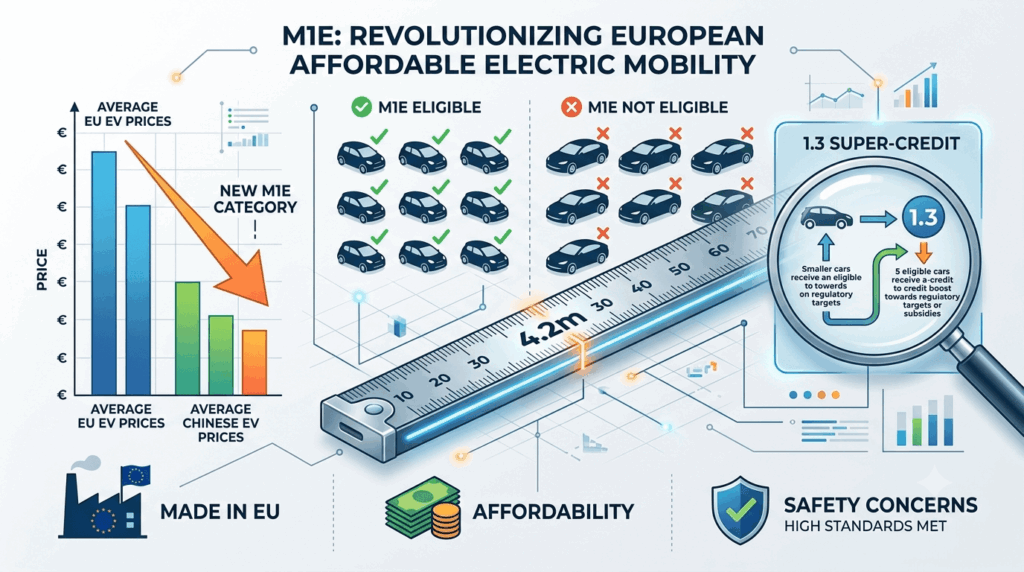
The Automotive Omnibus — formally a proposal amending Regulations (EC) No 561/2006, (EU) 2018/858, (EU) 2019/2144, and (EU) 2024/1257 — introduces a new sub-category of passenger cars designated M1E. This sub-category is defined specifically for small electric vehicles of category M1, based on a maximum vehicle length of 4.2 metres.
The 4.2 metre threshold is not arbitrary. According to the European Commission, there are currently only 12 battery-electric models below €25,000 in this size segment across the entire EU market. The threshold is intended to provide targeted incentives for affordable electric vehicles by creating a regulatory category that specifically rewards manufacturers for producing in this segment.
The “made in EU” condition:
Crucially, the M1E category incentives are not available to all small EVs — they are specifically for vehicles manufactured in the EU. The Automotive Package explicitly creates a new small, affordable, “made-in-EU” EV car category. This conditionality represents a significant industrial policy dimension to what might otherwise appear to be a simple regulatory simplification.
The super-credit mechanism:
The most consequential incentive within the Omnibus proposal is the introduction of “super-credits” for small affordable EVs built in Europe. Under the proposed system, small electric vehicles manufactured in the EU and falling within the M1E category are to be included with a factor of 1.3 in the calculation of a manufacturer’s average specific CO₂ emissions.
What this means in practice: each M1E-compliant small EV that a manufacturer sells counts as 1.3 vehicles toward their fleet average CO₂ compliance. This multiplier effect provides a powerful regulatory incentive for manufacturers to prioritise the development, production, and marketing of small affordable EVs — because every such vehicle helps them meet their emissions targets more efficiently than a standard EV would.
The broader Omnibus package:
The M1E category is one component of a broader Automotive Omnibus that includes several other significant measures:
- Simplification of regulatory requirements: The Omnibus is expected to cut administrative costs for manufacturers by approximately €706 million annually
- Exemptions for electric vans: Removal of tachograph requirements for battery-electric light commercial vehicles below 4.25 tonnes, and exemption from speed limitation device requirements
- Simplification of Euro 7 testing: Removal of some low-temperature laboratory tests from the Euro 7 Regulation
- Charging infrastructure interoperability: Authorisation for the Commission to adopt delegated acts on technical requirements for vehicle interoperability with charging infrastructure and grid
Why the Omnibus Emerged at This Moment
The Industrial and Political Context
The struggling European automotive sector:
The December 2025 Automotive Package — of which the Omnibus is a core component — was explicitly framed by the European Commission as a proposal to support the struggling EU automotive sector. The package sought to strike a balance between galvanising industry competitiveness without counteracting progress on decarbonisation.
Several factors converged to create the political space for this regulatory intervention:
Chinese EV competition:
Chinese brands have captured approximately 10% of Europe’s EV market. They hold a significant cost edge — often pricing EVs roughly 10% below comparable European models — thanks to high-volume production, local battery production facilities, and in some cases state support. European manufacturers have been struggling to compete on both price and volume in the EV segment, particularly in the small car category where Chinese competition is most acute.
The affordability gap:
The European EV market has developed an increasingly clear affordability problem. While premium and mid-range EVs have proliferated, the small car segment — historically the largest volume segment in many European markets — has seen limited EV options. The Commission’s own analysis identified only 12 battery-electric models below €25,000 in the small car size segment across the entire EU. This supply gap has been a significant barrier to mass-market EV adoption.
Regulatory complexity and cost:
The European automotive industry has long complained about the cumulative burden of multiple overlapping regulatory frameworks. The Omnibus represents the ninth set of simplification measures (also known as “omnibus packages”) published by the Commission since 2025. The administrative cost savings of approximately €706 million annually are intended to free up manufacturer resources for investment in EV development.
The political calculation:
The Omnibus also reflects a political calculation about the European automotive industry’s viability. With significant employment at stake across Germany, France, Italy, and Eastern European manufacturing centres, the Commission has signalled a willingness to provide regulatory relief and targeted incentives rather than maintaining a purely emissions-focused regulatory approach that some manufacturers argued was pushing them toward uncompetitive positions.
The Stakeholder Impact Analysis
What the M1E Category Means for Each Group
Impact on European Automotive Manufacturers
The primary beneficiaries:
European manufacturers that produce small cars are the primary intended beneficiaries of the M1E category. The super-credit mechanism provides a direct regulatory advantage to manufacturers who can bring small affordable EVs to market — effectively rewarding them with easier CO₂ compliance for doing exactly what the Commission wants them to do.
Renault Group: Renault has long been a leader in the European small car segment and has already demonstrated commitment to affordable EVs with the Renault 5 EV. The M1E category and super-credit system align well with Renault’s existing product strategy, potentially providing additional regulatory benefit for vehicles they were already planning.
Volkswagen Group: VW’s ID. Life concept and the broader ID. series have signalled interest in smaller EVs, though the group’s small car offerings have been slower to electrify than some competitors. The M1E category may accelerate VW’s small EV development timeline.
Stellantis: With brands including Fiat, Peugeot, Citroën, and Opel/Vauxhall, Stellantis has the deepest portfolio of small car heritage in Europe. The Fiat 500e and e-208 have already demonstrated that Stellantis can produce compelling small EVs, though pricing remains a challenge. The M1E category provides additional incentive to expand this portfolio.
The “made in EU” conditionality:
The requirement that M1E vehicles must be manufactured in the EU to qualify for super-credits is a significant industrial policy signal. This conditionality has several implications:
- It protects European manufacturing employment by ensuring that the incentives benefit EU-based production rather than imports
- It creates a competitive disadvantage for Asian manufacturers who might otherwise have sought to compete in the small EV segment through imports
- It raises questions about how “made in EU” will be defined — the proposal does not yet define the methodology, leaving this critical question to future delegated acts
The investment signal:
For manufacturers making product investment decisions, the M1E category provides a clear regulatory signal: invest in small EV development and EU-based production, and receive regulatory rewards. This is precisely the kind of targeted policy intervention that can influence decade-long product development cycles.
Impact on European EV Buyers
The promise of affordable EVs:
The most direct implication for European consumers is the promise of more affordable small EVs. The M1E category is specifically designed to address the affordability gap by making it regulatorily advantageous for manufacturers to produce and sell small EVs.
If the policy works as intended, European buyers should see:
- A broader range of small EV models available in the coming years
- More competitive pricing in the small car segment
- Greater availability of EVs in the sub-€25,000 price range
The safety concern:
However, the Omnibus proposal has also raised significant safety concerns. The European Transport Safety Council (ETSC) has warned that the proposal to freeze safety requirements for small electric cars for up to ten years could put lives at risk and create a two-tier vehicle safety system. The concern is that in the pursuit of affordability, safety standards for smaller vehicles may be compromised relative to larger vehicles.
This is a genuine tension in the policy design. Affordable small cars historically have lower profit margins than larger vehicles, and manufacturers face cost pressures in bringing them to market. Relaxing safety requirements could reduce production costs — but at the potential cost of occupant and pedestrian safety.
The consumer choice implication:
For European consumers, the M1E category represents a potential expansion of choice. Instead of being limited to premium EVs or accepting that a new EV is simply out of reach financially, consumers may have genuine small EV options across multiple brands and price points.
The timing consideration:
The Omnibus was presented to Parliament committees on 3 June 2026. The legislative process is ongoing, and the final form of the M1E category — including the specific definition of “made in EU” and the detailed technical requirements — will be determined through the legislative process and subsequent delegated acts. Consumers should not expect immediate changes, but the policy direction is now clear.
Impact on European Charging Infrastructure and the EV Ecosystem
The volume effect:
The success of the M1E category depends on whether it actually stimulates sufficient additional small EV sales to make a material difference to the European EV fleet. If it does, the increased volume of EVs on European roads will have downstream effects:
- Increased demand for public charging infrastructure in urban areas where small cars are most commonly used
- Greater utilisation of existing charging networks
- Potential pressure on grid capacity in densely populated areas
The “made in EU” supply chain effect:
The conditionality of the M1E incentives also has implications for the European battery and EV supply chain. To qualify for super-credits, manufacturers will need to source components and assemble vehicles within the EU — which should theoretically strengthen the European EV supply chain and reduce dependence on Asian imports.
The potential unintended consequences:
However, the “made in EU” requirement could also create unintended consequences:
- It may incentivise manufacturers to produce small EVs in Europe while continuing to import larger EVs from Asian facilities
- It may create a two-tier market where European-made small EVs benefit from regulatory advantages while imported EVs face different competitive conditions
- It raises questions about the definition of “made in EU” — will it apply to the final assembly, the battery production, or a percentage of component content?
The Safety Controversy
The ETSC Warning and the Two-Tier Safety Concern
The specific concern:
The European Transport Safety Council has raised a specific and serious concern about the Omnibus proposal: the plan to freeze safety requirements for small electric cars for up to ten years. The ETSC warns that this could create a two-tier vehicle safety system where smaller, more affordable EVs are subject to lower safety standards than larger vehicles.
The regulatory context:
The Omnibus proposal simplifies rules for EU type-approval of new motor vehicles in terms of their sound level and removes some testing requirements from Euro 7. While these changes are presented as administrative simplifications, safety advocates worry that they represent a broader relaxation of standards that could disproportionately affect smaller vehicles.
The counterargument:
Proponents of the Omnibus argue that the safety concerns are overstated — that the simplifications are administrative rather than substantive, and that existing safety standards remain in place. They also argue that by accelerating the transition to EVs — even smaller ones — the Omnibus ultimately improves safety through the reduced crash risk associated with lower vehicle kilometres driven and the potential for advanced safety features in new vehicles.
The honest assessment:
The safety concern is legitimate and deserves monitoring. The tension between affordability and safety is a real one in vehicle regulation, and the Omnibus does represent a departure from the trend of ever-increasing safety requirements. Whether this departure is a reasonable recalibration or a dangerous relaxation will depend on the specific details of the implementing legislation and how manufacturers actually respond to the incentives.
The Comparison With Global Small EV Policy
How the M1E Category Compares to Other Markets
The Chinese small EV market:
China has already developed a thriving small EV market, with models like the Wuling Hongguang Mini EV achieving enormous sales volumes at price points far below anything available in Europe. The Chinese approach has been market-led rather than regulatory — manufacturers identified the demand for affordable urban EVs and responded with appropriate products.
The European M1E category represents a different approach: using regulatory incentives to stimulate supply rather than waiting for market forces to produce affordable EVs organically. Whether this regulatory intervention will be more or less effective than the Chinese market-led approach remains to be seen.
The US small EV market:
The US market has seen limited small EV availability, with American consumers historically favouring larger vehicles. The absence of a federal ZEV mandate and the expiry of the $7,500 federal EV tax credit have further reduced incentives for manufacturers to develop affordable small EVs for the US market.
The European M1E category, by contrast, represents a deliberate policy intervention to create a market segment that might not otherwise develop organically.
The UK position:
The UK — having left the EU but maintaining close regulatory alignment — has its own ZEV mandate that requires specific percentages of manufacturer sales to be zero-emission. The UK approach is more prescriptive than the EU’s M1E category, but both recognise the need for targeted policy to address the affordability gap in small EVs.
The Honest Policy Assessment
What the M1E Category Actually Represents
The case for the Omnibus:
Honest engagement with the arguments for the M1E category acknowledges genuine policy substance:
The affordability gap in European EVs is real and has been a barrier to mass-market adoption. The M1E category directly addresses this gap by creating regulatory incentives for manufacturers to produce affordable small EVs.
The “made in EU” conditionality protects European manufacturing employment and reduces dependence on Asian supply chains. In an era of strategic competition, this industrial policy dimension is legitimate and defensible.
The super-credit mechanism is a proven regulatory tool — similar mechanisms have been used in previous EU CO₂ regulations to incentivise specific outcomes. The 1.3 multiplier provides a meaningful incentive without fundamentally distorting the emissions reduction framework.
The case against the Omnibus:
Equally honest engagement with the arguments against acknowledges genuine policy concerns:
The safety implications of the Omnibus are concerning. If the pursuit of affordability comes at the cost of lower safety standards for smaller vehicles, this would represent a genuine regression in European vehicle safety policy.
The “made in EU” conditionality raises protectionist concerns and may conflict with WTO rules. It also raises questions about whether European consumers will have access to the most affordable small EVs if they are produced outside the EU.
The super-credit mechanism, while well-intentioned, may create perverse incentives. Manufacturers could theoretically prioritise small EV production for compliance purposes while continuing to produce larger, more profitable ICE vehicles — potentially slowing the overall transition rather than accelerating it.
The Omnibus does not yet define the methodology for determining when a vehicle qualifies as “made in the EU,” leaving this critical question to future delegated acts. This creates uncertainty for manufacturers making investment decisions.
What European EV Buyers Should Actually Do With This Information
Practical Guidance for EV Purchase Decisions in 2026
The short-term reality:
The M1E category is a legislative proposal, not yet implemented law. The Omnibus was presented to Parliament committees on 3 June 2026, and the legislative process will take time. European EV buyers in 2026 should not expect immediate changes to the available small EV models or pricing.
The medium-term opportunity:
For buyers who can wait 2-3 years, the M1E category should result in a broader range of small affordable EVs becoming available. Manufacturers who respond to the super-credit incentives will bring new models to market, and increased competition should put downward pressure on prices.
The purchase decision framework:
The economic case for EV ownership in Europe in 2026 — driven by significantly lower per-kilometre fuel costs, lower maintenance costs, and the availability of home charging — remains strong regardless of the M1E category. Buyers should continue to evaluate EVs based on their total cost of ownership, range requirements, and charging access.
The policy monitoring recommendation:
European EV buyers should monitor the legislative progress of the Omnibus — particularly the definition of “made in EU” and the specific technical requirements for the M1E category. These details will determine whether the policy delivers on its promise of affordable small EVs or falls short.
Internal Links — Further Reading on Clean Energy Bazaar
The EU Omnibus automotive proposal small affordable EV category guide connects to the broader European EV policy and market guides on cleanenergybazaar.com.
For the comprehensive analysis of the EU 2035 ICE ban revision that provides the broader regulatory context for the Omnibus, our EU 2035 ICE ban softened to 90 percent what does the December 2025 proposal mean now guide covers the CO₂ target revision that the Omnibus complements. For the US state EV policy scorecard that provides the American policy contrast to Europe’s regulatory approach, our US state EV policy scorecard is your state a green light or red light guide covers American state-level EV policy in detail. For the federal EV fee proposal guide that covers US federal EV policy in the contrasting American context, our $130 federal EV fee proposal guide covers the American road use fee discussion. For the NACS vs ChaoJi connector standards guide covering the global charging standard competition, our Tesla NACS vs China ChaoJi super-standard battle guide covers the global standards landscape. And for the EV total cost of ownership guide that contextualises the purchase decision economics, our EV vs ICE cost comparison guide covers the complete ownership economics.
Final Thoughts
The EU Omnibus automotive proposal small affordable EV category represents a significant and deliberate policy intervention in the European EV market. It recognises a genuine problem — the absence of affordable small EVs in the European market — and proposes a targeted regulatory solution.
The M1E category, with its super-credit incentives and “made in EU” conditionality, could genuinely accelerate the development and availability of affordable small EVs for European consumers. The 1.3 multiplier provides a meaningful incentive for manufacturers to prioritise this segment, and the 4.2 metre threshold creates a clear regulatory category.
However, the Omnibus also raises legitimate concerns. The safety implications — particularly the ETSC warning about freezing safety requirements for small electric cars — deserve serious attention. The “made in EU” conditionality raises industrial policy questions that will need careful definition. And the broader question of whether regulatory incentives can successfully create a market segment that has not developed organically remains to be answered.
For European EV buyers, the Omnibus represents a reason for cautious optimism. The policy direction is clear: the Commission wants more affordable small EVs in the European market. Whether the specific mechanisms of the M1E category will deliver that outcome depends on the legislative details yet to be determined and the manufacturer response to the incentives created.
The direction of travel is toward a more diverse, more affordable European EV market. The Omnibus is a significant step in that direction — but as with all policy interventions, the proof will be in the implementation.