There is a straightforward argument at the centre of the proposed federal EV fee, and it deserves to be stated clearly before the politics, the complications, and the competing interests obscure it: drivers who use public roads should pay for the maintenance of those roads, and the current mechanism for collecting that payment — the federal gasoline tax of 18.4 cents per gallon — collects nothing from battery electric vehicles that consume no gasoline.
That is the genuine, substantive policy problem the $130 federal EV fee proposal is designed to address. It is a real problem. The federal Highway Trust Fund — the primary federal mechanism for road infrastructure funding — has been running chronic shortfalls, historically covered by general fund transfers, as vehicle fuel efficiency has improved and as EV adoption has reduced the fuel tax collection that originally funded the mechanism. The bipartisan support for some form of EV road use contribution reflects genuine cross-partisan recognition that the user-pays principle underlying transportation funding should apply to all road users regardless of fuel type.
Where the politics become complicated — and where the specific proposal’s details matter enormously — is in the specific fee level, the comparison with what gasoline vehicle drivers pay, the interaction with state-level EV fees that already exist in many states, and the broader context of EV incentive policy in a moment when the federal $7,500 new EV tax credit has expired and state-level policy has become the primary support mechanism.
This guide on the new $130 federal EV fee proposal how much will you pay provides the complete, honest analysis — what the bipartisan proposal specifically involves, what EV and PHEV owners would pay, how this compares with what equivalent gasoline vehicle drivers pay in fuel taxes, the current legislative status, how state fees interact with the federal proposal, and the honest financial and policy assessment that American EV owners need to navigate this issue accurately.
What the Proposal Actually Is
The Specific Legislative Proposal and Its Origins
The bipartisan basis:
The $130 federal annual fee for battery electric vehicles and $35 annual fee for plug-in hybrid electric vehicles has been developed through bipartisan legislative discussion motivated by the Highway Trust Fund’s structural funding challenge. The proposal has garnered support from both Republican and Democratic legislators — Republicans who have long argued against EV-specific subsidies and for equal treatment of all vehicles, and Democrats who support the user-pays principle while expressing concern about fee levels that might disproportionately burden lower-income EV owners.
The legislative vehicle:
The fee proposal has been developed in the context of broader highway and transportation funding legislation — it is not a standalone EV tax bill but a provision within the transportation funding discussion that has been ongoing since the 2021 Infrastructure Investment and Jobs Act established the NEVI programme and the most recent surface transportation reauthorisation discussion began.
The specific fee structure:
Battery Electric Vehicles (BEVs — purely battery-powered, no combustion engine): $130 per year flat federal annual fee
Plug-in Hybrid Electric Vehicles (PHEVs — vehicles with both battery and combustion engine): $35 per year flat federal annual fee
Conventional gasoline and diesel vehicles: No new fee — continue paying the existing federal gasoline tax of 18.4 cents per gallon (diesel: 24.4 cents per gallon)
How the fee would be collected:
The proposal envisions collection through the existing vehicle registration process — an annual fee assessed alongside (or as part of) the federal contribution to state registration processes. The specific administrative mechanism is one of the proposal’s less-developed elements, as the federal government does not directly administer vehicle registration (this is a state function), requiring either a federal fee collected separately or an agreement with states to collect on the federal government’s behalf.
The destination of collected revenue:
Collected fees would be directed to the Highway Trust Fund — specifically the Highway Account, which funds federal highway and bridge programmes — consistent with the gasoline tax’s destination and the user-pays framing of the proposal.
The Fairness Comparison — What Gasoline Drivers Actually Pay
The Most Important Context for Evaluating Whether $130 Is Fair
Why this comparison is essential and frequently done incorrectly:
The question of whether $130 is a “fair” EV fee cannot be answered without comparing it to what an equivalent gasoline vehicle driver pays in federal fuel taxes. This comparison is frequently done poorly in media coverage — either using a low-mileage vehicle to make the gas tax look small (supporting the argument that EV fees are too high) or using a gas-guzzling truck at high mileage to make the gas tax look large (supporting the argument that EV drivers are getting off lightly).
An honest comparison requires a representative vehicle at a representative annual mileage.
The representative comparison:
The average American driver drives approximately 14,200 miles per year (FHWA data).
Average new car fuel economy in 2026: approximately 28.4 mpg (EPA data, fleet average trending upward)
Federal fuel tax for an average vehicle at average mileage:
14,200 miles ÷ 28.4 mpg = 500 gallons per year
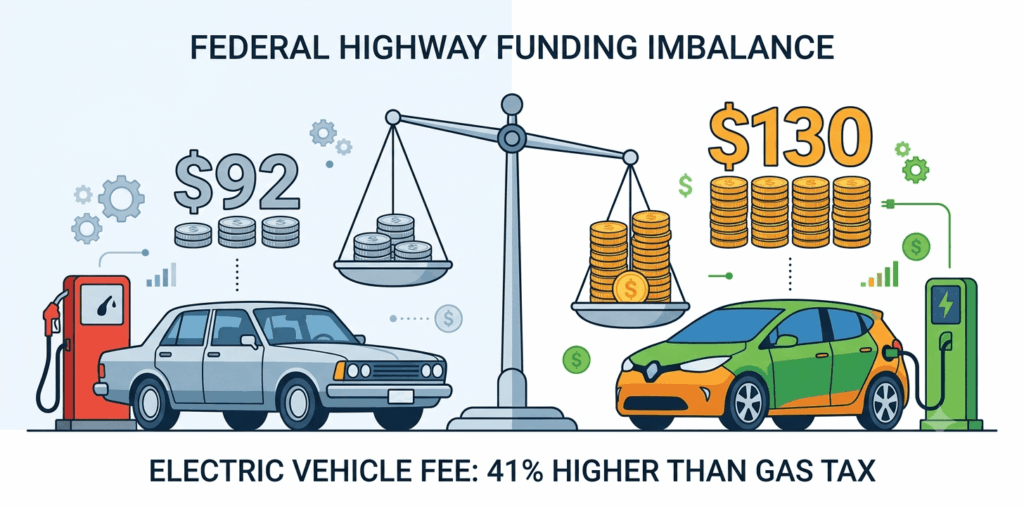
500 gallons × $0.184 federal gas tax = $92 per year in federal fuel tax
The proposed EV fee: $130 per year
The direct comparison:
An average fuel economy gasoline vehicle driver at average US mileage pays $92/year in federal fuel taxes.
The proposed BEV fee is $130/year — approximately 41% more than an average gasoline vehicle driver pays.
This is the honest comparison that most proponents of the $130 figure do not lead with, because it reveals that the proposed “fairness” measure actually charges EV drivers more than average gasoline vehicle drivers at average mileage, rather than an equivalent amount.
The comparison across different vehicles:
| Vehicle Type | Annual Miles | Fuel Economy / Efficiency | Annual Federal Tax/Fee |
|---|---|---|---|
| Average US car (gasoline) | 14,200 | 28.4 mpg | $92 (fuel tax) |
| Fuel-efficient compact (gasoline) | 14,200 | 40 mpg | $65 (fuel tax) |
| Full-size pickup truck (gasoline) | 14,200 | 17 mpg | $154 (fuel tax) |
| Large SUV (gasoline) | 14,200 | 18 mpg | $145 (fuel tax) |
| BEV (proposed flat fee) | 14,200 | N/A | $130 (flat fee) |
| PHEV (proposed flat fee) | 14,200 | N/A | $35 (flat fee) |
What this table reveals:
The $130 BEV flat fee is:
- More than an average car driver pays ($92)
- Roughly equivalent to a large SUV driver pays ($145)
- Less than a large pickup truck driver pays ($154)
- More than a fuel-efficient compact car driver pays ($65)
In other words, the $130 flat fee is roughly fair compared to the least fuel-efficient gasoline vehicles but represents an overcharge compared to average and fuel-efficient gasoline vehicles.
The mileage problem with flat fees:
The flat fee structure creates a specific fairness issue: a BEV owner who drives 8,000 miles per year pays the same $130 as a BEV owner who drives 25,000 miles per year. The gasoline tax, by contrast, is inherently mileage-proportional — high-mileage drivers pay more because they buy more fuel. The flat fee structure overcharges low-mileage EV drivers relative to the user-pays principle and undercharges high-mileage EV drivers.
What a mileage-equivalent fee would look like:
If the federal fuel tax’s effective rate per mile for an average vehicle is calculated:
$0.184 ÷ 28.4 mpg = $0.00648 per mile
At 14,200 miles: $92 per year (consistent with above)
A mileage-equivalent EV fee would therefore be:
$0.00648 × 14,200 miles = $92/year for an average-mileage driver
The $130 flat fee implies a per-mile rate of $130 ÷ 14,200 = $0.00915/mile — approximately 41% above the per-mile rate that average gasoline vehicles pay.
The PHEV Analysis — The $35 Fee and Its Complications
Why PHEV Owners Have A More Complex Calculation
The PHEV’s dual-fuel reality:
PHEVs present the most complex equity calculation in the fee proposal because they pay both the federal fuel tax (for gasoline consumed) and, under the proposal, the $35 annual flat fee (for the plug-in capability). The combined federal contribution from a PHEV driver therefore depends on how much of their driving is electric versus gasoline-powered.
The calculation for a typical PHEV driver:
A 2026 PHEV with 35 miles of electric range (representative of mainstream PHEVs like the Toyota RAV4 Prime, Hyundai Tucson PHEV):
If the PHEV is regularly charged and electric range is maximised:
- Electric miles: approximately 8,000/year (55% of 14,200 total miles)
- Gasoline miles: approximately 6,200/year
- At 35 mpg in gasoline mode: 177 gallons × $0.184 = $33 in federal fuel tax
- Plus proposed $35 PHEV fee
- Total federal highway contribution: $68/year
If the PHEV is rarely charged (driven primarily on gasoline):
- Electric miles: approximately 1,000/year (7% of 14,200 total miles)
- Gasoline miles: approximately 13,200/year
- At 35 mpg in gasoline mode: 377 gallons × $0.184 = $69 in federal fuel tax
- Plus proposed $35 PHEV fee
- Total federal highway contribution: $104/year
The PHEV equity observation:
A PHEV driver who actively charges (maximising electric miles) pays less total federal highway contribution ($68) than a PHEV driver who rarely charges ($104) — which actually creates a perverse incentive from a grid and emissions perspective: the PHEV driver who is using the vehicle more as designed (charging regularly, maximising electric miles) pays less in total, while the PHEV driver who is not charging contributes more to the Highway Trust Fund.
This is actually appropriate from a user-pays perspective (the rarely-charging PHEV driver is using more gasoline and imposing more road wear) but may create political complexity when PHEVs are characterised as a single category with uniform fee treatment.
The State Fee Interaction — The Stacking Problem
How the Federal Proposal Interacts With Existing State EV Fees
The state fee landscape in 2026:
As documented in our state EV policy scorecard, many states — including some low-scoring “red light” states — have already enacted state-level annual EV fees, often framed as road use fees compensating for lost fuel tax revenue. The interaction between these existing state fees and the proposed federal fee creates a stacking problem that significantly affects total annual fee burden for EV owners in states that have already enacted fees.
The current state fee range:
States with the highest existing annual EV registration fees:
Washington: $225/year
Georgia: $220/year (the state that eliminated its $5,000 EV rebate in 2015 now charges among the highest EV fees)
West Virginia: $200/year
Wyoming: $200/year
South Carolina: $120/year
Mississippi: $150/year
Missouri: $150/year
Arkansas: $200/year (the state that added an EV fee without providing purchase incentives)
The combined burden in high-fee states:
In states with existing high EV fees, the proposed federal $130 fee stacks on top:
Georgia EV owner:
Existing state fee: $220/year
Proposed federal fee: $130/year
Combined EV annual fee: $350/year
Washington EV owner:
Existing state fee: $225/year
Proposed federal fee: $130/year
Combined EV annual fee: $355/year
Compared to gasoline vehicle road use costs:
In these same states, a gasoline vehicle driver at average mileage pays:
State gasoline tax (Georgia example): $0.291/gallon × 500 gallons = $145.50
Federal gasoline tax: $0.184/gallon × 500 gallons = $92.00
Total gasoline vehicle fuel taxes: $237.50/year
Georgia EV owner total annual road fee: $350/year
Georgia average gasoline vehicle annual fuel taxes: $237.50/year
The combined state-plus-federal EV fee in Georgia would charge EV owners 47% more than an average gasoline vehicle driver pays in total fuel taxes. In Washington, the combination produces similar overcharge relative to average vehicles.
The states where stacking creates the most significant burden:
This table shows the combined annual road use cost for EV owners in high-fee states after the proposed federal fee is added:
| State | Current State EV Fee | Proposed Federal Fee | Combined | Average Gas Car Total Fuel Tax |
|---|---|---|---|---|
| Washington | $225 | $130 | $355 | $237* |
| Georgia | $220 | $130 | $350 | $284* |
| West Virginia | $200 | $130 | $330 | $232* |
| Wyoming | $200 | $130 | $330 | $232* |
| Arkansas | $200 | $130 | $330 | $248* |
| Missouri | $150 | $130 | $280 | $231* |
| Mississippi | $150 | $130 | $280 | $229* |
*Combined federal + state gas tax at 14,200 miles, 28.4 mpg
The political incongruity:
Most of the states with the highest existing EV fees are states that simultaneously provide no EV purchase incentives — the Brookings red light states. These states have created an environment where EV owners receive zero state purchase support and pay the highest road use fees. The addition of a federal fee amplifies this burden further.
The Low-Income EV Owner Impact
The Distributional Effect the Proposal’s Proponents Don’t Lead With
Who bears this fee disproportionately:
A flat $130 annual fee is regressive by definition — it represents a higher proportion of annual income for lower-income EV owners than for higher-income EV owners. This distributional concern is particularly acute given the policy context:
The expiry of the federal $7,500 new EV tax credit eliminated the federal support that partially compensated for EV acquisition cost premiums over comparable gasoline vehicles.
Lower-income EV buyers disproportionately own used EVs — for which the expired $4,000 used EV federal credit was specifically designed.
The proposed $35 PHEV fee is lower than the $130 BEV fee, but PHEVs’ higher vehicle prices mean PHEV owners are generally higher-income than BEV owners of used, lower-cost EVs.
The specific lower-income EV buyer situation:
A lower-income buyer who purchased a used Nissan Leaf for $14,000 (taking advantage of the now-expired $4,000 used EV federal credit when it was available):
Annual income: $45,000
Proposed annual EV fee as percentage of income: $130 ÷ $45,000 = 0.29%
A higher-income buyer who purchased a new Tesla Model 3 for $42,000:
Annual income: $150,000
Proposed annual EV fee as percentage of income: $130 ÷ $150,000 = 0.087%
The flat fee represents 3.3× the proportional income burden for the lower-income buyer compared to the higher-income buyer.
The comparison with the gasoline vehicle alternative for lower-income drivers:
A lower-income driver who specifically purchased a used EV to reduce operating costs — the primary financial motivation for many lower-income EV buyers — faces a specific situation where the annual fee reduces the operating cost advantage that motivated the EV purchase:
Used Leaf annual electricity cost (home charging, 12,000 miles): approximately $540/year at $0.15/kWh average
Comparable used gasoline car annual fuel cost (12,000 miles, 32 mpg): approximately $1,500/year at $4.00/gallon
Annual operating cost saving from EV: approximately $960/year
The $130 fee reduces this operating cost saving from $960 to $830 per year — a 14% reduction in the financial incentive that motivated the EV purchase.
The Current Legislative Status
Where This Proposal Actually Stands in 2026
The honest status assessment:
As of mid-2026, the $130/$35 federal EV fee proposal is a legislative discussion item rather than enacted law. Its bipartisan sponsorship gives it more realistic legislative prospects than purely partisan proposals, but several specific legislative hurdles remain:
The revenue destination debate:
Some legislators specifically want EV fee revenue directed to the Highway Trust Fund’s Highway Account, while others propose a portion going to the Mass Transit Account — a debate that mirrors the longstanding gas tax allocation dispute.
The administrative mechanism dispute:
The collection mechanism — whether through federal direct assessment, IRS collection, state collection on federal behalf, or DMV integration — has not been resolved and represents a significant implementation challenge given that vehicle registration is a state function.
The fee level negotiation:
The $130 BEV and $35 PHEV levels are negotiating positions rather than final numbers. Policy advocates have proposed alternatives ranging from $50 (arguing $130 overcharges average-mileage EV owners) to $175 (arguing high-mileage EV owners should contribute more). A road-mileage-based fee (cents per mile rather than flat annual fee) has been proposed as a fairer alternative that aligns better with the user-pays principle.
The status of larger transportation funding legislation:
The EV fee proposal is embedded in a larger surface transportation reauthorisation discussion that has its own timeline — the fee’s legislative prospects are tied to whether comprehensive transportation funding legislation moves forward in the current Congress.
The interaction with reconciliation and broader tax policy:
The simultaneous discussion of extending tax cuts, adjusting EV-related tax provisions, and the broader federal budget context creates a complex legislative environment where the EV fee could be incorporated into a broader package, stripped from the transportation bill, or modified significantly from the current proposal.
The Road Usage Charge Alternative — The More Equitable Option
What Policy Experts Propose Instead of a Flat Fee
The Vehicle Miles Traveled (VMT) fee concept:
The policy alternative that most transportation economists prefer to the flat annual fee is a Vehicle Miles Traveled charge — a per-mile fee collected on actual road use rather than a flat annual assessment.
How a VMT fee would work:
A federal VMT fee at the per-mile equivalent of the current federal gas tax for an average vehicle ($0.00648/mile, as calculated above) would produce:
8,000 miles/year: $51.84/year
14,200 miles/year (average): $92/year (exactly equivalent to average gas car)
25,000 miles/year: $162/year
This approach is:
- Proportional to actual road use (more equitable than flat fee)
- Revenue-equivalent across the fleet (average-mileage driver pays same as average gas car driver)
- Automatically adjusted for high and low mileage (no arbitrary flat fee overcharges low-mileage drivers)
The VMT implementation challenges:
Despite its theoretical superiority, VMT fee implementation faces specific challenges:
Privacy concerns — collecting mileage data requires either odometer reporting (low privacy concern) or GPS-based mileage tracking (high privacy concern)
Administrative complexity — per-mile billing requires mileage verification that the current registration system doesn’t provide
Transition complexity — implementing VMT for EVs while maintaining gas tax for gasoline vehicles creates a two-track system
Several states — Oregon, Utah, Hawaii, Virginia — have piloted voluntary VMT programmes that provide useful implementation evidence, but national mandatory VMT implementation faces political and administrative barriers that explain why the simpler (if less equitable) flat fee approach has more current legislative momentum.
What EV Owners Should Do Right Now
Practical Guidance While the Legislation Develops
Track state legislation separately from federal:
The federal proposal’s uncertain legislative timeline means state-level EV fees are the more immediately relevant policy for most EV owners. If you live in a state with an existing high EV registration fee — and particularly if you live in a state that combines a high EV fee with no purchase incentives — engaging with your state legislature on fee level and structure is immediately actionable in a way that federal advocacy is not.
Calculate your current total road use contribution:
Use the framework this guide provides to calculate what you currently pay in state EV fees, what you would pay in federal gas tax if you drove a comparable gasoline vehicle, and what the combined state-plus-proposed-federal fee would represent relative to your gasoline vehicle equivalent. This specific calculation is the most powerful advocacy tool in any conversation with legislators about whether the proposed fee level is appropriate.
The total cost of ownership calculation update:
Incorporate the $130 proposed federal fee into your EV total cost of ownership calculation alongside your state fee, your home electricity cost, your public charging cost, and the absence of the federal purchase credit — this complete annual cost picture is the information EV buyers need in 2026 rather than calculations that still incorporate the now-expired federal credit.
Consider the fee’s impact on your specific driving pattern:
At 8,000 miles/year: $130 flat fee vs $52 equivalent-mileage gas tax — significant overcharge
At 14,200 miles/year: $130 flat fee vs $92 equivalent gas tax — modest overcharge
At 25,000 miles/year: $130 flat fee vs $162 equivalent gas tax — meaningful undercharge
High-mileage EV drivers should note that the flat fee structure specifically benefits them relative to mileage-proportional alternatives — the flat fee is only disadvantageous for below-average-mileage drivers.
Internal Links — Further Reading on Clean Energy Bazaar
The new $130 federal EV fee proposal how much will you pay guide connects to the US market EV policy and ownership cost guides on cleanenergybazaar.com.
For the US state EV policy scorecard that covers the state-level EV fees that stack with the proposed federal fee, our US state EV policy scorecard is your state a green light or red light guide covers every state’s current policy position. For the federal EV tax credit analysis covering the expired incentives that the fee proposal’s policy context must be understood alongside, our federal EV credit expiry guide covers the complete incentive transition. For the EV total cost of ownership guide that incorporates the fee into the complete annual EV ownership cost calculation, our EV vs gasoline cost comparison covers the full financial picture. For the home EV charging cost analysis that contextualises the charging electricity cost alongside the proposed annual fee, our home EV charging cost guide covers every charging cost component. And for the used EV buying guide where the fee’s disproportionate lower-income burden is most relevant, our used EV market guide covers the complete pre-owned EV analysis.
Final Thoughts
The new $130 federal EV fee proposal how much will you pay is a legitimate policy question with a genuinely nuanced answer that resists the politically convenient framings offered by both proponents and opponents.
Proponents who characterise it as simple fairness — EV drivers using roads should pay for roads — are correct in principle but imprecise about the amount. The $130 fee charges average-mileage BEV drivers 41% more than an average gasoline vehicle driver pays in federal fuel tax. If fairness is the standard, a mileage-equivalent fee would be approximately $92 for an average-mileage driver — not $130.
Opponents who characterise it as an anti-EV tax designed to punish clean vehicle owners overstate the political motivation and understate the genuine Highway Trust Fund funding problem. EV road use does impose costs on road infrastructure. Some mechanism for EV road use contribution is appropriate in principle, and the bipartisan support for the proposal reflects genuine cross-partisan recognition of this.
The honest assessment is that the $130 figure is higher than equivalent-fairness requires for average-mileage drivers, that the flat fee structure is inherently less equitable than a mileage-based alternative, that the interaction with existing state fees creates a stacking problem that produces genuine overcharges in multiple states, and that the distributional impact on lower-income EV owners deserves more policy attention than the current proposal provides.
For individual EV owners, the practical impact is clear: $130/year for BEV owners if enacted as proposed, $35/year for PHEV owners, with state fees stacked on top in states that have already enacted them. Against the annual electricity cost saving from home charging versus gasoline costs — typically $900-$1,500/year for average drivers — the $130 fee is a meaningful but not devastating reduction in EV ownership’s financial advantage.
The policy debate will continue. The fee level may change. The structure may evolve toward a VMT-based alternative. What won’t change is the underlying policy problem: roads cost money, and EV drivers use roads. Some version of a road use contribution from EV drivers is coming — the question is whether the specific design is fair, proportionate, and appropriately structured relative to what gasoline vehicle drivers pay.