The global electric vehicle narrative has a new centre of gravity. While the United States retreats from federal support and Europe recalibrates its regulatory targets, the most dramatic growth in electric vehicle adoption is occurring in markets that were barely on the radar five years ago.
The International Energy Agency’s Global EV Outlook 2026 confirmed the shift. Electric car sales in Southeast Asia more than doubled in 2025 to over 500,000 vehicles, with EVs accounting for nearly one in five new cars sold. In Latin America, sales grew by 75%, led by Brazil and Mexico. More than 100 countries recorded electric car sales growth in 2025, and in one-third of these, EVs represented at least 10% of new car sales.
This is the emerging market EV explosion: Southeast Asia doubles sales, LatAm grows 75%. It is not a story of wealthy countries subsidising a transition. It is a story of developing economies finding their own paths to electric mobility, often faster and more decisively than the markets that pioneered the technology.
Southeast Asia: From 500,000 Units to a Regional Tipping Point
The IEA’s data confirmed what regional analysts had been tracking for months. Southeast Asia’s electric car sales more than doubled in 2025, reaching over 500,000 vehicles and a sales share of nearly 20%. The growth was led by Vietnam, Indonesia, and Thailand, supported by a combination of policy incentives, expanding domestic production, and imports, particularly from China.
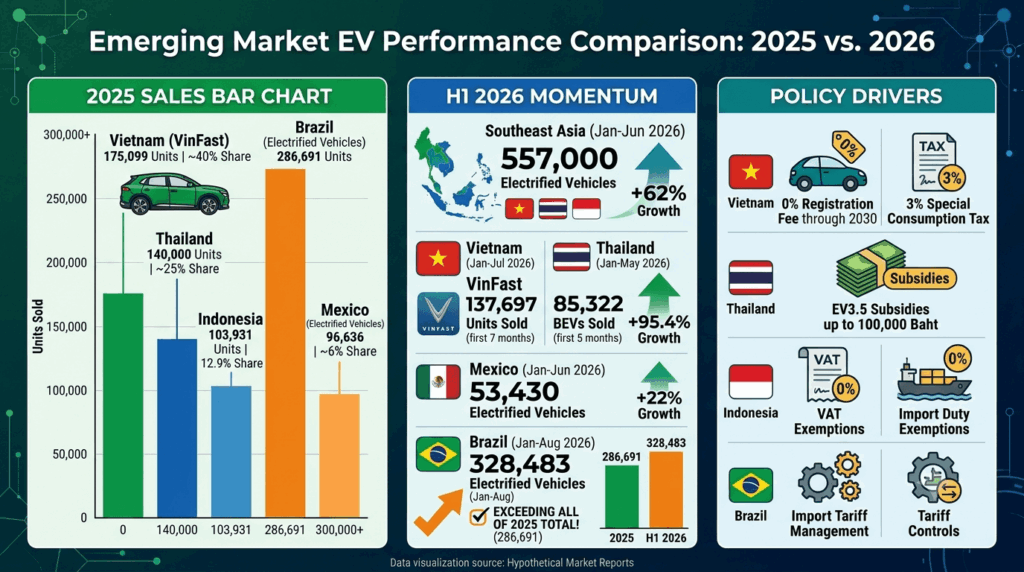
The momentum has carried into 2026. In the first half of 2026, the six major Southeast Asian markets of Indonesia, Malaysia, Thailand, Vietnam, the Philippines, and Singapore recorded approximately 557,000 electrified vehicle sales, a 62% increase over the same period a year earlier. The growth is broad-based, not confined to a single market or a single manufacturer.
The scale of the shift is best understood by looking at where the region started. In 2020, electric cars were a marginal presence across Southeast Asia. Vietnam’s market was close to zero. Thailand’s was negligible. Indonesia had not yet registered a single battery electric vehicle. Five years later, the region has become one of the fastest-growing EV markets in the world.
The drivers are consistent across the region. Government incentives have reduced the upfront cost of electric vehicles. Domestic production has expanded, particularly in Thailand and Indonesia, where Chinese manufacturers have established assembly operations. And the availability of affordable Chinese models has brought electric vehicles within reach of a much broader segment of consumers than the premium-priced EVs that initially defined the market.
Vietnam: Nearly 40% Market Share and a Single-Brand Revolution
Vietnam emerged as Southeast Asia’s largest electric car market in 2025, with electric vehicles accounting for nearly 40% of new car sales. That placed Vietnam ahead of Thailand and Indonesia and above the global average of about 25%. The IEA projects that Vietnam could reach an electric car sales share of more than 80% by 2035, the highest among Southeast Asian countries.
The transformation is almost entirely attributable to one company. VinFast delivered 175,099 electric vehicles in Vietnam in 2025. In the first seven months of 2026, it delivered 137,697 units and aimed to sell 300,000 electric cars for the full year. Its market share in Vietnam has risen from around 35% in 2024 to an estimated 45% in August 2026.
The policy framework behind this growth is targeted rather than comprehensive. Vietnam has exempted battery electric vehicles from first-time registration fees since 2022, and the exemption has been extended through the end of 2030 under Decree No. 202/2026/ND-CP. Battery EVs will continue to pay a 0% first-time registration fee from March 1, 2027, to December 31, 2030. The special consumption tax on battery electric cars is 3%, compared with significantly higher rates for internal combustion engine vehicles.
The affordability strategy has been equally important. VinFast’s VF 3 and VF 5 models are priced at levels that conventional imported EVs cannot match. The VF 3, a small city car, has become one of the best-selling models in the market. The Limo Green, designed for commercial and fleet use, has also performed strongly.
The charging network has been built ahead of demand. V-Green, the charging infrastructure company backed by VinFast’s founder, operates more than 150,000 charging ports nationwide and is investing in larger charging hubs to support long-distance travel. The network covers 34 provinces and cities.
The concentration of the market in a single manufacturer is both a strength and a vulnerability. It has allowed Vietnam to achieve scale and coordinate infrastructure deployment in a way that fragmented markets cannot. But it also means that the health of the market is closely tied to the health of one company.
Thailand: 140,000 Sales and the Chinese Manufacturing Footprint
Thailand was the region’s second-largest electric car market in 2025, with sales rising 70% to about 140,000 vehicles, nearly one-quarter of new car sales. The momentum has continued into 2026. In the first five months of 2026, BEV passenger car registrations reached 85,322 units, a 95.4% increase over the same period a year earlier, with penetration reaching a historic high of 30%.
The policy framework behind Thailand’s growth is the EV3.5 scheme, which came into force in January 2024. The scheme provides purchase subsidies, excise tax breaks, and import duty reliefs. Subsidies of up to 100,000 baht, approximately $3,200, are available for eligible passenger cars and pickups, along with partial VAT exemptions.
The earlier EV3.0 scheme was designed to drive domestic production. It required manufacturers to register their domestic electric car production in exchange for import duty exemptions. Thai-made electric cars represented 20% of the market in 2025, up from about 5% the year before. Despite this shift toward local production, Chinese-made electric cars still represented three-quarters of the Thai market in 2025.
The Chinese manufacturing footprint in Thailand is substantial. BYD, Chery, SAIC, Changan, Geely, and Great Wall Motor all have a presence. In the first five months of 2026, Chinese brands accounted for 90.6% of BEV passenger car registrations, with BYD alone holding 21.4% of the market. Thailand has become a manufacturing hub for Chinese EVs destined for the wider Southeast Asian region.
Indonesia: 103,931 Sales and the Shift from LCGC to BEV
Indonesia’s electric vehicle market crossed a significant threshold in 2025. Battery electric vehicle sales reached 103,931 units, up from zero in 2019, capturing 12.9% of the national market. In the first quarter of 2026, BEV sales reached 33,150 units, a 95.9% increase over the same period a year earlier, with a market share of 15.9%.
The growth has come at the expense of the low-cost green car segment, the LCGC, which was once the dominant category for middle-income buyers. LCGC market share fell from 21.1% in 2019 to 13.8% by March 2026. The shift reflects both the growing affordability of electric vehicles and the impact of policy incentives that favour electrified models.
Indonesia’s policy support has primarily taken the form of VAT and import duty exemptions for battery electric cars. In anticipation of the tariff exemption for BEV imports coming to an end in December 2025, manufacturers ramped up imports towards the end of the year, resulting in about half of 2025 sales taking place in the last quarter. About 75% of 2025 sales were imports from China, while the rest were cars produced domestically by Chinese manufacturers, mostly by Wuling, supported by a wide range of manufacturing incentives.
BYD leads Indonesia’s BEV segment with a share of around 35% to 39%. The company has been expanding its local presence, and Indonesia is positioning itself as a regional manufacturing hub for Chinese EVs. The country’s nickel reserves, a key input for battery production, give it a strategic advantage in the battery supply chain that few other emerging markets can match.
Latin America: 75% Growth and the One Million Vehicle Milestone
Latin America’s electric vehicle market grew by 75% in 2025, with sales reaching more than 350,000 units. The growth was led by Brazil and Mexico, which together accounted for the vast majority of the regional increase.
The region passed a symbolic milestone in 2026. By September, Brazil alone had surpassed one million electrified vehicles sold since 2012, according to the Brazilian Association of Electric Vehicles. The milestone was reached on September 24, 2026. Between January and August 2026, Brazil registered 328,483 electrified vehicles, a volume that already far exceeded the 223,912 units registered during all of 2025.
Brazil’s growth has been concentrated in the last few years. The country needed more than a decade from the start of the ABVE’s historical series in 2012 to reach the one million mark, but a significant portion of sales occurred in 2026 alone. In the battery electric vehicle segment specifically, 143,574 units were sold in 2026 through September. BYD leads with 88,981 units and a 61.98% share, followed by Geely with 28,525 units and a 19.87% share. Between the two companies, they account for more than 81% of the BEV market.
Mexico’s performance has been equally striking. Sales of electrified vehicles, including battery electric, plug-in hybrid, and range-extended vehicles, grew 38.5% in 2025 to 96,636 units, bringing Mexico close to the 100,000-unit annual milestone. In the first half of 2026, electrified light vehicle sales reached 53,430 units, a 22% increase over the same period a year earlier. BEVs accounted for 22,236 units, up 14% year on year, while plug-in hybrids reached 31,063 units, a 29% increase.
Mexico’s EV sales tripled in 2025, pushing the market share of BEVs and PHEVs above 7% of total new car sales, up from approximately 2% in 2024. By July 2026, electrified vehicles, including conventional hybrids, captured a 12.7% share of the overall light vehicle market.
The regional trajectory has continued into 2026. Latin America recorded more than 106,000 electric and plug-in hybrid vehicle sales in the first quarter of 2026 alone. The regional fleet of electrified light vehicles reached over 837,000 units by the end of the first quarter, and the total was expected to exceed one million before the end of the year. The IEA projects that Latin American EV sales will grow by 45% in 2026.
The Common Thread: Chinese Models and Targeted Policy
The emerging market EV explosion is not a coincidence. It is the product of two forces that have converged across the Global South.
The first is the availability of affordable Chinese electric vehicles. In Thailand, Chinese-made electric cars represented three-quarters of the market in 2025. In Indonesia, about 75% of 2025 sales were imports from China. In Brazil, BYD and Geely together account for more than 81% of BEV sales. In Vietnam, VinFast is a domestic manufacturer, but its model strategy has been explicitly built around affordability in a way that mirrors the Chinese approach.
The second is targeted policy. The emerging markets that have achieved the fastest growth have not relied on broad, expensive subsidy programmes. They have used specific, fiscally sustainable measures that reduce the upfront cost of electric vehicles relative to their petrol equivalents. Vietnam eliminated the registration fee and reduced the special consumption tax. Thailand’s EV3.5 scheme combines purchase subsidies with excise tax breaks and import duty reliefs. Indonesia provides VAT and import duty exemptions. Brazil has used import tariff structures to encourage local assembly while managing the pace of import growth.
The combination has proven powerful. It has allowed countries with limited fiscal space to accelerate EV adoption without committing to the kind of open-ended subsidy programmes that have strained budgets in wealthier markets.
The Infrastructure Challenge: Growth Outpacing Grids
The rapid growth of electric vehicle sales has exposed infrastructure gaps that are now the primary constraint on further adoption.
In Mexico, the charging network reached 60,932 connections by the end of the first half of 2026, a 17.5% increase from a year earlier. But the network is overwhelmingly private. More than 55,000 of the connections are private charging points, and only about 4,378 are public. The EMA’s consumer survey identified charging infrastructure as the country’s main barrier to wider EV adoption. Industry analysts have noted that 30% of final distribution grids in Mexico are obsolete, and that the system has fallen below a 6% power reserve, leading to blackouts.
Across Latin America, the challenge is similar. The main constraint is not the number of chargers but the capacity of the installed grid, which is often not technologically advanced enough to support rapid, widespread electrification. The integration of electric vehicles could raise peak electricity demand by 20% to 30% in major cities, requiring investment in smart charging and grid upgrades that many utilities are not yet prepared to make.
Southeast Asia faces its own infrastructure challenges. Vietnam’s charging network is concentrated in cities and along major highways, with rural coverage limited. Apartment buildings and residential areas present particular problems, with many buildings restricting EV parking and charging. Grid capacity and power supply are constraints that will require sustained investment.
The infrastructure gap is not a reason to expect the growth to reverse. It is a signal of where the next phase of investment will need to go. The vehicles are being sold. The chargers and the grids must now catch up.
What the 2026 Outlook Holds
The IEA’s projections suggest that the momentum will continue. The agency anticipates that around 23 million electric vehicles will be sold globally in 2026, representing nearly 30% of all new car sales. Asia Pacific excluding China is expected to grow by more than 50%, and Latin America by 45%.
The structural drivers remain intact. Oil price volatility, driven by the conflict in the Middle East, has reinforced the economic case for electric vehicles in oil-importing nations. The IEA noted that the global EV fleet avoided the consumption of approximately 1.7 million barrels of oil per day in 2025, up from 0.4 million barrels per day in 2020. The agency projects that this figure could reach 5 million barrels per day by 2030.
The policy environment in emerging markets is also becoming more supportive. Vietnam has extended its registration fee exemption through 2030. Thailand has adjusted its EV3.5 scheme to support local production while maintaining consumer incentives. Indonesia is developing a domestic battery supply chain anchored by its nickel reserves. Brazil and Mexico are managing the balance between encouraging adoption and building local manufacturing capacity.
The emerging market EV explosion is not a temporary surge. It is a structural shift in the geography of electric mobility. The markets that were once considered followers are now setting the pace. The lessons they are teaching, about targeted policy, affordable models, and the importance of building infrastructure ahead of demand, are relevant to every country seeking to accelerate its own transition.