In 2020, electric cars were a marginal presence in Vietnam. The market was close to zero. Five years later, Vietnam has become the largest electric car market in Southeast Asia, with nearly 40% of new car sales being electric, above levels recorded in most European countries.
The transformation is one of the fastest in the world. It was not driven by the kind of comprehensive subsidy programmes that Europe and China deployed. It was driven by a combination of targeted tax policy, a domestic manufacturer willing to build affordable vehicles, and a charging network built ahead of demand.
Vietnam becomes Southeast Asia’s largest EV market: lessons for emerging economies is not just a story about one country. It is a case study in how a developing economy with a nascent automotive industry can leapfrog into electric mobility, and what other emerging economies can learn from the experience.
The Data: How Vietnam Overtook Thailand and Indonesia
The IEA’s Global EV Outlook 2026 confirmed Vietnam’s position. Electric car sales in Vietnam more than doubled in 2025, lifting the EV share of new car sales to around 40%. That placed Vietnam ahead of Thailand, which recorded approximately 140,000 EV sales representing nearly one-quarter of new car sales, and Indonesia, where EVs reached 15% of new car sales.
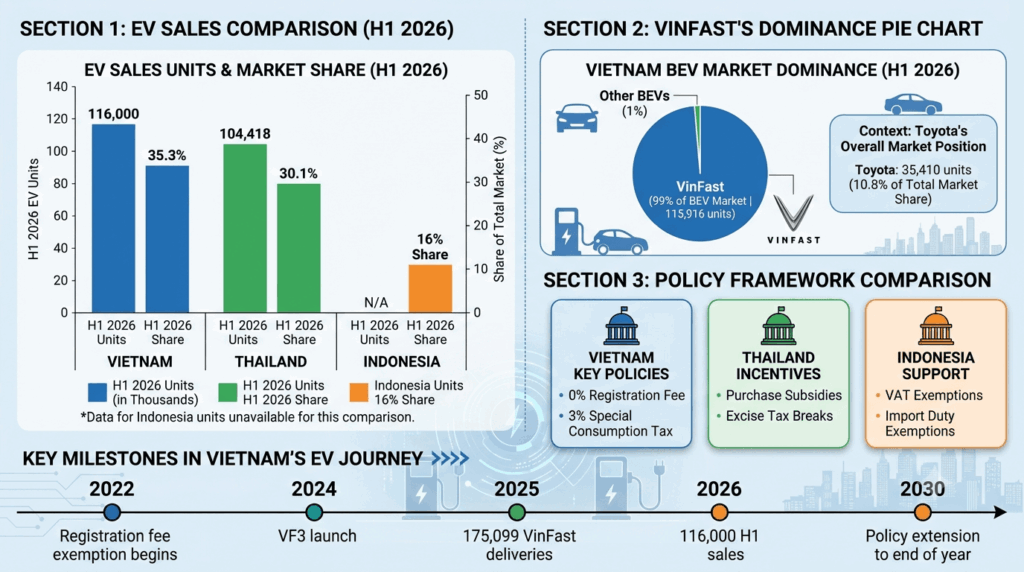
The momentum continued into 2026. In the first half of 2026, Vietnam recorded approximately 116,000 battery electric vehicle sales, giving EVs a 35.3% share of the market. Thailand followed with 104,418 units and a 30.1% penetration rate. In the first quarter of 2026, the two markets were separated by just over 3,400 units. By the end of the first half, Vietnam’s lead had widened.
The IEA projects that Vietnam could reach an electric car sales share of more than 80% by 2035, the highest of any Southeast Asian country. The Vietnam Automobile Manufacturers’ Association projects that electric cars on Vietnam’s roads will reach around 1 million by 2028 and 3.5 million by 2040.
VinFast: The Single-Brand Market
The most distinctive feature of Vietnam’s EV market is its concentration. In the first half of 2026, VinFast registered 115,916 battery electric vehicles, representing essentially the entire BEV market. The second-placed brand, Toyota, registered 35,410 units across all powertrains, capturing just 10.8% of the total market.
VinFast delivered 175,099 electric vehicles in Vietnam in 2025, a record for the Vietnamese automotive industry. December 2025 was the highest-ever monthly sales figure recorded by any automaker in Vietnam, with 27,649 vehicles delivered. VinFast has maintained its position as the market leader for 21 consecutive months.
The model mix reveals the strategy. The Limo Green, a vehicle designed for commercial and fleet use, delivered 27,927 units in the first half of 2026, emerging as Vietnam’s best-selling model. The VF 3, a small, affordable city car, sold 23,781 units. The VF 5 shifted 20,167 units. Together, these three models account for the majority of VinFast’s volume.
The concentration is both a strength and a vulnerability. It has allowed VinFast to achieve scale quickly and to coordinate the build-out of charging infrastructure with vehicle sales. But it also means that the health of Vietnam’s EV market is closely tied to the health of a single company.
The Policy Framework: Targeted, Not Comprehensive
Vietnam’s policy support for EVs has been narrower than Europe’s or China’s, but it has been precisely targeted at the point of purchase.
The core policy is the registration fee exemption for battery electric vehicles, which has been in place since 2022. The exemption has been extended multiple times. The government has decided to extend the registration fee exemption for BEVs through the end of 2030. From March 1, 2027, to December 31, 2030, battery electric vehicles will be exempt from registration fees at a rate of 0%.
The second policy lever is the special consumption tax. Vietnam applies a special consumption tax of 3% to battery electric cars with fewer than 24 seats, compared with significantly higher rates for internal combustion engine vehicles. The Ministry of Finance has proposed extending this preferential rate until the end of 2030.
The combination of zero registration fee and a 3% special consumption tax is powerful. In Vietnam, registration fees for conventional cars can be as high as 10% to 12% of the vehicle’s value. Eliminating that cost, combined with a special consumption tax that is a fraction of what petrol cars pay, substantially reduces the upfront price of an EV relative to an equivalent petrol vehicle.
The policy has been extended repeatedly because it works. The IEA noted that Vietnam’s policy support for electric car purchases has primarily been provided through registration fee exemptions for BEVs since 2022, while VinFast’s expansion of affordable models has helped broaden the market.
The Affordability Factor: VF3 and VF5
Price is the single most important determinant of EV adoption in emerging economies. Vietnam addressed it directly.
The VinFast VF 3 was launched as a small, affordable city car. In July 2026, its price was reduced to 285 million Vietnamese dong, approximately $11,200. The VF 5 Plus was reduced to 496 million dong, approximately $19,500.
These price points are within reach of a meaningful segment of Vietnamese consumers in a way that the $40,000 to $50,000 EVs sold in Europe and the United States are not. The IEA specifically noted that in 2025, the price competitiveness of the best-selling models VF3 and VF5 helped them outsell conventional rivals in similar size segments.
The affordability strategy extends beyond the purchase price. VinFast has offered zero-down-payment schemes, discounts of 6% to 10% on mass-market models, and free charging at V-Green stations until 2027. These incentives reduce the total cost of ownership and address the upfront cost barrier that is particularly acute in emerging markets.
The Charging Network: Built Ahead of Demand
Charging infrastructure is the chicken-and-egg problem of EV adoption. Consumers will not buy EVs without chargers. Companies will not build chargers without EVs to use them.
Vietnam solved this by integrating the charging network with the vehicle manufacturer. V-Green, the charging infrastructure company backed by VinFast’s founder, operates approximately 150,000 charging ports across Vietnam. The network covers 34 provinces and cities.
V-Green is investing 10 trillion Vietnamese dong, approximately $400 million, in a nationwide ultra-fast charging network. The plan includes 99 mega charging stations capable of serving up to 100 vehicles simultaneously, reducing charging time to about 15 minutes. These stations are being installed along major national and provincial highways, supporting long-distance and inter-provincial travel.
The company’s next development phase aims to expand the network to 500,000 charging ports. VinFast has also partnered with Petrolimex and PVOIL to install EV charging facilities at petrol stations, and PV Power has signed a cooperation agreement with South Korea’s EN Technologies to study and develop EV charging systems.
The charging network is not without challenges. Land availability for charging stations is emerging as a major issue in large cities. Many apartment buildings prohibit electric vehicles from being parked in basements or restrict battery charging, creating safety concerns and limiting access for residents without private parking. Investment procedures, power supply, construction requirements, and urban planning remain obstacles.
But the direction is clear. Vietnam built the charging network ahead of demand, not in response to it. That is a lesson that emerging economies can replicate.
The Fleet Dimension: Taxis and Commercial Vehicles
Private car buyers were not the only driver of Vietnam’s EV growth. Commercial fleets played a significant role.
In April 2026, Hanoi-based taxi operator Lavi Taxi signed an agreement with VinFast to replace its entire fleet of 2,000 internal combustion engine vehicles with VinFast EVs. Taxi drivers reported monthly operational savings of roughly 2 to 3 million Vietnamese dong after making the switch.
Several transport and taxi companies have deployed the Limo Green as their primary fleet model, cementing its role as VinFast’s key sales pillar since deliveries commenced in August 2025. Around 60% of Hanoi’s more than 14,300 licensed taxis have already switched to electric vehicles, and the capital aims to convert its entire taxi fleet to electric or environmentally friendly vehicles by 2030.
The fleet segment matters because it creates predictable, high-utilisation demand. A taxi operator that switches to EVs charges them multiple times per day, generating revenue for the charging network and demonstrating the reliability and cost-effectiveness of electric vehicles to a broad audience of drivers and passengers.
Lessons for Emerging Economies
Vietnam’s experience offers several lessons for other emerging economies seeking to accelerate EV adoption.
Targeted tax policy can be more effective than broad subsidies. Vietnam did not offer a generous purchase subsidy. It eliminated the registration fee and reduced the special consumption tax. These measures reduced the upfront price of an EV relative to a petrol car without requiring a direct cash outlay from the government. For emerging economies with limited fiscal space, targeted tax relief is a more sustainable model than direct subsidies.
Domestic manufacturing matters. VinFast’s ability to produce affordable vehicles at scale was central to Vietnam’s success. The company’s VF 3 and VF 5 models were priced at levels that conventional imported EVs could not match. Emerging economies that build domestic manufacturing capacity can achieve price points that importing vehicles cannot.
Charging infrastructure should be built ahead of demand. V-Green’s network of 150,000 charging ports was not a response to demand. It was an enabler of demand. The integration of the charging network with the vehicle manufacturer allowed both to scale together.
Fleet electrification creates momentum. Taxi fleets and commercial operators provide predictable, high-utilisation demand that supports the economics of charging infrastructure and demonstrates the viability of EVs to a broad audience.
Persistence pays. Vietnam’s registration fee exemption has been extended multiple times. The policy has been maintained across changes in the economic environment. Consistency matters for consumer confidence.
The Challenges That Remain
Vietnam’s EV success is real, but it is not complete.
Charging infrastructure remains uneven. While 150,000 charging ports is a substantial network, it is concentrated in cities and along major highways. Rural areas and smaller towns have less coverage. Apartment buildings and residential areas present particular challenges, with many buildings restricting EV parking and charging.
The market is heavily dependent on a single manufacturer. VinFast’s dominance is a strength in terms of coordination and scale, but it is a vulnerability in terms of competition and resilience. The entry of other manufacturers, including Chinese brands, is limited. In Vietnam, Chinese brands account for less than 5% of pure EV sales, compared with 91% in Thailand.
Grid capacity and power supply are constraints. The rapid growth of EVs places additional demand on the electricity system. Investment procedures and power supply issues are among the challenges identified by industry experts.
The policy framework needs to evolve. The registration fee exemption and special consumption tax rate have been extended, but they are time-limited. A longer-term policy framework that provides certainty to manufacturers and consumers is needed to sustain growth beyond 2030.
What Comes Next
Vietnam’s trajectory from a near-zero EV market in 2020 to Southeast Asia’s largest in 2025 is one of the most rapid electric mobility transitions in the world. The IEA projects that EVs could account for more than 80% of new car sales in Vietnam by 2035.
The next phase will require addressing the challenges that remain. Charging infrastructure must expand beyond cities and highways. The market must diversify beyond a single manufacturer. The grid must accommodate the additional load. And the policy framework must provide long-term certainty.
But the foundation is in place. The vehicles are affordable. The charging network is extensive. The policy is supportive. And consumers have demonstrated, by buying nearly 176,000 VinFast EVs in 2025, that they are willing to make the switch.
Vietnam becomes Southeast Asia’s largest EV market: lessons for emerging economies is not a story about a wealthy country subsidising a transition. It is a story about a developing economy using targeted policy, domestic manufacturing, and infrastructure investment to achieve something that many wealthier countries have not. That is the lesson worth taking.