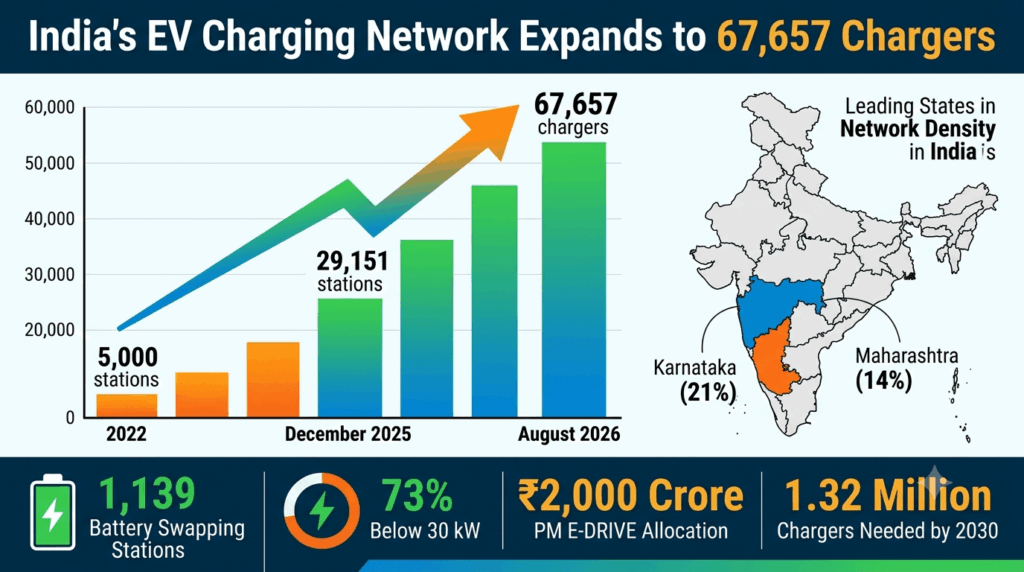
India’s electric vehicle charging infrastructure has reached a significant milestone. As of August 7, 2026, the country had installed 67,657 electric vehicle chargers across states and union territories, including 1,139 chargers associated with battery swapping stations.
This represents a remarkable expansion from just around 5,000 charging stations in 2022. The number of public EV charging stations stood at 29,151 as of December 2025, a nearly six-fold increase. More than 200 Charge Point Operators (CPOs) are now operating across the country.
This guide on India’s EV charging network expands to 67,657 chargers: what it means for EV adoption provides the complete, honest analysis. It covers the infrastructure growth, the role of government schemes like FAME-II and PM E-DRIVE, the challenges of low utilisation and high costs, and what this all means for India’s EV future.
The Numbers: 67,657 Chargers and 29,151 Stations
Understanding the Infrastructure Scale
Chargers vs. stations:
The distinction between chargers and stations is important. A charging station can have multiple chargers. India’s charger count, a more granular measure than station count, stood at 67,657 as of August 7, 2026. This includes 1,139 chargers associated with battery swapping stations (BSS).
Station growth:
The number of public EV charging stations reached 29,151 as of December 2025, up nearly six-fold from around 5,000 stations in 2022. Of these, 8,805 were fast chargers and 20,346 were slow chargers.
Charger composition:
Excluding battery swapping stations, 48,709 of 66,518 chargers, or about 73%, are rated below 30 kW. This points to significant headroom for higher-power infrastructure as passenger EV adoption scales.
State distribution:
The top 10 states account for nearly 78% of the charging infrastructure base. Karnataka leads with approximately 21% of installed charging stations, followed by Maharashtra at 14%. Uttar Pradesh (8%), Delhi (7%), and Tamil Nadu (6%) follow.
Battery swapping stations:
Battery swapping is emerging as a complementary charging solution, particularly for commercial vehicles. The 1,139 chargers associated with battery swapping stations represent a growing segment of India’s EV infrastructure.
The Policy Framework: FAME-II and PM E-DRIVE
How Government Schemes Are Driving Infrastructure Growth
FAME-II scheme:
The Faster Adoption and Manufacturing of (Hybrid &) Electric Vehicles in India (FAME India) Scheme Phase-II was implemented for five years from April 1, 2019, to March 31, 2024, with a total budgetary outlay of Rs 11,500 crore. The scheme provided demand incentives for e-2Ws, e-3Ws, e-4Ws and grants for e-buses and the setting up of EV public charging stations.
Under FAME-II, 9,583 EV public charging stations were installed nationwide. The scheme also supported 16.72 lakh EVs, including e-2Ws, e-3Ws, and e-4Ws. In addition, 5,299 electric buses were deployed under the scheme.
The Ministry of Heavy Industries allocated ₹912.50 crore under FAME-II for setting up EV public charging stations across the country.
PM E-DRIVE scheme:
Building on FAME-II’s momentum, the government launched the PM Electric Drive Revolution in Innovative Vehicle Enhancement (PM E-DRIVE) scheme. The scheme is being implemented from April 1, 2024, to March 31, 2028, with an overall allocation of Rs 10,900 crore.
The scheme has been extended by two years to March 2028, with its overall outlay increased to ₹11,900 crore. Of this, ₹2,000 crore has been earmarked for public EV charging infrastructure.
Charging infrastructure approvals:
As of July 22, 2026, proposals for 5,871 EV chargers across nine states had been approved under PM E-DRIVE. Karnataka received approval for the largest number at 1,571 chargers, followed by Delhi with 1,146 and Rajasthan with 805. Separately, 691 chargers of three oil marketing companies have also been approved under the scheme.
The deployment gap:
However, the government clarified that no chargers had been installed under PM E-DRIVE as of July 22, 2026. The charging infrastructure component remains at the approval and deployment stage. Progress in charging infrastructure remains at an early stage, with the 6,562 approved chargers yet to be deployed.
Supporting EV sales:
Despite the slow charging rollout, PM E-DRIVE has supported the sale of 26.54 lakh electric vehicles as of July 22, 2026. The scheme has supported 23.79 lakh electric two-wheelers, 2.68 lakh electric three-wheelers, 6,547 e-rickshaws and e-carts, and 55 electric trucks. It has also allocated 14,000 e-buses.
The EV Adoption Context: Sales and Penetration
How Charging Infrastructure Aligns with EV Growth
FAME-II sales:
Under FAME-I, 2.80 lakh EVs were supported, while 16.72 lakh EVs were sold under FAME-II including e-2Ws, e-3Ws, and e-4Ws. The scheme provided demand incentives that helped drive early EV adoption.
PM E-DRIVE sales:
PM E-DRIVE has supported the sale of 26.54 lakh electric vehicles. Maharashtra recorded the highest number of EVs supported at 4.28 lakh, followed by Uttar Pradesh at 2.78 lakh and Karnataka at 2.67 lakh.
EV penetration rates:
As of mid-August 2026, EV penetration stood at 60.77% among three-wheelers, 8.88% among two-wheelers, and 5.70% among four-wheelers. The high penetration among three-wheelers reflects the success of electric mobility in the commercial segment.
The charger-to-EV ratio:
There were 52,718 public EV charging stations across the country as of March 31, 2026, translating to roughly one public charging station for every 190 EVs. As the number of EVs continues to grow, the charging infrastructure must keep pace.
The Challenges: Low Utilisation and High Costs
The Honest Assessment of Infrastructure Barriers
Low charger utilisation:
Despite the rapid expansion, charger utilisation remains low. According to an SBI report, utilisation ranges between 1-3%, and around 5% according to S&P Global. This is well below potential capacity.
The paradox at the heart of India’s charging story is this: stations have grown six-fold since 2022, but utilisation is still stuck at 1-5%. This gap is where CPOs will either make money or burn through it.
High electricity tariffs:
Electricity tariffs are high and uneven, ranging from Rs 6 to Rs 15 per kWh. These costs squeeze margins, particularly at low-utilisation stations.
Third-party host-site complications:
CPOs often operate chargers at malls, highway restaurants, and other commercial premises but rely on often-unorganised hosts for the electricity connection. This creates blind spots around bill payments, GST/ITC compliance, and energy-cost efficiency.
Expensive site acquisition:
Acquiring sites for charging stations is expensive. A mandated minimum monthly uptime of 98% adds further operational and capital pressure.
The deployment gap under PM E-DRIVE:
Despite approvals, no chargers had been installed under PM E-DRIVE as of July 22, 2026. While the scheme has been extended to March 2028, the gap between approvals and deployment represents a significant opportunity for CPOs.
The 2030 Target: 1.32 Million Charging Points
The Massive Build-Out Ahead
India will need 1.32 million EV charging points (chargers) by 2030, against the 67,657 installed as of August 2026. This points to a massive build-out ahead for the sector.
A CII estimate cited by IBEF suggests that India could require at least 1.32 million public charging points by 2030, nearly 20 times the current installed base, based on a planning ratio of one charger for every 40 EVs.
The gap between the current 67,657 chargers and the 1.32 million target represents a significant opportunity for infrastructure development. With EV adoption expected to accelerate, the report concludes that charging infrastructure must scale dramatically.
What This Means for Today’s EV Buyers
The Practical Implications
More chargers are coming:
The charging network has expanded from around 5,000 stations in 2022 to 29,151 stations in December 2025. The 67,657 chargers as of August 2026 represent significant progress. However, the 1.32 million chargers needed by 2030 indicate that the build-out is far from complete.
Charging availability varies by state:
Karnataka and Maharashtra lead in charging infrastructure. Buyers in these states have better access to public charging. Other states, particularly in the northeast and rural areas, have less infrastructure.
Battery swapping is an option:
The 1,139 battery-swapping station chargers provide an alternative to conventional charging. This is particularly relevant for commercial vehicles and two-wheelers.
Home charging remains important:
With public charger utilisation still low and charging infrastructure deployment lagging in some areas, home charging remains the most reliable option for many EV owners.
Government support continues:
The GST on electric vehicles and their chargers/charging stations has been reduced to 5%. Green licence plates for battery-operated vehicles are exempt from permit requirements. The PM E-DRIVE scheme has been extended to March 2028.
The charger rollout will take time:
While 5,871 chargers have been approved under PM E-DRIVE, none had been installed as of July 22, 2026. Buyers should not expect an overnight transformation in charging availability.
Internal Links: Further Reading on Clean Energy Bazaar
The India’s EV charging network expands to 67,657 chargers: what it means for EV adoption guide connects to the EV market and policy guides on cleanenergybazaar.com.
For the MG Hector Tomahawk EV and PHEV launch guide covering India’s first mainstream plug-in hybrid SUV, our MG Hector Tomahawk EV and PHEV launch: India’s first mainstream plug-in hybrid SUV guide covers the dual launch in detail. For the Tata Motors’ EV offensive guide covering the Sierra EV and Safari EV, our Tata Motors’ EV offensive: Sierra EV launch and Safari EV coming soon guide covers Tata’s electric SUV lineup. For the Mahindra electric SUV lineup guide covering XEV 9S, BE 07, and XUV 3XO EV, our Mahindra’s expanding electric SUV lineup: XEV 4e, XEV 9S, BE 07, and XUV 3XO EV guide covers Mahindra’s comprehensive portfolio. For the India EV sales boom guide covering the record H1 2026 sales, our India’s EV sales boom: crossing 11% market share and 79% growth in H1 2026 guide covers the market growth that charging infrastructure must support.
Final Thoughts
India’s EV charging network expands to 67,657 chargers: what it means for EV adoption — and the honest answer is that India has made significant progress, but the journey is far from complete.
The numbers are impressive. From around 5,000 stations in 2022 to 29,151 stations in December 2025, and 67,657 chargers by August 2026. The 1,139 battery-swapping station chargers add another dimension to the infrastructure.
The policy framework is in place. FAME-II installed 9,583 stations and supported 16.72 lakh EVs. PM E-DRIVE has allocated ₹2,000 crore for charging infrastructure and approved 5,871 chargers. The scheme has been extended to March 2028.
But the challenges are real. Charger utilisation remains stuck at 1-5%. High electricity tariffs squeeze margins. The deployment of approved chargers under PM E-DRIVE has not yet begun. The gap between approvals and actual deployment represents a significant challenge.
The honest verdict: India’s EV charging network is expanding rapidly, but it is not yet where it needs to be. The 1.32 million chargers needed by 2030 represent a massive build-out ahead. For today’s EV buyers, the infrastructure is improving but remains uneven across states and regions. Home charging remains the most reliable option for many. The coming years will determine whether India can build the charging network that its growing EV fleet demands.