Battery recycling has long been trapped in an economic paradox. The materials inside a spent lithium-ion battery are valuable. But the processes required to extract them, whether high-temperature smelting or multi-step chemical leaching, consume so much energy and generate so much waste that the recovered materials often struggle to compete with virgin supply on cost.
A research collaboration between Worcester Polytechnic Institute and Argonne National Laboratory has delivered a breakthrough that directly addresses that paradox. The team developed a leaching-assisted upcycling strategy that achieves more than 95% elemental reuse under ambient conditions, while transforming low-value battery waste into a high-value next-generation cathode material.
This is the battery recycling breakthrough that matters: 95% elemental recovery without extreme conditions, and a pathway to recycling facilities that generate value rather than consume it.
The Problem With Conventional Recycling
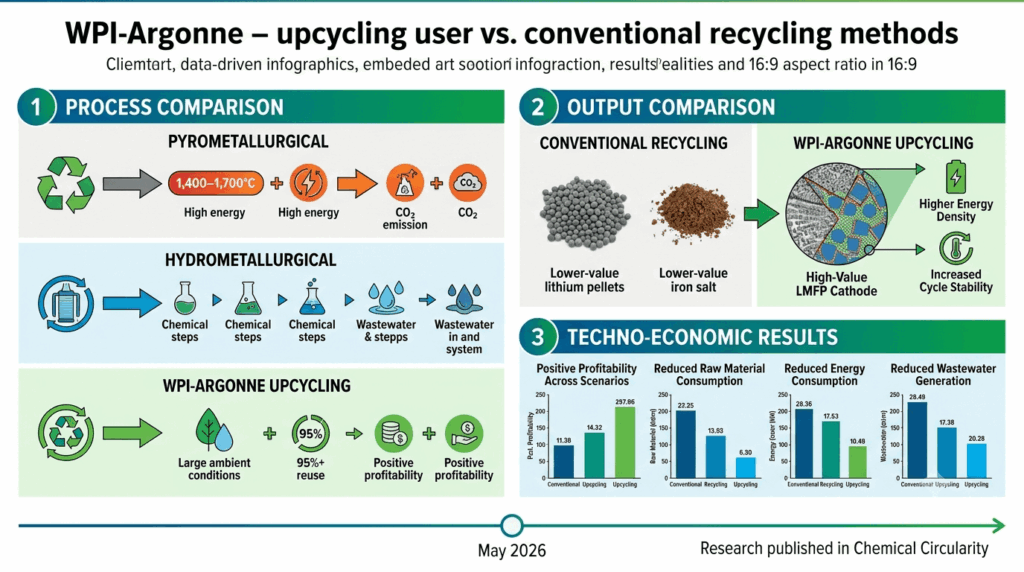
The limitations of existing recycling methods are well documented. Pyrometallurgical processes recover metals through smelting at temperatures ranging from 1,400 to 1,700 degrees Celsius. They are simple and scalable, but they require massive energy consumption and generate significant carbon emissions.
Hydrometallurgical processes operate at lower temperatures but involve multiple chemical steps, often producing wastewater and hazardous waste. Both approaches tend to focus on recovering low-value salts, particularly from lithium iron phosphate batteries, which have become increasingly dominant in the market. The economic incentive to recycle LFP batteries has been weak because the recovered products, lithium salts and iron salts, are worth relatively little.
The WPI-Argonne team took a different approach. Rather than extracting materials and selling them as commodity salts, they asked whether battery waste could be upgraded into something more valuable than the original material.
The Breakthrough: Leaching-Assisted Upcycling
The process the team developed is called leaching-assisted upcycling. It preserves the original particle morphology of battery materials while converting mixed spent cathode materials, including lithium iron phosphate and lithium manganese oxide, into lithium manganese iron phosphate, a next-generation cathode material with higher energy density and stronger long-term performance.
The key technical achievement is the operating environment. The process avoids high-pressure hydrothermal synthesis and instead relies on processing conditions compatible with existing hydrometallurgical infrastructure. It achieves more than 95% elemental reuse under ambient conditions.
This is not a marginal improvement. Conventional recycling recovers materials, but it degrades them into lower-value forms. The WPI-Argonne process recovers materials and reassembles them into a higher-value form. The recovered LMFP cathode has higher energy density and better cycle stability than the original LFP material.
The Economic Case: Recycling as a Value-Generating Hub
The techno-economic analysis is where the breakthrough becomes commercially significant.
The analysis showed positive profitability across multiple scenarios, supporting the potential for recycling facilities to evolve into value-generating hubs within a circular battery supply chain. This is a critical shift. Recycling has historically been framed as an environmental obligation, a cost centre that companies absorb for regulatory compliance or sustainability reporting. The WPI-Argonne process reframes it as an economic opportunity.
The process also reduces raw material consumption, energy consumption, and wastewater generation compared with conventional recycling methods. The environmental and economic benefits point in the same direction, which is unusual in industrial processing.
The Broader Context: A Wave of Low-Temperature Breakthroughs
The WPI-Argonne work is part of a broader shift in battery recycling research toward milder conditions and higher-value outputs.
In March 2026, researchers at the Chinese Academy of Sciences published a method using carbon dioxide and water to extract lithium with more than 95% efficiency under mild conditions. The process transforms other metals into high-value catalysts while capturing carbon dioxide.
At Rice University, researchers developed a plasma pretreatment combined with citric acid that recovers nearly 95% of critical metals from battery black mass at room temperature, while also regenerating graphite.
A separate study published in Chemical Engineering Journal demonstrated a low-temperature pyrolysis process using oxygen vacancies and carbon monoxide that reduces the peak reduction temperature of NCM cathodes from 696 degrees Celsius to 428 degrees Celsius, achieving 94.27% lithium recovery while generating negative carbon emissions.
The common thread across these breakthroughs is the recognition that the energy intensity of recycling is the primary barrier to both economic viability and environmental benefit. Lowering the temperature and simplifying the process does not just reduce emissions. It makes recycling cheaper, which makes it more attractive, which increases the volume of batteries recycled, which improves the economics further.
The Challenges That Remain
The WPI-Argonne team is candid about the barriers to scale. Industrial battery waste streams vary significantly in composition. Future work needs to improve impurity management, conduct pilot demonstrations, and bring recyclers, manufacturers, and policymakers into coordinated action.
The shift from laboratory-scale demonstration to industrial deployment is where most recycling breakthroughs fail. The process must handle the messy reality of real-world battery waste, which contains inconsistent chemistries, residual electrolytes, and physical contaminants that do not appear in controlled laboratory samples.
But the direction is clear. The economic model of recycling is changing. Instead of recovering low-value salts, the new generation of processes upgrades waste into next-generation cathode materials. Recycling is no longer an obligation. It is becoming an opportunity.
What This Means for the Battery Supply Chain
For automakers and battery manufacturers, the WPI-Argonne breakthrough offers a path to closing the loop on battery materials. The ability to upcycle LFP and LMO waste into LMFP cathode material means that end-of-life batteries become feedstock for new batteries, rather than a waste management problem.
For recyclers, the techno-economic analysis suggests that facilities built around upcycling rather than extraction can be profitable across multiple scenarios. That changes the investment case for recycling infrastructure.
For policymakers, the breakthrough reinforces the case for supporting recycling infrastructure and collection systems. The India-EU joint initiative on EV battery recycling, launched in May 2026 with €15.2 million in funding, is one example of the kind of coordinated action that the WPI-Argonne team identified as necessary.
The battery recycling breakthroughs: 95% elemental recovery without extreme conditions is not a laboratory curiosity. It is a commercially viable pathway that transforms battery waste into a strategic resource. The technology works. The economics are positive. The challenge now is scale.