China’s winter climate spans a range that few countries on earth experience within a single national EV market. In Harbin, January mornings regularly hit -25°C, with extreme cold snaps reaching -30°C to -35°C. In Shanghai, the same season brings a different but equally charging-relevant challenge: temperatures rarely drop below -5°C, but sustained damp cold combined with 75-85% humidity creates its own distinct set of problems for EV charging hardware and battery performance.
These are not variations on the same winter problem. They are two genuinely different engineering challenges, requiring different equipment specifications, different charging strategies, and different owner habits.
This guide on winter EV charging guide 2026 cold weather performance for Harbin -30C vs wet Shanghai covers both extremes in full technical and practical detail — what actually happens to batteries and chargers in each climate, how much range and charging speed you genuinely lose, what equipment specification survives each environment, and the specific operational habits that separate Chinese EV owners who sail through winter from those who get stranded.
Understanding Why Cold Affects EV Charging — The Battery Chemistry Foundation
What Happens Inside a Lithium Battery at Low Temperature
Before comparing Harbin and Shanghai specifically, understanding the underlying battery chemistry explains why temperature — not just absolute cold, but the rate of temperature change and the duration of exposure — drives every winter charging challenge.
The ion mobility problem:
Lithium-ion batteries (including both NMC chemistry used by NIO, Xpeng, and Zeekr, and LFP chemistry used by BYD’s Blade Battery) charge and discharge through lithium ions moving between the anode and cathode through a liquid electrolyte. This ion movement is an electrochemical process whose rate is temperature-dependent — the colder the battery, the slower lithium ions can move through the electrolyte and intercalate into the electrode materials.
Why this matters for charging specifically:
At low temperatures, attempting to charge a battery at a normal rate forces lithium ions to try to intercalate into the anode faster than the cold electrochemistry allows. Instead of inserting properly into the graphite anode structure, lithium can deposit on the anode surface as metallic lithium — a process called lithium plating.
Why lithium plating matters:
Lithium plating is not just an efficiency loss — it is a genuine battery degradation and safety mechanism. Plated lithium reduces usable capacity permanently (it doesn’t fully reintegrate into normal cycling), and in severe cases, can create internal short circuit risk. This is why every EV manufacturer’s battery management system (BMS) deliberately reduces charging current at low temperatures — not as an inconvenience, but as essential protection against this degradation mechanism.
The practical result: Charging current reduction in cold weather is not a design flaw or a charger limitation — it is the vehicle’s BMS protecting the battery from a genuine chemical degradation risk. Understanding this prevents the common but mistaken belief that a “better charger” can somehow bypass cold-weather charging rate reduction.
LFP vs NMC Cold Weather Behaviour — A Critical Chinese Market Distinction
China’s EV market is unusual globally in its heavy use of LFP (Lithium Iron Phosphate) battery chemistry — used by BYD’s Blade Battery across most of its lineup, and increasingly by other Chinese manufacturers — alongside NMC (Nickel Manganese Cobalt) chemistry used by NIO, Xpeng, Zeekr, and most non-Chinese brands.
LFP cold weather characteristics:
LFP batteries are generally understood within the battery industry to have somewhat worse low-temperature performance than NMC, primarily because LFP’s flatter discharge voltage curve and slightly different electrolyte formulation can reduce ion mobility more significantly in cold conditions. BYD and other LFP-focused manufacturers have invested heavily in BMS-level cold weather management and battery heating systems to compensate for this inherent chemistry characteristic.
NMC cold weather characteristics:
NMC batteries generally tolerate cold somewhat better at the cell chemistry level, though this advantage is partially offset in practice by other vehicle-specific engineering factors — battery heating system sophistication, cabin heating efficiency, and overall thermal management design vary significantly between specific models regardless of underlying cell chemistry.
The practical Chinese market implication:
The difference between LFP and NMC cold-weather performance, while real at the cell chemistry level, is smaller in practice than the difference between a vehicle with a sophisticated active battery heating system and one without. A well-engineered LFP vehicle with active heating can outperform a poorly thermally managed NMC vehicle in cold weather, and vice versa. Chinese owners should research their specific vehicle model’s documented cold-weather performance rather than assuming LFP versus NMC chemistry alone determines winter behaviour.
Harbin: The -30°C Extreme Cold Reality
What -30°C Actually Does to Your EV
Harbin represents the most extreme cold-weather charging environment in China’s major EV markets — and one of the most challenging EV charging environments in any major EV market globally.
Range loss at -30°C:
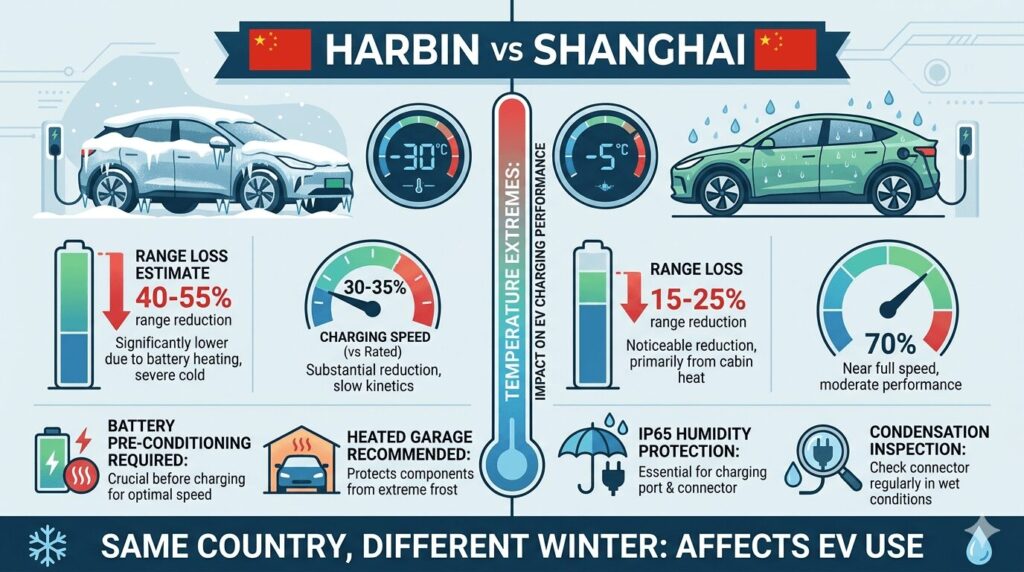
Real-world data and owner-reported experience across Chinese EV models consistently shows range reduction of 40-55% at -25°C to -30°C compared to the same vehicle’s rated range at 20-25°C optimal conditions. This is driven by three compounding factors:
Factor 1: Reduced battery capacity at low temperature
The battery’s chemically available capacity is genuinely reduced at low temperature — this isn’t just a charging speed issue, it’s a usable energy issue. A battery that delivers 100% of its rated capacity at 25°C might deliver only 75-80% of that capacity at -25°C, even before accounting for heating energy consumption.
Factor 2: Cabin heating energy consumption
Unlike a petrol vehicle that uses waste engine heat for cabin warmth essentially for free, an EV must use battery energy directly for cabin heating. In Harbin’s deep winter, cabin heating can consume 3-6 kW continuously — a substantial parasitic load on an already cold-reduced battery.
Factor 3: Battery self-heating energy consumption
Most modern EVs, including the Chinese models covered throughout this guide series, include active battery heating systems that consume energy specifically to warm the battery pack toward a more efficient operating temperature range — itself drawing from the same constrained battery that’s trying to power the vehicle.
The charging speed reduction at -30°C:
As covered in our weatherproof charger guide, charging rate reduction at extreme cold is severe:
| Temperature | AC Charging Rate (% of rated) | DC Charging Rate (% of rated) |
|---|---|---|
| -25°C | 40% | 15-20% |
| -30°C | 30-35% | 10-15% |
| -35°C (extreme Harbin events) | 20-25% | 5-10% |
What this means practically: A BYD Han EV’s normal 7 kW home AC charging rate, at -30°C, might genuinely deliver only 2.1-2.5 kW effective charging rate until the battery warms sufficiently through the charging process itself to allow faster charging.
The Harbin Charger Hardware Survival Requirements
As established throughout this guide series’ weatherproof and northeast China-specific content, Harbin’s charging hardware requirements are the most demanding in China’s EV market:
The non-negotiable specification baseline:
- Charger operating temperature rating: -30°C minimum, with genuine preference for equipment rated to -35°C or -40°C given documented extreme cold events
- Cable material: Cold-rated compound that remains flexible at -30°C rather than becoming brittle (standard PVC cable jackets crack and fail at sustained extreme cold)
- Connector latching mechanism: Spring-loaded components specifically rated for cold-weather reliability, as standard spring steel can become brittle and fail at extreme cold
- IP65 rating: Required regardless of cold specification, as Harbin’s winter also brings significant snow and ice exposure
The Autel MaxiCharger position in Harbin specifically:
As detailed in our weatherproof guide, the Autel MaxiCharger’s -30°C rating, IP65 protection, and cold-rated cable specification make it effectively the only mainstream consumer charger appropriate for genuine outdoor Harbin installation. This isn’t a marketing recommendation — it reflects the narrow field of products that survive Harbin’s documented winter conditions without hardware failure.
Harbin-Specific Charging Strategy
Strategy 1: Indoor or heated installation wherever possible
The single most impactful decision a Harbin EV owner can make is securing indoor or heated covered parking for their charging location, rather than fully exposed outdoor installation. A charger and vehicle in even an unheated but enclosed garage experiences meaningfully less extreme temperature exposure than one in fully open outdoor conditions, due to wind chill elimination and some thermal buffering from the building structure.
Strategy 2: Battery pre-conditioning before both charging and driving
Most Chinese EVs sold in 2024-2026 include battery pre-conditioning functions accessible through the vehicle app — allowing the owner to trigger battery warming before plugging in to charge, or before departure, using either grid electricity (while still plugged in) or remaining battery energy.
The practical Harbin routine many owners develop:
Trigger pre-conditioning approximately 20-30 minutes before unplugging in the morning, while still connected to the charger, so that the energy used for battery warming comes from grid electricity rather than the vehicle’s own battery reserves. This single habit, mentioned by Wang Lei in our user stories guide, makes a meaningful difference to both available range and DC fast charging speed if needed during the day.
Strategy 3: Never allow the battery to sit at very low SOC in extreme cold
The combination of low state of charge and extreme cold is specifically risky — both for the immediate practical risk of being stranded with insufficient range, and for longer-term battery health, as cold batteries at low SOC are more vulnerable to the voltage characteristics that can accelerate degradation. Harbin owners should maintain a more conservative minimum SOC threshold (25-30% rather than the 20% often suggested for milder climates) during the deepest winter months.
Strategy 4: Accept longer charging times as a structural winter reality, not a fault
As established in our charge time calculator guide, charge times genuinely extend by 30-60%+ during extreme cold. Harbin owners should plan charging schedules with this structural reality built in — starting overnight charging earlier in the evening, or accepting that very low battery on a -30°C evening may not fully replenish within a single overnight valley-rate window without supplementary charging.
Shanghai: The Wet, Mild-Cold Winter Reality
What Shanghai’s Winter Actually Does to Your EV
Shanghai’s winter presents a fundamentally different engineering challenge from Harbin’s. Temperatures rarely approach the extreme cold thresholds that drive lithium plating risk and severe charging rate reduction — Shanghai’s coldest days typically reach -3°C to -8°C, occasionally touching -10°C during unusual cold snaps. But Shanghai’s combination of persistent dampness, high humidity (often 75-85% during winter months), and temperatures that hover frustratingly around the freezing point creates its own distinct set of charging challenges.
Range loss in Shanghai winter:
Real-world range reduction in Shanghai’s winter conditions (0°C to -8°C with high humidity) typically runs 15-25% compared to optimal conditions — meaningfully less severe than Harbin’s 40-55%, but still a genuine and noticeable reduction that catches some owners unprepared, particularly those who assume Shanghai’s relatively mild climate means winter charging is a non-issue.
The humidity-temperature interaction:
Shanghai’s specific winter challenge is the combination of near-freezing temperatures with very high humidity — a combination that creates condensation risk inside insufficiently sealed charging equipment in a way that drier cold climates like Beijing or even Harbin (which, despite extreme cold, has relatively low absolute humidity) don’t experience to the same degree.
The specific condensation mechanism:
As covered in our weatherproof guide’s discussion of Yangtze Basin climate, Shanghai’s winter thermal cycling — cold nights followed by slightly warmer, humid days — creates a specific condensation risk for charging equipment with IP54 (dust-protected but not dust-tight) rather than IP65 specification. Warm humid air penetrates marginal enclosure seals during the day; overnight cooling causes this moisture to condense on internal components.
Shanghai’s Charging Speed Reality
Shanghai’s milder cold means charging rate reduction is meaningfully less severe than Harbin’s:
| Temperature | AC Charging Rate (% of rated) | DC Charging Rate (% of rated) |
|---|---|---|
| 5°C | 85% | 70% |
| 0°C | 75-80% | 55-60% |
| -5°C | 70% | 50% |
| -8°C (Shanghai extreme) | 60-65% | 40-45% |
The practical implication: A BYD Han EV’s 7 kW home charging rate in Shanghai’s coldest typical winter conditions (around -3°C to -5°C) might deliver approximately 70% of rated speed — meaningfully slower than summer charging, but far less severe than Harbin’s reduction to 30-35%.
The Shanghai-Specific Hardware Requirement
Why IP65 matters more in Shanghai winter than the temperature rating does:
For Shanghai specifically, the charger’s IP rating — specifically dust-tight, condensation-resistant sealing — matters more for winter reliability than an extreme cold temperature rating that Shanghai’s actual climate rarely tests. A charger rated to -20°C is more than adequate for any temperature Shanghai genuinely experiences; a charger with only IP54 protection is genuinely vulnerable to the humidity-condensation mechanism described above.
The practical recommendation: Shanghai EV owners, particularly those with semi-outdoor or ventilated underground parking exposed to seasonal humidity variation, should prioritise IP65 charger specification over extreme cold temperature rating — the inverse priority from Harbin, where extreme cold rating is the dominant concern and IP65 is necessary but secondary.
Shanghai-Specific Charging Strategy
Strategy 1: Address humidity exposure proactively, not reactively
Unlike Harbin’s extreme cold, which announces itself unmistakably, Shanghai’s humidity-driven equipment degradation can develop gradually and silently — intermittent connectivity issues, occasional charging faults, or connector corrosion that isn’t immediately obvious. Shanghai EV owners should perform periodic visual inspection of charging equipment specifically looking for moisture-related discolouration or corrosion, particularly at the end of the wettest winter months.
Strategy 2: Don’t over-invest in extreme cold specification unnecessarily
Shanghai’s actual winter temperature range doesn’t require the -30°C specification that Harbin genuinely needs. A charger rated to -20°C, which is widely available at lower cost than -30°C-rated equipment, provides ample margin for Shanghai’s actual climate. The money saved by not over-specifying cold rating can be better directed toward IP65 protection, which matters more in Shanghai’s actual climate profile.
Strategy 3: Battery pre-conditioning still matters, just less dramatically
While Shanghai’s winter doesn’t demand the same intensity of cold-weather battery management as Harbin, the same pre-conditioning principle still provides genuine benefit — particularly for owners who use DC fast charging during winter months, where Shanghai’s 40-60% DC charging rate reduction at the coldest temperatures still meaningfully extends charging stops.
Strategy 4: Monitor for the specific Shanghai winter range anxiety trap
Some Shanghai EV owners, having become accustomed to minimal range impact during the mild local autumn and most of winter, are caught off guard during the relatively rare but real cold snaps when temperatures drop to -8°C to -10°C — a Shanghai “extreme cold” event that still represents only moderate cold by Harbin standards, but which can produce a noticeably sharper range reduction than the owner’s typical winter experience has prepared them for.
The Direct Comparison Table — Harbin vs Shanghai Winter Charging
| Factor | Harbin | Shanghai |
|---|---|---|
| Typical winter low | -20°C to -25°C | -3°C to -5°C |
| Extreme cold event | -30°C to -35°C | -8°C to -10°C |
| Typical range loss | 40-55% | 15-25% |
| AC charging rate reduction (typical low) | 55-60% reduction | 20-25% reduction |
| AC charging rate reduction (extreme) | 65-70% reduction | 35-40% reduction |
| Dominant hardware requirement | -30°C+ temperature rating | IP65 humidity/condensation protection |
| Secondary hardware requirement | IP65 (snow/ice exposure) | -20°C temperature rating (more than sufficient) |
| Primary owner habit | Battery pre-conditioning, indoor parking | Humidity inspection, avoid over-specifying cold rating |
| Charging time extension (typical) | +60-100% | +15-30% |
| Connector/cable material concern | Cold brittleness, spring mechanism failure | Corrosion from condensation cycling |
The Battery Pre-Conditioning Deep Dive — Applicable to Both Climates
How Pre-Conditioning Actually Works
Battery pre-conditioning — sometimes called battery warming or thermal management pre-activation — is available on most Chinese EVs sold since approximately 2022, accessed through the vehicle’s app or, on some models, automatically triggered when a DC fast charging station is selected as a navigation destination.
The mechanism:
The vehicle’s BMS activates the battery’s heating system (typically either resistive heating elements or, in more sophisticated implementations, heat pump-based systems that also serve cabin heating) to raise the battery pack temperature toward an optimal range — typically targeting 15-25°C internal cell temperature — before either a charging session or, for driving, before the battery would otherwise need to warm gradually during early driving.
Why this matters for charging specifically:
A battery that begins a charging session already warmed to an efficient temperature range can accept significantly higher charging current immediately, rather than requiring the charging session itself to gradually warm the battery before reaching efficient charging rates. This is particularly impactful for DC fast charging, where the difference between starting a charge at -25°C versus starting at a pre-warmed 10-15°C can mean the difference between a 60-minute charging stop and a 25-minute charging stop for the same energy delivery.
The Energy Source Distinction That Matters
Pre-conditioning while still plugged into a home charger: The energy used for battery warming comes from grid electricity — effectively free in the context of the vehicle’s own range, since it doesn’t consume battery charge that would otherwise be available for driving.
Pre-conditioning while driving toward a destination, using the vehicle’s own battery: This consumes battery energy that would otherwise extend driving range — a genuine trade-off, though usually a worthwhile one if a faster subsequent DC charging session is the goal.
The optimal Chinese winter routine, applicable in both Harbin and Shanghai:
For overnight home charging: Trigger pre-conditioning in the final 20-30 minutes before unplugging in the morning, while still connected to grid power, so the warming energy comes from the charger rather than the battery.
For planned DC fast charging stops during a journey: Use the vehicle’s navigation-integrated pre-conditioning (where available) by setting the charging station as a waypoint or destination 20-30 minutes before arrival, allowing the vehicle to use driving-phase battery energy for pre-conditioning specifically because the resulting faster DC charging more than compensates for the modest additional energy consumed during the warming process.
The Heated Garage and Covered Parking Calculation
Quantifying the Value of Indoor Parking in Cold Climates
For Harbin owners specifically, but with relevant application to any genuinely cold Chinese city (Changchun, Shenyang, Hohhot, and similar northern markets), the practical value of securing indoor or heated covered parking deserves explicit financial and practical quantification, rather than just qualitative recommendation.
The temperature differential:
An unheated but enclosed garage, even without active heating, typically maintains an internal temperature 8-15°C warmer than outdoor ambient temperature during extreme cold, due to elimination of wind chill, some thermal mass buffering from the building structure, and (in attached garages) some heat transfer from the adjoining heated living space.
The practical charging rate implication:
| Location | Effective Temperature (when outdoor is -30°C) | AC Charging Rate |
|---|---|---|
| Fully exposed outdoor | -30°C | 30-35% of rated |
| Unheated enclosed garage | -18°C to -20°C | 50-55% of rated |
| Minimally heated garage (5°C internal) | 5°C | 85% of rated |
| Heated garage (15°C internal) | 15°C | 95-100% of rated |
The financial calculation for heated garage investment:
For Harbin EV owners specifically, the value of even minimal garage heating — a basic space heater running during the coldest charging hours, or improved insulation of an existing enclosed but unheated garage — pays for itself through both genuinely faster charging (less time, less inconvenience) and, more significantly, reduced cumulative cold-weather stress on both the vehicle’s battery and the charging hardware itself, extending the practical service life of both.
The Battery Longevity Question — Does Winter Charging Damage Your Battery?
The Honest Technical Answer
This is a question that generates considerable anxiety among Chinese EV owners, particularly in Harbin and similarly extreme climates, and deserves a direct, honest answer.
Charging in cold weather, when managed by the vehicle’s BMS as designed, does not cause meaningful battery degradation. The BMS’s deliberate reduction of charging current at low temperature exists specifically to prevent the lithium plating degradation mechanism described earlier in this guide. A vehicle charging at a BMS-managed 30% of rated rate at -30°C is not being damaged by this slow charging — it is being protected by it.
What genuinely can cause cold-weather battery degradation:
The actual risks come from circumstances that bypass or stress the BMS’s protective management:
Risk 1: Repeatedly allowing the battery to reach very low SOC in extreme cold — as mentioned in the Harbin strategy section, this combination creates voltage conditions that are more stressful for cell longevity than either factor alone.
Risk 2: Attempting to force faster charging through non-certified or improperly functioning equipment that might not correctly communicate temperature-appropriate charging parameters to the vehicle — another reason the certified equipment emphasis throughout this guide series matters specifically in extreme cold climates.
Risk 3: Physical damage to charging hardware from cold-weather brittleness (cracked cable jackets, failed connector latches) that creates intermittent connection issues, which themselves can create irregular charging patterns that are less optimal than consistent, properly functioning charging sessions.
The reassuring conclusion: Chinese EV owners in Harbin and similar climates should trust their vehicle’s BMS to manage cold-weather charging appropriately, rather than seeking workarounds to “force” faster charging in cold conditions. The slower charging is the system working correctly, not a problem to be solved.
The Winter Driving Range Planning Framework
Building Realistic Winter Range Expectations
For Chinese EV owners in either Harbin’s extreme cold or Shanghai’s milder but still meaningful winter range reduction, building accurate planning expectations prevents both unnecessary anxiety and genuine range-related incidents.
The Harbin winter range planning approach:
Plan all routine driving, including daily commuting, around an assumption of 45-50% of rated range availability during the deepest winter months (typically late December through February). For any genuinely cold day (below -20°C), apply this conservative planning rather than the vehicle’s optimistic range estimate, which is typically calibrated to milder conditions and can overestimate actual cold-weather range by a meaningful margin.
The Shanghai winter range planning approach:
Plan routine winter driving around an assumption of 75-80% of rated range during the coldest weeks (typically January), with awareness that occasional genuine cold snaps (below -5°C) can push this toward 65-70% temporarily.
The universal winter planning principle:
Regardless of specific climate, Chinese EV owners should treat their vehicle’s displayed range estimate with appropriate skepticism during cold weather specifically, cross-referencing against their own accumulated experience of actual range achieved in similar conditions, rather than trusting the vehicle’s algorithm, which — across virtually every Chinese EV brand — tends toward optimism that doesn’t fully account for the specific combination of temperature, heating use, and driving style that any individual owner experiences.
Internal Links — Further Reading on Clean Energy Bazaar
The winter EV charging guide 2026 cold weather performance for Harbin -30C vs wet Shanghai guide is the seasonal deep-dive companion to the climate and specification guidance covered throughout this content cluster.
For the weatherproof charger specification guide that establishes the IP rating and temperature rating principles applied throughout this winter-specific guide, our weatherproof EV chargers 2026 IP ratings for humid southern China vs dusty northern China guide covers every Chinese climate zone in full technical detail. For the charge time calculator that quantifies exactly how much winter cold extends your specific vehicle’s charging time, our EV charge time calculator 2026 how long to full for your Chinese EV BYD to NIO guide covers every model with cold-weather adjustment guidance. For the tier 1 vs tier 2 vs rural cities guide that contextualises Harbin’s extreme northeast climate within China’s broader geographic diversity, our tier 1 vs tier 2 city charging solutions for Beijing high-rises vs Chengdu villas vs rural villages guide covers every regional scenario. For the real user stories guide featuring Wang Lei’s direct Harbin winter delivery experience referenced throughout this guide, our user stories real EV charger setups from Chinese drivers from Shenzhen taxis to Hainan tourists guide covers eight genuine first-person accounts. For the load balancing guide covering how cold-weather grid behaviour interacts with older apartment electrical infrastructure, our load balancing EV chargers 2026 avoid tripping breakers in old Chinese apartment blocks guide covers every scenario. And for the 3C certification guide ensuring the cold-rated and humidity-resistant equipment recommended throughout this winter guide is genuinely safety-verified, our 3C certification and EV chargers 2026 why buying non-certified chargers is dangerous in China guide covers every safety requirement.
Final Thoughts
The winter EV charging guide 2026 cold weather performance for Harbin -30C vs wet Shanghai comparison reveals that “winter EV charging in China” is not one challenge but at least two genuinely distinct engineering and behavioural problems, depending entirely on which of China’s dramatically different winter climates an owner actually experiences.
Harbin’s challenge is fundamentally about extreme cold’s effect on battery electrochemistry and charging hardware survival — demanding -30°C-rated equipment, aggressive battery pre-conditioning habits, and realistic acceptance of 40-55% range reduction and significantly extended charging times during the deepest winter months. The owners who thrive in this environment, like Wang Lei in our user stories guide, are the ones who treat cold-weather charging discipline as a genuine operational necessity rather than an occasional inconvenience.
Shanghai’s challenge is fundamentally about humidity-driven equipment degradation and a more moderate but still real range and charging speed reduction — demanding IP65 protection as the priority specification, periodic equipment inspection for condensation-related issues, and realistic planning for the relatively rare but genuine cold-snap events that can catch owners accustomed to the city’s typically mild winter off guard.
Both climates demand the same underlying principle that runs throughout this entire content cluster: match your equipment specification and your operational habits to your actual environment, rather than assuming either that “any charger will do” in a climate you’ve underestimated, or that you need Harbin-level cold specification in a climate as mild as Shanghai’s actually is.
Winter in China is not one season. For EV owners, it is at least two — and understanding which one you actually face is the foundation of charging reliably through every month of it.