China has an entire cultural vocabulary for its hottest cities. 火炉城市 — “furnace cities” — is the term that has stuck for the handful of Yangtze River basin and Sichuan basin cities whose summer combination of extreme heat, crushing humidity, and minimal nighttime cooling relief has been notorious for generations, long before EVs existed. Wuhan, Chongqing, and Nanjing top most versions of this informal ranking, with Changsha and Nanchang frequently included.
For EV owners in these cities, summer presents a genuinely different engineering challenge from the winter cold extensively covered elsewhere in this content cluster — and one that receives far less attention despite being, in its own way, equally demanding on both vehicle and charging hardware.
This guide on hot weather EV charger tips thermal management for furnace cities like Wuhan and Chongqing covers the complete picture of summer EV charging challenges in China’s most brutally hot urban climates — what extreme heat and humidity actually do to batteries, charging hardware, and charging speed, which equipment specifications genuinely matter in this environment, and the specific operational habits that separate EV owners who sail through furnace-city summers from those who experience preventable equipment failures and frustrating performance degradation.
Why “Furnace Cities” Are a Genuinely Distinct Engineering Challenge
What Makes Wuhan and Chongqing’s Heat Different From Generic “Hot Weather”
Before addressing specific charging guidance, understanding why these particular Chinese cities warrant their own dedicated treatment — rather than generic “hot weather” advice — clarifies the actual engineering problem.
The temperature profile:
Wuhan and Chongqing summer daytime temperatures regularly reach 35-39°C from June through August, with documented extreme events exceeding 40°C. This alone is significant but not globally unique — many hot climates worldwide reach similar peak temperatures.
The humidity compounding factor:
What distinguishes furnace cities from dry-hot climates (such as parts of northwest China or many desert climates globally) is the combination of extreme heat with persistent high humidity, frequently 70-85% relative humidity even during the hottest afternoon hours. This combination creates a “feels like” temperature, and more importantly an actual thermal stress on equipment, that significantly exceeds what the air temperature alone suggests.
The minimal nighttime cooling relief:
Perhaps the most distinctive characteristic of furnace city summers, and the one most relevant to overnight EV charging specifically, is the minimal temperature drop overnight. While many hot climates see significant nighttime cooling that provides thermal relief, Wuhan and Chongqing summer nights frequently remain above 28-30°C even in the early morning hours, with humidity remaining elevated throughout.
Why this overnight characteristic matters specifically for EV charging:
Throughout this content cluster, overnight charging during the TOU valley rate window (typically 11pm-8am) has been established as the financially optimal charging strategy. In furnace cities during peak summer, this overnight charging period occurs at ambient temperatures and humidity levels that would represent daytime extreme conditions in most other Chinese climates — meaning furnace city EV chargers experience thermal stress during their most-used charging window that other Chinese climates largely avoid by virtue of overnight cooling.
Sichuan Basin vs Yangtze Basin — Two Distinct Furnace Mechanisms
Chongqing and the Sichuan Basin heat trap:
Chongqing’s specific furnace effect stems significantly from its basin topography — surrounded by mountains that trap both heat and humidity, preventing the air circulation that might otherwise provide some relief. This geographic trapping effect, combined with the Yangtze and Jialing rivers’ moisture contribution, creates Chongqing’s distinctive sauna-like summer atmosphere.
Wuhan and the Yangtze River heat and humidity combination:
Wuhan’s furnace characteristic stems from its position at the confluence of the Yangtze and Han rivers, surrounded by numerous lakes, creating extremely high ambient humidity that compounds with the Yangtze basin’s general summer heat. Wuhan’s “three furnaces” historical ranking alongside Chongqing and Nanjing reflects this specific river-and-lake-driven humidity intensity combined with basin-trapped heat.
The practical implication for charging equipment: Both cities require essentially the same hardware specification response — IP65 rating for humidity protection, upper operating temperature rating well above the 50°C ceiling that adequately serves milder Chinese climates — but the underlying meteorological mechanism driving the challenge differs slightly between the river-humidity-driven Wuhan pattern and the basin-trapped Chongqing pattern.
What Extreme Heat Actually Does to EV Batteries
The Thermal Stress Mechanism
Just as our winter charging guide explained the electrochemistry of cold-weather lithium plating risk, understanding the thermal mechanism behind heat-related battery stress clarifies why furnace city charging deserves specific attention.
The high-temperature degradation mechanism:
Unlike cold, which primarily creates a charging speed and immediate performance limitation, sustained high temperature creates a different and in some ways more concerning risk profile: accelerated long-term capacity degradation. Lithium-ion battery chemistry — both LFP and NMC — experiences accelerated unwanted side reactions at sustained high temperature, including electrolyte decomposition and solid electrolyte interphase (SEI) layer growth on the anode, both of which permanently consume usable battery capacity over time.
Why this matters more for furnace cities specifically:
A battery that experiences occasional brief exposure to high temperature — a single hot day, an isolated heat wave — experiences minimal cumulative degradation impact. A battery that experiences sustained high temperature exposure for 4-5 months annually, with minimal overnight relief, as is genuinely the case in Wuhan and Chongqing summers, experiences meaningfully more cumulative thermal stress over a vehicle’s typical 8-10 year ownership lifespan.
The charging-specific heat risk:
Beyond the passive degradation from ambient heat exposure, the charging process itself generates additional heat within the battery — both from the fundamental electrochemical charging reaction and from internal resistance losses. In a furnace city summer, a battery beginning a charging session already at 35-38°C ambient-equivalent internal temperature, then experiencing additional charging-generated heat, can reach internal temperatures that trigger the vehicle’s BMS to actively reduce charging current to prevent further temperature rise — the heat-related analog to the cold-weather charging rate reduction covered extensively in our winter guide.
The Charging Rate Reduction at High Temperature
The high-temperature charging rate reduction reference:
| Battery Temperature | AC Charging Rate (% of rated) | DC Charging Rate (% of rated) |
|---|---|---|
| 25-30°C (optimal) | 100% | 100% |
| 35°C | 95% | 90% |
| 40°C | 85% | 70% |
| 45°C | 65% | 45% |
| 50°C+ (extreme, rare but documented) | 40-50% | 20-30% |
Why this matters specifically for furnace city DC fast charging:
The most acute manifestation of this heat-related charging reduction occurs during DC fast charging on a hot Wuhan or Chongqing summer afternoon, when ambient temperature combined with the additional heat generated by high-current DC charging can push battery temperature into the range where the BMS significantly throttles charging speed — sometimes producing a frustrating experience where a 30-minute expected fast charge stretches toward 45-50 minutes specifically due to heat-related rate reduction, even though the charging station itself is functioning at full rated output.
The active cooling distinction:
Most modern Chinese EVs, including virtually every model covered throughout this guide series’ vehicle-specific content, include active liquid cooling systems for the battery pack specifically designed to manage this heat challenge during DC fast charging. The effectiveness of this active cooling varies meaningfully between vehicle models and is a genuine differentiator — vehicles with more sophisticated and higher-capacity cooling systems maintain faster charging speeds for longer during hot-weather DC charging sessions before thermal throttling engages, compared to vehicles with more basic cooling provisions.
What Extreme Heat Does to Charging Hardware Specifically
The Charger Enclosure Thermal Challenge
Beyond the vehicle battery itself, the home or public charger hardware experiences its own distinct thermal stress in furnace city conditions — a challenge covered at a general level in our weatherproof charger guide, but warranting specific elaboration for the furnace city context.
The enclosure heat accumulation problem:
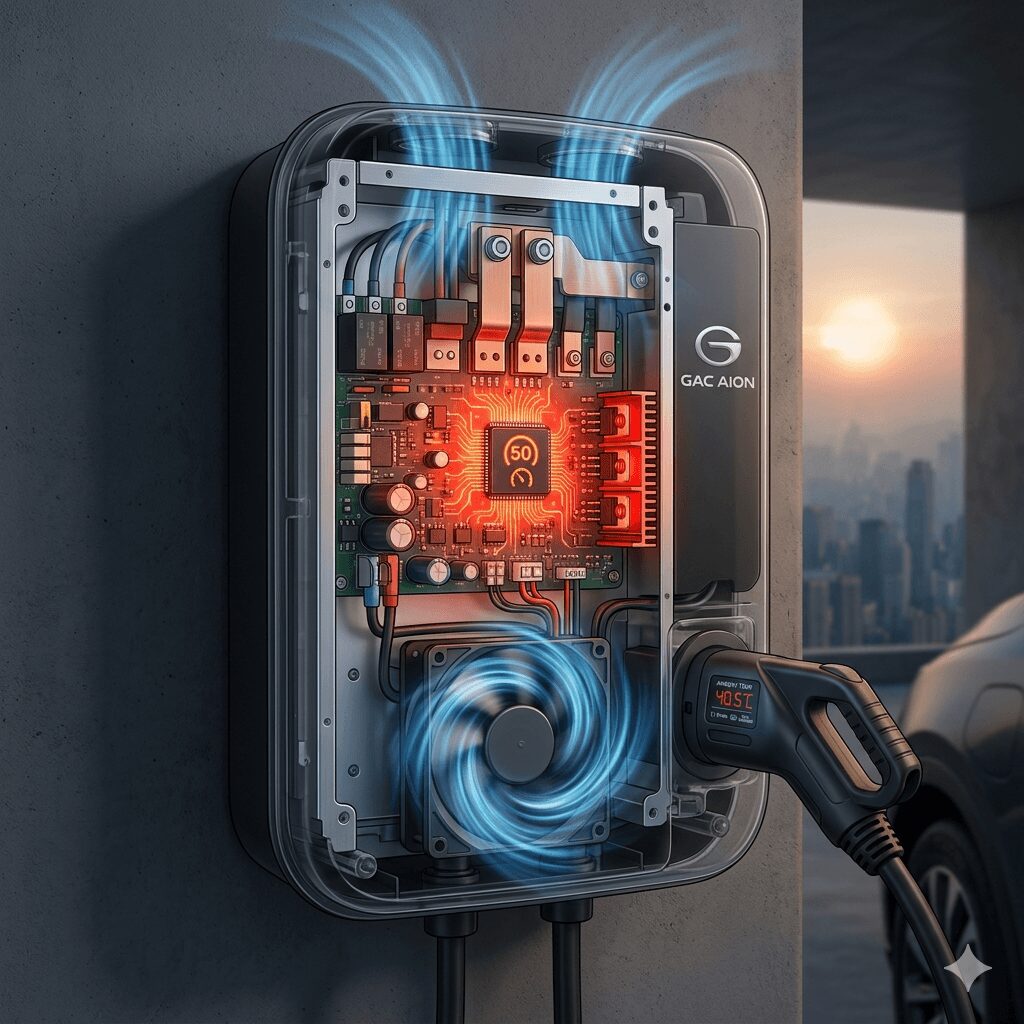
A home EV charger mounted on an exterior wall or in a poorly ventilated covered parking space, in direct or indirect sun exposure during a Wuhan or Chongqing summer day, can experience internal enclosure temperatures significantly exceeding ambient air temperature — sometimes by 10-15°C or more, due to solar heat absorption by the charger’s housing material and limited convective cooling in still, humid air.
Why this matters for charger electronics:
The power electronics inside an EV charger — the relays, contactors, and control circuitry that manage current delivery — have their own upper operating temperature limits, typically specified by manufacturers in the 45-55°C ambient range, beyond which the charger’s own internal protection systems may reduce output current or, in extreme cases, temporarily shut down to prevent component damage.
The furnace city specific risk: In a charger experiencing 45°C+ internal enclosure temperature on a hot Wuhan afternoon — entirely plausible given ambient temperatures of 38-40°C combined with solar heat gain and limited convective cooling — the charger may be operating at or near its own thermal protection threshold, independent of whatever temperature the vehicle’s battery itself is experiencing.
The Critical Specification: Upper Operating Temperature Rating
Why this specification matters more in furnace cities than almost anywhere else in China:
As established in our comprehensive weatherproof charger guide, most discussion of charger temperature specification in Chinese EV charging content focuses overwhelmingly on the lower temperature rating (-20°C, -30°C, etc.) relevant to cold climates like Beijing, Harbin, and similar northern markets. The upper temperature rating receives comparatively little attention in most general guidance — but it is the specification that matters most directly for Wuhan and Chongqing summer reliability.
The specification comparison:
| Charger | Upper Operating Temperature | Suitability for Furnace Cities |
|---|---|---|
| Standard budget chargers (various brands) | 40-45°C | Marginal — operating near limit during peak summer |
| StarCharge S1 | 50°C | Adequate with appropriate installation positioning |
| Autel MaxiCharger | 55°C | Strong margin for furnace city conditions |
| Sungrow EV Charger | 55°C | Strong margin, relevant for solar-equipped properties |
| Ginlong Solis Smart | 55°C+ | Best-in-class margin |
| Huawei FusionCharge | 50-55°C (model dependent) | Generally adequate to strong |
The practical recommendation for furnace city installation: Prioritise chargers with 50°C+ rated upper operating temperature, and specifically avoid mounting positions with direct afternoon sun exposure even when the charger’s rated specification technically permits it — the combination of rated specification margin and sensible installation positioning provides genuine reliability buffer rather than operating at the edge of stated tolerances throughout the most demanding months of the year.
The Humidity-Heat Combination Effect on Connector Corrosion
Why furnace city humidity accelerates connector degradation specifically:
As covered in our weatherproof guide’s general discussion of humid climate connector corrosion, the combination of high temperature and high humidity specifically accelerates the electrochemical corrosion processes that degrade electrical contact quality at connector interfaces over time — heat generally accelerates chemical reaction rates, and the corrosion process driven by humidity exposure is no exception.
The furnace city compounding factor:
Because Wuhan and Chongqing experience both elevated temperature and elevated humidity simultaneously, and for a more sustained portion of the year (often 4-5 months of genuinely furnace-like conditions versus the more seasonally limited extreme heat windows of other Chinese climates), connector corrosion risk accumulates more rapidly than in climates experiencing either heat or humidity as isolated factors.
The practical specification response: As covered in our luxury EV charging guide’s discussion of premium connector materials, furnace city installations — even for mainstream rather than luxury vehicles — benefit meaningfully from chargers using stainless steel or gold-plated connector contact pins rather than standard plated contacts, given the accelerated corrosion environment these cities present.
The Wuhan-Specific Charging Reality
Wuhan’s Distinctive Summer Profile
The temperature and humidity pattern:
Wuhan’s summer (typically intensifying from late May through early September, with the most severe period concentrated in July and August) combines daytime temperatures regularly reaching 35-38°C with relative humidity frequently exceeding 75-80%, even during peak afternoon heat — a combination that produces persistent, oppressive conditions throughout both day and the relatively limited nighttime cooling period.
The specific Wuhan installation consideration:
Wuhan’s extensive lake system (东湖 and numerous other urban lakes) and its position astride the Yangtze and Han rivers mean that ambient humidity remains elevated essentially year-round, but particularly during summer months when warm air holds more moisture. EV charger installations near any of Wuhan’s many lakeside residential developments should anticipate humidity exposure at the more severe end of even the furnace city range.
Wuhan-Specific Equipment and Strategy Recommendations
Hardware specification for Wuhan:
IP65 rating as the non-negotiable baseline (covered extensively in our weatherproof guide’s Yangtze Basin section), combined with 50°C+ upper operating temperature rating given Wuhan’s genuine summer heat intensity, and specific attention to connector corrosion resistance given the sustained high-humidity exposure.
The Wuhan-specific charging time consideration:
As established in our charge time calculator guide, Wuhan’s combination of summer heat affecting charging speed (the heat-related rate reduction mechanism described above) and the city’s specific TOU valley rate structure (covered in our TOU savings guide) means Wuhan owners should anticipate that peak summer overnight charging sessions may run somewhat slower than the same vehicle would charge during Wuhan’s milder spring or autumn months — a structural seasonal variation worth building into charging schedule expectations rather than treating as an equipment malfunction.
The Wuhan ventilation positioning recommendation:
For underground or covered parking installations specifically, Wuhan EV owners should specifically seek charging positions with the best available natural or mechanical ventilation, given the city’s combination of heat and humidity that makes adequate air circulation around the charger enclosure meaningfully more important than in drier or cooler Chinese climates where convective cooling occurs more readily even without optimal ventilation.
The Chongqing-Specific Charging Reality
Chongqing’s Distinctive Basin Heat Profile
The temperature and humidity pattern:
Chongqing’s mountain-ringed basin topography creates a heat-trapping effect that produces some of China’s most sustained extreme summer temperatures, frequently exceeding 38-40°C during the peak July-August period, combined with humidity levels that, while sometimes marginally lower than Wuhan’s lake-and-river-driven humidity, still remain consistently high enough to create the characteristic furnace city thermal stress on both human residents and EV charging equipment.
The specific Chongqing installation consideration:
Chongqing’s notoriously hilly topography, combined with its dense high-rise residential development pattern, means many EV charging installations occur in underground or semi-underground parking structures built into hillsides — creating specific ventilation and humidity considerations distinct from the flatter topography of cities like Wuhan or Shanghai.
The hillside parking ventilation challenge:
Underground parking carved into Chongqing’s hillside terrain can experience distinctive humidity and ventilation patterns compared to conventional flat-site underground car parks — sometimes better natural cooling due to consistent ground temperature, but sometimes worse humidity retention due to limited air exchange in deeply embedded structures. Chongqing EV owners should specifically assess their actual installation location’s ventilation characteristics rather than assuming generic furnace city guidance applies uniformly, given the city’s distinctive topography-driven variation in specific parking structure conditions.
Chongqing-Specific Equipment and Strategy Recommendations
Hardware specification for Chongqing:
The same IP65 and 50°C+ upper temperature rating baseline established for Wuhan applies equally to Chongqing, given the comparable overall furnace city intensity — though Chongqing’s specific basin-trapped heat profile, with potentially less air movement than Wuhan’s more open river-and-lake geography, may warrant particular attention to charger positioning for maximum available ventilation even within the constraints of underground hillside parking structures.
The Chongqing-specific humidity timing pattern:
Chongqing’s basin geography can produce a distinctive pattern where morning humidity, driven by overnight moisture accumulation in the trapped basin air, sometimes exceeds even the peak afternoon humidity levels — a pattern Chongqing EV owners should be aware of when considering the timing of overnight charging sessions relative to humidity exposure, even though this timing consideration doesn’t change the underlying equipment specification recommendation.
The Direct Comparison Table — Furnace City Summer Charging Factors
| Factor | Wuhan | Chongqing |
|---|---|---|
| Typical peak summer temperature | 35-38°C | 38-40°C |
| Typical peak summer humidity | 75-85% | 70-80% |
| Primary humidity source | Rivers and extensive lake system | Basin moisture trapping |
| Topography challenge | Generally flat, good ventilation potential | Hilly, hillside parking ventilation variability |
| Overnight cooling relief | Minimal | Minimal, sometimes humidity peaks overnight |
| Primary hardware concern | IP65 + connector corrosion resistance | IP65 + ventilation-dependent positioning |
| Charging rate reduction (peak summer DC) | 15-25% reduction typical | 15-30% reduction typical |
| Best installation positioning strategy | Maximise natural ventilation, avoid direct sun | Assess specific hillside structure ventilation |
The Battery Cooling System — Why Your Vehicle Choice Matters More Than Most Owners Realise
The Active vs Passive Cooling Distinction
Active liquid cooling systems:
Most Chinese EVs sold in 2024-2026, particularly those from established manufacturers like BYD, NIO, Xpeng, and Zeekr, include active liquid cooling circuits that circulate coolant through the battery pack, with a radiator and pump system actively managing battery temperature during both driving and charging, particularly during high-current DC fast charging sessions.
The furnace city relevance:
For Wuhan and Chongqing owners specifically, the sophistication and capacity of their vehicle’s active cooling system meaningfully affects how much the heat-related charging rate reduction described earlier in this guide actually impacts their real-world charging experience. A vehicle with a more capable cooling system can maintain higher charging rates for longer during hot-weather DC fast charging before thermal throttling becomes necessary, compared to a vehicle with more basic cooling provisions attempting to manage the same ambient heat and humidity conditions.
The practical owner-level implication:
While this guide’s focus is primarily on charging equipment and habits rather than vehicle selection, furnace city residents specifically evaluating EV purchases should weight documented hot-weather DC fast charging performance — increasingly discussed in Chinese EV owner forums and some manufacturer technical documentation — more heavily in their vehicle choice than owners in milder Chinese climates might need to, given the genuine and sustained thermal stress their specific environment will place on whatever cooling system their chosen vehicle includes.
Home AC Charging vs DC Fast Charging Heat Stress — An Important Distinction
Why home AC charging is less heat-stressed than DC fast charging:
The heat-related challenges described throughout this guide are considerably more pronounced for DC fast charging than for standard home AC charging, because DC fast charging’s much higher current delivery generates substantially more internal battery heat through the charging process itself, compounding with already-elevated ambient furnace city temperature.
The practical implication for furnace city owners:
Home overnight AC charging at 7 kW, even during peak Wuhan or Chongqing summer conditions, generates relatively modest additional heat within the battery compared to ambient conditions — meaning the charging rate reduction for standard home AC charging is considerably less severe than the DC fast charging reduction table suggests, typically remaining in the 90-95% of rated AC charging speed range even during the hottest summer nights, rather than the more dramatic reductions associated with DC fast charging in the same conditions.
The strategic implication: Furnace city EV owners should specifically prioritise home AC charging over DC fast charging during the most extreme summer heat periods wherever practically possible, not only for the financial TOU savings emphasized throughout this guide series, but specifically because home AC charging during furnace city summer genuinely subjects the battery to less thermal stress than DC fast charging would during the same conditions.
The Solar Integration Consideration for Furnace City Villa Owners
Why Solar Generation and Furnace City Climate Interact Distinctively
For Wuhan and Chongqing villa owners with rooftop solar installations — relevant given this guide series’ broader coverage of solar-EV charging integration — furnace city climate creates a distinctive interaction worth specific mention.
The solar generation profile in furnace cities:
Despite the intense heat, Wuhan and Chongqing’s summer solar generation potential remains substantial given the genuinely long daylight hours and, for Wuhan specifically, relatively good direct solar exposure outside of the relatively brief monsoon-influenced rainy periods. Chongqing’s basin topography and associated higher cloud cover frequency (the city’s famous “fog city” historical nickname reflects this) can moderate solar generation somewhat compared to Wuhan’s typically clearer summer skies.
The thermal management synergy:
A specific consideration for furnace city solar-equipped properties: rooftop solar panel installation can, in some configurations, provide incidental shading benefit to charger installation positions mounted beneath or near the solar array structure, potentially offering modest additional protection from direct solar heat gain on the charger enclosure itself — a secondary benefit beyond the primary financial solar-EV charging integration covered in our Chengdu villa and tier 1 vs tier 2 city guides.
The Maintenance Routine for Furnace City Charging Equipment
What Furnace City Owners Should Check and When
Pre-summer inspection (April-May, before peak heat arrives):
Visual inspection of charger enclosure for any signs of the previous summer’s heat or humidity stress — discolouration, any softening or warping of plastic components, connector inspection for early corrosion signs. This timing allows any necessary remediation or replacement before the most demanding months arrive.
Mid-summer spot check (July):
Brief temperature assessment using the same warm-hand test methodology covered in our DIY charging guide, but specifically performed during the hottest part of a typical summer day rather than just after a charging session — assessing whether the charger enclosure itself, independent of any charging activity, is reaching concerning temperatures purely from ambient heat and solar exposure.
Post-summer assessment (September-October):
A more thorough inspection once the most extreme heat has passed, specifically checking connector condition for any corrosion that developed during the peak humidity-heat months, and confirming continued reliable operation of all smart features (WiFi connectivity, app communication) that can sometimes be subtly affected by sustained heat exposure to charger electronics even without outright failure.
Internal Links — Further Reading on Clean Energy Bazaar
The hot weather EV charger tips thermal management for furnace cities like Wuhan and Chongqing guide is the summer-specific companion to the comprehensive climate guidance covered throughout this content cluster.
For the weatherproof charger specification guide that establishes the IP rating and humidity protection principles applied specifically to furnace city conditions throughout this guide, our weatherproof EV chargers 2026 IP ratings for humid southern China vs dusty northern China guide covers every Chinese climate zone including the Yangtze Basin humidity profile relevant to Wuhan specifically. For the winter charging guide that provides the cold-weather complement to this summer-focused thermal management guidance, our winter EV charging guide 2026 cold weather performance for Harbin -30C vs wet Shanghai guide covers the opposite seasonal extreme in equal technical depth. For the charge time calculator that quantifies exactly how furnace city summer heat affects your specific vehicle’s charging time, our EV charge time calculator 2026 how long to full for your Chinese EV BYD to NIO guide covers every major model. For the tier 1 vs tier 2 city guide that contextualises Chongqing and Wuhan’s specific regional characteristics within China’s broader geographic diversity, our tier 1 vs tier 2 city charging solutions for Beijing high-rises vs Chengdu villas vs rural villages guide covers every regional scenario including Sichuan basin considerations relevant to Chongqing. For the real user stories guide featuring Mr Liu’s direct Chengdu fleet management experience with humidity-related equipment challenges in the broader Sichuan basin region, our user stories real EV charger setups from Chinese drivers from Shenzhen taxis to Hainan tourists guide covers eight genuine first-person accounts. And for the 3C certification guide ensuring the heat-resistant and humidity-resistant equipment recommended throughout this furnace city guide is genuinely safety-verified, our 3C certification and EV chargers 2026 why buying non-certified chargers is dangerous in China guide covers every safety requirement.
Final Thoughts
The hot weather EV charger tips thermal management for furnace cities like Wuhan and Chongqing guide addresses a genuinely underserved aspect of Chinese EV charging guidance — most discussion of climate-related charging challenges, including much of the content elsewhere on this site, naturally gravitates toward the more dramatic and immediately tangible challenges of extreme cold, leaving the equally real but less viscerally obvious challenges of extreme heat and humidity comparatively under-addressed.
Wuhan and Chongqing’s furnace city summers present a genuinely distinct engineering challenge from China’s cold-weather extremes — not a lesser challenge, but a different one, centred on sustained thermal stress to both vehicle battery and charging hardware, accelerated humidity-driven equipment degradation, and a charging rate reduction mechanism (heat-related BMS throttling) that mirrors but inverts the more widely discussed cold-weather charging rate reduction.
The practical response for furnace city EV owners centres on a few key priorities: charger hardware with genuinely adequate upper operating temperature rating (50°C+) rather than the cold-weather-focused specification emphasis common in general guidance, IP65 humidity protection that matters as much for connector corrosion prevention as for any single dramatic failure event, thoughtful installation positioning that maximises ventilation and minimises direct solar exposure, and a general preference for home AC charging over DC fast charging during the most extreme summer periods specifically because of the more pronounced heat stress that DC fast charging’s higher current creates.
Furnace cities have earned their dramatic nickname through generations of human experience with their brutal summers. EV charging equipment and batteries experience genuine, measurable stress from these same conditions — stress that, properly understood and properly prepared for, need not translate into the equipment failures and performance frustrations that under-prepared furnace city EV owners sometimes experience. The owners who thrive through Wuhan and Chongqing summers are the ones who treat their region’s distinctive thermal challenge with the same seriousness that Harbin owners apply to their region’s distinctive cold.