Here is the mistake that Chinese EV owners in Guangzhou, Shenzhen, Wuhan, and Chengdu make more often than any other installation error.
They buy a home EV charger with IP54 weather protection — the most common IP rating in the Chinese residential charger market. They install it in their parking space. For the first six months, everything works. Then the summer monsoon season arrives. The car park receives water intrusion during sustained heavy rainfall events. The charger’s IP54 enclosure — rated for water splash but not water jets — allows moisture to reach the electronics during a particularly intense rainstorm.
The charger stops working. Sometimes it stops safely. Sometimes it stops with an electrical fault that the RCCB catches. In either case, the owner is replacing a ¥899-¥1,499 charger that could have been avoided with an ¥1,299-¥1,599 IP65 unit from the start.
Here is the mistake that Chinese EV owners in Harbin, Changchun, Hohhot, and Urumqi make less often but more expensively.
They buy a charger appropriate for Shanghai conditions — IP55, -20°C minimum operating temperature, standard ABS plastic enclosure. They install it in their outdoor or semi-outdoor parking in January. The charger works through most of winter. By February, the temperature in Harbin drops to -28°C for a two-week period. The charger enters startup fault mode because it is operating below its rated temperature. The plastic enclosure has developed hairline cracks from sustained thermal cycling between -28°C nights and 0°C days. The connector housing has become so stiff in cold conditions that daily engagement and release is degrading the locking mechanism faster than design specification anticipated.
Both of these scenarios are entirely predictable and entirely preventable. Preventing them requires understanding what IP ratings actually mean, what China’s regional climate variations specifically require, and which charger specifications are genuinely appropriate for each of China’s distinct weather environments.
This guide on weatherproof EV chargers 2026 IP ratings for humid southern China vs dusty northern China provides exactly that understanding — from the complete IP rating framework through the specific climate demands of China’s major regional environments to the specific charger recommendations for each.
The IP Rating System — What Every Number Actually Means
The IP (Ingress Protection) rating system is defined by international standard IEC 60529, adopted in China as GB/T 4208. It describes a product’s protection against the ingress of solid objects (dust) and liquids (water) using two digits after “IP.”
Understanding both digits — not just the headline “IP65” or “IP54” label — is essential for matching charger protection to Chinese climate conditions.
The First Digit — Dust and Solid Object Protection
The first digit after “IP” describes protection against solid particles, from large objects through fine dust:
| First Digit | Protection Level | Practical Meaning for EV Chargers |
|---|---|---|
| 0 | No protection | Completely open — never acceptable for any installation |
| 1 | 50mm+ objects | Protects against accidental hand contact — minimal protection |
| 2 | 12.5mm+ objects | Fingers and similar objects — inadequate for any outdoor use |
| 3 | 2.5mm+ objects | Tools and thick wire — inadequate for outdoor use |
| 4 | 1mm+ objects | Most wires and screws — minimum for any outdoor-adjacent installation |
| 5 | Dust protected | Dust does not enter in quantities that impair operation — adequate for most installations |
| 6 | Dust tight | Complete dust exclusion — required for extreme dust environments |
For Chinese EV charger context:
- IP5x (dust protected): Adequate for most Chinese residential installations — urban apartments, standard car parks, most city environments
- IP6x (dust tight): Required for high-dust environments — northern Chinese loess plateau areas, industrial adjacent areas, open desert-edge locations in Xinjiang and Inner Mongolia
The Second Digit — Water Protection
The second digit describes protection against liquid ingress, from dripping water through complete submersion:
| Second Digit | Protection Level | Test Condition | Practical Meaning |
|---|---|---|---|
| 0 | No protection | — | Never acceptable |
| 1 | Dripping water | Vertical drips | Indoor only |
| 2 | Dripping at 15° | Tilted to 15° | Indoor with some tilt |
| 3 | Spraying water | 60° spray | Sheltered outdoor — limited |
| 4 | Splashing water | All directions | Some outdoor protection |
| 5 | Water jets | 6.3mm nozzle, any direction | Moderate outdoor — most common standard |
| 6 | Powerful water jets | 12.5mm nozzle, any direction | Strong outdoor protection |
| 7 | Immersion (30min, 1m) | Complete submersion | Flood-prone areas |
| 8 | Continuous immersion | Deeper than 1m | Permanently submerged |
For Chinese EV charger context:
- IPx4 (splashing): Minimum for any outdoor-adjacent installation — inadequate for direct outdoor mounting in rainfall-prone areas
- IPx5 (water jets): Standard outdoor protection — adequate for most Chinese installation environments
- IPx6 (powerful jets): Recommended for Guangdong, Fujian, Hainan monsoon conditions and direct outdoor mounting in high-rainfall areas
- IPx7 (immersion): Required only for flood-prone parking areas — uncommon in residential contexts
The Most Common Chinese EV Charger IP Ratings and What They Mean
IP54 (most common — StarCharge S1, TELD, many budget chargers):
- Dust protected (not dust tight)
- Water splash resistant from any direction
- Not suitable for: Direct outdoor mounting in high-rainfall areas, areas where water jets may contact the charger (cleaning operations, heavy rainfall driving directly at the unit)
- Suitable for: Covered underground parking, sheltered outdoor parking with roof cover, standard indoor garage installation
IP55 (Tesla Wall Connector China, Xiaomi, NIO, BYD):
- Dust protected
- Water jet resistant (6.3mm nozzle)
- Not suitable for: Extreme rainfall environments (direct monsoon exposure), high-dust northern China
- Suitable for: Partially covered outdoor parking, most urban residential installations
IP65 (Autel MaxiCharger, Growatt, Ginlong Solis, some Huawei):
- Dust tight (complete dust exclusion)
- Water jet resistant (6.3mm nozzle)
- Not suitable for: Only flood-prone locations requiring IP67+
- Suitable for: All Chinese residential installation environments except flood-prone underground car parks — the correct standard for fully outdoor mounting in any Chinese city
IP66 (Ginlong Solis premium):
- Dust tight
- Powerful water jet resistant (12.5mm nozzle)
- Suitable for: All Chinese residential environments including direct monsoon exposure in Guangdong coastal areas and high-rainfall mountain zones
IP67 (some commercial/industrial chargers):
- Dust tight
- Immersion to 1 metre for 30 minutes
- Suitable for: Parking areas with documented flood risk — uncommon in residential context but relevant for ground-level outdoor installations in low-lying areas
China’s Regional Climate Diversity — Why One IP Rating Does Not Fit All
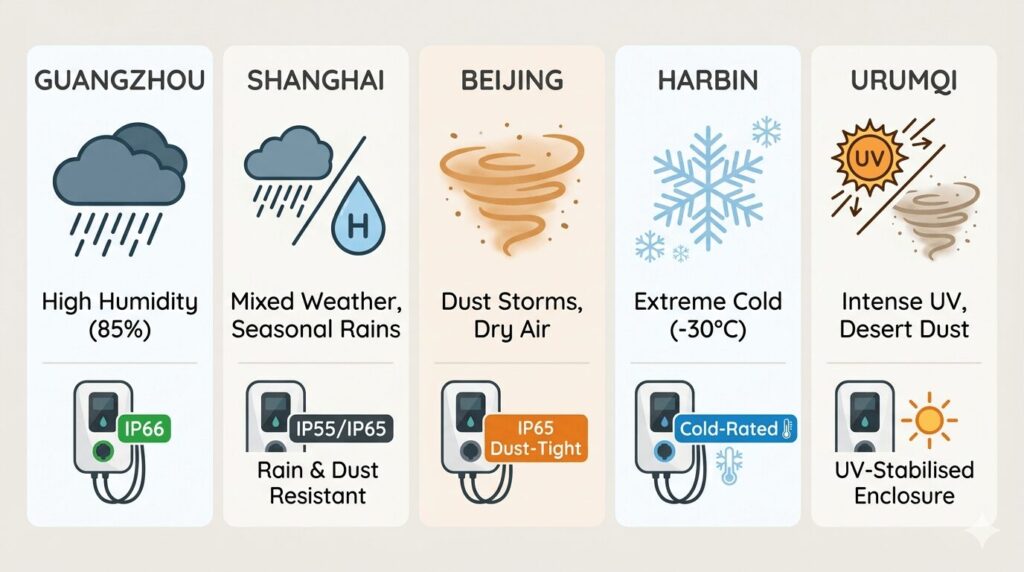
China’s geographic scale creates dramatically different climate demands for electrical equipment. A charger appropriate for a Shanghai underground car park is not necessarily appropriate for outdoor installation in Guangzhou, and certainly not appropriate for Harbin winter conditions.
Understanding China’s five distinct climate zones relevant to EV charger specification prevents the most common installation errors.
Climate Zone 1: South China Monsoon Humid (华南季风湿润区)
Cities: Guangzhou (广州), Shenzhen (深圳), Foshan (佛山), Dongguan (东莞), Zhuhai (珠海), Xiamen (厦门), Fuzhou (福州), Haikou (海口), Nanning (南宁)
Climate characteristics relevant to EV charger specification:
Annual rainfall: 1,600-2,200mm (Guangzhou average: 1,800mm; Haikou: 2,000mm+)
- Comparison: London receives approximately 600mm/year; Shanghai receives approximately 1,200mm/year
- South China’s rainfall is approximately 3× London and 1.5× Shanghai
Monsoon season characteristics:
- Duration: April-September (6 months of high-rainfall risk)
- Peak intensity: May-June and August-September
- Typhoon season: July-September — with extreme rainfall events that can deposit 100-200mm in a 24-hour period
- Driving rain: Typhoon conditions create horizontal water jets that challenge even IP55-rated equipment
Humidity:
- Annual average humidity: 75-85%
- Summer humidity: 80-95%
- Sustained high humidity accelerates connector corrosion, encourages condensation inside insufficiently sealed enclosures, and degrades cable jacket materials faster than temperate climate conditions
Temperature range: +5°C to +38°C (no below-zero temperatures in most areas)
- High summer temperatures in confined parking spaces: up to +45°C
- Thermal stress on enclosure materials: sustained UV exposure, ozone, high temperature — all accelerate plastic degradation
What this climate demands from a home EV charger:
Minimum IP rating: IP65 — the difference between IP55 and IP65 water protection is significant in typhoon conditions. An IP55 charger rated for 6.3mm water jets may be challenged by the horizontally-driven rainfall of a typhoon. IP65’s identical water jet resistance (the x5 and x6 second digits both use 6.3mm nozzle tests — the difference is nozzle pressure: IP65 uses 12.5L/min vs IP55’s 12.5L/min at lower pressure… note: the more important distinction in practice is that IP65 combines with dust-tight first digit, ensuring no accumulated dust compromises the enclosure’s water resistance over time)
Actually: Let us be precise about this distinction because it affects the recommendation materially.
Corrected understanding:
- IP55: Dust protected (some dust ingress possible) + water jets from any direction
- IP65: Dust tight (zero dust ingress) + water jets from any direction (same water test as IP55)
- IP66: Dust tight + powerful water jets (higher pressure than IP65)
For South China monsoon environments: IP65 is the appropriate recommendation for most installations — the dust-tight protection prevents the gradual dust accumulation through microscopic enclosure gaps that would eventually allow moisture ingress in high-humidity environments. In direct typhoon-exposed outdoor mounting, IP66 provides additional margin.
Connector and cable material requirements: South China’s humidity and salt air (coastal areas) accelerate connector pin corrosion. Specify chargers with:
- Stainless steel or gold-plated connector contact pins
- UV-stabilised cable jacket material
- Marine-grade sealant around all cable entry points
Recommended chargers for South China:
- Autel MaxiCharger (IP65, -30°C): Primary recommendation for all South China outdoor and semi-outdoor installations
- Ginlong Solis Smart (IP66): For direct outdoor mounting in coastal Guangdong and Hainan — the additional water jet resistance provides margin in typhoon conditions
- Growatt EV Charger (IP65): For South China villa owners with Growatt solar installations
Chargers to avoid in South China outdoor installation:
- StarCharge S1 (IP54): Insufficient for direct outdoor mounting in high-rainfall South China
- TELD entry (IP54): Same limitation
- Xiaomi EV Charger (IP55): Adequate for covered installation, marginal for direct outdoor exposure
Climate Zone 2: Yangtze River Basin Humid Subtropical (长江中下游湿润亚热带)
Cities: Shanghai (上海), Nanjing (南京), Hangzhou (杭州), Wuhan (武汉), Chengdu (成都), Chongqing (重庆), Changsha (长沙)
Climate characteristics:
Annual rainfall: 1,000-1,400mm
- Less extreme than South China monsoon but still significant
- “Plum rain” season (梅雨季节): June-July — sustained rainfall of 2-4 weeks with persistent moderate rainfall and very high humidity (90%+)
- Summer typhoon influence: less direct than South China but occasional significant rainfall events from typhoon remnants
Humidity:
- Annual average: 70-80%
- Plum rain season: 85-95% sustained
- Chengdu and Chongqing basin: among China’s highest annual average humidity due to topographic moisture trapping
Temperature range: -5°C to +40°C
- Brief below-zero periods in winter (Wuhan, Nanjing) — occasional frost
- Chengdu: rarely below -5°C but sustained cold damp conditions
- Shanghai: occasional -5°C events, typically brief
What this climate demands:
Minimum IP rating: IP55 for covered installations (underground car parks), IP65 for outdoor and semi-outdoor installations
For Shanghai specifically: Shanghai’s underground car parks in many older residential compounds experience significant humidity — particularly during plum rain season when humid air penetrates underground parking through ventilation. An IP55 charger in a Shanghai underground car park is adequate. An IP54 charger is marginal — the dust-protected (not dust-tight) first digit allows gradual humidity penetration over time that may lead to moisture accumulation inside the enclosure.
The condensation problem in humid subtropics: Thermal cycling in humid subtropical climates creates a specific failure mode for insufficiently sealed charger enclosures. During cold winter nights, the charger enclosure cools. During warm humid days, the enclosure warms. If the enclosure is not fully sealed (IP54 dust-protected enclosure), warm humid air enters during the warm day and condenses on cooler internal surfaces during the cold night cycle. Over months, this condensation accumulates — reaching electronics and connector components.
IP65’s dust-tight sealing prevents this condensation cycle by preventing warm humid air ingress entirely.
Recommended chargers for Yangtze Basin:
- Covered underground parking: StarCharge S1 (IP54) is adequate — the most cost-effective appropriate choice for standard Shanghai apartment underground car park installation
- Semi-covered or outdoor parking: Autel MaxiCharger (IP65) — the additional protection justifies the ¥300-¥400 premium
- Wuhan/Changsha humid outdoor: Autel MaxiCharger (IP65) — Wuhan’s summer combination of high temperature and high humidity is among China’s harshest conditions for electrical equipment
Chengdu and Chongqing specific note: The Sichuan basin’s topographic humidity trapping creates some of China’s highest persistent humidity outside coastal South China. For outdoor Chengdu and Chongqing installations, IP65 is the correct specification despite the absence of typhoon-level rainfall events.
Climate Zone 3: North China Semi-Arid (华北半干旱区)
Cities: Beijing (北京), Tianjin (天津), Zhengzhou (郑州), Jinan (济南), Taiyuan (太原), Hohhot (呼和浩特 — Inner Mongolia)
Climate characteristics:
Annual rainfall: 400-700mm (Beijing: approximately 600mm — similar to London but concentrated in summer)
- Dry season: October-May (7 months with minimal rainfall)
- Rainy season: June-September (concentrated summer rainfall)
- Beijing’s summer rainfall intensity: Heavy thunderstorm events are common — rainfall can reach 50-100mm/hour during intense convective events
Dust: North China’s semi-arid climate combined with the Loess Plateau geography and proximity to the Gobi Desert creates significant dust conditions:
- Spring dust storms (沙尘暴): March-May
- Beijing experiences 5-10 significant dust storm events annually
- Dust particle concentration during major events: 500-1,000 μg/m³ (severely hazardous air quality levels)
- Hohhot: more severe dust exposure than Beijing — 10-20 significant dust events annually
The dust ingress concern for EV chargers: North China dust storms deposit fine loess particles that can penetrate IP54 (dust protected) enclosures over repeated exposure. An IP54 charger in Beijing exposed to the car park environment through multiple dust storm seasons will accumulate fine particle contamination inside the enclosure that an IP65 (dust tight) unit prevents entirely.
Temperature range:
- Beijing: -15°C to +40°C (extremes: -20°C possible, +42°C rare peak)
- Hohhot: -30°C to +38°C (extreme winter severity)
- Tianjin: -15°C to +39°C
What this climate demands:
Minimum IP rating: IP65 — both dust-tight and water-jet resistant
- The dust-tight first digit (IP6x) is more important in North China than in most other regions
- IP54 and IP55 chargers with dust-protected (not dust-tight) enclosures allow gradual dust ingress that accumulates over repeated Beijing spring dust storm seasons
Temperature specification:
- Beijing: -20°C charger specification recommended (StarCharge -20°C minimum is adequate for most Beijing winters, but borderline for exceptional cold events — Autel or Tesla -30°C provide better margin)
- Hohhot: -30°C charger specification required (see Northern China section below)
The Beijing installation scenario analysis:
Underground covered parking: IP54 is technically adequate for water — but IP65’s dust-tight advantage applies even in covered parking, as Beijing’s dust storm particles penetrate underground car parks through ventilation systems. For budget-conscious buyers, StarCharge S1 (IP54) is functionally adequate in most cases. For maximum hardware longevity, Autel (IP65) prevents the cumulative dust ingress issue.
Semi-covered or outdoor parking: IP65 required — combined dust storm exposure and summer thunderstorm events demand full IP65 protection.
Recommended chargers for North China:
- Beijing covered parking (budget): StarCharge S1 (IP54, -20°C) — technically adequate with noted dust accumulation risk over time
- Beijing covered parking (preferred): Autel MaxiCharger (IP65, -30°C) — better long-term hardware protection
- Beijing outdoor/semi-outdoor: Autel MaxiCharger (IP65, -30°C) — required specification
- Hohhot: Autel MaxiCharger (IP65, -30°C) — minimum acceptable specification
Climate Zone 4: Northeast China Severe Winter (东北严寒区)
Cities: Harbin (哈尔滨), Changchun (长春), Shenyang (沈阳), Jilin (吉林), Mudanjiang (牡丹江), Qiqihar (齐齐哈尔)
Climate characteristics:
Temperature range:
- Harbin: -38°C (extreme recorded low) to +38°C (summer high)
- Average January low: -24°C
- Average January high: -14°C
- Days below -20°C: approximately 30-40 per year
- Changchun: -35°C extreme to +38°C
- Average January low: -20°C
- Shenyang: -30°C extreme to +37°C
- Average January low: -17°C
These temperatures are the primary charger specification driver in this climate zone — everything else is secondary.
Snowfall and ice:
- Annual snowfall: Harbin 150-200cm
- Ice coating on outdoor equipment: common December-February
- Freeze-thaw cycles: March-April create thermal shock conditions
Humidity in summer: Surprisingly humid summer conditions (80%+ relative humidity July-August) — Northeast China experiences both extreme cold and warm-season humidity, requiring full weather protection year-round.
Dust: Less severe than North China but Northeast China’s spring thaw period (March-April) creates significant windborne silt from agricultural areas.
What this climate demands:
Temperature specification — non-negotiable:
| City | Average January Low | Minimum Required Charger Spec | Recommended |
|---|---|---|---|
| Harbin | -24°C | -30°C or below | -30°C |
| Changchun | -20°C | -25°C or below | -30°C |
| Shenyang | -17°C | -20°C or below | -25°C or -30°C |
Why the margin matters: A charger specified to -20°C minimum operating temperature is designed and tested to function at -20°C. In Harbin, this means the charger is at its design limit on average January mornings. A 2-3°C cold snap below average — entirely common in Harbin — pushes the charger below its rated range. Startup failures, connector stiffness causing locking mechanism issues, and LCD/indicator failures from extreme cold are documented failure modes in underspecified chargers.
The -30°C specification advantage: A charger specified to -30°C has 6°C of operating margin on Harbin’s average coldest morning — it is well within its rated operating range throughout the entire winter rather than operating at the edge of its specification.
Cold-rated cable requirement: Cable jacket materials behave differently at extreme cold. Standard PVC cable jacket becomes stiff and crack-prone at -20°C. A cable that flexes easily in summer becomes rigid and brittle in Harbin winter. Forced flexing of a cold-stiffened cable damages the internal conductors through repeated bending at the same stress point.
Cold-rated cable compounds (used in Autel, Tesla Wall Connector, Grizzl-E Ultimate in the US market) maintain flexibility at -30°C — the cable remains manageable in extreme cold rather than requiring the owner to carefully warm it before connecting.
Connector cold weather behaviour: The GB/T AC connector’s locking mechanism involves spring-loaded components. At extreme cold, spring materials stiffen, locking engagement forces increase, and repeated forceful engagement accelerates wear. Chargers with higher-quality connector assemblies (with cold-tolerant spring materials) show significantly better cold-climate connector longevity.
Outdoor vs indoor installation in Northeast China: For Harbin EV owners: wherever possible, indoor installation (heated garage or at minimum covered semi-indoor parking) significantly reduces cold weather specification demands. A charger in a -5°C heated garage performs better than a -30°C-rated charger in a -28°C outdoor installation.
Recommended chargers for Northeast China:
| Location | Best Choice | Why |
|---|---|---|
| Harbin outdoor | Autel MaxiCharger (IP65, -30°C) | -30°C specification, IP65, cold-rated cable compound |
| Harbin indoor (heated) | StarCharge S Series Pro or Autel | -20°C adequate for heated indoor; -30°C for margin |
| Changchun outdoor | Autel MaxiCharger (IP65, -30°C) | -30°C for outdoor margin |
| Shenyang outdoor | Autel MaxiCharger or Pilot-EV (-25°C, IP55) | -25°C adequate; IP65 preferred |
Chargers to absolutely avoid in Harbin and Changchun outdoor installation:
- StarCharge S1 (-20°C): Will fail on coldest Harbin mornings
- Xiaomi EV Charger (-20°C): Same limitation
- TELD entry (-20°C): Same limitation
Climate Zone 5: Northwest China Arid (西北干旱区)
Cities: Urumqi (乌鲁木齐), Xi’an (西安), Lanzhou (兰州), Yinchuan (银川), Dunhuang (敦煌 — extreme example)
Climate characteristics:
Dust: Northwest China presents the most severe dust conditions of any inhabited Chinese region:
- Gobi Desert proximity — Urumqi and Lanzhou experience regular severe dust storms
- Loess Plateau exposure (Xi’an, Lanzhou) — fine loess particles
- Annual dust storm frequency: Urumqi 15-25 significant events; Xi’an 10-15
The dust concern is more severe than North China because: Northwest China dust events are more concentrated, more frequent, and occur in a drier environment where dust remains airborne longer and penetrates more effectively into insufficiently sealed enclosures.
Temperature range:
- Urumqi: -41°C (extreme) to +45°C — the most extreme temperature range of any major Chinese city
- Xi’an: -20°C to +43°C
- Lanzhou: -22°C to +40°C
Annual rainfall:
- Urumqi: 250-300mm (semi-arid, low absolute rainfall)
- Xi’an: 550-750mm (more rainfall but dust remains dominant concern)
UV radiation: Northwest China’s high altitude and low cloud cover creates extremely high UV radiation levels — among the highest in China. UV degradation of ABS plastic enclosures is accelerated in Xinjiang and Gansu compared to eastern China.
What this climate demands:
IP rating: IP66 recommended for outdoor installation — the enhanced dust-tight protection of IP6x combined with IP66’s powerful water jet resistance provides the most robust protection for northwest China’s extreme dust events and occasional intense rainfall.
The IP65 vs IP66 distinction for northwest China: Both IP65 and IP66 are dust-tight (first digit 6). The second digit difference:
- IP65: Protected against water jets from 6.3mm nozzle at 12.5 L/min flow
- IP66: Protected against powerful jets from 12.5mm nozzle at 100 L/min flow
For northwest China’s primary climate concern (dust), both IP65 and IP66 provide the same protection. The IP66 advantage applies only if the charger is in a location with strong water jet exposure — which is less relevant in the dry northwest than in coastal south China.
Practical recommendation: IP65 is adequate for most northwest China installations from a water protection standpoint. The critical specification is IP6x (dust tight) — not IP55’s dust-protected standard.
Temperature specification: Urumqi’s -41°C extreme temperature is the most demanding of any Chinese city. Standard -30°C charger specifications are adequate for Urumqi average conditions but approach their limits during extreme cold events.
For Urumqi specifically: Autel MaxiCharger (-30°C) is the best available standard consumer charger specification. For Urumqi’s coldest periods, heated indoor installation is strongly recommended over outdoor installation.
UV protection: Specify UV-stabilised polycarbonate enclosures (Autel, Tesla, Schneider) over standard ABS plastic for northwest China outdoor installations. UV degradation of ABS in Xinjiang’s high-UV environment can cause enclosure embrittlement within 3-5 years — significantly shortening effective charger lifespan.
Recommended chargers for Northwest China:
- Outdoor (Urumqi, Lanzhou): Autel MaxiCharger (IP65, -30°C, UV-stabilised polycarbonate)
- Indoor (Xi’an covered parking): StarCharge S Series Pro (IP54 adequate for indoor dust protection)
- Semi-outdoor (Xi’an): Autel MaxiCharger (IP65)
The Complete IP Rating Selection Matrix for China
Use this matrix to identify the minimum appropriate IP rating for your specific installation:
| Installation Type | South China | Yangtze Basin | North China | Northeast | Northwest |
|---|---|---|---|---|---|
| Underground covered parking | IP54 minimum / IP65 preferred | IP54 adequate | IP55 minimum / IP65 preferred | IP55 minimum | IP55 minimum |
| Covered outdoor (roof, no walls) | IP65 required | IP65 preferred | IP65 required | IP65 required | IP65 required |
| Fully outdoor (no cover) | IP65-IP66 | IP65 required | IP65 required | IP65 required | IP65-IP66 |
| Ground level (flood risk) | IP67 | IP67 | IP65 | IP65 | IP65 |
The Temperature Rating Selection Matrix for China
| City | Coldest Expected Temperature | Minimum Charger Rating | Recommended |
|---|---|---|---|
| Guangzhou, Shenzhen | +2°C | -10°C | -20°C |
| Shanghai, Hangzhou | -8°C | -20°C | -20°C |
| Wuhan, Nanjing | -12°C | -20°C | -20°C |
| Beijing, Tianjin | -20°C | -25°C | -30°C |
| Xi’an, Lanzhou | -20°C | -25°C | -30°C |
| Hohhot (outdoor) | -30°C | -30°C | -30°C |
| Shenyang (outdoor) | -25°C | -30°C | -30°C |
| Changchun (outdoor) | -32°C | -30°C | -30°C |
| Harbin (outdoor) | -38°C | -30°C | -30°C + heated where possible |
| Urumqi (outdoor) | -41°C | -30°C + heated | Indoor installation strongly preferred |
The Charger Selection Guide by Region
For South China (Guangdong, Fujian, Guangxi, Hainan)
The non-negotiable specification: IP65 or IP66 for any installation with outdoor exposure. IP54 is insufficient for direct monsoon and typhoon exposure.
Top recommendation: Autel MaxiCharger AC (IP65, -30°C, ¥1,299-2,499)
- IP65 provides genuine protection through typhoon season
- -30°C capability is excessive for South China temperatures but provides hardware longevity in conditions that don’t stress the cold weather specification
- Dual-band WiFi (2.4 + 5 GHz) — useful in dense urban Guangdong/Shenzhen apartment buildings
- Solar integration available — relevant for South China villa owners with solar
For South China coastal direct outdoor mounting: Ginlong Solis Smart EV Charger (IP66, -30°C, ¥1,500-3,200)
- IP66’s enhanced water jet resistance provides additional margin for direct typhoon exposure
- -30°C cold weather specification unnecessary in South China’s climate but provided as standard
- OCPP 2.0 — future-proofing for Shenzhen’s electricity market reform programmes
Charger to avoid for South China outdoor: StarCharge S1 (IP54) — should not be installed in any outdoor or semi-outdoor position in Guangdong, Fujian, or Hainan. Adequate only for fully covered underground parking.
For Yangtze Basin (Shanghai, Jiangsu, Zhejiang, Hubei, Sichuan)
The nuanced specification: IP54 is adequate for well-protected underground parking in Shanghai. IP65 is preferred for outdoor and semi-outdoor installations, and for Wuhan/Chengdu’s particularly humid conditions.
For Shanghai covered underground parking (most common scenario): StarCharge S1 (IP54, -20°C, ¥899-1,099)
- IP54 adequate for covered underground installation
- Most cost-effective smart charger in the market
- Best 物业 approval familiarity and after-sales network for Shanghai
For Shanghai outdoor/semi-outdoor, Wuhan outdoor, Chengdu outdoor: Autel MaxiCharger AC (IP65, -30°C, ¥1,299-2,499)
- IP65 justified for semi-outdoor or outdoor exposure in these humid climates
- -30°C exceeds Shanghai/Wuhan winter requirements but provides margin
For Chengdu and Chongqing specifically: The basin’s humidity trapping makes Autel (IP65) the preferred choice even for covered parking positions — the sustained humidity environment makes IP65’s dust-tight sealing more valuable than in Shanghai’s less persistently humid underground car parks.
For North China (Beijing, Tianjin, Zhengzhou, Jinan)
The specification balance: IP65 for dust-tight protection plus -30°C for Beijing’s cold snaps. The dust concern is real — spring dust storms are an annual occurrence.
Primary recommendation for Beijing outdoor and semi-outdoor: Autel MaxiCharger AC (IP65, -30°C, ¥1,299-2,499)
- IP65 dust-tight protection prevents cumulative dust ingress from Beijing spring storms
- -30°C provides comfortable margin for Beijing’s coldest conditions (-15°C average, -20°C extreme)
- Solar integration available for Beijing villa owners
For Beijing covered underground parking (budget): StarCharge S Series Pro (IP54, -20°C, ¥1,199-1,499)
- IP54 is technically adequate for underground installation — but note dust ingress risk from ventilation
- -20°C adequate for most Beijing winter conditions
- Cost saving versus Autel: ¥100-¥1,000
For Hohhot outdoor installation: Autel MaxiCharger AC (IP65, -30°C) — minimum specification. The combination of dust storm frequency and cold temperatures makes Autel the only appropriate choice from the mainstream consumer charger market.
For Northeast China (Harbin, Changchun, Shenyang, Jilin)
The temperature specification is the dominant requirement.
For Harbin and Changchun outdoor installation: Autel MaxiCharger AC (IP65, -30°C, ¥1,299-2,499) — the only mainstream consumer charger that meets the specification requirements for outdoor installation in these locations.
No other charger reviewed in the Chinese market content cluster provides -30°C + IP65 at accessible residential pricing. The choice for Harbin outdoor installation is between the Autel MaxiCharger and not having an outdoor charger.
For Harbin heated indoor installation: StarCharge S Series Pro or NIO Home Charger — in a heated garage that maintains above -5°C, -20°C charger specification is adequate and opens up the full product range.
For Shenyang outdoor installation: Autel MaxiCharger (IP65, -30°C) — Shenyang’s -25°C extreme makes Pilot-EV’s -25°C specification borderline. The Autel’s -30°C provides safety margin.
For Northwest China (Urumqi, Xi’an, Lanzhou, Yinchuan)
The dust specification is the dominant requirement for Urumqi and Lanzhou. Temperature is additionally critical for Urumqi.
For Urumqi outdoor installation: Autel MaxiCharger AC (IP65, -30°C) — indoor installation strongly preferred. If outdoor installation is unavoidable, Autel is the only appropriate option from the mainstream market — and even this is operating near its temperature limit in Urumqi’s coldest conditions.
For Xi’an outdoor installation: Autel MaxiCharger (IP65, -30°C) — Xi’an’s dust storm exposure from Loess Plateau proximity makes IP65 dust-tight specification important. -30°C provides margin for Xi’an’s -20°C extreme conditions.
For Xi’an covered indoor installation: StarCharge S Series Pro (IP54, -20°C) — adequate for covered indoor Xi’an installation at budget pricing.
The IP Rating Verification Guide — How to Confirm a Charger’s Actual IP Rating
One of the most important practical points in this guide: the IP rating on a product’s specification sheet is only meaningful if it was established through genuine IP testing by an accredited laboratory.
How Genuine IP Testing Works
Standard IP testing for Chinese electrical equipment: IP ratings for consumer electrical equipment sold in China should be tested according to GB/T 4208 (equivalent to IEC 60529). Testing is performed by an accredited testing laboratory — either as part of 3C certification or as a standalone product test.
For 3C certified chargers: The 3C certification process includes IP rating verification as part of the product testing. A charger with genuine 3C certification has had its IP rating verified by independent testing. This is the most reliable confirmation of an IP rating claim.
For non-3C certified chargers: IP rating claims on uncertified chargers are self-declared and should not be trusted — particularly for outdoor installation decisions where the IP rating is critical for hardware safety.
How to verify:
- Check that the charger has genuine 3C certification (CQC certificate number verification as described in our 3C certification guide)
- Confirm the certificate documentation specifically lists the IP rating tested
The Red Flag — IP Rating Without Test Documentation
Any charger specification sheet that lists an IP rating without referencing a test standard and providing a certificate number should be treated with scepticism. The IP rating claim cannot be independently verified and may be inaccurate.
This is particularly common for:
- Very cheap chargers (below ¥500) claiming IP55 or IP65
- Products on Taobao or Pinduoduo where specification sheets are seller-generated
- Products from unregistered or unverifiable manufacturers
The Long-Term Cost of Wrong IP Rating — The Financial Case
The financial case for buying the correct IP rating the first time is straightforward:
The IP54 Failure in South China Scenario
Year 0: Buy StarCharge S1 (IP54) for outdoor Guangzhou installation: ¥999 + ¥1,700 installation = ¥2,699 Year 2: Monsoon season moisture ingress causes electronics failure. Out of warranty (3 years — barely within). Replace unit: ¥999 (charger) + ¥500 (electrician swap) = ¥1,499 Year 5: Same failure. Out of warranty. Second replacement: ¥1,499 5-year total: ¥2,699 + ¥1,499 + ¥1,499 = ¥5,697
Alternative: Buy Autel MaxiCharger (IP65) from the start: Year 0: ¥1,499 + ¥1,700 installation = ¥3,199 Years 1-5: No moisture-related failures 5-year total: ¥3,199
Saving from buying correct IP rating initially: ¥2,498
The IP65 Autel costs ¥500 more than the IP54 StarCharge at purchase — and saves ¥2,498 over 5 years in a South China outdoor installation scenario.
The -20°C Failure in Harbin Scenario
Year 0: Buy StarCharge S1 (-20°C) for outdoor Harbin installation: ¥999 + ¥1,700 = ¥2,699 Year 1: February cold snap (-26°C) causes startup failures. Charger enters fault mode on 15 mornings during the coldest period. Each fault requires manual reset. No warranty replacement — operating within (cold) rated range on average conditions Year 2: Connector housing has cracked from thermal cycling. Connector requires replacement: ¥200 parts + ¥300 labour = ¥500 Year 3: Control board failure from cumulative thermal stress operating near -20°C limit. Out of warranty. Replacement: ¥1,499
3-year total: ¥2,699 + ¥500 + ¥1,499 = ¥4,698
Alternative: Buy Autel MaxiCharger (-30°C, IP65): Year 0: ¥1,699 + ¥1,700 = ¥3,399 Years 1-3: No cold-weather failures 3-year total: ¥3,399
Saving from buying correct temperature specification: ¥1,299 over 3 years
Internal Links — Further Reading on Clean Energy Bazaar
Weatherproof EV chargers 2026 IP ratings for humid southern China vs dusty northern China is the climate specification guide within the Chinese market content cluster.
For the charger comparison covering every product’s IP rating and temperature specification, our best home EV chargers 2026 top 7 comparison for Chinese homeowners Star Charge Autel guide covers every specification. For the head-to-head between Tesla, StarCharge, and Autel where IP ratings are directly compared, our Tesla Universal Wall Connector vs Star Charge vs Autel 2026 China market comparison guide covers every dimension. For the safety certification framework that verifies whether IP rating claims are genuine, our 3C certification and EV chargers 2026 why buying non-certified chargers is dangerous in China guide covers verification. For the budget charger options showing which affordable chargers have genuine IP65 certification, our best budget EV chargers under ¥2,000 2026 Chinese options that actually work guide covers affordable certified options. For the European equivalent covering IP rating guidance for UK and European outdoor installations, our weatherproof EV chargers 2026 IP ratings US UK guide provides the international comparison. And for the complete buying process ensuring the correct weatherproof specification is included in the installation design, our find the right EV charger for your home China edition guide covers every pre-purchase decision.
Final Thoughts
The weatherproof EV chargers 2026 IP ratings for humid southern China vs dusty northern China analysis produces clear recommendations for every Chinese climate zone.
The regional specification summary:
South China (Guangdong, Fujian, Hainan): IP65 minimum for any outdoor exposure. IP66 for direct monsoon/typhoon facing installations. The monsoon rainfall intensity and typhoon season make IP54 genuinely inadequate for outdoor South China installation — not marginal, genuinely inadequate.
Yangtze Basin (Shanghai, Wuhan, Chengdu): IP54 adequate for covered underground parking. IP65 preferred for outdoor, semi-outdoor, and the persistently humid basin climates of Chengdu and Chongqing.
North China (Beijing, Hohhot): IP65 required for outdoor installation — the dust-tight specification prevents cumulative Beijing spring storm dust ingress. -30°C recommended for outdoor Beijing installations despite average conditions being manageable with -20°C chargers.
Northeast China (Harbin, Changchun): -30°C specification is non-negotiable for outdoor installation. IP65 required. The Autel MaxiCharger is the only mainstream consumer charger meeting both requirements. Indoor installation in heated spaces should be prioritised wherever possible.
Northwest China (Urumqi, Xi’an): IP65 required for dust-tight protection against severe loess and Gobi dust exposure. -30°C for Urumqi and Xinjiang. Indoor installation strongly preferred for Urumqi given the potential for temperatures approaching -41°C.
The two chargers that cover every Chinese climate zone without compromise:
- Autel MaxiCharger AC (IP65, -30°C): The all-China specification charger — appropriate from Hainan typhoon coast to Harbin winter to Xinjiang dust storm
- Ginlong Solis Smart (IP66, -30°C): The enhanced-specification option for extreme South China coastal or Northwest China dust environments
For Chinese apartment owners in the standard covered underground parking scenario in most Chinese cities: the StarCharge S1 (IP54, -20°C) remains the value leader — the climate conditions in covered underground parking in Shanghai, Beijing (non-outdoor), Guangzhou (underground), and most tier-2 cities do not require the IP65 premium. But the moment any outdoor or semi-outdoor exposure is introduced — in any Chinese city — IP65 becomes the correct and financially rational specification.
Buy for the climate you’re actually in. The ¥300-¥500 IP rating premium costs less than one replacement unit.