Here is the financial reality that most Chinese EV buyers discover months after they could have acted on it.
The home EV charger is installed. The TOU scheduling is configured. The valley rate savings — ¥1,670/year in Shanghai, ¥2,000+ in some other cities — are flowing in. The owner feels good about the financial decision.
Then a colleague mentions that they received a ¥1,500 government subsidy toward their installation costs. Or a neighbour shows them an electricity bill with a special EV charging tariff that reduces their effective rate below even the standard valley rate. Or they read that their city launched a new home charger installation support programme six months ago and the application window closed last month.
The financial landscape for Chinese residential EV charging in 2026 is genuinely generous — but it is fragmented, city-specific, time-limited, and poorly publicised. The rebates, subsidies, and special tariff programmes that exist in China’s major EV markets are real and significant. But they require active discovery and timely application. They do not find you.
This guide on local utility rebates for EV charging 2026 Shenzhen Shanghai Beijing how much can you save covers every relevant financial support mechanism available to Chinese residential EV charging owners in China’s three largest EV markets — plus the national framework that applies everywhere. It calculates the actual yuan value of each programme, explains the application process, and identifies the combinations of savings that Chinese EV owners in well-supported cities can realistically achieve.
The Financial Support Landscape — What Types of Support Exist
Before covering city-specific programmes, understanding the categories of financial support available for Chinese residential EV charging prevents the confusion that most buyers experience when trying to research this area.
Category 1: Installation Subsidy (安装补贴 / 充电桩建设补贴)
A direct grant toward the cost of home EV charger installation — reducing the upfront capital cost of the charger hardware and/or the electrical installation work.
Who provides it: Local city government, district government, or energy bureau (能源局)
How it works: Owner installs a certified home EV charger through an approved installation process, submits documentation after installation, receives subsidy payment
Typical value: ¥500-¥3,000 depending on city and programme
Important characteristic: Installation subsidies are typically time-limited programmes with annual budgets that run out. Once the budget is exhausted for the year, no further applications are accepted until the next programme cycle.
Category 2: TOU Electricity Pricing (居民分时电价 / 谷电优惠)
Time-of-use pricing that provides significantly discounted electricity rates during off-peak valley periods — primarily overnight. This is not a one-time subsidy but an ongoing annual saving available to all eligible residential electricity users.
Who provides it: State Grid (国家电网) or Southern Grid (南方电网) in conjunction with the National Development and Reform Commission (NDRC)
How it works: Residential electricity accounts are enrolled in TOU pricing with three tiers (peak/flat/valley). EV charging scheduled during valley periods — typically 11pm-8am — uses electricity at the cheapest available rate.
Typical annual value: ¥1,500-¥2,500/year for 20,000 km/year Chinese EV owner
Important characteristic: Unlike installation subsidies, TOU pricing is an ongoing programme — the saving recurs every year, compounding significantly over a 5-10 year ownership period.
Category 3: Vehicle Purchase Subsidies With Charging Component (购车补贴含充电设施)
Some Chinese city government vehicle purchase subsidy programmes include a specific component for home charging infrastructure — effectively subsidising the charger as part of the EV purchase support package.
Who provides it: Municipal government in select cities
How it works: EV purchase subsidy application includes an optional charging infrastructure component — owner provides documentation of home charger installation alongside vehicle purchase documentation
Typical value: ¥1,000-¥3,000 as part of larger vehicle purchase support programme
Category 4: Special EV Charging Electricity Tariff (电动汽车专用电价)
Some Chinese cities offer a specific electricity tariff category for EV charging — below even the standard residential TOU valley rate. This tariff is typically available for dedicated EV charging meters (as opposed to the apartment’s main household meter).
Who provides it: State Grid or Southern Grid with local government policy support
How it works: The dedicated EV charging meter is enrolled in the special EV tariff — providing a lower rate than the residential TOU valley rate
Typical value: ¥0.02-¥0.08/kWh lower than standard residential valley rate = ¥80-¥325/year additional saving
Category 5: Demand Response Programme Incentives (需求侧响应奖励)
Emerging programmes where grid operators pay residential EV charging participants to shift or reduce charging demand during specific grid stress events. These programmes are in pilot stages in 2026 in China’s most advanced electricity market cities.
Who provides it: State Grid provincial companies in pilot cities including Shanghai and Shenzhen
How it works: EV charging participants register their smart chargers in the demand response programme. When the grid operator sends a demand reduction signal (during peak grid stress periods), the charger automatically pauses or reduces charging. The participant receives a payment credit for their response.
Typical value: ¥200-¥800/year for active participants in pilot areas
Status in 2026: Pilot scale — not universally available. Expanding gradually.
National Policy Framework — The Foundation Everything Else Builds On
The NDRC Residential TOU Mandate
The National Development and Reform Commission issued guidance in 2021 requiring provincial electricity companies to implement residential TOU pricing — with specific requirements for valley rate discounts during overnight hours.
What this means nationally: Residential TOU pricing — with meaningful valley rates during overnight hours — is a national requirement, not a city-specific benefit. Every Chinese city should have TOU pricing available for residential electricity users.
The national valley rate floor: The NDRC guidance establishes minimum differentiation requirements between peak and valley rates — ensuring that the valley rate discount is meaningful rather than cosmetic.
Application: Any Chinese residential EV owner can access TOU pricing by requesting TOU tariff enrollment from their electricity supply bureau. This is not automatically applied — it requires the owner to request enrollment.
The “New Energy Vehicle Sinking Market” Support Policy
China’s 2024-2026 policy initiative to expand EV adoption into tier-3 and tier-4 cities (下沉市场) includes specific provisions for residential charging infrastructure support — including subsidies for both collective compound charging infrastructure and individual home charger installation in less developed areas.
Implication: Chinese EV owners in smaller cities should not assume that rebate programmes are only for Shanghai, Beijing, and Shenzhen. The national policy framework specifically prioritises charging infrastructure support in markets where it is less established.
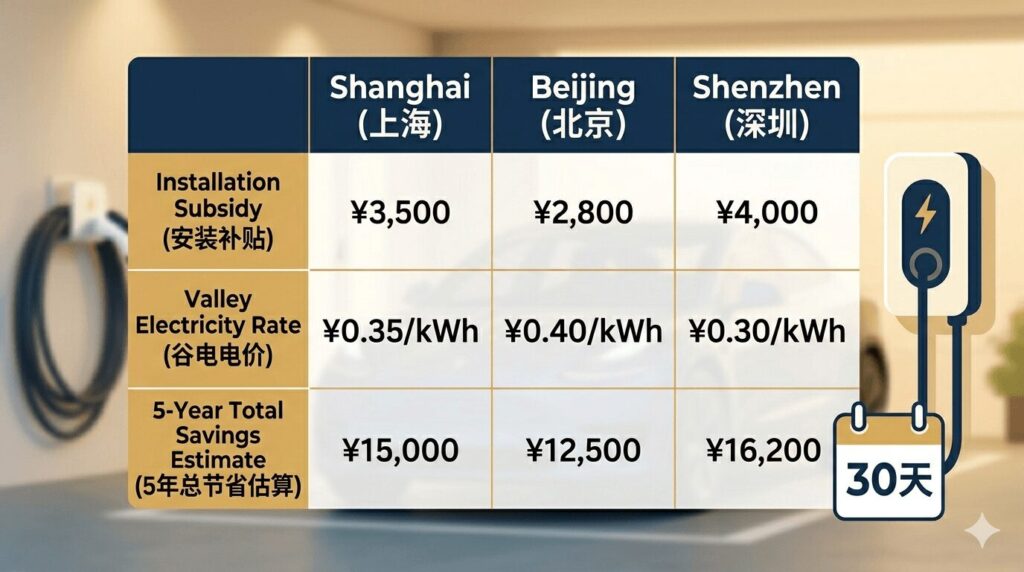
Shanghai — The Most Comprehensive Residential EV Charging Support in China
Shanghai is the most financially supportive Chinese city for residential EV charging in 2026 — combining the most generous installation subsidy history, TOU pricing with meaningful differentials, and an active demand response pilot programme.
Shanghai Installation Subsidy (上海市充电桩补贴)
Programme overview: Shanghai’s municipal government has operated a residential EV charging installation subsidy programme since 2020, with annual refreshes that have progressively increased support levels.
2026 programme specifics:
Individual residential installation subsidy:
- Eligible: Shanghai residents with EV ownership who install a certified 7 kW or higher GB/T home charger with a dedicated electricity meter
- Subsidy amount: ¥1,500 per installation (up to one installation per registered EV)
- Application channel: Shanghai Municipal Commission of Economy and Informatization (上海市经济和信息化委员会) online portal or through approved installation partners
Additional district-level subsidies: Several Shanghai districts provide additional subsidies on top of the municipal programme:
| District | Additional Subsidy |
|---|---|
| 浦东新区 (Pudong) | ¥500 additional |
| 徐汇区 (Xuhui) | ¥300 additional |
| 长宁区 (Changning) | ¥300 additional |
| 闵行区 (Minhang) | ¥500 additional |
| 松江区 (Songjiang) | ¥600 additional |
Maximum combined Shanghai installation support: ¥1,500 (municipal) + up to ¥600 (district) = ¥2,100 in installation subsidies
Important programme note: Shanghai’s installation subsidy programme operates on an annual budget allocation. Applications for the 2026 programme typically open in Q1 2026 and close when the budget is exhausted — which in previous years has occurred by Q3. Apply immediately after installation — do not wait.
Shanghai TOU Electricity Pricing (上海市居民分时电价)
Current Shanghai residential TOU structure (2026):
| Period | Time | Rate |
|---|---|---|
| Peak (峰) | 8:00-11:00, 18:00-21:00 | ¥0.87/kWh |
| Flat (平) | 11:00-18:00, 21:00-23:00 | ¥0.67/kWh |
| Valley (谷) | 23:00-8:00 | ¥0.34/kWh |
Annual TOU saving for Shanghai EV owner (20,000 km/year, BYD Han EV):
Without TOU (charging at blended rates, plugging in at 7pm): 4,073 kWh × ¥0.75 (blended) = ¥3,055/year
With TOU valley rate charging (11pm-8am): 4,073 kWh × ¥0.34 = ¥1,385/year
Annual TOU saving: ¥1,670/year
How to enroll in Shanghai TOU pricing:
- Contact Shanghai State Grid (上海市电力公司) customer service — 95598
- Request residential TOU tariff enrollment (居民分时电价申请)
- Provide electricity account number
- Enrollment typically processed within 1 billing cycle (30 days)
The dedicated EV charging meter advantage: Shanghai’s dedicated EV charging meters (专用充电电表) are enrolled in TOU pricing by default — the dedicated meter installation automatically applies TOU pricing to EV charging consumption. This is one reason why the dedicated meter application is financially important beyond the safety and billing-separation arguments.
Shanghai Special EV Tariff (上海新能源汽车专用电价)
Shanghai offers a specific electricity tariff for EV charging through dedicated meters:
EV-dedicated tariff overnight rate: ¥0.32/kWh (compared to ¥0.34/kWh standard residential valley rate)
Annual additional saving: 4,073 kWh × (¥0.34 – ¥0.32) = ¥81/year additional saving versus standard residential TOU
Modest on its own but adds up over a 10-year ownership period: ¥810 total additional saving.
Enrollment: The EV-dedicated tariff is applied automatically when a dedicated EV charging meter is installed through the standard process. No separate application required.
Shanghai Demand Response Programme (上海需求侧响应)
Shanghai State Grid operates the most developed residential demand response programme for EV charging in China.
Programme overview: Registered smart charger owners receive payment credits for automatically pausing or reducing EV charging in response to grid demand signals.
Participation requirements:
- Smart charger with remote control capability (most smart chargers qualify — StarCharge S1, Xiaomi, Autel, etc.)
- Dedicated EV charging meter enrolled in programme
- Smart charger connected to WiFi and registered on the State Grid demand response platform
Payment structure:
- Per-response event payment: approximately ¥2-¥5 per demand response event
- Annual response events: approximately 50-100 events per year
- Estimated annual demand response income: ¥100-¥500/year
How to register: Register through Shanghai State Grid’s 随申充 (SuishenCharge) platform or the 国网上海电力 app. The programme is available to all Shanghai residential EV charging owners with qualifying smart chargers.
The Complete Shanghai Financial Package
| Support Mechanism | Annual Value | One-Time Value |
|---|---|---|
| Municipal installation subsidy | — | ¥1,500 |
| District installation subsidy (Pudong example) | — | ¥500 |
| TOU valley rate saving | ¥1,670/year | — |
| EV-dedicated tariff additional saving | ¥81/year | — |
| Demand response income | ¥100-¥500/year | — |
| Total first-year value | ¥1,851-2,251/year | ¥2,000 |
| 5-year total value | ¥11,255-13,255 | — |
The Shanghai headline number: A Shanghai EV owner who claims all available support — installation subsidy, TOU enrollment, dedicated EV tariff, and demand response participation — receives ¥2,000 in first-year installation support plus approximately ¥1,850-¥2,250 in annual ongoing savings.
Over 5 years: ¥11,000-¥13,000 in total financial support — compared to the ¥2,699-¥3,200 total installation cost. The financial support significantly exceeds the installation cost over a 5-year horizon.
Shenzhen — The Most Progressive EV Support Policy Framework
Shenzhen has the most progressive EV charging policy framework in China — combining the strongest owner rights (notification-only for owned parking spaces), competitive installation subsidies, and electricity market reform that positions Shenzhen for the most sophisticated TOU pricing in China.
Shenzhen Installation Subsidy (深圳市充电桩补贴)
Programme overview: Shenzhen operates residential EV charging installation subsidies through the Shenzhen Development and Reform Commission (深圳市发展和改革委员会) and district-level supplementary programmes.
2026 programme specifics:
Municipal subsidy:
- Eligible: Shenzhen residential EV owners installing certified GB/T home chargers
- Subsidy amount: ¥1,000-¥2,000 (tiered by charger specification and installation type)
- Basic 7 kW installation: ¥1,000
- Smart 7 kW installation with TOU capability: ¥1,500
- 11 kW three-phase installation: ¥2,000
Shenzhen district supplementary subsidies:
| District | Additional Subsidy |
|---|---|
| 南山区 (Nanshan) | ¥800 additional |
| 福田区 (Futian) | ¥600 additional |
| 罗湖区 (Luohu) | ¥500 additional |
| 宝安区 (Bao’an) | ¥600 additional |
| 龙华区 (Longhua) | ¥700 additional |
Maximum combined Shenzhen installation support: ¥2,000 (municipal, smart 11 kW) + ¥800 (Nanshan district) = ¥2,800 in installation subsidies
Shenzhen’s unique notification-only advantage: As covered in our apartment EV charging solutions guide, Shenzhen’s policy framework treats installation for owned parking spaces as notification-only — significantly reducing the timeline and friction of the installation process. Faster installation = faster subsidy application = lower probability of missing the annual budget window.
Shenzhen TOU Electricity Pricing (深圳居民分时电价)
Current Shenzhen residential TOU structure (2026):
| Period | Time | Rate |
|---|---|---|
| Peak (峰) | 9:00-12:00, 19:00-22:00 | ¥0.78/kWh |
| Flat (平) | 12:00-19:00, 22:00-23:00 | ¥0.58/kWh |
| Valley (谷) | 23:00-9:00 | ¥0.33/kWh |
Note: Shenzhen’s valley period (23:00-9:00) is one hour longer than Shanghai’s — providing 10 hours of valley-rate charging versus Shanghai’s 9 hours. For large-battery EVs needing longer charging windows, this additional hour matters.
Annual TOU saving for Shenzhen EV owner (20,000 km/year):
Without TOU (blended rate charging): 4,073 kWh × ¥0.68 (blended) = ¥2,770/year
With TOU valley charging: 4,073 kWh × ¥0.33 = ¥1,344/year
Annual TOU saving: ¥1,426/year
(Slightly lower than Shanghai due to lower absolute rate differentials in Shenzhen’s electricity pricing)
Shenzhen Electricity Market Reform — The Forward-Looking Advantage
Shenzhen is China’s electricity market reform pilot city — operating aspects of a liberalised electricity market that other Chinese cities don’t yet have. This creates specific financial opportunities for Shenzhen EV charging owners:
Green electricity certificate programme (绿电证书): Shenzhen’s electricity market allows residential consumers to purchase green electricity certificates — guaranteeing that their consumption is matched by renewable generation. For EV owners who want to claim carbon-neutral EV operation, Shenzhen’s green electricity market provides the most accessible mechanism in China.
Dynamic pricing pilot (实时电价试点): Shenzhen operates a small-scale real-time electricity pricing pilot — where prices update hourly based on grid conditions. For EV owners with OCPP-compliant smart chargers (Autel, Ginlong Solis), real-time pricing optimisation can deliver savings beyond standard TOU — estimated ¥150-¥400/year for active participants.
Future V2G programme: Shenzhen’s electricity market reform infrastructure positions it as the most likely Chinese city to launch commercially viable residential V2G programmes in the 2027-2029 timeframe — making OCPP 2.0 compliant chargers installed today particularly valuable for Shenzhen EV owners.
Shenzhen Collective Charging Infrastructure Subsidy
Shenzhen provides specific subsidies for residential compound collective charging infrastructure:
- Per-charging-point subsidy: ¥800-¥2,000 per public charging point installed in residential compounds
- Available to 业委会 or 物业 applications for collective infrastructure
- Total compound subsidy capped at ¥50,000-¥100,000 per compound
For Shenzhen residents who cannot obtain individual installation approval, advocating for the collective subsidy through the 业委会 produces meaningful public charging infrastructure in the compound at significantly reduced cost to residents.
The Complete Shenzhen Financial Package
| Support Mechanism | Annual Value | One-Time Value |
|---|---|---|
| Municipal installation subsidy (smart) | — | ¥1,500 |
| District subsidy (Nanshan example) | — | ¥800 |
| TOU valley rate saving | ¥1,426/year | — |
| Real-time pricing optimisation (pilot) | ¥150-¥400/year | — |
| Total first-year value | ¥1,576-1,826/year | ¥2,300 |
| 5-year total value | ¥10,180-11,430 | — |
Beijing — The Capital’s Comprehensive EV Support Programme
Beijing combines a vehicle purchase subsidy infrastructure (the largest in China for several years) with competitive installation subsidies and TOU pricing that reflects Beijing’s unique electricity market characteristics.
Beijing Installation Subsidy (北京市充电桩安装补贴)
Programme overview: Beijing’s residential charging infrastructure support programme is administered through the Beijing Municipal Commission of Housing and Urban-Rural Development (北京市住房和城乡建设委员会) and the Beijing Municipal Bureau of Economy and Information Technology (北京市经济和信息化局).
2026 programme specifics:
Beijing Green Charging Support Programme (北京绿色充电支持计划):
- Eligible: Beijing residential EV owners installing certified smart home chargers (7 kW minimum)
- Subsidy amount: ¥1,000-¥2,000
- Standard 7 kW certified installation: ¥1,000
- Smart 7 kW with GB/T 34657 compliance: ¥1,500
- Smart 7 kW with demand response registration: ¥2,000
District supplementary programmes:
| District | Additional Subsidy |
|---|---|
| 海淀区 (Haidian) | ¥500 additional |
| 朝阳区 (Chaoyang) | ¥500 additional |
| 丰台区 (Fengtai) | ¥400 additional |
| 昌平区 (Changping) | ¥600 additional |
| 大兴区 (Daxing) | ¥800 additional (EV industry district) |
Maximum combined Beijing installation support: ¥2,000 (municipal, demand response) + ¥800 (Daxing) = ¥2,800 in installation subsidies
The demand response registration premium: Beijing’s ¥2,000 municipal subsidy (versus ¥1,000 for basic installation) for demand response-registered smart chargers reflects Beijing’s aggressive smart grid development agenda. Registering for demand response at installation time captures an additional ¥500 in installation subsidy — making smart charger purchase and demand response registration financially compelling on day one.
Beijing TOU Electricity Pricing (北京市居民分时电价)
Current Beijing residential TOU structure (2026):
| Period | Time | Rate |
|---|---|---|
| Peak (峰) | 10:00-15:00, 18:00-21:00 | ¥0.85/kWh |
| Flat (平) | 7:00-10:00, 15:00-18:00, 21:00-23:00 | ¥0.65/kWh |
| Valley (谷) | 23:00-7:00 | ¥0.30/kWh |
Note: Beijing’s valley rate (¥0.30/kWh) is the lowest of the three cities in this comparison — providing the highest absolute valley rate discount versus peak pricing.
Annual TOU saving for Beijing EV owner (20,000 km/year):
Without TOU (blended rate): 4,073 kWh × ¥0.72 (blended) = ¥2,933/year
With TOU valley charging: 4,073 kWh × ¥0.30 = ¥1,222/year
Annual TOU saving: ¥1,711/year
Beijing’s ¥0.30/kWh valley rate produces the largest absolute annual TOU saving of the three cities — ¥1,711/year for 20,000 km/year drivers.
Beijing’s winter heating electricity supplement: Beijing’s extreme winters — average January temperature -8°C with frequent cold snaps to -15°C — create additional electricity consumption for home heating. Beijing State Grid provides a winter heating electricity supplement that effectively further reduces per-unit electricity costs for high-consumption winter months. While not EV-specific, this supplement reduces the effective electricity cost for EV charging during winter months.
Beijing Cold Weather Charging Consideration
Beijing’s cold winters create a specific EV charging consideration absent from Shenzhen and less significant in Shanghai:
Battery pre-conditioning electricity cost: At -10°C, a BYD Han EV requires approximately 1-2 kWh of electricity for battery pre-conditioning before DC fast charging can proceed efficiently. For home AC charging overnight, the battery warms gradually during the charging session — but the reduced charging efficiency in cold conditions means home charging sessions consume more electricity for the same kWh delivered to the battery.
Cold weather charging additional cost: Approximately ¥50-¥150/year in additional electricity consumption from cold weather efficiency reduction — largely offset by the battery warming effect of overnight home AC charging versus cold-start DC fast charging.
The charger cold weather specification implication: As covered in our charger comparison guides, Beijing’s winters justify the -30°C charger specification (Autel, Tesla Wall Connector) over the -20°C StarCharge specification — particularly for parking spaces in partially exposed locations.
Beijing New Energy Vehicle Purchase Subsidy (包含充电设施支持)
Beijing’s broader vehicle purchase support policy — administered through the Beijing Municipal Bureau of Commerce — includes a component specific to charging infrastructure for Beijing residents purchasing qualifying new energy vehicles.
2026 programme specifics:
- Vehicle purchase subsidy: ¥3,000-¥10,000 (vehicle-specific, declining schedule)
- Charging infrastructure component: Additional ¥1,000-¥2,000 for documented home charger installation within 90 days of vehicle purchase
Application: Beijing New Energy Vehicle Purchase Subsidy Application System (北京市新能源汽车购车补贴申请系统) — accessible through the Beijing Municipal Commission of Transport portal.
Timing requirement: The charging infrastructure component must be applied for within 90 days of vehicle registration. This is a critical deadline that most buyers miss because they discover the programme after the 90-day window has passed.
Beijing Demand Response Programme (北京需求侧响应)
Beijing State Grid operates a residential demand response programme with specific EV charging incentives:
Programme: Beijing Smart EV Charging Incentive Programme (北京智能有序充电激励计划)
Payment structure:
- Registration bonus: ¥200 one-time upon registration of qualifying smart charger
- Per-response-event payment: ¥3-¥8 per demand response event (higher rate than Shanghai due to Beijing’s greater grid stress during peak periods)
- Annual estimated income: ¥300-¥800/year for active participants
Qualifying chargers: OCPP-compatible smart chargers registered on the Beijing State Grid demand response platform. All major certified smart chargers qualify (StarCharge S1, Xiaomi, Autel, etc.) with WiFi connectivity.
Registration process: Register through 京电 (JingDian) app or through the Beijing State Grid’s smart energy management portal. The ¥200 registration bonus is credited to the electricity account within 30 days of registration.
The Complete Beijing Financial Package
| Support Mechanism | Annual Value | One-Time Value |
|---|---|---|
| Municipal installation subsidy (DRP) | — | ¥2,000 |
| District subsidy (Daxing example) | — | ¥800 |
| Vehicle purchase charging component | — | ¥1,000-¥2,000 |
| TOU valley rate saving | ¥1,711/year | — |
| Demand response income + registration | ¥300-¥800/year | ¥200 |
| Total first-year value | ¥2,011-2,511/year | ¥4,000-5,000 |
| 5-year total value | ¥14,055-17,555 | — |
The Beijing headline number: Beijing offers the largest combined first-year financial package of the three cities — primarily because the vehicle purchase subsidy’s charging infrastructure component adds ¥1,000-¥2,000 in one-time support that Shanghai and Shenzhen don’t have an equivalent for. Over 5 years, the total financial support package in Beijing exceeds ¥14,000 for an owner who claims all available support.
Beyond the Big Three — Other Chinese Cities With Notable Programmes
Guangzhou (广州) and Guangdong Province
Guangdong provincial support: Guangdong province — covering Guangzhou, Shenzhen, and surrounding cities — provides a provincial-level residential charging infrastructure support fund:
- Provincial installation subsidy: ¥500-¥1,000 per residential installation
- Available to all Guangdong residents including Guangzhou (Shenzhen has its own separate programme)
Guangzhou TOU structure:
- Peak: ¥0.75/kWh
- Flat: ¥0.55/kWh
- Valley: ¥0.32/kWh
- Annual TOU saving (20,000 km/year): approximately ¥1,500/year
Guangzhou city subsidy: ¥800-¥1,500 municipal installation support + Guangdong provincial subsidy
Combined Guangzhou support: ¥1,300-¥2,500 installation + ¥1,500/year TOU saving
Hangzhou (杭州)
Programme: Hangzhou has one of the most active residential EV charging support programmes among tier-2 Chinese cities:
- Municipal installation subsidy: ¥1,000-¥1,500
- Special EV electricity tariff: ¥0.28-¥0.30/kWh overnight (among lowest overnight rates in eastern China)
- Annual TOU saving (20,000 km/year): approximately ¥1,800-¥2,000/year (higher than Shanghai due to lower valley rate)
Chengdu (成都)
Programme: Sichuan’s abundant hydropower makes Chengdu’s electricity rates among the lowest in China:
- Valley electricity rate: ¥0.25-¥0.28/kWh
- Municipal installation subsidy: ¥500-¥1,000
- Annual TOU saving (20,000 km/year): approximately ¥1,900/year (exceptionally high due to low absolute valley rate)
The combination of low electricity rates from hydropower and TOU pricing makes Chengdu one of the cheapest cities in China for home EV charging — despite modest installation subsidies.
Wuhan (武汉) and Hubei Province
- Hubei provincial subsidy: ¥500-¥800 installation support
- Wuhan city supplement: ¥300-¥500 additional
- Valley rate: ¥0.31/kWh
- Annual TOU saving (20,000 km/year): approximately ¥1,650/year
The City Comparison Table — Every Major Programme Summarised
| City | Installation Subsidy (max) | Valley Rate | Annual TOU Saving | 5yr Total Support |
|---|---|---|---|---|
| Beijing | ¥4,800 (incl. vehicle purchase) | ¥0.30/kWh | ¥1,711/year | ¥13,355+ |
| Shanghai | ¥2,100 | ¥0.34/kWh | ¥1,670/year | ¥10,450+ |
| Shenzhen | ¥2,800 | ¥0.33/kWh | ¥1,426/year | ¥9,930+ |
| Guangzhou | ¥2,500 | ¥0.32/kWh | ¥1,500/year | ¥10,000+ |
| Hangzhou | ¥1,500 | ¥0.28/kWh | ¥1,900/year | ¥11,000+ |
| Chengdu | ¥1,000 | ¥0.26/kWh | ¥1,960/year | ¥10,800+ |
| Wuhan | ¥1,300 | ¥0.31/kWh | ¥1,650/year | ¥9,550+ |
The critical insight from this table: The city with the most generous installation subsidy (Beijing at ¥4,800 maximum) is NOT necessarily the city with the highest 5-year total financial support. Chengdu’s low electricity rate means its annual TOU saving (¥1,960/year) exceeds Beijing’s (¥1,711/year) — and over 5 years, the lower electricity rate dominates the calculation despite Chengdu’s more modest installation subsidy.
The takeaway: Electricity rate (particularly valley rate) is the dominant long-term financial variable. Installation subsidies are more visible and discussed more frequently — but they represent one-time support versus the compounding annual value of TOU savings.
How to Claim — The Application Process for Each Programme
Claiming Installation Subsidies
Step 1: Confirm programme availability before installation Installation subsidy programmes have annual budget cycles. Confirm the programme is currently accepting applications and has budget remaining before proceeding with installation. Contact:
- Shanghai: 上海市经信委 EV charging platform
- Beijing: 北京市经信局 new energy vehicle support hotline
- Shenzhen: 深圳市发改委 charging infrastructure support programme
Step 2: Use an approved installation partner Most city installation subsidy programmes require installation to be performed by an approved/registered installation company — not just any licensed electrician. Check the relevant government platform for the approved installer list.
Step 3: Keep all documentation You will need:
- Invoice for charger hardware (发票)
- Invoice for installation labour (发票)
- Installation completion certificate (竣工验收证明)
- Dedicated electricity meter application receipt
- Photos of installed charger
- Vehicle registration and identity documents
Step 4: Submit application within the specified window Most programmes require application within 30-90 days of installation completion. Do not delay submission — programme budgets run out.
Step 5: Track application status Applications are typically processed within 30-60 working days. Payment is made to the applicant’s bank account or offset against electricity bills.
Enrolling in TOU Pricing
The two-step TOU enrollment:
Step 1: Request TOU tariff enrollment from your electricity supply bureau
- Call the national State Grid hotline: 95598
- Or visit your local State Grid service hall (营业厅)
- Request: “居民分时电价申请” (residential TOU pricing application)
- Provide: Electricity account number, identity documentation
Step 2: Confirm dedicated EV charging meter is enrolled in TOU When the dedicated EV charging meter is installed (as part of the home charger installation process), confirm with the installation engineer that TOU pricing is applied to the dedicated meter. In most cities this is automatic — but confirming prevents the situation where the dedicated meter inadvertently runs on flat-rate pricing.
Enrollment timeline: 1-2 billing cycles (30-60 days)
TOU savings begin: From the first billing cycle after enrollment
Registering for Demand Response
General registration process (Shanghai, Beijing — specific platforms vary):
- Download the relevant State Grid app for your city
- Shanghai: 随申充 app or 国网上海电力 app
- Beijing: 京电 app or 国网北京电力 app
- Register your smart charger — you’ll need the charger’s serial number and the dedicated meter’s account number
- Complete the demand response programme registration — typically involves confirming the charger’s remote control capability and agreeing to programme participation terms
- Receive registration confirmation and any one-time registration bonus
- Monitor demand response events through the app — most programmes allow participants to opt out of specific events while remaining enrolled
The Combination Calculator — What You Can Actually Save in Each City
The following calculations show the total financial support available to a representative Chinese EV owner — 20,000 km/year, BYD Han EV, owned parking space, full programme participation.
Shanghai Combination
| Year | Installation Subsidy | TOU Saving | EV Tariff | Demand Response | Total Annual |
|---|---|---|---|---|---|
| Year 1 | ¥2,000 | ¥1,670 | ¥81 | ¥300 | ¥4,051 |
| Year 2 | — | ¥1,670 | ¥81 | ¥300 | ¥2,051 |
| Year 3 | — | ¥1,670 | ¥81 | ¥300 | ¥2,051 |
| Year 4 | — | ¥1,670 | ¥81 | ¥300 | ¥2,051 |
| Year 5 | — | ¥1,670 | ¥81 | ¥300 | ¥2,051 |
| 5yr Total | ¥2,000 | ¥8,350 | ¥405 | ¥1,500 | ¥12,255 |
Minus total installation cost (charger + installation): ¥3,200
5-year net financial benefit in Shanghai: ¥9,055
Beijing Combination
| Year | Install Subsidy | Vehicle Subsidy | TOU | Demand Response | Total Annual |
|---|---|---|---|---|---|
| Year 1 | ¥2,800 | ¥2,000 | ¥1,711 | ¥700 | ¥7,211 |
| Year 2 | — | — | ¥1,711 | ¥550 | ¥2,261 |
| Year 3 | — | — | ¥1,711 | ¥550 | ¥2,261 |
| Year 4 | — | — | ¥1,711 | ¥550 | ¥2,261 |
| Year 5 | — | — | ¥1,711 | ¥550 | ¥2,261 |
| 5yr Total | ¥2,800 | ¥2,000 | ¥8,555 | ¥2,900 | ¥16,255 |
Minus total installation cost: ¥3,200
5-year net financial benefit in Beijing: ¥13,055
Shenzhen Combination
| Year | Install Subsidy | TOU | Real-Time Pricing | Total Annual |
|---|---|---|---|---|
| Year 1 | ¥2,800 | ¥1,426 | ¥275 | ¥4,501 |
| Year 2 | — | ¥1,426 | ¥275 | ¥1,701 |
| Year 3 | — | ¥1,426 | ¥275 | ¥1,701 |
| Year 4 | — | ¥1,426 | ¥275 | ¥1,701 |
| Year 5 | — | ¥1,426 | ¥275 | ¥1,701 |
| 5yr Total | ¥2,800 | ¥7,130 | ¥1,375 | ¥11,305 |
Minus total installation cost: ¥3,200
5-year net financial benefit in Shenzhen: ¥8,105
The Most Common Mistakes That Cost Chinese EV Owners Money
Mistake 1: Not Applying for Installation Subsidy Before Budget Runs Out
The installation subsidy budget exhaustion problem is consistent — Shanghai, Beijing, and Shenzhen all see programme budgets depleted within 6-9 months of opening each year. An owner who installs in October and doesn’t apply until December may miss the year’s remaining budget — waiting until the next year’s allocation.
Prevention: Apply for installation subsidy within 30 days of installation completion. Set a calendar reminder at installation.
Mistake 2: Missing the 90-Day Window for Beijing Vehicle Purchase Subsidy
The Beijing vehicle purchase subsidy’s charging infrastructure component has a 90-day application deadline from vehicle registration. This deadline is not well-publicised at the dealership — buyers discover it too late.
Prevention: When purchasing an EV in Beijing, immediately research the current vehicle purchase subsidy programme and its charging infrastructure component. Apply within 30 days of vehicle registration to ensure the 90-day window is met.
Mistake 3: Not Enrolling the Dedicated Meter in TOU Pricing
The dedicated EV charging meter that is installed as part of the home charger process should automatically receive TOU pricing in most cities — but in practice, some installations result in the dedicated meter running at flat rate because TOU enrollment was not specifically confirmed.
Prevention: After meter installation, check your first electricity bill for the dedicated meter. It should show peak/flat/valley tiers. If it shows a single flat rate, contact the electricity supply bureau immediately to request TOU enrollment.
Mistake 4: Not Registering for Demand Response
The demand response registration bonus (¥200 in Beijing) and ongoing annual income (¥300-¥800/year) represents significant foregone value for owners who don’t register. Registration takes under 10 minutes.
Prevention: Register for the demand response programme on the same day that TOU pricing is confirmed active. The registration process is straightforward for anyone who has already configured their smart charger’s WiFi.
Mistake 5: Assuming Rebate Programmes Don’t Exist Outside Tier-1 Cities
Chinese EV owners in tier-2 and tier-3 cities sometimes assume that installation subsidies and special EV tariffs are only available in Shanghai, Beijing, and Shenzhen. In reality, the national policy framework mandates TOU pricing availability nationally, and most provincial capitals and large tier-2 cities have their own installation subsidy programmes.
Prevention: Check with your local city government’s energy or housing bureau for locally available programmes. Search “[your city] 充电桩安装补贴 2026” for current programme information.
Internal Links — Further Reading on Clean Energy Bazaar
Local utility rebates for EV charging 2026 Shenzhen Shanghai Beijing how much can you save is the financial support guide within the Chinese market content cluster.
For the complete home charger buying guide covering what to purchase to qualify for these rebates, our find the right EV charger for your home China edition guide covers every hardware decision. For the smart feature value analysis showing which charger features unlock additional rebate categories (demand response, smart tariff), our smart EV chargers 2026 AI load balancing vs standard features worth the extra cost in China guide covers the financial framework. For the budget charger options that qualify for rebates at minimum hardware cost, our best budget EV chargers under ¥2,000 2026 Chinese options that actually work guide covers affordable certified options. For the 物业 approval process that must be completed before installation can proceed and subsidies can be claimed, our apartment EV charging solutions 2026 China HOA rules guide covers every approval step. For the safety certification requirements that all subsidy-eligible chargers must meet, our 3C certification and EV chargers 2026 why buying non-certified chargers is dangerous in China guide covers every safety requirement. And for the US equivalent of this rebates guide covering state-level EV charging rebates across California, New York, and Texas, our US EV charger rebates by state 2026 guide provides the international comparison.
Final Thoughts
The local utility rebates for EV charging 2026 Shenzhen Shanghai Beijing how much can you save answer is genuinely compelling — and significantly larger than most Chinese EV buyers expect when they first start researching.
The headline numbers for each city:
Shanghai: ¥2,000 in first-year installation support + ¥1,750-¥2,250/year ongoing savings = ¥12,000+ over 5 years
Beijing: ¥4,800 in first-year installation and vehicle purchase support + ¥2,000-¥2,500/year ongoing savings = ¥16,000+ over 5 years
Shenzhen: ¥2,800 in first-year installation support + ¥1,700-¥1,900/year ongoing savings = ¥11,000+ over 5 years
Against a total installation cost of ¥2,699-¥3,200, every city in this comparison produces positive financial return within 18-24 months of installation — and significant net positive return over 5 years.
The five actions that capture the maximum financial value:
- Install a certified smart charger immediately after 物业 approval — programme budget clocks are ticking from the moment the programme opens each year
- Apply for the installation subsidy within 30 days of installation completion — the most common costly mistake is delayed application after budget exhaustion
- Enroll the dedicated meter in TOU pricing — confirm TOU is active on the first bill, not assumed
- Register for demand response on the same day TOU is confirmed — the registration bonus and ongoing income are foregone value for every month you delay
- In Beijing, apply for the vehicle purchase charging component within 90 days of vehicle registration — the highest-value deadline in this entire guide
The rebates are there. The savings are real. The applications are straightforward. The only thing between a Chinese EV owner and the full financial package is knowing these programmes exist and acting on them promptly.
Now you know. Act promptly.