The connector war is over. The transition is not.
Tesla’s charging connector, now formalised as SAE J3400 and known as the North American Charging Standard, has won. Every major automaker selling electric vehicles in the United States has committed to adopting it. The federal government has endorsed it. The charging networks are deploying it. By May 2026, NACS connectors represented 48% of all public DC fast-charging ports in the United States, surpassing the 41% held by CCS1.
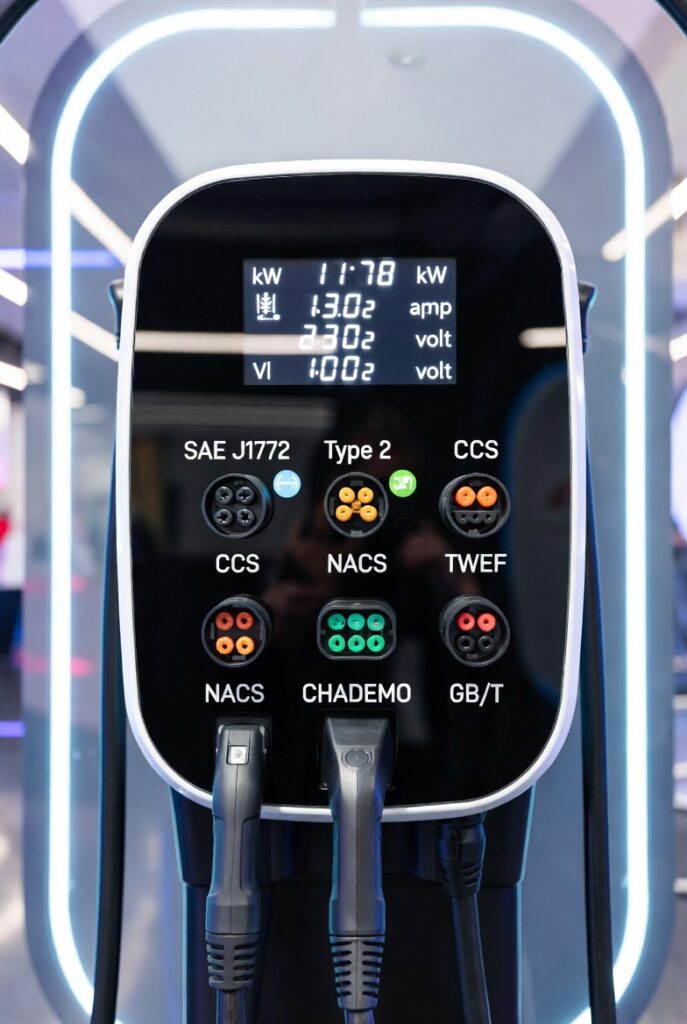
But standardisation is not the same as completion. For the next several years, American EV drivers will live in a multi-standard world. Millions of vehicles on the road have CCS ports. Tens of thousands of chargers have CCS cables. And the adapters that bridge the two standards will be essential equipment for years to come.
This is what SAE J3400 standardisation actually means for US drivers, beyond the press releases and the political rhetoric.
What SAE J3400 Actually Is
SAE J3400 is the formal engineering standard for the connector that Tesla developed and opened to the industry in November 2022. The standard was developed through SAE International’s consensus process, with input from automakers, charging equipment manufacturers, utilities, and research institutions.
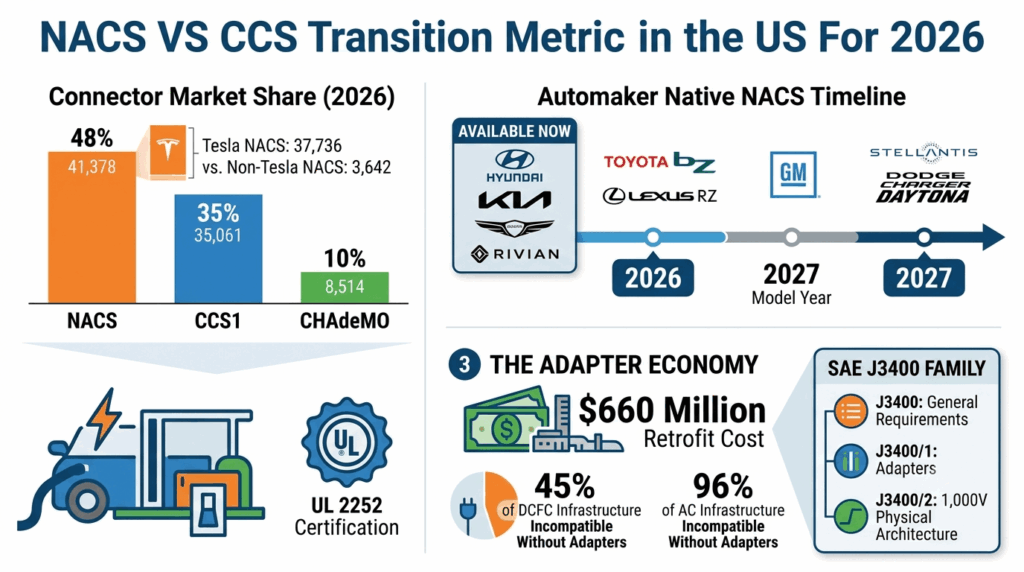
The J3400 family of documents is more detailed than most drivers realise. SAE J3400 defines the general requirements for the NACS connector, including AC and DC power transfer rates, interoperability, security, and communication protocols. SAE J3400/1 specifies the physical, electrical, and performance requirements for adapters that connect CCS chargers to NACS vehicles. SAE J3400/2, published in 2025, standardises the physical architecture of the 1,000-volt-capable connector and charge port, including 2D mechanical drawings and 3D models for manufacturers.
The 1,000-volt capability is the most important technical development. The original NACS connector was limited to 500 volts. J3400/2 raises that ceiling to 1,000 volts, enabling charging power of up to 1 megawatt in theory. Current deployed chargers operate at 350 to 500 kilowatts, but the standard is designed to support the higher voltages and currents that next-generation vehicles will require.
The physical connector looks almost identical to the original Tesla plug. The difference is the spacing between the positive and negative terminals, which was increased slightly to provide the creepage and clearance necessary for higher voltages. Cars built to the 500-volt standard still work with the 1,000-volt plug, just at lower power.
The Numbers: NACS Leads, but CCS Is Not Gone
The market share data tells a story of rapid adoption and stubborn persistence.
As of June 1, 2026, the United States had over 73,900 publicly accessible DC fast-charging ports. The Alternative Fuels Data Center listed 41,378 NACS connectors, 35,061 CCS1 connectors, and 8,514 CHAdeMO connectors. NACS held 48% of the market, CCS1 held 35%, and CHAdeMO was fading.
The NACS total is dominated by Tesla. Of the 41,378 NACS connectors, 37,736 were Tesla Superchargers and 3,642 were non-Tesla NACS chargers. But the non-Tesla share is growing. In May 2026, non-Tesla NACS deployment exceeded 800 new connectors, a record, and the total non-Tesla NACS deployment exceeded Tesla’s own deployment for the month.
CCS is not standing still. In the first five months of 2026, CCS1 infrastructure expanded by 3,695 connectors, compared with 3,911 for NACS. The gap between the two standards narrowed from roughly 8,000 more NACS connectors in January to about 6,300 by December 2025, and the two are now growing at similar rates. CCS1 remains a substantial portion of the public charging network, and it will remain so for years.
The Adapter Economy: Why Adapters Are Not a Stopgap
The single most important practical reality for US EV drivers is that adapters are not a temporary inconvenience. They are a strategic necessity for at least the next five years.
A complete transition to NACS is unlikely before 2031. Reviewing automaker announcements, vehicle production timelines, and software access rollouts, the industry consensus is that the multi-standard landscape will persist through the end of the decade. During that period, millions of vehicles with native NACS ports will still need access to existing CCS and J1772 infrastructure. Without adapters, approximately 45% of public DC fast charging and 96% of public AC charging infrastructure would be incompatible with many post-2026 EVs.
Retrofitting the existing infrastructure to eliminate the mismatch is economically impractical. Estimates place the cost of replacing CCS and J1772 connectors nationwide at more than $660 million, with California alone accounting for nearly $190 million. Those figures do not include permitting delays, downtime, or the environmental impact of prematurely retiring functional equipment.
This is why certified adapters matter. UL 2252 certification ensures that adapters are engineered to manage thermal loads, communication protocols, and mechanical tolerances. Uncertified adapters can damage charging stations, fail to initiate sessions, or create safety hazards. The California Air Resources Board has indicated that CCS-to-NACS adapter inclusion should be a prerequisite for new NACS-equipped vehicle models sold in the state, a stance likely to influence other regulated markets.
For drivers, the practical implication is simple: if you buy a NACS-equipped vehicle before 2031, you should budget for a certified CCS-to-NACS adapter. If you own a CCS-equipped vehicle, you should budget for a certified NACS-to-CCS adapter. Neither is optional if you want full access to the public charging network.
The Automaker Timeline: Who Has Native Ports and Who Does Not
The transition to native NACS ports is progressing, but not uniformly.
By mid-2026, approximately one in five non-Tesla EVs sold included native NACS inlets. Hyundai, Kia, Genesis, and Rivian were among the early adopters. Toyota began equipping its 2026 bZ and 2026 Lexus RZ with factory NACS inlets, while providing adapters for earlier models. General Motors announced that its 2027 model year EVs would come standard with NACS ports, though most 2026 models still use CCS1 and require adapters.
Stellantis was the last major automaker to commit to NACS. It announced adoption in November 2025 and began granting Supercharger access to Jeep, Dodge, and other Stellantis EVs in March 2026. But none of those vehicles have native NACS ports yet. The first Stellantis EV with a native NACS port is the 2027 Dodge Charger Daytona. Until then, owners need an adapter, which Stellantis sells through its Free2Move brand for around $386.
The pattern is clear. Native NACS ports are arriving, but they are arriving gradually. The 2026 model year is a transitional year, with a mix of native NACS and CCS vehicles. The 2027 model year will see more native NACS adoption, particularly from GM and Stellantis. By the end of the decade, native NACS will be the default. But for now, drivers need to check the port on the specific vehicle they are buying, not assume that the standard has been implemented uniformly.
The Policy Dimension: NEVI and the Dual-Standard Requirement
The federal government’s role in the NACS transition has been more complicated than a simple endorsement.
The National Electric Vehicle Infrastructure program originally required CCS connectors as a condition of federal funding. That requirement has been relaxed. Updated guidance allows NEVI-funded stations to include NACS connectors alongside CCS, and some states have gone further. Texas, for example, mandates that publicly funded charging stations must offer both CCS and NACS connectors. Minnesota requires at least four NACS and four CCS1 interfaces at funded stations, each capable of delivering at least 150 kW simultaneously.
The practical result is that NEVI-funded stations are becoming dual-standard by design. That is good for drivers, because it means federal money is building infrastructure that can serve both the existing CCS fleet and the growing NACS fleet. It is also good for the long-term transition, because it avoids the stranded-asset problem that would arise if federal funding built CCS-only stations that NACS vehicles could not use without adapters.
But the policy landscape is not uniform. Some states have moved faster than others. Some charging networks have been more aggressive in deploying NACS. The result is a patchwork, not a national standard, and drivers need to plan accordingly.
What This Means for Drivers
The standardisation of NACS as SAE J3400 is a genuine milestone. It ends the connector war, gives manufacturers a clear target, and creates the conditions for a simpler charging experience in the long run. But the long run is not here yet.
For drivers buying a new EV in 2026, the practical advice is straightforward. Check the charging port on the specific vehicle. If it is CCS, budget for a NACS adapter. If it is NACS, budget for a CCS adapter. Either way, you will need both to access the full public charging network for at least the next five years.
For drivers who already own a CCS vehicle, the advice is similar. A certified NACS adapter is not a temporary accessory. It is essential equipment for accessing Tesla’s Supercharger network and the growing number of non-Tesla NACS chargers. The adapter market has matured, with UL 2252 certified products available from multiple manufacturers.
For drivers who are waiting for the transition to be complete before buying an EV, the advice is to stop waiting. The transition will not be complete until 2031 at the earliest. The vehicles available today are better, cheaper, and more capable than the vehicles available five years ago. The charging network is larger and more reliable. The adapter inconvenience is real but manageable. Waiting for perfection is a recipe for missing the benefits of electric driving.
The connector war is over. NACS won. But the transition to a NACS-only world is a decade-long process, and drivers who understand that will be better equipped to navigate it than drivers who expect the standardisation to deliver immediate simplicity.
The honest assessment is that SAE J3400 is a success of standardisation, not a completion of infrastructure. The standard is clear. The vehicles are coming. The chargers are being built. But the adapters, the dual-standard stations, and the multi-standard reality will be part of American EV driving for years to come.