On June 11, 2026, Stellantis and Factorial Inc. announced that FEST solid-state battery cells had been integrated into a Dodge Charger Daytona development vehicle and that a road-testing programme had begun. The announcement was framed as the first automotive integration of solid-state technology in North America. It was accompanied by a press release, a video, and a wave of media coverage.
Three days earlier, Factorial had listed on the Nasdaq.
That timing is not incidental. It is relevant context for reading the pace and sequencing of announcements from a newly public company that needs to demonstrate commercial momentum. The road test is real. The technology is real. But the announcement serves two purposes: a technical milestone and an investor relations event.
This is the Stellantis-Factorial solid-state road test: what it proves and what it doesn’t.
What the Road Test Actually Proves
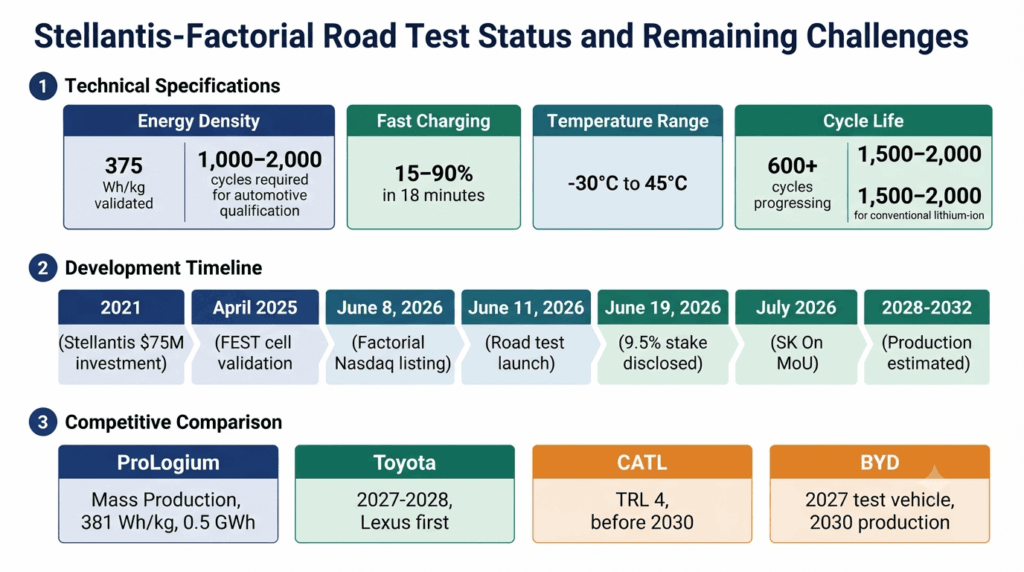
The significance of the milestone is not the performance figures. Those were validated at cell level in April 2025 and were already public. The 77 Ah FEST cells demonstrated 375 Wh/kg energy density, charging from 15% to 90% in 18 minutes, and operation from minus 30°C to 45°C. They completed more than 600 cycles progressing toward automotive qualification. Those numbers were published over a year before the road test began.
What the road test proves is integration. Moving a cell from a laboratory bench into a vehicle is where most solid-state battery programmes have failed. The automotive industry is littered with solid-state announcements that performed well at cell level and then stalled during pack integration. The Dodge Charger Daytona development vehicle represents the first time FEST cells have had to perform within the thermal management, control systems, and structural constraints of an actual Stellantis platform.
The integration required a patented new mechanical architecture designed by Stellantis to accommodate solid-state cells within the existing battery pack format. Engineers also adapted control systems and pack design to meet automotive safety and durability requirements. That the integration required a proprietary mechanical architecture underlines how non-trivial the transition from bench to vehicle genuinely is.
The choice of platform is significant. The Dodge Charger Daytona is built on Stellantis’s STLA Large architecture, the same platform underpinning the Jeep Wagoneer S and Alfa Romeo Stelvio EV. Successful road testing would validate solid-state integration on a platform already committed to significant production volume. The programme is connected to real commercial stakes rather than being a standalone technology demonstrator.
Ned Curic, Stellantis Chief Engineering and Technology Officer, framed the achievement in practical terms: “Battery development is a balancing act. It’s not enough to optimize a single metric. We need a system that delivers real benefits in a real vehicle. This milestone shows we are bringing solid-state batteries closer to our customers with the potential for longer range, faster charging and lower costs”.
The road-testing programme will tune and further verify pack performance and reliability under charging and driving conditions, in addition to vehicle safety. This is the phase where real-world variables enter the equation: vibration, temperature cycling, repeated fast charging, and the accumulated wear of daily driving.
What the Road Test Does Not Prove
The road test does not prove that FEST cells are ready for production vehicles. It proves they can be integrated and driven. It does not prove they can be manufactured at scale, at cost, or with the durability that automotive qualification requires.
The most significant limitation is cycle life. FEST cells have demonstrated more than 600 cycles progressing toward automotive qualification. Automotive qualification typically requires 1,000 to 2,000 cycles at 80% capacity retention, representing 150,000 to 300,000 miles of vehicle life. Six hundred cycles is meaningful progress. It is not automotive grade.
Industry analysts have been direct about this gap. Reporting on the Stellantis-Factorial collaboration in late 2025 noted that the solid-state cells were expected to have a lifespan of around 600 charge cycles, while conventional liquid-electrolyte lithium-ion batteries achieve at least 1,500 to 2,000 cycles. The cycle life deficit is the single most important technical hurdle remaining.
The road test also does not prove manufacturing scale. Stellantis and Factorial have not announced a production facility, a manufacturing partner, or a volume target for FEST cells. The development vehicle uses hand-built or low-volume cells. Scaling to hundreds of thousands of vehicles requires manufacturing infrastructure that does not yet exist.
This is where Factorial’s partnership with SK On becomes relevant. In July 2026, Factorial signed a memorandum of understanding with SK On to evaluate the production of FEST solid-state batteries using SK On’s existing lithium-ion manufacturing infrastructure. SK On operates more than 200 GWh of annual battery production capacity worldwide, including approximately 100 GWh in the United States.
The focus of the collaboration is to assess whether SK On’s existing lithium-ion battery facilities and pilot capabilities could support future production of Factorial’s FEST solid-state cells. This is an evaluation, not a production commitment. Factorial’s CEO, Siyu Huang, has emphasised that FEST’s compatibility with lithium-ion manufacturing processes is a critical enabler: “FEST’s strong compatibility with lithium-ion manufacturing processes gives us a critical path to scale this technology”.
That compatibility claim will be tested by the SK On evaluation. If FEST cells can be manufactured on existing lithium-ion lines with minimal modification, the capital investment required to scale production is dramatically lower than building new factories. If they cannot, the path to mass production becomes longer and more expensive.
The Cycle Life Problem in Context
The cycle life gap is not unique to FEST. It is a challenge that affects the entire solid-state battery sector.
Solid-state batteries use lithium-metal anodes, which store approximately ten times more lithium per unit volume than graphite. That is the pathway to higher energy density. But lithium-metal anodes are also more reactive and more prone to degradation than graphite. The solid-solid interface between the electrolyte and the electrodes is difficult to maintain as the electrodes expand and contract during cycling. Contact can be lost, increasing resistance and accelerating capacity fade.
CATL chairman Robin Zeng placed all-solid-state chemistry at level four on the nine-point Technology Readiness Level scale, indicating that the architecture remains restricted to laboratory validation and prototype engineering phases. He identified the manufacturing bottleneck as the solid-solid interface layer, where engineers use warm isostatic pressing at 6,000 atmospheres to bind components, but materials with different compaction densities face structural misalignments under high pressure.
The industry’s response to the cycle life challenge has been varied. Some companies are pursuing hybrid architectures that combine solid and liquid electrolytes to improve interface stability. Factorial’s FEST technology uses a quasi-solid electrolyte, which places it in the hybrid solid-liquid category rather than true all-solid-state under China’s new GB/T 43568-2026 classification standard. Other companies are pursuing sulfide or oxide chemistries with different trade-offs.
Toyota, which has been developing solid-state batteries for over a decade, has delayed its mass production timeline to 2027 or 2028. The company chose the sulfide route, which offers the highest theoretical performance but also the greatest manufacturing challenges. Toyota’s first solid-state vehicles will be high-end Lexus models, where higher initial costs can be absorbed.
BYD is planning small-batch fleet trials of roughly 1,000 vehicles around 2027, focusing on high-end Yangwang and Denza models. Large-scale commercial production is targeted for around 2030.
ProLogium, which began mass production of its Gen 3.5 all-solid-state battery in September 2026, has verified 381 Wh/kg energy density and all-solid-state classification under the GB/T standard. But its Taoyuan line runs at 0.5 GWh per year, approximately 6,000 battery packs of 80 kWh each. Small against conventional battery plants, but a functioning production line rather than a pilot project.
The honest assessment is that FEST is in the same developmental stage as its competitors. The technology has been validated at cell level. It has been integrated into a vehicle. It is now being road-tested. The remaining questions are cycle life, cost, and manufacturing scale. None of those questions will be answered by the road test alone.
The Strategic Context: Stellantis’s 9.5% Stake
Eight days after the road-testing announcement, on June 19, 2026, a Securities and Exchange Commission filing revealed that Stellantis holds a 9.5% stake in Factorial Energy.
The stake, equal to approximately 8.67 million shares held through Stellantis Europe and Stellantis Ventures, stems from investments made in recent years and converted into an equity holding. Stellantis may buy further shares in the future. Based on current valuations, the stake is worth approximately $126 million.
The deepening of the equity stake is a signal of Stellantis’s commitment to solid-state technology. This is not a passive investment or a hedging bet. It is a strategic move in the race for solid-state batteries, which promise longer range, faster charging, improved safety, and lower costs than traditional lithium-ion.
Stellantis’s initial investment in Factorial was $75 million in 2021. The conversion of that investment into a 9.5% equity stake, combined with the road-testing programme and the SK On manufacturing evaluation, represents a multi-year strategic bet on FEST technology. Factorial is also backed by Mercedes-Benz, Hyundai, and Kia, giving it access to multiple automotive partners and potential customers.
What Happens Next
The road-testing programme will continue through 2026 and into 2027. The data gathered will inform the next phase of development. Stellantis has stated that this milestone marks the first vehicle in a previously announced multi-stage development vehicle programme. Additional vehicles are expected.
The critical milestones ahead are:
Cycle life validation. FEST cells need to demonstrate 1,000 to 2,000 cycles at 80% capacity retention to meet automotive qualification standards. The road test will provide real-world cycle life data, but the full validation will take years.
Manufacturing feasibility. The SK On evaluation will determine whether FEST cells can be produced on existing lithium-ion lines at competitive cost. If the answer is yes, the path to scale is shorter. If the answer is no, a dedicated manufacturing facility will be required.
Cost reduction. Current solid-state cell costs are significantly higher than production lithium-ion. The cost curve will not bend until production volumes justify capital investment in specialised manufacturing equipment.
Production timeline. Stellantis has not announced a production date for solid-state vehicles. Industry estimates suggest 2028 to 2032 for meaningful production volumes. The road test is an early step in a long journey.
The honest assessment is that the Stellantis-Factorial road test is a genuine milestone. It moves solid-state batteries from the laboratory to the road. It validates integration on a production platform. It provides real-world data that no laboratory test can replicate.
But it does not change the fundamental timeline. Solid-state batteries remain years from mass production. The cycle life gap remains significant. The manufacturing scale does not yet exist. And the cost competitiveness of solid-state cells against lithium-ion has not been demonstrated.
What the road test proves is that the technology works. What it does not prove is that the technology is ready. Those are two very different things. The solid-state battery era is coming. It is not here yet.