On September 2, 2026, ProLogium Technology announced that its Gen 3.5 Lithium Ceramic Battery had entered mass production at its Giga-level manufacturing facility in Taoyuan, Taiwan. The announcement was not accompanied by the usual caveats that have characterised solid-state battery news for the past decade. There was no “pilot line,” no “limited production,” no “targeting mass production in the coming years.” The cells are being manufactured. They are being shipped. And they have been independently verified.
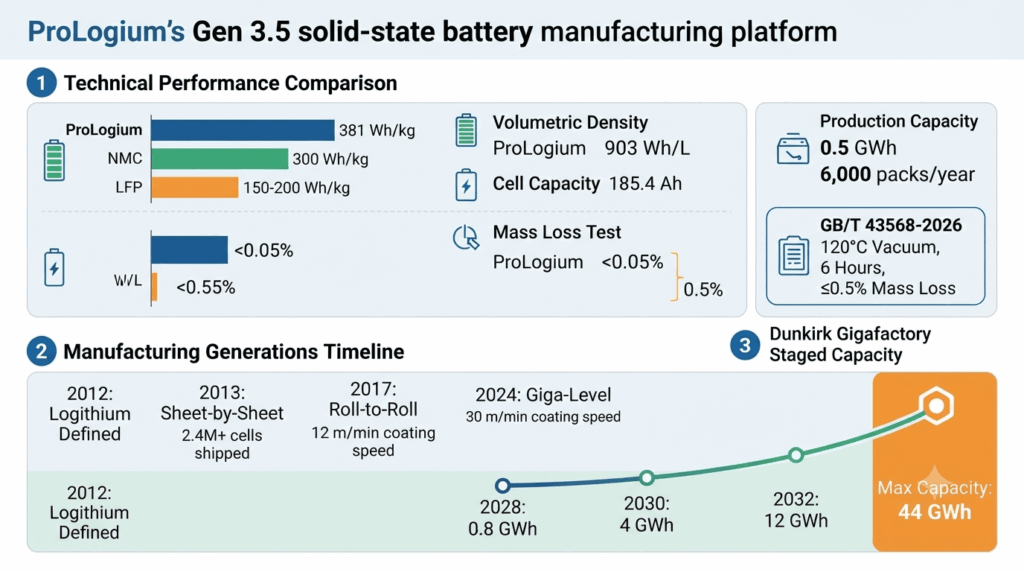
The numbers behind the announcement are equally unambiguous. A third-party TÜV test report confirmed that the 185.4 Ah large-format cell achieved 381 Wh/kg gravimetric energy density and 903 Wh/L volumetric energy density. Separately, UL Solutions tested the cell under China’s GB/T 43568-2026 methodology. After six hours under vacuum at 120°C, the cell recorded weight loss of less than 0.05%, well below the 0.5% maximum threshold for all-solid-state classification.
This is ProLogium’s Gen 3.5 solid-state battery: inside the first mass production line.
The Specifications That Matter
The energy density figures place the Gen 3.5 cell roughly 30% above the nickel-manganese-cobalt cells that power most electric cars today, which typically top out at around 300 Wh/kg at the cell level. Lithium iron phosphate cells, which are increasingly finding their way into mainstream EVs, deliver between 150 and 200 Wh/kg.
The gravimetric energy density of 381 Wh/kg means that for a given battery weight, the Gen 3.5 cell stores substantially more energy than conventional lithium-ion. The volumetric energy density of 903 Wh/L means the same is true for battery volume. For vehicle designers, this translates directly into either longer range for the same battery size or the same range with a lighter, smaller battery pack.
The all-solid-state classification is equally significant. China’s GB/T 43568-2026 standard, which came into effect in July 2026, was introduced specifically to differentiate true all-solid-state cells from those that still contain liquid electrolyte. The test is simple and quantitative: heat the cell under vacuum at 120°C for six hours, and measure the mass loss. If more than 0.5% of the cell’s mass evaporates, it contains too much liquid to be classified as all-solid-state. ProLogium’s cell lost less than 0.05%.
The standard has also been submitted to the International Electrotechnical Commission as a reference for international standardisation, suggesting that the methodology could become the global benchmark for solid-state classification.
The Logithium Architecture: 13 Years in the Making
The Gen 3.5 cell is not a laboratory breakthrough that has been hastily scaled. It is the product of a manufacturing platform that ProLogium has been developing since 2012, when the company completed the core design and patent groundwork for its Logithium Cell Architecture.
The architecture combines a ceramic separator with a proprietary edge-frame structure, creating an additional separator around the electrode perimeter to help isolate potential burrs while providing sealing and insulation. The ceramic separator architecture has remained the foundation of ProLogium’s platform as electrolyte chemistry and active materials have evolved through four generations of battery technology and three generations of manufacturing technology.
The manufacturing journey has been methodical rather than dramatic. In 2013, ProLogium began commercial production on its first-generation Sheet-by-Sheet line, initially targeting higher-margin niche markets including consumer electronics, wearables, explosion-resistant applications, medical devices, and semiconductor equipment. That strategy allowed the company to fund and refine its early manufacturing ramp-up through commercial orders, accumulating experience in process control, yield, quality, and customer delivery.
In 2017, ProLogium introduced its second-generation Roll-to-Roll line, moving into continuous manufacturing with higher automation, throughput, and consistency. The third-generation Giga-level platform entered operation in 2024, scaling more than a decade of manufacturing experience into large-format cell production and providing the production data needed to further improve yield, consistency, and equipment stability.
Rather than making a single jump from pilot line to gigawatt-hour scale, ProLogium has progressively expanded its manufacturing capability through commercial production, with each generation building on the process experience and quality data of the previous one. By the time the Gen 3.5 cell entered mass production in September 2026, ProLogium had already shipped more than 2.4 million cells on its LCB platform, building a manufacturing track record spanning consumer, specialty, and automotive applications.
Inside the Manufacturing Process
The manufacturing process behind the Gen 3.5 cell is where ProLogium’s approach diverges most sharply from conventional solid-state battery programmes.
The core innovation is a roll-to-roll ceramic separator coating process. ProLogium’s exclusive coating process applies the ceramic separator directly to the anode, eliminating the need for a separator film placement step. The GWh-level production line, launched in 2024, achieves ceramic separator coating speeds of 30 metres per minute, enabling dual-layer coating to simultaneously apply the electrode slurry and the ceramic separator.
The process has been progressively refined across generations. ProLogium developed coating-based ceramic separator fabrication in 2013 and established a pilot roll-to-roll line in 2017. The GWh-level production line in 2024 marked the transition to commercial-scale manufacturing.
The electrode assembly process is equally distinctive. ProLogium’s multi-layer coating allows for roll-to-roll production, and the electrode assembly process efficiently bonds 12 inlays in a single hot pressing, reducing interface resistance at high temperatures and improving electrical performance. Conventional battery manufacturing, constrained by material limitations and the inability to withstand high temperatures, can only bond one layer at a time.
The dehydration process, which removes moisture from the electrode materials, uses a technique ProLogium calls “thermal flow dehydration” rather than the traditional approach of repeatedly vacuum baking the entire electrode roll for eight hours. ProLogium’s process completes the dehydration in approximately eight minutes.
The Production Line: 0.5 GWh and 6,000 Packs
The Taoyuan line runs at an initial capacity of 0.5 GWh per year. In practical terms, that is approximately 6,000 battery packs of 80 kWh each. Against a conventional lithium-ion cell plant producing hundreds of gigawatt-hours annually, that figure is modest. LG Energy Solution’s North America operations, by comparison, operate at a scale measured in tens of gigawatt-hours.
But the significance of the Taoyuan line is not its current output. It is the proof of concept. The line demonstrates that all-solid-state cells can be manufactured at commercial scale using automated production processes. It provides the production data needed to improve yield, consistency, and equipment stability. And it establishes the manufacturing platform that will be replicated at larger scale in Taiwan, France, and North America.
ProLogium’s manufacturing strategy is built around three regions. Taiwan serves as the technology development and manufacturing validation base. France will provide scaled production for European customers. North America will provide localised supply and manufacturing capacity. In the first phase of its North American plan, the company will evaluate partnerships under which Inlays, the single-layer unit that forms an LCB cell, would be produced at scale in France and shipped to North America, where partners would stack them into pouch cells and handle module and pack integration closer to end customers.
The Dunkirk Gigafactory: Scaling to 44 GWh
The Taiwan line is the beginning. The Dunkirk gigafactory in northern France is where ProLogium intends to scale.
ProLogium broke ground on the Dunkirk facility on February 10, 2026, marking the transition from planning to execution for its first overseas production base. The company has signed a subsidy package worth up to approximately €1.375 billion from the French government, with the total investment estimated at €5.2 billion. French President Emmanuel Macron described the investment as “a source of pride for France” that would create jobs and support the low-carbon economic transition.
The staged capacity build-out is ambitious. The initial phase targets 0.8 GWh in 2028. That rises to 4 GWh by 2030 and 12 GWh by 2032. The site has a maximum planned capacity of 44 GWh.
The timeline deserves honest scrutiny. At the groundbreaking ceremony in February 2026, the staged figures were 0.8 GWh in 2028, 4 GWh by 2030, and 12 GWh by 2032. ProLogium now describes the plant as starting at 4 GWh and topping out at 44. The two accounts are not obviously reconcilable. The company has also slowed the French expansion once already, in 2024. These discrepancies suggest that the Dunkirk timeline should be treated as an aspiration rather than a commitment.
The European context adds urgency. Northvolt, Europe’s most heavily funded homegrown battery champion, went bankrupt in 2024 and its assets were acquired by America’s Lyten. The largest new cell project in France is now Taiwanese-owned, French-subsidised, nuclear-powered, and certified against a Chinese standard. Whether the chemistry arrives at European scale in time is the question that has followed Northvolt’s collapse.
The Customer and Partnership Base
ProLogium’s customers span consumer electronics, specialty applications, and automotive.
The company’s LCB cells are supplied to a well-known US automotive audio-system company and installed in vehicles from a Japanese automaker ranked among the top three in North American sales. The audio-system customer has placed more than 175 repeat orders, with cumulative deliveries exceeding 900,000 cells. ProLogium has also received orders from the unmanned systems market, for applications in which payload, endurance, and recharge time matter.
ProLogium obtained IATF 16949 automotive quality-management certification for its production line in 2022 and has continued to pass annual surveillance audits.
The most significant automotive partnership is with Mercedes-Benz. The two companies have been collaborating since 2016, progressing from early hybrid-solid-state Gen 3 development through joint testing to potential future vehicle platform planning. In September 2026, Mercedes-Benz and ProLogium entered into a joint testing agreement covering ProLogium’s latest Gen 4 Superfluidized All Inorganic Solid State Battery Cell Technology. Mercedes-Benz has secured priority access to the fourth-generation cells and will begin verifying the technology for future electric vehicle platforms.
The Gen 4 technology replaces the Gen 3.5 electrolyte with a fully inorganic superfluidised electrolyte system while keeping the same Logithium architecture and manufacturing process. ProLogium estimates that approximately 10% of the existing Giga-level line and related equipment would need modification to build Gen 4 cells. The generation adds an Active Safety Mechanism designed to prevent thermal runaway by stabilising electrode active materials at high temperature, and is expected to improve low-temperature performance and reduce material and manufacturing costs.
The Competitive Landscape
ProLogium has established a lead in solid-state battery manufacturing that its larger competitors have not yet matched.
CATL chairman Robin Zeng has placed all-solid-state chemistry at level four on the nine-point Technology Readiness Level scale and stated that large-scale commercialisation will not be achievable before 2030. CATL has confirmed plans to start limited production of solid-state batteries in 2027, but has suggested that moving to much larger volumes would be difficult.
Toyota has delayed its mass production timeline to 2027 or 2028, with the first vehicles to receive all-solid-state batteries being high-end Lexus models. The company chose the sulfide route, which offers the highest theoretical performance but also the greatest manufacturing challenges.
BYD is expected to put a solid-state battery into a vehicle in 2027, possibly the Yangwang flagship sedan. The company is planning small-batch fleet trials of roughly 1,000 vehicles, focusing on high-end models where higher initial material costs can be absorbed. Large-scale commercial production is targeted for around 2030.
The distinction between ProLogium and these competitors is not the ambition of their technology roadmaps. It is the stage of manufacturing. CATL, Toyota, and BYD are developing solid-state batteries. ProLogium is manufacturing them.
What the Gen 3.5 Launch Actually Proves
The Gen 3.5 mass production milestone proves three things.
First, all-solid-state batteries can be manufactured at commercial scale. The Taoyuan line is small by conventional battery standards, but it is a functioning production line, not a pilot project. The cells are being manufactured, tested, and shipped.
Second, the performance claims are verifiable. TÜV and UL Solutions are independent testing organisations with global reputations. Their verification of 381 Wh/kg energy density and all-solid-state classification under GB/T 43568-2026 is not a company press release. It is third-party validation.
Third, the manufacturing platform is replicable. The Logithium architecture has remained consistent across four generations of battery technology and three generations of manufacturing technology. The Dunkirk gigafactory is designed to replicate the Taoyuan platform at larger scale.
What the milestone does not prove is equally important. It does not prove that ProLogium can manufacture solid-state batteries at a cost that competes with conventional lithium-ion. It does not prove that the Dunkirk timeline will be met. It does not prove that automotive customers will integrate these cells into production vehicles at volume. And it does not prove that solid-state batteries will displace lithium-ion in the mass market.
What it does prove is that solid-state batteries have left the laboratory. The first mass production line is running. The cells are shipping. The era of solid-state battery promises is over. The era of solid-state battery products has begun.