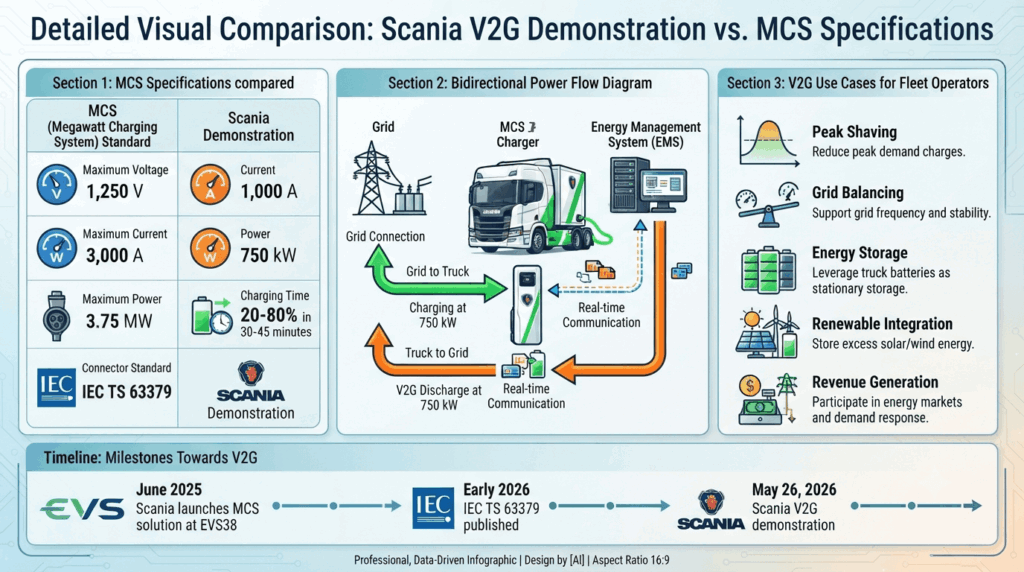
On May 26, 2026, Scania successfully demonstrated a vehicle-to-grid application for heavy-duty electric trucks using the Megawatt Charging System for the first time. The system achieved charging and discharging power outputs of up to 1,000 amps and 750 kilowatts.
This was not a laboratory test. It was not a simulation. It was a real truck, connected to a real charger, pushing real power back into the grid. And it represents one of the first practical demonstrations of bidirectional energy transfer via MCS in heavy-duty transport anywhere in the world.
Scania’s demonstration matters because it addresses a question that has lingered over the electrification of heavy transport: what happens when trucks are parked? For a passenger car, the answer is simple. It sits idle. For a commercial truck fleet, the answer is more complicated. A truck that is not moving is not earning freight revenue. The business case for electric trucks depends on maximising utilisation and minimising downtime.
Scania’s answer is that a parked truck can become an energy asset. It can store excess renewable generation during periods of low demand. It can feed power back to the grid during peak periods. It can participate in balancing markets. And it can do all of this while sitting at a depot, waiting for its next assignment.
This is megawatt charging for trucks, and Scania’s 750 kW V2G demonstration explains how it works.
The Technology: MCS and Bidirectional Power Transfer
The Megawatt Charging System is the new industry standard for fast charging of heavy-duty commercial vehicles. It was developed specifically for electric trucks and buses and is designed to enable charging capacities of several megawatts. The standard provides for power outputs of up to 3.75 MW, which is significantly higher than the current CCS standard.
The MCS connector operates at voltages up to 1,250 volts and currents up to 3,000 amperes. At full specification, a typical truck battery can be charged from 20% to 80% in approximately 30 to 45 minutes, aligning with the legally mandated driver rest breaks that apply to long-haul operations.
Scania’s demonstration used the MCS standard to achieve bidirectional power transfer. The truck drew power from the grid at up to 750 kW and fed power back at the same rate. The 1,000-ampere current matches the maximum output Scania’s first-generation MCS system is designed to deliver. The batteries that Scania uses in its electric trucks, which are shared with MAN, support a maximum fast-charging capacity of 375 kW via CCS and 750 kW via MCS.
The charging system achieved what Scania describes as secure real-time communication between the truck, the charger, and energy management systems. This is the fundamental requirement for heavy electric vehicles to become active, controllable components of the energy system. The communication layer allows charging and discharging processes to be dynamically controlled, aligned with transport requirements and current grid conditions.
The IEC TS 63379 standard, which defines the interface configurations for megawatt-level conductive charging, was published in early 2026. It establishes operating voltages of up to 1,250 volts and currents of up to 3,000 amperes. The physical connector interface has now been standardised. Software and communication aspects are still being completed, with CharIN expected to need the remainder of 2026 to finish that work.
What V2G Actually Does for a Truck Fleet
The practical value of V2G for a truck fleet is not the technology itself. It is the economics.
Bidirectional charging enables electric truck fleets to support the power grid by providing flexibility services such as peak shaving, grid balancing, and energy storage. Using bidirectional power transfer within depot operations can also improve the utilisation of local renewable energy generation such as solar power, while allowing more flexible grid connections and energy management.
For fleet operators, V2G creates the potential for new revenue streams. A truck parked at a depot can participate in flexibility and balancing markets, earning money while it sits idle. The same vehicle that represents a capital cost and a charging expense can become an income-generating asset during the periods when it would otherwise be unproductive.
Scania highlights that the combination of high-power charging and integration into energy management systems could enhance the economic viability of battery-electric trucks. The manufacturer sees the initial use case for V2G technology primarily in depots, specifically where vehicles are parked for longer periods and charging can be coordinated with energy demand and grid conditions.
Tobias Ejderhamn, Global Manager for Transformation and New Business at Scania, framed the shift in straightforward terms: “Electric trucks will not only consume electricity, they can also become an active resource in the energy system. This shift transforms the fleet operator’s role from solely providing transport services to also offering energy flexibility.”
Yorben Muller, Product Manager of Charging at TRATON, Scania’s parent company, added: “What makes this significant is not only the bidirectional energy flow itself, but the ability to combine megawatt charging with intelligent energy management. To our knowledge, this is one of the world’s first demonstrations of vehicle-to-grid functionality using MCS for heavy commercial vehicles.”
The Context: Why MCS Matters More Than the V2G Headline
The V2G demonstration is the headline. The MCS standard is the underlying story.
A few weeks before Scania’s demonstration, project partners in Germany demonstrated bidirectional charging with a MAN truck, feeding 325 kW of power back into the grid. That trial involved a CCS charging process, not MCS. The distinction matters because MCS is the standard that will define heavy-duty charging infrastructure for the next decade.
The Megawatt Charging System has been under development within the CharIN organisation for roughly eight years. Industry stakeholders have been working to standardise megawatt charging to ensure that charging large commercial vehicles via the MCS plug works universally and under all conditions. The publication of IEC TS 63379 in early 2026 marked the first major milestone in that standardisation process.
Scania is convinced that MCS will play a key role in the breakthrough of electric long-haul transport and future energy services such as V2G. The company launched its MCS rapid charging solution at EVS38 in June 2025, announcing that its trucks would be able to use MCS starting in early 2026. The V2G demonstration is the first major validation of that commitment.
The stakes are high. Heavy-duty transport accounts for a significant share of global road freight emissions. Electrifying long-haul trucking requires charging infrastructure that can match the operational patterns of commercial fleets. Drivers are legally required to take rest breaks of 30 to 45 minutes. If a truck can charge to 80% or fully charge within that window, the operational penalty of electrification approaches zero. MCS makes that possible.
The Challenges: What the Demonstration Does Not Solve
The demonstration is a technical milestone. It is not a commercial deployment. Several challenges remain before V2G becomes a routine part of fleet operations.
The most significant challenge is grid connection. A depot that can simultaneously charge multiple trucks at 750 kW each requires a grid connection of several megawatts. Upgrading grid infrastructure is expensive and time-consuming. The ability to use bidirectional charging to reduce peak demand and participate in balancing markets may actually help reduce the grid connection requirement, but the initial infrastructure investment remains substantial.
The second challenge is market access. V2G revenue depends on participation in flexibility and balancing markets. These markets have different rules in different countries, and access for aggregated vehicle fleets is not universally available. The regulatory framework for V2G is still developing.
The third challenge is operational. A truck that is discharging to the grid is a truck that is not available for freight. Fleet operators must balance the revenue from V2G against the opportunity cost of vehicle availability. For depots with predictable schedules and sufficient vehicles, the calculation may favour V2G. For operations with tight margins and high utilisation, the calculus is different.
The fourth challenge is hardware cost. Bidirectional chargers are more expensive than unidirectional chargers. The incremental cost must be justified by the revenue generated through V2G participation. At current market prices, the payback period for bidirectional charging infrastructure is not yet well established.
Scania’s demonstration does not resolve any of these challenges. What it does is prove that the technology works. The economics will be determined by market development, regulatory evolution, and the operational patterns of individual fleet operators.
What Happens Next
Scania’s demonstration is part of a broader movement toward integrating heavy transport into the energy system. The company sees the initial use case for V2G in depot charging, where vehicles are parked for extended periods. Vehicles are often parked there for extended periods, allowing bidirectional energy flows to be purposefully coordinated with the site’s electricity demand and grid requirements.
The combination of high-power charging and smart energy management could become an additional building block for the economic viability of electric commercial vehicle fleets. As MCS infrastructure is deployed and the standardisation of communication protocols is completed, the technical foundation for V2G in heavy transport will be in place.
The next phase is commercial validation. Scania’s demonstration has proven that the technology works. The next phase is proving that the business model works. That will require real fleet operators, real grid connections, real market participation, and real revenue. Until that happens, V2G for trucks remains a promising technology in search of a proven business case.
The megawatt charging era for trucks has begun. The question is how quickly fleet operators can turn parked trucks into revenue-generating assets.