The global transition to electric vehicles has entered a phase of structural fragmentation. Three of the world’s largest automotive markets are now pursuing fundamentally different policy paths, and the consequences are reshaping the geography of electric mobility.
In the United States, the federal government has completed a comprehensive withdrawal from EV support. In Europe, regulators are recalibrating ambitious targets while maintaining regulatory pressure on manufacturers. In China, the state continues to drive electrification at a pace that has left the rest of the world behind.
The global EV policy divergence: US retreat, EU regulation, China dominance is not a temporary fluctuation. It is a strategic realignment that will define the competitive landscape for the remainder of the decade.
The United States: A Policy Withdrawal in Full
The US retreat from EV support is now comprehensive. The $7,500 federal clean vehicle credit expired on September 30, 2025. The Environmental Protection Agency has rescinded greenhouse gas emissions standards for light-duty vehicles. Fuel economy rules have been rewritten to require minimal electrification. California’s waiver to set its own stricter standards was revoked. Federal grants for clean manufacturing projects have been axed.
The market consequences were immediate. Battery electric vehicles made up a record 12% of US light-duty vehicle sales in September 2025, immediately before the credits expired. That figure fell to 6% in the second quarter of 2026, down from 7% a year earlier. BEV sales accounted for just 5.9% of the US new-car market in the first half of 2026, a figure that places the United States well behind China and Europe and even some emerging markets.
Hybrids filled the gap. Hybrid electric vehicles reached a record 16% of US light-duty vehicle sales in the second quarter of 2026, up from 14% a year earlier. Hybrids were not eligible for the federal tax credits that expired, and their sales have risen as BEV sales have declined.
The corporate response has been equally dramatic. Automakers have discontinued or delayed nearly 20 EV models since the tax credit expired. Honda cancelled the 0 Saloon. Several manufacturers have paused battery joint ventures and shifted their focus back to hybrid and internal combustion engine vehicles. The message from Detroit and its competitors is clear: without federal support, the business case for EVs in the US market is weaker than it was.
The exception is California. The state has launched its own $3,500 instant rebate for first-time EV buyers, funded by $135.5 million from the 2026-2027 budget. But California alone cannot reverse a national trend. The divergence between states with their own incentive programs and those without will define the US EV market for years to come.
The European Union: Regulation With Recalibration
Europe has not retreated from EV policy. It has recalibrated it.
The European Commission’s Automotive Package, presented in December 2025, replaced the existing 100% fleet-wide CO2 reduction target for cars and vans in 2035 with a 90% reduction target compared to 2021 levels. The remaining emissions would be offset through a credit system. The Commission also introduced new flexibilities for manufacturers to meet their specific emission reduction targets.
This was a significant concession to industry. Transport & Environment, the green campaign group, has warned that weakening the 2030 target would delay price parity between EVs and combustion engine vehicles by at least two years. But the Commission’s core regulatory pressure on manufacturers remains intact. The 2030 targets, which require a 55% reduction for passenger cars and 50% for light commercial vehicles, were maintained.
The European market responded to the original regulatory framework with strong growth. Electric car sales rose more than 30% in 2025, reaching 28% of total sales. That momentum has continued into 2026, with Europe reaching 26% BEV market share in July. The IEA projects that EV and plug-in hybrid sales will rise about 20% in 2026, accounting for one in three cars sold.
The EU is also adding industrial policy to its regulatory framework. The Industrial Accelerator Act’s local content requirement, effective from 2027, will require almost two-thirds of electric cars sold in the EU to have batteries produced in Europe. By 2030, this rises to at least five components, including cells, cathode active materials, and battery management systems. The policy is designed to ensure that the transition to electric mobility builds European manufacturing capacity rather than simply replacing imported oil with imported batteries.
China: The Dominant Force
China’s dominance of the global EV market has become more pronounced, not less.
In the first eight months of 2026, Chinese new energy passenger vehicles accounted for 62% of the global market. In July and August, that figure reached 65.3%. In the pure electric vehicle segment, China held 59% of the global market in 2026, rising to 63.6% in the third quarter. In the plug-in hybrid segment, China’s share reached 71%.
Chinese manufacturers delivered 60% of global electric car sales in 2025, while European and North American automakers each held around 15%. On the battery side, seven Chinese manufacturers now control 72.4% of global supply. China also accounted for more than 80% of global battery cell production.
The policy framework behind this dominance is deliberate. China has recalibrated its NEV purchase tax exemptions, halving them from January 2026 with a full phase-out by end-2027. But the reduction in purchase subsidies has been offset by continued support in other areas: acquisition tax reductions, local government incentives, charging infrastructure investment, and supply chain development. The transition from policy-driven adoption to market-driven adoption is well advanced.
China’s domestic market has reached a tipping point. Electric vehicles and plug-in hybrids accounted for more than 50% of total passenger car sales in 2025. The IEA’s Global EV Outlook 2026 notes that China and a few other emerging markets already support continued EV adoption through competitive economics alone, without relying on policy support. The transition in China has moved from policy-driven to market-driven.
The Comparison: Three Markets, Three Trajectories
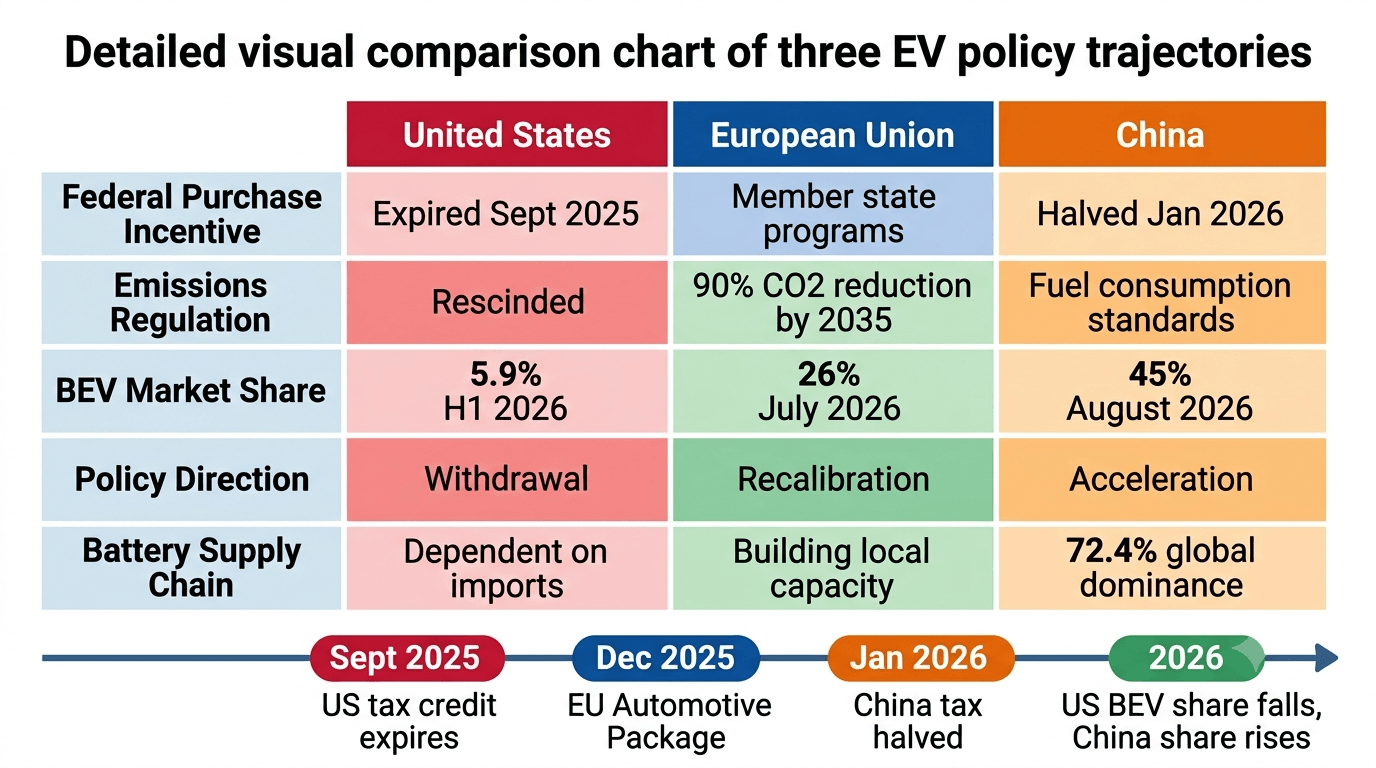
| Dimension | United States | European Union | China |
|---|---|---|---|
| Federal purchase incentive | Expired Sept 2025 | Member state programs | Halved Jan 2026, phasing out |
| Emissions regulation | Rescinded | 90% CO2 reduction by 2035 | Fuel consumption standards |
| BEV market share (H1 2026) | 5.9% | 26% (July) | 45% (August) |
| Policy direction | Withdrawal | Recalibration | Acceleration |
| Battery supply chain | Dependent on imports | Building local capacity | Dominant (72.4% global) |
| Domestic manufacturing | Retrenching | Local content requirements | Vertically integrated |
The IEA’s projections illustrate the divergence. In the Current Policies Scenario, the global EV fleet exceeds 450 million by 2035, more than five times the number at the end of 2025. But the share of that fleet located in China declines from 70% in 2025 to over 55% by 2035, as adoption accelerates in emerging markets. The growth is no longer concentrated in a single market. It is spreading.
The United States is not participating in that growth. The IEA notes that EV sales stall in regions with limited policy support or inadequate charging infrastructure. The US now falls into that category.
What the Divergence Means
The fragmentation of global EV policy has several implications.
For automakers: The US market is becoming a hybrid-first market. The European market remains an EV-first market with regulatory pressure and industrial policy. The Chinese market is a market where EVs are winning on economics. Manufacturers must now operate three fundamentally different product strategies in three regions.
For consumers: American buyers face a market where EV prices are higher and choices are narrower than they were a year ago. European buyers face a market where regulatory pressure is weaker but industrial policy may raise costs. Chinese buyers face a market where EVs are the default choice.
For the global supply chain: The EU’s local content requirements and the US withdrawal from EV manufacturing incentives are creating pressure for regionalised supply chains. China’s dominance of battery manufacturing is the baseline against which those regionalisation efforts will be measured.
For the energy transition: The US retreat will delay the country’s contribution to global emissions reduction. The IEA’s Stated Policies Scenario still sees the global EV fleet growing, but the pace is slower than it would be with US participation.
The global EV policy divergence is not a temporary condition. It reflects fundamental differences in how the world’s three largest automotive markets view the role of government in the transition to electric mobility. The United States has chosen to let the market decide. Europe has chosen to regulate and recalibrate. China has chosen to lead.
The consequences of those choices are now visible in the market share numbers. They will become more visible in the years ahead.