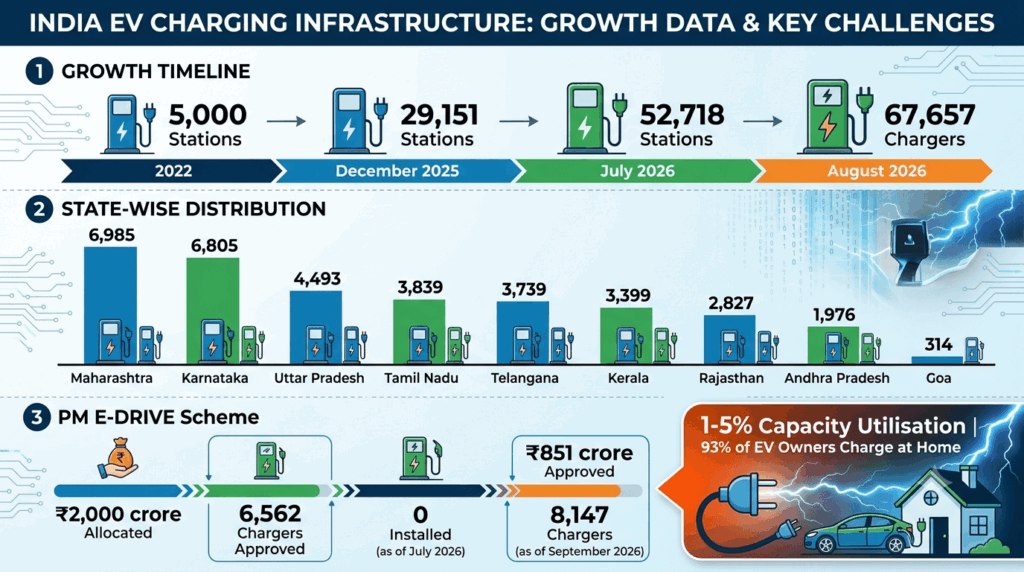
India’s electric vehicle charging infrastructure has reached a significant milestone. As of August 7, 2026, the country had installed 67,657 electric vehicle chargers across states and union territories, including 1,139 chargers associated with battery swapping stations. The public charging station count reached 29,151 as of December 2025, nearly six times the approximately 5,000 stations recorded in 2022.
The growth is genuine. The infrastructure gap is also genuine. India’s EV charging network expands to 67,657 chargers: what it means for adoption requires examining both the numbers on the board and the experience on the ground. And on the ground, the picture is more complicated than the headline figures suggest.
The Numbers: Six-Fold Growth in Four Years
The scale of the build-out is the first thing to understand. India’s public charging station count grew from around 5,000 in 2022 to 29,151 by December 2025, a nearly six-fold increase. By July 2026, that figure had reached 52,718 charging stations.
The charger count, a more granular measure than station count, stood at 67,657 as of August 7, 2026. This includes 1,139 chargers associated with battery swapping stations. Excluding battery swapping stations, 48,709 of 66,518 chargers, or about 73 percent, are rated below 30 kW.
More than 200 Charge Point Operators are now operating across India, alongside e-mobility service providers, charging aggregators, and franchise partners. Government support has been a key catalyst. The PM E-DRIVE scheme has been extended by two years to March 2028, with its overall outlay increased to ₹11,900 crore, including ₹2,000 crore earmarked for public EV charging infrastructure. Under the FAME-II scheme, 9,583 public charging stations were installed, supported by an allocation of ₹912.50 crore.
The growth drivers are clear. Rising EV adoption, with 2.3 million EVs registered in 2025, has created demand. Simplified licensing norms, with charging stations notified as an unlicensed activity, have reduced barriers to entry. Diversifying industry participation, from oil and gas majors to power utilities and automotive OEMs, has brought new capital into the sector. Fleet electrification, particularly among e-three-wheelers and e-buses, has created recurring, predictable charging demand.
The State-Level Distribution: Southern States Lead
The geographic distribution of charging infrastructure reveals significant disparities. The top 10 states account for nearly 78 percent of the total installed base.
Maharashtra leads with 6,985 charging stations as of July 29, 2026. Karnataka follows closely with 6,805 stations, accounting for nearly 13 percent of India’s total. Bengaluru, which has emerged as a major centre for electric vehicle manufacturers, startups, and mobility companies, is a significant contributor to Karnataka’s position.
Uttar Pradesh ranks third with 4,493 charging stations. Tamil Nadu has 3,839 stations, followed by Telangana at 3,739 and Kerala at 3,399. Rajasthan has 2,827 stations, while Andhra Pradesh has 1,976 and Goa has 314.
The southern states have emerged as India’s largest EV manufacturing and charging infrastructure hub. This concentration reflects both industrial policy and market demand. Karnataka, Tamil Nadu, and Telangana have attracted significant EV manufacturing investment, creating a virtuous cycle where vehicle production and charging infrastructure reinforce each other.
At the other end of the spectrum, several northeastern states and smaller union territories have fewer than 100 charging stations. The availability of EV charging infrastructure remains highly uneven across different parts of the country. For drivers in these regions, the charging network is not a convenience issue. It is an adoption barrier.
The Utilisation Paradox: Six-Fold Growth, 1-5 Percent Usage
The central paradox of India’s charging story is that stations have grown six-fold since 2022, but utilisation is still stuck at 1 to 5 percent. An SBI report estimates capacity utilisation at just 1 to 3 percent. An S&P Global report puts it at around 5 percent.
The reason is straightforward. EV owners prefer charging at home or at work. A 2023 Tata Motors report found that 93 percent of its EV owners charge their vehicles at home or in the office, with public charging stations used mostly for emergencies and long-distance trips. Ather Energy data showed that 90 to 95 percent of charging happens at home.
For Charge Point Operators, this creates a difficult economic equation. Operators must cover costs including land and site development, electricity, and regulatory requirements to stay operational 98 percent of the time. Electricity tariffs vary widely across states, ranging from ₹6 to ₹12 per kWh, making it difficult to establish uniform pricing. At utilisation levels of 1 to 5 percent, recovering these expenses is a significant challenge.
As Tushar Bhaskar, president of Rubix Data Sciences, put it: “That gap is where CPOs will either make money or burn through it. The winners will be the ones that pick the sites that fleet vehicles and high-traffic corridors actually use instead of trying to increase their presence on the map.”
The Policy Pipeline: Approved but Not Yet Installed
The PM E-DRIVE scheme has allocated ₹2,000 crore for public EV charging infrastructure. But the gap between approval and deployment remains significant.
As of July 22, 2026, the Indian government had approved 6,562 public EV charging points across the country. None had been installed. Karnataka received approval for the largest number at 1,571 chargers, followed by Delhi with 1,146 and Rajasthan with 805. Separately, 691 chargers of three oil marketing companies were also approved.
By September 28, 2026, ₹851 crore had been approved for the deployment of 8,147 chargers to three oil marketing companies and 10 states. The PM E-DRIVE scheme supports charging infrastructure with grants for EV public charging stations and upgrades to testing agencies. Battery swapping or charging stations set up at any location are eligible for 80 percent support on upstream costs.
The deployment gap represents both a challenge and an opportunity. The approvals are in place. The funding is allocated. The execution is pending. For CPOs with strong site networks and the operational capability to deploy quickly, the extended implementation window to March 2028 represents a significant opportunity.
The Battery Swapping Dimension
India’s battery swapping ecosystem has grown alongside conventional charging infrastructure. The 1,139 battery swapping station chargers counted in the national total represent a growing segment of the market.
Yuma Energy, backed by Magna, operates more than 2,500 charging units across over 400 locations in 18 Indian cities, with more than 100,000 batteries deployed. The company is expanding into Chennai and Pune. Indofast Energy and GLIDA have partnered to deploy 100-plus battery swapping stations across India, building on Indofast’s network of 1,900-plus swap stations across 24 cities.
The technology has also advanced. The Technology Development Board supported InfinityX Innovations for automated battery swapping stations that enable a complete battery swap in under 40 seconds. The system is designed to support high-utilisation use cases, making it particularly suitable for gig economy workers and fleet operators.
Battery swapping matters because it addresses the charging time barrier directly. For commercial fleets and last-mile delivery operations, a 40-second swap is functionally equivalent to refuelling. The challenge is standardisation and interoperability across vehicle platforms, which the InfinityX modular architecture is designed to address.
The 2030 Target: 1.32 Million Chargers
India will need 1.32 million EV charging points by 2030, according to CII estimates cited by IBEF. That is nearly 20 times the 67,657 chargers installed as of August 2026.
The calculation is based on a planning ratio of one charger for every 40 EVs. India recorded over 2.3 million EV sales in 2025. The India Energy Storage Alliance projects annual EV sales could reach 3.04 crore units by 2032 under a high-growth scenario, roughly 12 times the 2025 figure.
The gap between current deployment and the 2030 target is substantial. A Business Standard report in September 2026 noted that the ₹2,000-crore allocation for public EV charging under PM E-DRIVE could support less than 2 percent of the public chargers estimated to be required by 2030. The allocation could support approximately 18,811 charging points under the policy target mix.
That gap is not a prediction of failure. It is a signal of the scale of investment required. Government funding alone will not close it. Private capital, attracted by viable business models and supportive regulation, will be essential.
The Experience Gap: What the Numbers Do Not Capture
The IEEFA’s September 2026 report on improving the EV charging experience in India identified several issues that negatively affect charging beyond the raw number of chargers. Poor reliability of public EV chargers. Interoperability hurdles among charging networks. Expensive public charging. Home charging challenges. Delays in grid connection.
These are not deployment problems. They are experience problems. And they matter for adoption.
A charger that is installed but not working is worse than no charger at all. It creates frustration, erodes trust, and reinforces the perception that EV ownership is inconvenient. Interoperability issues mean that a driver with an account on one network cannot use chargers on another. Expensive public charging erodes the cost advantage of EVs for drivers without home charging access. Grid connection delays slow deployment even when the capital is available.
The IEEFA report recommends a holistic approach that addresses convenience, cost, and ecosystem enablers in tandem. Policy interventions should aim to reduce friction in EV charging, strengthen charging economics, and accelerate India’s transition to electric mobility.
What It Means for Adoption
India’s EV charging network has expanded rapidly. The 67,657 chargers represent genuine progress from the approximately 5,000 stations in 2022. The policy framework is in place, with PM E-DRIVE extended to 2028 and ₹2,000 crore allocated for charging infrastructure.
But the network is not yet sufficient to support mass adoption. 73 percent of chargers are rated below 30 kW, limiting their usefulness for passenger vehicles on long journeys. Utilisation remains at 1 to 5 percent, undermining the economics of charging operators. The geographic distribution is concentrated in a handful of states, leaving large parts of the country with minimal coverage. And the experience of charging, from reliability to interoperability to cost, remains inconsistent.
The next phase of India’s EV transition will require more than building chargers. It will require building a charging network that drivers can rely on. That means higher-power chargers, better reliability, interoperable networks, transparent pricing, and grid infrastructure that can support the load. The 67,657 chargers are a foundation. The 1.32 million target by 2030 is the ambition. The gap between them is where the work lies.