The next twelve months will define the shape of electric vehicle policy on both sides of the Atlantic for the remainder of the decade. The United States and the European Union are moving in opposite directions, and the divergence is becoming structural rather than cyclical.
This is not a story of one region getting policy right and the other getting it wrong. It is a story of two different answers to the same question: what role should government play in the transition to electric mobility? The US has answered by stepping back. Europe has answered by doubling down on regulation while adding industrial policy on top. The 2027 outlook for US and European EV policies is a study in how those answers will play out.
The United States: Deregulation Meets State-Level Resistance
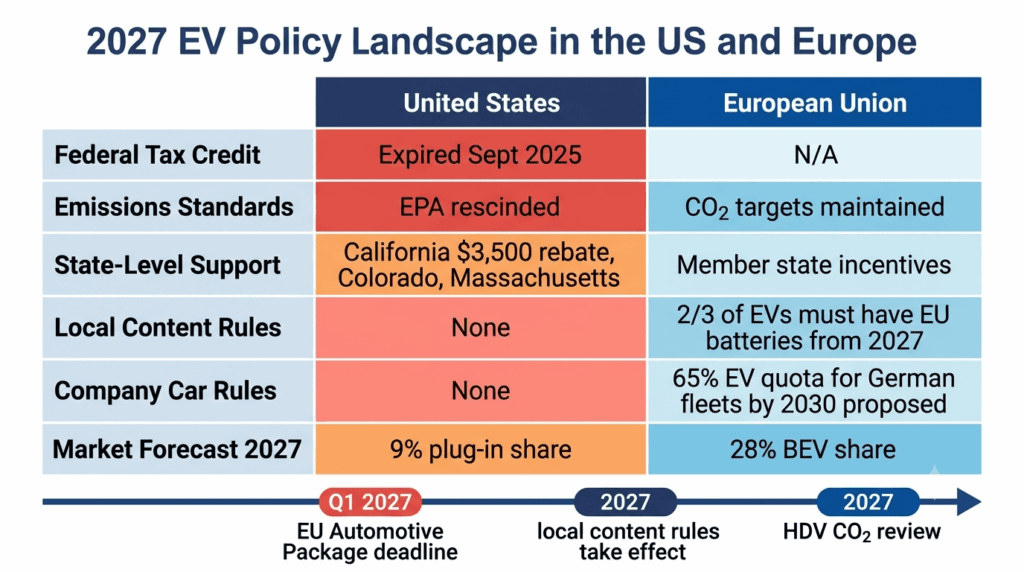
The US federal government has completed its withdrawal from EV support. The $7,500 clean vehicle credit expired on September 30, 2025. The EPA has rescinded greenhouse gas emissions standards for light-duty vehicles and proposed delaying the Tier 4 criteria emission standards by two years until model year 2029.
The consequences are measurable. EPA now projects battery electric vehicle market share of eight percent in model year 2027 and 12 percent in model year 2028, a fraction of what the previous administration’s Multi-Pollutant Rule anticipated. BloombergNEF expects the plug-in share of US sales to land at 8.4% in 2026 and 9% in 2027, with the market only catching back up to 2025 levels in 2028.
The California waiver revocation removed the single most powerful regulatory driver of EV adoption in the United States. The waiver allowed California to set its own emissions standards, which fifteen other states had adopted. Without it, the state-level mandate that would have required automakers to reach 100% plug-in sales by 2035 is off the books, though California and allied states are challenging the decision in court.
California has responded by constructing its own incentive architecture. Governor Gavin Newsom signed SB 168 in July 2026, creating the MyFirstEV instant rebate program. First-time EV buyers receive $3,500 off a new electric vehicle with an MSRP up to $50,000, or $1,750 off a used EV priced up to $25,000. The $135.5 million state investment is matched dollar-for-dollar by participating automakers, delivering a combined $270 million in point-of-sale savings.
Other states are following California’s lead. Colorado, Massachusetts, and Oregon already operate state-level EV incentive programs. Maryland has adopted the Advanced Clean Cars II regulation, leveraging state and federal incentives for zero-emission vehicles through model year 2027.
The 2027 outlook for US EV policy is therefore not one of uniform federal retreat but of a patchwork. Buyers in California, Colorado, and Massachusetts will have access to meaningful state support. Buyers in states that have not established their own programs will face a market without purchase incentives for the first time in a decade.
The European Union: Regulatory Consolidation and Industrial Policy
The European Commission’s Automotive Package, presented in December 2025, was intended to resolve the most contentious issues in EU vehicle regulation. Instead, it has become a battleground. The package may not be finalised until 2027, with MEP Jens Gieseke stating that “everything must be finalised by the end of the first quarter of 2027”.
The delay is driven by electoral politics as much as policy disagreement. French presidential elections in May 2027, alongside parliamentary elections in Poland and Spain, mean that member states are reluctant to commit to contentious regulatory decisions before their electorates have voted.
The most contentious element is the treatment of company car fleets. The Commission proposed separate rules for the electric vehicle share of fleets operated by larger companies, with member-state-specific targets. The Parliament’s draft now proposes higher quotas: 65% zero-emission vehicles for German company fleets by 2030, up from the Commission’s proposed 54%. The 2035 target rises from 95% to 99%.
The Social Democrats have gone further, demanding that member states “must no longer grant tax or financial advantages for fossil-fuel-powered company cars from 2028 onwards,” with only electric vehicles “made in Europe” receiving tax privileges. The European People’s Party opposes the draft, and the German automotive industry association has rejected any additional regulatory framework for corporate fleets, calling instead for reduced bureaucracy.
The Commission’s proposal to revise the 2035 target from 100% to 90% CO2 reduction has become the central fault line. The change would correspond to a fleet CO2 emissions average of eleven grams per kilometre per manufacturer, instead of zero grams. The remaining emissions would be offset through a credit system.
Transport & Environment, the green campaign group, has warned that weakening the 2030 target would delay price parity between EVs and combustion engine vehicles by at least two years. The group estimates that battery electric vehicles will account for 23% of new car sales in the EU and Norway in 2026 and 28% in 2027, driven by cheaper models and emission targets.
One element of EU policy that is moving forward without delay is the Industrial Accelerator Act’s local content requirement. From 2027, almost two-thirds of electric cars sold in the EU will be required to have batteries produced in Europe. The rules define made-in-EU batteries as having at least three components, including the cells, produced in Europe. By 2030, this rises to at least five components, including cells, cathode active materials, and battery management systems.
The local content requirement creates a direct link between EV policy and industrial policy. It is designed to ensure that the transition to electric mobility builds European manufacturing capacity rather than simply replacing imported oil with imported batteries.
The Cost Convergence Underway
The policy divergence between the US and Europe is occurring against a backdrop of rapid cost reduction in battery technology. Analysis from Columbia Threadneedle estimates that EV costs will come down by approximately 20% by 2027, bringing EVs close to cost parity with internal combustion engine vehicles.
The cost gap between EVs and ICE vehicles in the US and EU is currently 20-25%. Over 80% of this gap is driven by higher powertrain and overhead costs. As battery pack costs fall below $100/kWh, which occurred for the first time in 2026, the economics of EV ownership improve regardless of policy.
This creates an interesting dynamic for the 2027 outlook. In the United States, where policy support is being withdrawn, the falling cost of EVs may partially offset the loss of incentives. In Europe, where policy support is being maintained, cost reduction accelerates an already strong market.
Chinese manufacturers have already achieved price parity, with EVs often pricing below comparable internal combustion vehicles in China. Their cost advantages are technological as well as scale-driven, and they are exporting that advantage to both the US and European markets. The EU’s local content rules are a direct response to this competitive pressure.
What 2027 Will Actually Look Like
The 2027 US EV market will be smaller than it would have been with federal support. BNEF projects a plug-in share of nine percent, down from earlier forecasts of nearly 50% by 2030. The market will be concentrated in states with their own incentive programs, particularly California, and in segments where the economics of EVs are already compelling without subsidies, such as commercial fleets and high-mileage drivers.
The removal of the California waiver and the federal tax credit has not eliminated EV adoption in the US. It has narrowed it. The states that choose to support electrification will see continued growth. The states that do not will see a market that develops more slowly, driven primarily by consumer demand and operating cost savings rather than policy.
The 2027 European EV market will be shaped by two forces: the CO2 standards that drive manufacturers to sell EVs, and the local content rules that determine where those EVs and their components are made. The Automotive Package’s delay into 2027 means that the final shape of company car rules and the 2035 target remains uncertain, but the direction of travel is clear.
The European market is expected to reach 28% battery electric vehicle share in 2027, up from 23% in 2026. The cost of EVs is falling, with models below €25,000 becoming available and battery prices declining. Policy support remains in place, particularly for company fleets, which account for a significant share of European new car sales.
The 2027 outlook for US and European EV policies is not a story of one region succeeding and the other failing. It is a story of two regions making different choices about the role of government in the transition to electric mobility.
The United States has chosen to let the market determine the pace of adoption, with states and consumers filling the gap left by federal withdrawal. Europe has chosen to maintain regulatory pressure on manufacturers while adding industrial policy to ensure that the transition builds European manufacturing capacity.
Both approaches will produce results. The US will see slower EV adoption but potentially lower costs for the EVs that are sold, as manufacturers compete on price without the cushion of subsidies. Europe will see faster adoption but higher costs, as local content requirements and regulatory complexity add to the price of European-made EVs.
The honest question for 2027 is not which model is better. It is which model produces a more durable transition. The US approach is more exposed to oil price volatility and consumer sentiment. The European approach is more exposed to industrial policy failure and the risk that local content requirements raise costs without building competitive capacity.
That question will not be answered in 2027. But the policy decisions made this year will determine the shape of the answer for the remainder of the decade.