The battery industry has a vocabulary problem. Terms like “solid-state,” “semi-solid,” and “quasi-solid” are used interchangeably in marketing materials, press releases, and media coverage, often without any clear definition of what they actually mean. The result is confusion among consumers, investors, and even industry professionals.
In July 2026, that confusion was formally addressed. China’s national standard GB/T 43568-2026, titled “Solid-State Batteries for Electric Vehicles, Part 1: Terms and Classification,” came into effect. It is the world’s first national standard dedicated to automotive solid-state batteries, and it draws a clear line between the different battery architectures.
This guide explains what each term actually means, how the new standard defines them, and what the terminology reveals about the state of battery technology in 2026.
The Problem: Why the Terminology Became Confused
The confusion is not accidental. For years, the solid-state battery sector lacked unified definitions and classification standards. Companies used terms like “semi-solid,” “quasi-solid,” and “quasi-solid-state” as marketing labels rather than technical descriptors.
The ambiguity was exploited. A 2024 launch of a “Light-Year Solid-State Battery” by IM Motors turned out to be a semi-solid-state battery, not a true solid-state product. Media outlets routinely mislabeled semi-solid batteries as solid-state. The gap between what was being promised and what was actually being delivered became a credibility problem for the entire industry.
The new Chinese national standard was designed to end this. As the official announcement stated, the standard transforms “vague verbal agreements into measurable, verifiable technical benchmarks” and “bans misleading commercial labels such as ‘semi-solid’ and ‘quasi-solid,’ unifying them under the category of ‘hybrid solid-liquid batteries'”.
The New Classification: Three Categories, One Clear Line
The GB/T 43568-2026 standard divides batteries into three distinct categories based on how ions are transported within the cell: liquid batteries, hybrid solid-liquid batteries, and solid-state batteries.
The definition is deliberately simple. If the electrolyte is liquid, it is a liquid battery. If the electrolyte is solid, it is a solid-state battery. If the electrolyte contains both solid and liquid components, it is a hybrid solid-liquid battery.
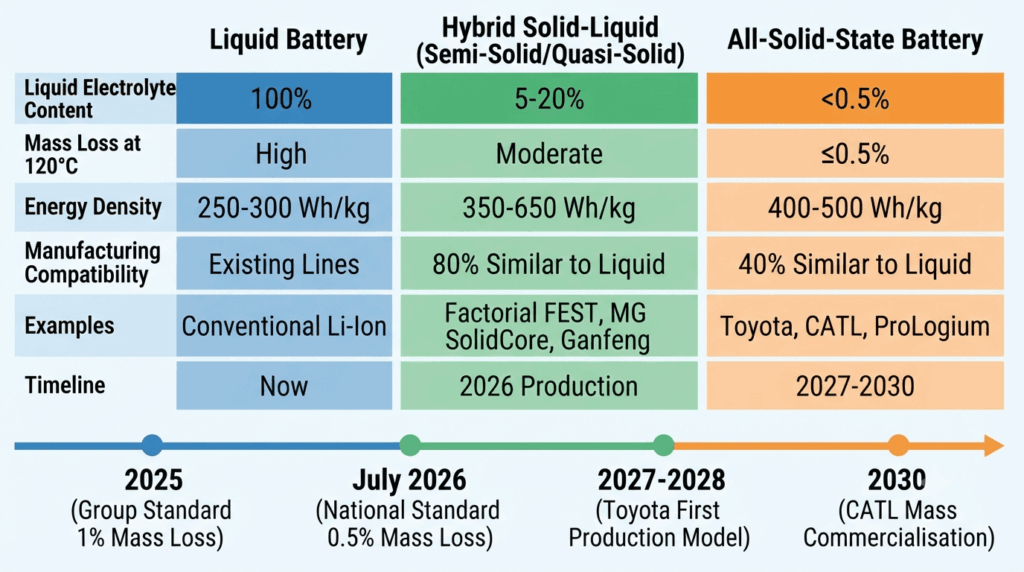
The standard also establishes a quantitative test to prevent mislabeling. A battery can only be called “all-solid-state” if it passes a specific test: heating at 120°C under vacuum for six hours, with a mass loss rate not exceeding 0.5%. The weight loss represents the liquid electrolyte that evaporates. If more than 0.5% of the battery’s mass is lost, it contains too much liquid to be considered solid-state.
The 0.5% threshold is stricter than the earlier industry group standard, which allowed up to 1% mass loss. The drafting team explained that while an ideal solid-state battery should contain no liquid at all, some solid electrolytes may undergo slight decomposition at high temperatures, hence the small allowance.
All-Solid-State Batteries: The True Solid-State
An all-solid-state battery is exactly what the name implies. The liquid electrolyte that conducts ions between the cathode and anode in a conventional lithium-ion battery is replaced entirely by a solid material. This can be a ceramic, a glass, a sulfide compound, or a polymer.
The advantages are significant. Solid electrolytes are non-flammable, eliminating the primary mechanism by which lithium-ion batteries catch fire. They enable the use of lithium-metal anodes, which store approximately ten times more lithium per unit volume than graphite. And they can operate at higher voltages, increasing energy density.
The energy density potential is substantial. All-solid-state batteries are expected to reach 400 to 500 Wh/kg, compared with 250 to 300 Wh/kg for current production lithium-ion cells. Toyota has publicly targeted mass production of all-solid-state batteries with energy density of 450 to 500 Wh/kg.
The challenges are equally significant. The solid-solid interface between the electrolyte and the electrodes is difficult to maintain. As the electrodes expand and contract during charging and discharging, contact can be lost, increasing resistance and degrading performance. Manufacturing requires precise control of humidity and pressure. And the cost of producing solid electrolytes at scale remains high.
CATL Chairman Robin Zeng has been direct about the timeline. He placed all-solid-state chemistry at level four on the nine-point Technology Readiness Level scale and stated that large-scale commercialisation will not be achievable before 2030. Toyota targets first production models using all-solid-state batteries in 2027 or 2028.
Semi-Solid Batteries: The Hybrid Category
Semi-solid batteries, now formally classified as hybrid solid-liquid batteries, occupy the space between conventional lithium-ion and true solid-state. They use a combination of solid electrolyte materials and a smaller amount of liquid electrolyte.
The new standard defines hybrid solid-liquid batteries as those containing between 5% and 20% liquid electrolyte by mass. This range captures what the industry previously called semi-solid or quasi-solid batteries.
The appeal of semi-solid architecture is practical. As Dr. Li Zheng, MG’s global chief battery scientist, explained, semi-solid batteries have about 80% similarity to conventional liquid lithium-ion batteries. “We only have a 20% change,” he said. “And for the all-solid, they’re only 40% similar compared with the liquid”.
That compatibility matters for manufacturing. Semi-solid batteries can be produced on modified versions of existing lithium-ion production lines, requiring far less capital investment than building new factories for all-solid-state cells.
MG’s SolidCore battery is a leading example of the semi-solid approach. SAIC Motor has rolled out semi-solid-state batteries across its vehicle range. MG currently has about 10 GWh of semi-solid capacity and plans to increase it to roughly 30 GWh by 2027.
Dr. Zheng argued that semi-solid batteries are not merely a transitional technology. “We think the semi-solid-state battery is not only a stage between the liquid and all-solid,” he said. “It will long-term exceed, because they can solve certain problems that are hard to solve with all-solid state batteries, because of the quick-response capabilities that we see only in semi-solid state batteries”.
Other companies have also achieved significant results with semi-solid chemistry. China’s Ganfeng Lithium began mass production of a semi-solid-state battery with energy density reaching 650 Wh/kg in February 2026. Svolt Energy targeted September 2026 for volume production of its semi-solid-state batteries.
Quasi-Solid Batteries: The Terminology That Refuses to Die
The term “quasi-solid” has been widely used in the industry, often interchangeably with “semi-solid.” The new Chinese standard effectively abolishes the distinction. Both terms are now unified under the formal classification of “hybrid solid-liquid batteries”.
The confusion arises because “quasi-solid” and “semi-solid” have been used by different companies to describe essentially the same architecture: a battery that uses a solid or gel-like electrolyte with some residual liquid content.
The most prominent example of a battery marketed as quasi-solid is Factorial Energy’s FEST technology. Factorial describes FEST as a “quasi-solid-state” battery that combines an ultrathin lithium-metal anode, a quasi-solid polymer electrolyte, and a high-capacity cathode.
The FEST cells validated with Stellantis in 2025 had a capacity of 77 Ah and a gravimetric energy density of 375 Wh/kg. They completed more than 600 cycles and could charge from 15% to 90% in 18 minutes at room temperature.
Factorial’s technology illustrates the practical appeal of the quasi-solid approach. The company says FEST has a “high degree of compatibility with conventional lithium-ion manufacturing equipment”. Factorial has signed a memorandum of understanding with SK On, one of the world’s largest battery manufacturers, to assess manufacturing FEST using existing lithium-ion production infrastructure.
Under the new Chinese standard, FEST would be classified as a hybrid solid-liquid battery, not a solid-state battery. But the distinction does not diminish the technology’s potential. It simply clarifies what it is.
Why the Terminology Matters
The terminology is not academic. It has practical implications for consumers, investors, and policymakers.
For consumers, the difference between an all-solid-state battery and a hybrid solid-liquid battery is the difference between a product that does not yet exist at scale and one that is already in production vehicles. Understanding the distinction prevents being misled by marketing claims.
For investors, the classification determines which companies are working on which technology and what the realistic timelines are. All-solid-state batteries are a long-term play. Hybrid solid-liquid batteries are a near-term commercial opportunity.
For policymakers, clear definitions enable effective regulation. The Chinese standard creates a framework for testing and certification that prevents companies from making unsubstantiated claims. The European Union and other jurisdictions are watching closely and may adopt similar standards.
The new standard also establishes a multi-dimensional classification framework that goes beyond the basic categories. Solid-state batteries are grouped by electrolyte type into sulfide, oxide, polymer, halide, and composite-electrolyte categories. They are classified by conducting ion into solid-state lithium-ion and solid-state sodium-ion. And they are divided by application into high-energy and high-power types.
What Comes Next
The Chinese national standard is the first step in a broader regulatory framework. The “Solid-State Batteries for Electric Vehicles” series is planned in four parts. Part 1, covering terminology and classification, is now in effect. Subsequent parts will address performance specifications, safety specifications, and lifespan specifications.
The standard will accelerate the commercialisation of hybrid solid-liquid batteries by providing a clear regulatory framework. It will also force companies developing all-solid-state batteries to meet a higher bar for performance and manufacturing quality.
For the industry, the most important outcome is clarity. The era of “semi-solid” and “quasi-solid” as marketing labels is ending. In its place is a technical classification that reflects what batteries actually are, not what companies want them to be called.
The terminology guide can be summarised simply. If it has liquid electrolyte, it is a liquid battery. If it has both solid and liquid electrolyte, it is a hybrid solid-liquid battery. If it has only solid electrolyte and passes the 0.5% mass loss test, it is an all-solid-state battery. Everything else is marketing.