The electric vehicle industry has spent two decades chasing energy density. Longer range. Lighter packs. More kilowatt-hours per kilogram. Nickel-manganese-cobalt chemistry became the default answer because it delivered on those metrics.
That default has been overturned. Lithium iron phosphate, a chemistry once dismissed as suitable only for buses and cheap city cars, now powers the majority of new electric vehicles sold worldwide. It is cheaper, safer, and lasts longer than NMC. And in 2026, it is winning the volume game so decisively that the question is no longer whether LFP will dominate mass-market EVs. It is how far upmarket it will go.
This is the rise of LFP, and why lithium iron phosphate is winning the volume game.
The Market Share Tipping Point
The numbers tell the story of a chemistry that has moved from niche to mainstream in less than five years.
LFP captured more than 55% of global EV battery deployments in 2025, up from nearly 50% in 2024. In China, the chemistry reached 81.2% of domestic EV battery installations. LFP powering two-thirds of electric car sales in emerging markets as Chinese manufacturers exported affordable models at scale.
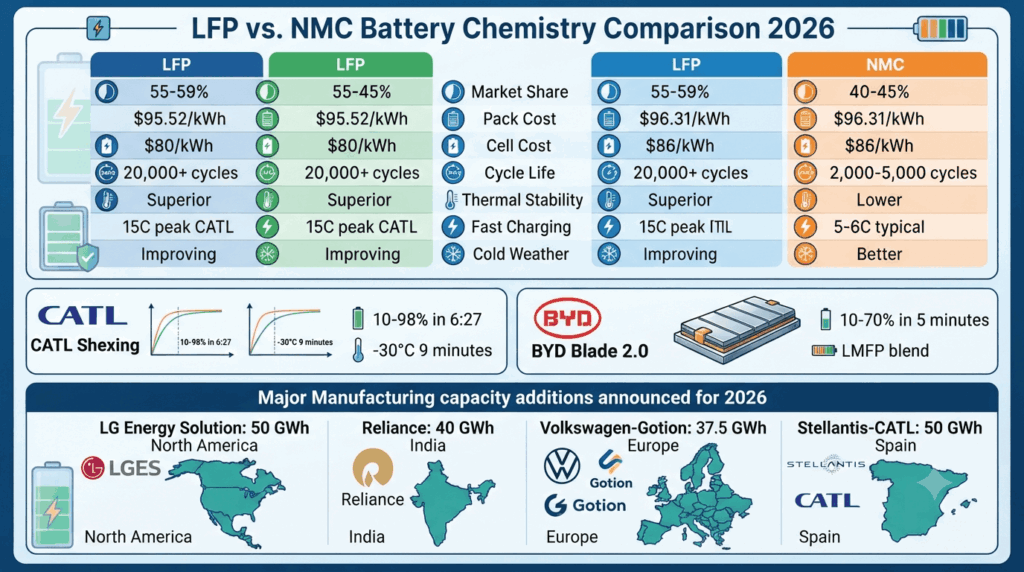
The momentum has continued into 2026. In the first quarter, LFP installations reached 128.1 GWh globally, a 20% year-on-year increase, taking 56.8% market share. By April 2026, LFP’s share of the global battery chemistry mix had risen to 59%, while NMC’s fell to 40%. In China specifically, March 2026 saw LFP installations jump 122.3% to 45.8 GWh, lifting its market share to 81%.
The shift is not confined to passenger cars. LFP accounted for 90% of the 108 GW of new battery storage added globally in 2025. China reached 144.7 GW of cumulative new-type energy storage capacity at the end of 2025, supported by LFP cells with certified cycle life above 20,000 cycles.
The market value reflects the volume. The LFP battery market is projected to grow from $22.72 billion in 2025 to $28.62 billion in 2026 and reach $84.37 billion by 2031, a compound annual growth rate of 24.14%.
The Cost Advantage That Changed Everything
LFP’s rise is fundamentally a cost story.
LFP packs cost more than 40% less per kilowatt-hour than NMC packs on average. Argonne National Laboratory’s 2026 cost model puts the price of LFP-graphite packs at $95.52 per kWh, compared with $96.31 per kWh for NMC-graphite/silicon packs. While those figures are close at the pack level, the cell-level cost difference is starker. Argonne’s model shows LFP cells at approximately $80 per kWh in 2026, down from $126 in 2019 for NMC chemistries.
The regional variation is significant. India’s landed LFP cell price stood at approximately $60 to $68 per kWh in June 2026, around 10% to 25% above China ex-works levels. At the cell level, standard-grade cylindrical LiFePO4 cells have fallen approximately 40% to 50% since 2021, reaching an estimated range of $55 to $80 per kWh. Utility-scale LFP battery systems are currently being quoted at around $70 to $75 per kilowatt-hour.
The cost advantage comes from two sources. First, LFP contains no cobalt or nickel, eliminating exposure to the most expensive and supply-constrained battery metals. Second, manufacturing processes for LFP are simpler and more mature than those for high-nickel chemistries, reducing production costs.
The economic logic is straightforward. For vehicles where range requirements are moderate, LFP delivers adequate performance at a lower price. For stationary storage, where weight is not a constraint, LFP is superior on nearly every metric that matters.
How CATL and BYD Turned LFP into a Performance Chemistry
The historical knock on LFP was that it traded performance for cost. Lower energy density. Slower charging. Poor cold-weather behaviour. In 2026, those trade-offs have been largely eliminated by two companies.
CATL’s third-generation Shenxing battery is built on LFP chemistry and delivers what CATL describes as the industry’s strongest charging capability. It achieves an equivalent 10C continuous rate and a peak 15C charging rate. Charging from 10% to 80% takes 3 minutes and 44 seconds. From 10% to 98% takes 6 minutes and 27 seconds. Even at minus 30°C, charging from 20% to 98% takes approximately nine minutes. After 1,000 complete cycles, capacity retention remains above 90%.
CATL’s achievement is not just about speed. It is about breaking the historical trade-off between fast charging and cycle life. The company reduced the battery’s internal resistance to a world-record 0.25 milliohms, about 50% lower than the average, which reduces heat generation during high-rate charging. The result is a battery that can charge faster than most NMC cells while lasting longer.
BYD’s second-generation Blade Battery takes a different approach. It uses LFP chemistry blended with lithium manganese iron phosphate to raise energy density by roughly 5% over the original Blade cell. The battery can charge from 10% to 70% in five minutes and reach 97% in nine minutes under optimal conditions, supported by BYD’s 1,500 kW flash charging system. The Blade’s structural design, where cells act as load-bearing elements within the chassis, improves space utilisation and adds rigidity to the vehicle frame.
The second-generation Blade reduces internal resistance, which lowers heat build-up during repeated fast-charge cycles and supports longer cell life. The first vehicle expected to use the new system is the Denza Z9GT, which BYD plans to introduce to European markets.
CATL’s chief scientist, Wu Kai, framed the strategic logic clearly: LFP has approached its theoretical energy density limit, so further development is most effective when focused on extreme fast charging to achieve an optimal performance balance. NCM remains the benchmark for energy density competition. The two chemistries are not competing for the same applications. They are dividing the market between them.
Tesla, Volkswagen, and the Global Supply Chain Realignment
The most significant structural shift of 2026 is not a single product. It is the wholesale realignment of the global battery supply chain around Chinese LFP technology.
Tesla now sources LFP cells from at least four Chinese suppliers. CATL is the primary supplier. BYD provides roughly 20% of the cells for Tesla’s Shanghai Megafactory. In April 2026, Tesla added Sunwoda as its fifth global battery supplier, with third-generation LFP cells already shipping on Shanghai-built vehicles destined for export. Tesla also signed a $4.3 billion deal with LG Energy Solution for LFP cells to be manufactured in Michigan starting in 2027.
Tesla’s shift from vertical integration to supply chain diversification is notable. As industrial analyst Fred Lambert noted, by adding Sunwoda, Tesla is “prioritizing cost leverage over vertical integration,” the opposite of what CEO Elon Musk envisioned in 2020. Lambert considered the move “the right call” because Chinese LFP suppliers have been so efficient that it makes it “unnecessary” for Tesla to engineer its own.
Volkswagen has gone further. The company became the largest shareholder of Gotion High-Tech, expanding its holding to more than 26% with a roughly $1 billion investment. In November 2025, Gotion began mass production of the “unified cell” that Volkswagen selected as the standard format across most of its EV lineup. Thomas Schmall, Volkswagen’s chief technology officer, stated that with LFP unified cells now being produced in China and Germany, Volkswagen is “prepared to supply next-generation, highly competitive battery technologies across all Volkswagen brands.”
The European expansion is accelerating. Volkswagen, PowerCo, and Gotion announced three joint ventures with a combined estimated investment of €3.22 billion. The Valencia and Slovakia facilities will have a combined planned annual capacity of 37.5 GWh of LFP cell production, alongside a cathode material plant in Morocco designed to produce 100,000 tonnes per year.
Stellantis formed a 50-50 joint venture with CATL to build a €4.1 billion LFP gigafactory in Zaragoza, Spain, set to come online in late 2026 with capacity scaling toward 50 GWh.
The message is unambiguous. The world’s largest automakers are not merely buying Chinese LFP cells. They are building their European and North American supply chains around Chinese LFP technology, licensing, co-developing, and forming joint ventures to access the chemistry, manufacturing know-how, and capital that China has developed.
The Manufacturing Scale
LFP’s dominance is being reinforced by a manufacturing build-out that dwarfs other chemistries.
LG Energy Solution plans to have more than 50 GWh of LFP cell-making capacity in North America by the end of 2026 across three wholly owned plants: Holland and Lansing in Michigan, and NextStar Energy in Windsor. The Lansing facility alone is projected to achieve annual production capacity exceeding 35 GWh.
In India, Reliance Industries is targeting commercial-scale production at its battery gigafactory around July 2026, with a planned annual capacity of 40 GWh of LFP-based batteries, increased from an earlier 30 GWh target.
The European build-out is proceeding despite setbacks. Norway-based Morrow Batteries filed for insolvency in 2026, and Sweden’s Northvolt announced bankruptcy in 2024. But the Volkswagen-Gotion joint ventures, the Stellantis-CATL gigafactory in Spain, and LG Energy Solution’s North American expansion demonstrate that LFP manufacturing capacity is being built at scale by companies with the balance sheets to sustain the investment.
The geography of LFP manufacturing is shifting. While China remains the dominant producer, the capacity being built in the United States, Europe, and India signals that LFP is becoming a global chemistry rather than a Chinese one. That matters for supply chain resilience and for the economics of EV production outside China.
What LFP Means for the EV Industry
The rise of LFP has implications that extend beyond a single chemistry.
For automakers: LFP offers a path to lower-cost EVs without sacrificing durability or safety. The chemistry’s long cycle life and thermal stability make it well-suited for high-utilisation commercial vehicles, ride-hailing fleets, and entry-level passenger cars. The ability to fast-charge LFP batteries at rates comparable to NMC removes the last significant performance disadvantage.
For consumers: LFP-powered EVs are cheaper to buy and cheaper to own. The chemistry’s longer cycle life means the battery is less likely to need replacement over the vehicle’s lifetime. Its superior thermal stability reduces fire risk. For buyers in moderate climates who do not need maximum range, LFP is the rational choice.
For the energy storage market: LFP is the default chemistry for grid-scale storage. Its combination of low cost, long cycle life, and thermal stability is unmatched by any alternative. The 108 GW of battery storage added globally in 2025 was overwhelmingly LFP. As renewable energy deployment accelerates, LFP storage will grow with it.
For the battery industry: LFP’s rise has created a two-chemistry market. NMC remains the benchmark for energy density and premium performance. LFP dominates volume and cost-sensitive applications. The two chemistries are not competing for the same customers. They are serving different needs within the same market.
The limitations of LFP are real. Gravimetric energy density remains lower than NMC, which matters for premium long-range vehicles and weight-sensitive applications. Cold-weather performance, while improving, still lags behind NMC in extreme conditions. For applications where every kilogram matters, NMC or solid-state will remain the chemistry of choice.
But for the vast majority of electric vehicles sold worldwide, LFP is now the default. It is cheaper. It lasts longer. It charges fast enough. And it is being manufactured at a scale that no other chemistry can match.
The volume game has a winner. It is lithium iron phosphate.