The electric vehicle industry has spent three decades building the lithium-ion battery into one of the most successful industrial products in history. From the first commercial lithium-ion cells in the early 1990s at approximately 100 Wh/kg to today’s best production cells exceeding 250 Wh/kg, the technology has delivered consistent, incremental improvement. Global battery demand is now projected to exceed 4 TWh by 2030, driven primarily by electric vehicles.
But lithium-ion is approaching its theoretical limits. The fundamental architecture — utilising liquid electrolytes — presents inherent safety concerns and density limitations that cannot be overcome without a paradigm shift in cell design. Enter the solid-state battery: replacing the flammable liquid electrolyte with a solid conductor, promising to address the limitations that lithium-ion can no longer surmount.
This guide on solid-state vs. lithium-ion: safety, range, and cost compared provides the complete, honest analysis — why solid-state is genuinely safer (and where the safety advantages are more nuanced than marketing suggests), how energy density could double current capabilities, why cycle life could extend dramatically, and the honest assessment of the mass-production hurdles that separate today’s laboratory demonstrations from tomorrow’s production vehicles.
The Fundamental Difference — What Actually Changes
The Architecture That Defines Both Technologies
The lithium-ion baseline:
Conventional lithium-ion batteries consist of three primary components: a cathode (typically nickel-manganese-cobalt or lithium-iron-phosphate), an anode (graphite), and a liquid electrolyte that sits between them. The electrolyte serves as the medium through which lithium ions travel during charging and discharging. It is also flammable.
The liquid electrolytes used in conventional Li-ion batteries are flammable and can lead to thermal runaway under certain conditions such as physical damage. The organic solvents that enable the electrolyte’s ionic conductivity are the same compounds that make the battery capable of catching fire and sustaining combustion.
The solid-state alternative:
Solid-state batteries replace the liquid electrolyte and the separator with a solid material — typically a ceramic, glass-ceramic, or polymer compound. This seemingly simple substitution has profound implications for safety, energy density, and longevity.
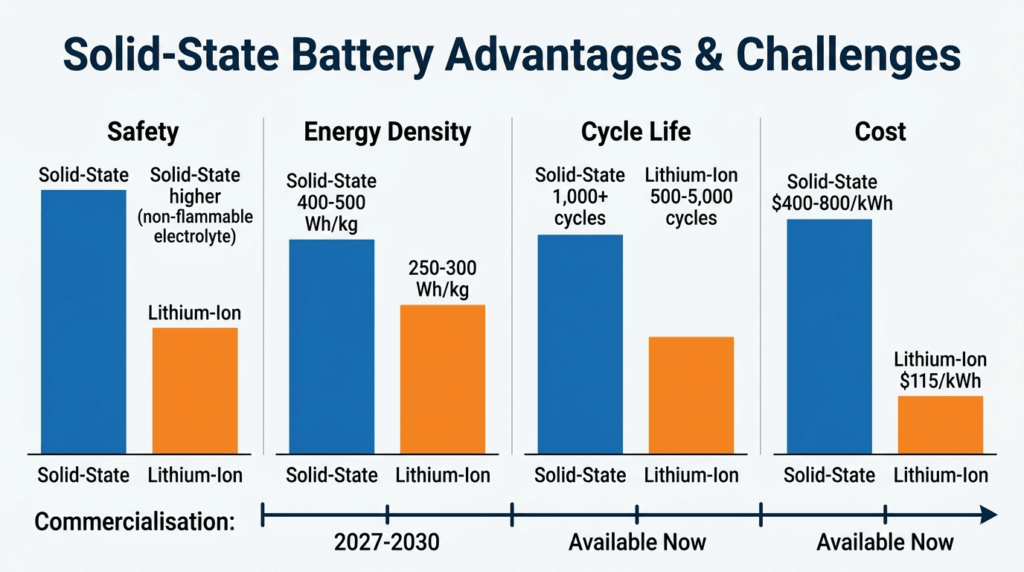
The elimination of flammable organic electrolytes addresses the primary safety concerns while enabling the use of lithium metal anodes with ten times the capacity of graphite. Because solid electrolytes are non-combustible, they fundamentally eliminate the risk of battery self-ignition from electrolyte combustion. Solid-state battery designs have shown the highest thermal stability overall.
Safety — Where Solid-State Wins and Where the Nuance Matters
The Honest Assessment of the Safety Advantage
The case for solid-state safety:
The safety argument for solid-state batteries is straightforward and compelling: replace the flammable liquid with a non-flammable solid, and you eliminate the primary mechanism by which lithium-ion batteries catch fire.
Solid-state batteries (SSBs) have become a promising candidate for the next step in lithium battery evolution. As they lack a flammable liquid electrolyte, SSBs may not pose the same fire risk that conventional lithium-ion batteries present. Solid-state batteries using solid electrolyte have attracted considerable attention as the most promising solution to the safety issue of lithium-ion batteries.
This is not a marginal improvement. The fundamental elimination of the flammable component that causes lithium-ion thermal runaway represents a genuine step-change in battery safety.
The nuance — solid-state can still fail:
Recent developments have called the common belief in “absolute safety” into question. Not only do solid-state electrolytes fail to prevent lithium filaments from propagating and causing short circuit events, but the higher energy density and presence of metallic lithium in SSBs create unique avenues for thermal runaway compared to lithium-ion.
University of Wisconsin-Madison researchers found that solid-state batteries experience thermal runaway, but at a significantly slower rate than traditional lithium-ion batteries. Their analysis demonstrated that solid-state batteries will experience thermal runaway and catch fire — but at a much slower rate. The risks of lithium metal reaction and combustion cannot be ignored.
The chemistry-specific risks:
Not all solid-state chemistries are equally safe. Sulfide-based solid electrolytes — currently the most promising for ionic conductivity — are extremely sensitive to moisture. Their reaction with moisture in the air produces highly toxic hydrogen sulfide (H₂S) gas, which imposes extremely stringent requirements on production environment humidity control. Comparative safety analysis has shown that sulfide SSBs present conditional H₂S risks upon moisture exposure.
The safety verdict:
Solid-state batteries are safer than lithium-ion, but not absolutely safe. They eliminate the most common thermal runaway trigger — flammable electrolyte ignition — but introduce new failure modes (lithium metal reactions, cracked separators, moisture sensitivity) that must be managed. The safety advantage is real but not absolute, and it comes with new safety considerations in manufacturing and operation.
Energy Density and Range — The Step-Change That Matters Most
What 400-500 Wh/kg Actually Means for EV Buyers
The current lithium-ion ceiling:
Lithium-ion battery technology is approaching its theoretical limits, with diminishing returns on research investments. The energy density of traditional liquid lithium-ion batteries is approaching its theoretical limit of approximately 300-350 Wh/kg. Current mainstream battery technology delivers 200-300 Wh/kg.
The solid-state promise:
Solid-state battery technology promises to address the limitations of conventional lithium-ion cells, offering theoretical energy densities exceeding 400 Wh/kg, potentially doubling current capabilities. Solid-state battery manufacturers are aiming for values of around 400 Wh/kg, which would roughly double the energy density of lithium-ion battery cells (currently 150 to 200 Wh/kg).
The all-solid-state battery is recognised as the next-generation battery technology with disruptive advantages, regarded by the industry as the “ultimate solution” to address the range anxiety of electric vehicles. Its energy density is expected to exceed 600 Wh/kg, which is more than twice that of the current mainstream liquid lithium-ion battery.
What this means in practice:
A 400-500 Wh/kg solid-state battery enables:
- Same range, half the weight: A battery pack that delivers current EV range at approximately half the weight, improving vehicle efficiency and handling
- Same weight, double the range: A 500+ mile EV without increasing battery pack size or mass
- Smaller pack, lower cost, adequate range: A smaller, lighter pack that still meets daily driving needs at potentially lower cost
Some estimates suggest solid-state packs could offer 50 to 100 percent more energy density than today’s best lithium-ion cells. Projected solid-state energy density of 400-500 Wh/kg could enable 500+ mile EV range.
The important caveat:
The gap between laboratory demonstration and production pack-level energy density is substantial. Many developers now report energy densities between 250 and 450 Wh/kg at the cell level, but pack-level density — accounting for structural elements, thermal management, and battery management electronics — will be lower. The headline figures are real, but they are cell-level measurements, not the complete battery pack.
Longevity and Cycle Life — The Durability Question
How Long Solid-State Batteries Could Last
The lithium-ion baseline:
Most lithium-ion batteries have a lifetime of about 5,000 cycles, with an energy density of 250 to 300 Wh/kg. For the average EV driver covering 10,000-12,000 miles per year, 5,000 cycles represents far more than the vehicle’s usable life — typically 15-20 years of driving. Cycle life is not a constraint for most EV owners today.
The solid-state advantage:
Solid-state batteries offer a longer service life, with cycle counts reaching thousands of times, reducing long-term usage costs. Some solid-state batteries have demonstrated the ability to last over 1,000 cycles — compared to 500 cycles in typical lithium-ion batteries.
Donut Lab, a solid-state battery developer, claims its all-solid-state battery technology is designed to last for up to 100,000 charging cycles. At the top of the advantages list for solid-state are increased safety and improved lifespan.
The nuance:
Cycle life claims vary dramatically across different solid-state chemistries and development stages. Not all solid-state batteries achieve automotive-grade cycle life. Some laboratory demonstrations show promising results, but translating those results to production cells with consistent performance across millions of units is a separate challenge.
The industry benchmark for automotive qualification is 1,000-2,000 cycles at 80% capacity retention. Many solid-state demonstrations are still below this threshold, though improving rapidly.
The lifetime energy consumption consideration:
When normalised with lifetime energy delivered, energy consumption depends strongly on lifespan. All-solid-state batteries show significantly higher energy use if their lifetime is half that of lithium-ion, whereas comparable or extended lifetimes yield no significant reduction in energy use. This means solid-state batteries must achieve comparable cycle life to lithium-ion to deliver their environmental benefits — shorter-lived solid-state batteries could actually be worse for overall energy consumption.
The Cost Barrier — The Honest Numbers
Why Solid-State Is Still 5-10x More Expensive
The current cost reality:
This is where the honest assessment becomes most uncomfortable for solid-state advocates. The cost gap between solid-state and lithium-ion is not marginal — it is a chasm.
Current solid-state production costs are $400-800/kWh versus approximately $115/kWh for lithium-ion. Some estimates suggest the cost of solid-state batteries is 5-10x higher at $400-800/kWh compared to $115/kWh for conventional batteries. While offering higher energy density and superior performance compared to lithium-ion batteries, current production costs remain a significant barrier to mass adoption.
In the Chinese market, all-solid-state cells currently cost between 1.6 and 2.2 yuan per Wh, whereas mainstream lithium iron phosphate cells have fallen to just 0.39 to 0.5 yuan per Wh. The current cost of manufacturing even a hybrid solid-liquid battery with a 95% solid electrolyte is about 12 cents per Wh, while modern LFP cells cost less than six cents per Wh.
Why solid-state is so expensive:
The cost premium reflects multiple factors:
- New manufacturing infrastructure: You cannot use the same manufacturing plants and processes for solid-state batteries. Up to 60 percent of the current production layout for lithium-ion batteries may have to be significantly changed.
- Stringent environmental controls: Sulfide electrolytes require ultra-dry environments with a dew point below -60°C (versus -40°C for lithium-ion standard), generating measured 5-16 ppm H₂S in standard dry rooms, necessitating chemical plant infrastructure.
- New processing methods: New processing methods are needed to produce thin and dense layers for solid-state electrolytes and lithium metal.
- Scale: Global lithium-ion manufacturing capacity exceeds 500+ GWh. Solid-state pilot lines are at 1-5 GWh.
The path to cost parity:
Some projections suggest that solid-state battery costs will decrease to $150-200 per kWh by 2030 and potentially reach $100 per kWh thereafter. Price parity with lithium-ion batteries is achievable by the early 2030s. The cost curve will not begin to bend until OEM purchase commitments justify capital investment in specialised manufacturing equipment.
The cost verdict:
Solid-state batteries are currently 5-10x more expensive than lithium-ion. The path to cost parity is measured in years, not months — early 2030s at the earliest. The cost advantage will come from scale, manufacturing innovation, and the elimination of expensive materials like cobalt. But that is a future projection, not a present reality.
The Mass-Production Hurdles — Why Solid-State Isn’t Here Yet
The Manufacturing Challenges That Define the Timeline
The Technology Readiness Level reality:
According to the International Energy Agency’s assessment framework, the Technology Readiness Level of all-solid-state batteries has currently reached levels 4-5 overall. This means proof-of-principle for core materials has been completed in the laboratory, and fundamental scientific issues have been largely clarified.
The current focus has shifted from “how to achieve high performance in a single sample” to “how to translate the performance advantages of the laboratory into mass-producible, commercially viable product competitiveness with high consistency and low cost”. Scientific verification is in full swing, engineering verification has just started, and commercial verification has not begun yet.
The three core manufacturing challenges:
1. Electrolyte material challenges:
Finding a “perfect” solid-state electrolyte that combines high ionic conductivity, excellent stability, and good mechanical properties is the primary challenge. The three main electrolyte systems — oxides, sulfides, and polymers — each have significant drawbacks. Sulfide electrolytes offer the best ionic conductivity (comparable to liquid electrolytes) but are chemically unstable and moisture-sensitive. Oxide electrolytes are more stable but have lower conductivity.
2. Interface engineering:
The interface between the solid electrolyte and the electrodes is a critical challenge. Ensuring these electrolytes remain chemically stable across wide voltage windows and developing design and operational strategies that mitigate mechanical stresses during cycling while preserving long-term performance are significant hurdles. Interface impedance degradation is a core bottleneck.
3. Manufacturing infrastructure:
Mass production of solid-state batteries requires an overhaul of existing manufacturing facilities and supply chains. Solid-state battery manufacturing will likely be a hybrid approach which adopts processes from both conventional lithium-ion and solid oxide fuel cell communities. Heat treatment steps need to be optimised.
The timeline reality:
Commercialisation of all-solid-state batteries is expected after 2030. 2026 is the starting point for semi-solid-state battery vehicle installation. Toyota targets 2027-2028 for first EV models. The period from 2027 to 2030 will be a crucial time to verify the feasibility of practical integration and widespread commercialisation.
Semi-Solid — The Bridge Technology
What’s Available While We Wait for All-Solid-State
The distinction that matters:
Most of the products that have been applied on a small scale in the market currently belong to the category of “semi-solid batteries” (also known as “solid-liquid batteries”), with a single-cell energy density of about 350 Wh/kg.
There are fundamental differences between all-solid-state and semi-solid in terms of technology. All-solid-state batteries are a disruptive innovation in materials, processes, and performance. Solid-liquid batteries are an improvement based on the existing liquid lithium-ion battery system. Semi-solid batteries have a gel-like electrolyte and can more easily integrate with facilities producing lithium-ion batteries.
What semi-solid delivers today:
The battery installed in the SAIC IM L6 model (from QingTao Energy) has an energy density of 368 Wh/kg. The cells of the 150 kWh ultra-long-range battery pack of NIO (from Weilan New Energy) have an energy density of 360 Wh/kg. These are meaningful improvements over conventional lithium-ion, but they are not the step-change that all-solid-state promises.
The commercial reality:
Semi-solid batteries are the bridge technology — delivering some of the benefits of solid-state while leveraging existing lithium-ion manufacturing infrastructure. They are what buyers can access in the near term while waiting for all-solid-state to mature.
The Competitive Landscape — Who Is Winning the Solid-State Race
The Global Race to Commercialisation
The major players:
The race to commercialise solid-state technology has attracted over $8 billion in announced investments from Toyota, Samsung SDI, QuantumScape, and Solid Power, among others. The global solid-state battery sector recorded over 57 financing deals between 2025 and Q1 2026, with 46 companies securing new funding.
Toyota:
Toyota has been the most prominent announcer of solid-state battery commercialisation timelines, targeting 2027-2028 for first EV models. The company’s ceramic/sulfide approach has faced repeated delays but remains the most advanced Japanese programme.
Chinese manufacturers:
CATL, the world’s largest EV battery manufacturer, is pursuing multiple directions simultaneously. Its “condensed state” (hybrid solid-liquid) battery line has achieved an energy density of approximately 500 Wh/kg. For its purely sulfide-based solid-state batteries, CATL plans to begin trial production in 2026 and integrate them into vehicles in 2027, with a target energy density of 450-500 Wh/kg.
BYD is developing solid-state batteries based on sulfides with energy densities of around 400 Wh/kg and a lifespan of up to 10,000 charge cycles. Chinese enterprises are almost on the same starting line as competitors from Europe, the United States, Japan, and South Korea.
Nissan:
Nissan opened its all-solid-state EV battery production line at its Yokohama plant in Japan in January 2025 and is partnering with US-based LiCAP Technologies for mass production. The company aims to launch its first EV powered by solid-state batteries in fiscal year 2028.
Stellantis/Factorial:
As covered in our Stellantis solid-state Dodge Charger Daytona guide, Stellantis is road-testing Factorial FEST solid-state cells with 375 Wh/kg energy density and 18-minute 15-90% charging in a development vehicle.
What This Means for Today’s EV Buyers
The Practical Purchasing Guidance
Should you wait for solid-state before buying an EV?
The honest answer: no. A buyer who waits for all-solid-state-equipped production vehicles before purchasing an EV is waiting until 2030 at the earliest — during which time they forego the fuel cost savings, lower maintenance costs, and driving experience advantages that current lithium-ion EVs provide.
The wait-for-better-technology calculation:
At $1,500-$2,500/year in fuel cost savings versus a comparable gasoline vehicle, waiting three additional years for solid-state costs approximately $4,500-$7,500 in foregone savings — a cost that would need to be recovered through solid-state technology advantages that, at the vehicle price premiums solid-state batteries will initially command, may not materialise.
The appropriate response:
- Buy current EVs with confidence: Lithium-ion technology is proven, available now, and delivers substantial cost savings over gasoline vehicles. The technology is not obsolete — it will remain the dominant EV battery chemistry for the remainder of this decade.
- Monitor solid-state development: The milestones over the next 2-3 years will provide genuine signal about whether solid-state is on track for the 2030 commercialisation timeline or facing the delays that have characterised previous announcements.
- Plan for the long term: For buyers considering their next vehicle after the next one, solid-state is relevant to consider. For buyers needing an EV now, current lithium-ion is the appropriate choice.
Internal Links — Further Reading on Clean Energy Bazaar
The solid-state vs. lithium-ion: safety, range, and cost compared guide connects to the battery technology and EV market guides on cleanenergybazaar.com.
For the Stellantis solid-state Dodge Charger Daytona guide covering the North American solid-state race, our Stellantis begins road-testing solid-state Dodge Charger Daytona guide covers FEST technology and road-testing milestones. For the Nissan + Oxford + Gelion lithium-sulfur partnership guide covering an alternative path to cheaper batteries, our Nissan + Oxford + Gelion partnership – can lithium-sulfur break the cost barrier? guide covers sulfur cathode technology. For the upcoming EV charger trends guide covering battery technology developments, our upcoming EV charger trends 2026-2027 V2G solid-state batteries guide covers the global battery innovation landscape. For the EU Omnibus automotive proposal guide covering the regulatory dimension of EV affordability, our EU Omnibus proposal small affordable EV category guide covers the European policy framework.
Final Thoughts
Solid-state vs. lithium-ion: safety, range, and cost compared — and the honest assessment is that solid-state delivers genuine advantages in each dimension, but the magnitude of those advantages varies dramatically and the timeline to commercialisation remains measured in years.
The safety advantage is real: eliminating flammable liquid electrolytes removes the primary thermal runaway trigger. But solid-state is not absolutely safe — lithium metal reactions, cracked separators, and moisture-sensitive chemistries introduce new failure modes that must be managed.
The energy density advantage is compelling: 400-500 Wh/kg versus 250-300 Wh/kg for today’s best lithium-ion. This could enable 500+ mile EVs, lighter vehicles, or smaller, more affordable packs. But the gap between cell-level laboratory demonstrations and production pack-level density remains substantial.
The longevity advantage is promising: potentially thousands more cycles than lithium-ion. But cycle life must be proven at automotive scale — laboratory demonstrations are not production validation.
The cost disadvantage is the elephant in the room. Solid-state batteries are currently 5-10x more expensive than lithium-ion. The path to cost parity is early 2030s at the earliest. The manufacturing hurdles are substantial — new facilities, new processes, new supply chains.
The honest verdict: solid-state is the future, but the future is not here yet. Today’s EV buyers should purchase current lithium-ion vehicles with confidence while monitoring solid-state development for their next purchase decision. Lithium-ion will remain the dominant EV battery chemistry for the remainder of this decade, and that is not a failure — it is a reflection of how successful the technology has become.