The United States is mounting a two-front push to commercialise solid-state battery technology — arguably the most important EV battery breakthrough since lithium-ion itself.
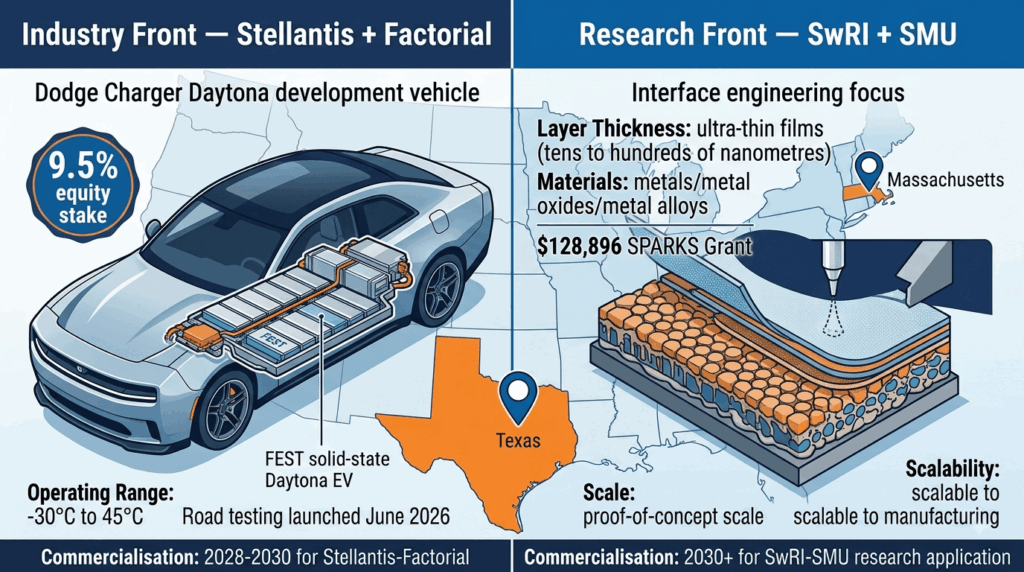
On one front, industry: Stellantis has deepened its partnership with Massachusetts-based Factorial Energy, taking a 9.5% equity stake and putting Factorial’s FEST solid-state cells into a Dodge Charger Daytona for real-world road testing — the first automotive integration of solid-state technology in North America.
On the other front, academia and research: Southwest Research Institute (SwRI) and Southern Methodist University (SMU) have launched a collaborative research project to solve one of solid-state battery’s most stubborn technical challenges — the unstable interface between the lithium metal anode and the solid electrolyte.
This guide on US focus: Factorial Energy’s partnership with Stellantis; SwRI and SMU collaborative research provides the complete, honest analysis — what the Stellantis-Factorial partnership actually involves and what the 9.5% stake means, how the Dodge Charger Daytona road-testing programme is progressing, what the SwRI-SMU research is trying to achieve and why it matters, and the honest assessment of where the United States stands in the global race to commercialise solid-state batteries.
Part One: Factorial Energy and Stellantis — The Industry Front
From Investment to Integration: How the Partnership Evolved
The 2021 beginning:
Stellantis first invested in Factorial Energy in 2021 through a €75 million funding round. At that time, Factorial was a promising but unproven startup developing solid-state battery technology in its Massachusetts laboratories. The investment was strategic — Stellantis needed access to next-generation battery technology to compete in the EV race, and Factorial needed automotive expertise and capital to scale.
The April 2025 validation milestone:
In April 2025, Stellantis and Factorial announced a significant milestone: the successful validation of automotive-sized solid-state battery cells with an energy density of 375 Wh/kg. The companies called this “a major step toward commercial use”.
The validated 77Ah FEST cells demonstrated:
- Energy density of 375 Wh/kg
- Ultra-fast charging from 15% to 90% in just 18 minutes
- Robust reliability across temperatures from -30°C to 45°C (-22°F to 113°F)
- Discharge rates up to 4C
- Over 600 cycles
The June 2026 road-testing milestone:
On June 11, 2026, Stellantis and Factorial announced the integration of Factorial’s advanced FEST solid-state battery technology into a Dodge Charger Daytona development vehicle and the launch of a road-testing programme.
This achievement marked the first integration of solid-state cells into a Stellantis vehicle and a breakthrough step towards automotive-grade application. The battery pack leverages a patented mechanical architecture, designed by Stellantis, to accommodate solid-state cells within the existing battery pack format.
Ned Curic, Stellantis Chief Engineering and Technology Officer, framed the achievement in practical terms: “Battery development is a balancing act. It’s not enough to optimise a single metric. We need a system that delivers real benefits in a real vehicle”. He added: “This milestone shows we are bringing solid-state batteries closer to our customers with the potential for longer range, faster charging and lower costs. Just as important, FEST’s strong compatibility with lithium-ion manufacturing processes gives us a critical path to scale this technology”.
Siyu Huang, CEO of Factorial, noted: “What we have built together, from cell chemistry to pack architecture to enable real-world road testing, is exactly the kind of deep, full-stack collaboration that solid-state has always required. This milestone doesn’t just validate FEST; it sets a new bar for what automotive-grade solid-state batteries can deliver”.
The June 2026 equity stake deepening:
Just eight days after the road-testing announcement, on June 19, 2026, it was revealed that Stellantis holds a 9.5% stake in Factorial Energy. The stake, equal to approximately 8.67 million shares held through Stellantis Europe and Stellantis Ventures, stems from investments made in recent years and converted into an equity holding. Stellantis may also buy further shares in the future.
The deepening of the equity stake is a clear signal of Stellantis’s commitment to solid-state technology. This is not a passive investment or a hedging bet — it is a strategic move in the race for solid-state technology, which promises longer range, faster charging, improved safety and lower costs than traditional batteries.
What the Dodge Charger Daytona Road Testing Actually Proves
The vehicle and the technology:
The Dodge Charger Daytona development vehicle is based on Stellantis’s STLA Large platform, which underpins the company’s largest and most performance-oriented EVs. The vehicle is now undergoing a road-testing and calibration programme to verify performance, safety and reliability under real-world conditions.
The testing programme will help tune and further verify pack performance and reliability under charging and driving conditions, in addition to vehicle safety. This is not a laboratory test or a controlled-environment demonstration — it is real-world validation on public roads.
What road testing proves:
Moving a cell from a lab into a car is the step where most battery promises fall apart. Bench numbers come under controlled temperatures and clean charge cycles. A road car faces cold starts, fast-charge heat, vibration, and years of wear.
The integration of FEST cells into the Charger Daytona’s existing battery pack using a patented new mechanical architecture demonstrates that solid-state cells can be integrated into production vehicle platforms without requiring a complete vehicle redesign. This has significant commercial implications — if Stellantis can upgrade existing platforms with solid-state batteries, the path to market is shorter and less capital-intensive than developing entirely new vehicle architectures.
What road testing does not yet prove:
The road-testing programme is validation, not production. It does not yet prove:
- Cycle life at automotive scale: 600 cycles is meaningful progress but below the 1,000-2,000 cycles that automotive qualification typically requires
- Cost at production scale: Development-scale cell costs are significantly higher than production lithium-ion
- Long-term field reliability: The temperature cycling, vibration, and moisture exposure that real-world vehicle use imposes cannot be compressed into months of testing
The FEST Technology — What Makes It Different
The quasi-solid approach:
Factorial’s FEST (Factorial Electrolyte System Technology) uses what the company calls “quasi-solid electrolytes”. This places it in the semi-solid category — not a true all-ceramic solid-state battery, but significantly more advanced than conventional liquid-electrolyte lithium-ion.
The FEST approach employs a lithium-metal anode — replacing the conventional graphite anode — combined with Factorial’s proprietary quasi-solid electrolyte. The lithium-metal anode enables the step-change in energy density: lithium metal stores approximately ten times more lithium per unit volume than graphite, and the elimination of graphite’s structural mass from the anode dramatically improves energy density at the cell level.
The manufacturing compatibility advantage:
One of the most significant aspects of FEST technology, from a commercialisation perspective, is its compatibility with existing lithium-ion manufacturing processes. This is not true of all solid-state chemistries — sulfide-based electrolytes, for example, require entirely new manufacturing environments with ultra-dry conditions.
The ability to leverage existing manufacturing infrastructure dramatically reduces the capital investment required to scale FEST production. This is a meaningful commercial advantage over solid-state chemistries that require entirely new factories.
Part Two: SwRI and SMU — The Research Front
The Interface Problem That Everyone Is Trying to Solve
The fundamental challenge:
On July 13, 2026, Southwest Research Institute (SwRI) and Southern Methodist University (SMU) announced a collaborative research project to advance solid-state battery technology.
The project addresses what Dr. John Hemmerling, a senior research engineer in SwRI’s Materials Engineering Department, describes as “one of the biggest technical hurdles” in solid-state battery development: the unstable interface between the lithium metal anode and the solid electrolyte.
In solid-state batteries, a solid lithium metal anode is in direct contact with a solid electrolyte. That interface is difficult to manage because lithium is highly reactive and can easily damage or chemically interact with materials that it touches, compromising the battery’s performance and stability.
The dendrite problem:
The lithium can also deposit in uneven growths, known as dendrites, that damage the contact area and hinder the transfer of ions. This accelerates battery degradation, making the battery less efficient over time.
Dendrite formation is one of the primary reasons lithium-metal batteries have historically been unsafe and short-lived. The dendrites can pierce the separator and cause short circuits, leading to thermal runaway. Addressing dendrite formation is essential for commercialising lithium-metal solid-state batteries.
The Ultra-Thin Film Solution
The interfacial engineering approach:
Hemmerling will collaborate with SwRI Staff Scientist Dr. Jianliang Lin and SMU J. Lindsay Embrey Professor and Assistant Professor of Mechanical Engineering Dr. Rong Kou to engineer ultra-thin films to reduce degradation and resistance at the anode-electrolyte interface.
Through a process called interfacial engineering, the researchers will deposit ultra-thin films tens to hundreds of nanometres thick onto the anode. These films include metals, metal oxides, and metal alloys, precisely tuned to stabilise the interface.
The project will leverage SwRI’s expertise in thin-film deposition and SMU’s strengths in solid-state battery development to establish quantitative structure-property-performance relationships linking interfacial chemistry, lithium nucleation behaviour, and long-term electrochemical performance.
The scalability advantage:
Dr. Hemmerling noted: “Although our current work is focused on a small, proof-of-concept scale, the thin-film deposition techniques we’re using are scalable, so if the concepts prove successful, they can be adapted relatively easily to larger-scale manufacturing”.
This is a critical point. Many promising laboratory solutions fail because they cannot be scaled to production volumes at reasonable cost. The SwRI-SMU approach specifically targets scalability from the outset.
The funding:
The project is funded by a $128,896 grant from the Seed Projects Aligning Research, Knowledge and Skills (SPARKS) joint program, which aims to strengthen and cultivate long-term research between SwRI and SMU.
Why This Research Matters
The interface bottleneck:
The anode-electrolyte interface is arguably the single most important technical challenge in solid-state battery development. It determines:
- Cycle life: How many times the battery can be charged and discharged before failing
- Power delivery: How quickly the battery can deliver energy
- Safety: Whether dendrites will cause short circuits
- Manufacturability: Whether the interface can be produced consistently at scale
The US competitive position:
The SwRI-SMU research is part of a broader US effort to compete in the global solid-state battery race. While Asian manufacturers (Toyota, CATL, Samsung SDI) and European automakers (Stellantis, Volkswagen through QuantumScape) have been the most prominent players, US research institutions and startups are making significant contributions.
Factorial Energy represents the US startup front. SwRI and SMU represent the US research front. Together, they address different parts of the solid-state commercialisation challenge — Factorial focusing on cell chemistry and automotive integration, SwRI and SMU focusing on fundamental interface science.
The Two Fronts Compared
Industry vs. Research — Different Timelines, Different Goals
| Dimension | Factorial + Stellantis | SwRI + SMU |
|---|---|---|
| Focus | Cell chemistry, pack integration, road validation | Interface science, thin-film engineering |
| Stage | Development vehicle, road testing | Proof-of-concept research |
| Timeline | Production vehicles 2028-2030 | Commercial application 2030+ |
| Funding | Stellantis equity stake, private investment | $128,896 SPARKS grant |
| Scale | Automotive-grade cells, production-capable | Laboratory-scale proof of concept |
| Geography | Massachusetts (Factorial), global (Stellantis) | Texas (SwRI, SMU) |
The complementary relationship:
The two fronts are complementary rather than competitive. Factorial’s FEST technology addresses the cell chemistry and pack integration challenges. SwRI and SMU’s research addresses the fundamental interface science that underpins all solid-state batteries, regardless of chemistry.
Progress on either front benefits the other. If SwRI and SMU develop a scalable interface stabilisation technique, it could be applied to Factorial’s cells (or any other solid-state chemistry). If Factorial demonstrates commercial viability, it validates the broader solid-state thesis that SwRI and SMU’s research supports.
The Competitive Landscape — Where the US Stands
The Global Solid-State Race
The major players:
The race to commercialise solid-state technology has attracted billions in investment from automakers, battery manufacturers, and venture capital. The major players include:
Toyota: The most prominent Japanese player, targeting 2027-2028 for first EV models. Toyota’s ceramic/sulfide approach has faced repeated delays but remains the most advanced Japanese programme.
CATL: The world’s largest EV battery manufacturer, pursuing multiple directions simultaneously. CATL plans to begin trial production of sulfide-based solid-state batteries in 2026 and integrate them into vehicles in 2027, with a target energy density of 450-500 Wh/kg.
BYD: Developing solid-state batteries based on sulfides with energy densities of around 400 Wh/kg and a lifespan of up to 10,000 charge cycles.
Nissan: Opened its all-solid-state EV battery production line at its Yokohama plant in January 2025, targeting 2028 for first EV powered by solid-state batteries.
Volkswagen/QuantumScape: Volkswagen-backed QuantumScape has demonstrated cell-level performance but has faced challenges scaling to automotive-grade format and cycle life.
Stellantis/Factorial: The focus of this guide — road-testing FEST cells in a Dodge Charger Daytona, with a 9.5% equity stake deepening the partnership.
The US position:
The United States is not the leader in solid-state battery development — that position belongs to Japan (Toyota) and China (CATL, BYD). However, the US is a credible contender, with Factorial representing the most advanced US startup, SwRI and SMU contributing fundamental research, and other players (Solid Power, QuantumScape) also in the race.
The Stellantis-Factorial partnership is particularly significant because it combines US startup innovation with global automaker scale and manufacturing capability. This is the model that has worked for Tesla with lithium-ion — US innovation, scaled through automotive manufacturing — and it may work for solid-state as well.
What This Means for Today’s EV Buyers
The Practical Purchasing Guidance
Should you wait for solid-state before buying an EV?
The honest answer, based on the timeline analysis above: no. The Factorial-Stellantis road-testing programme is validation, not production. The SwRI-SMU research is proof-of-concept, not commercialisation. Solid-state EVs are not coming to showrooms in 2026 or 2027.
The realistic timeline:
Based on the current development stage:
- Factorial-Stellantis road testing: 2026-2028
- Production vehicle integration: 2028-2030
- First solid-state EVs reaching consumers: 2029-2031 (realistic estimate)
The wait-for-better-technology calculation:
At $1,500-$2,500/year in fuel cost savings versus a comparable gasoline vehicle, waiting three additional years for solid-state costs approximately $4,500-$7,500 in foregone savings — a cost that would need to be recovered through solid-state technology advantages that, at the vehicle price premiums solid-state batteries will initially command, may not materialise.
The appropriate response:
- Buy current EVs with confidence: Lithium-ion technology is proven, available now, and delivers substantial cost savings over gasoline vehicles
- Monitor solid-state development: The Factorial-Stellantis road-testing programme’s milestones over the next 12-24 months will provide genuine signal about whether the technology is on track
- Plan for the long term: For buyers considering their next vehicle after the next one, solid-state is relevant to consider
Internal Links — Further Reading on Clean Energy Bazaar
The US focus: Factorial Energy’s partnership with Stellantis; SwRI and SMU collaborative research guide connects to the battery technology and EV market guides on cleanenergybazaar.com.
For the Stellantis solid-state Dodge Charger Daytona guide covering the road-testing programme in detail, our Stellantis begins road-testing solid-state Dodge Charger Daytona guide covers the FEST technology and testing milestones. For the solid-state vs. lithium-ion comparison guide covering the broader technology landscape, our solid-state vs. lithium-ion: safety, range, and cost compared guide covers the complete comparison. For the Nissan + Oxford + Gelion lithium-sulfur partnership guide covering an alternative path to cheaper batteries, our Nissan + Oxford + Gelion partnership – can lithium-sulfur break the cost barrier? guide covers sulfur cathode technology. For the EU Omnibus automotive proposal guide covering the European regulatory framework for affordable EVs, our EU Omnibus proposal small affordable EV category guide covers the European policy dimension.
Final Thoughts
US focus: Factorial Energy’s partnership with Stellantis; SwRI and SMU collaborative research — and the honest assessment is that the United States is mounting a credible two-front push to commercialise solid-state battery technology.
The industry front, represented by the Stellantis-Factorial partnership, is the more advanced of the two. The integration of FEST cells into a Dodge Charger Daytona and the launch of a road-testing programme represents the first automotive integration of solid-state technology in North America. The deepening of Stellantis’s equity stake to 9.5% signals serious commitment. The FEST cells’ demonstrated 375 Wh/kg energy density, 18-minute fast charging, and wide temperature range are real validated figures, not theoretical projections.
The research front, represented by the SwRI-SMU collaboration, addresses the fundamental science that underpins all solid-state batteries. The anode-electrolyte interface is one of the most stubborn challenges in solid-state development, and the ultra-thin film approach offers a promising path to stabilising it. The $128,896 SPARKS grant is modest, but the scalability of the thin-film deposition techniques means successful proof-of-concept could translate to manufacturing relatively quickly.
The honest verdict: the US is a credible contender in the global solid-state race, but not the leader. Japan and China remain ahead in commercialisation timelines. The Factorial-Stellantis partnership and the SwRI-SMU research represent meaningful progress, but production vehicles are still years away — 2029-2031 at realistic assessment. Today’s EV buyers should purchase current lithium-ion vehicles with confidence while monitoring solid-state development for their next purchase decision.