The electric vehicle industry has spent the better part of a decade locked in a battle against the fundamental economics of battery chemistry. Nickel is expensive. Cobalt is expensive and ethically compromised. Lithium is geographically concentrated. The materials that make lithium-ion batteries work are the same materials that keep EV prices stubbornly high and supply chains perpetually vulnerable to geopolitical disruption.
What if the solution was literally the most abundant element on the planet?
On June 2, 2026, Gelion PLC announced a three-year collaborative project with Nissan Technical Centre Europe and the University of Oxford to develop solid-state lithium-sulfur batteries for electric vehicles. The project, titled “Cost-effective, Resilient Solid-state Li–S” (CoRe-SoLiS), carries a total cost of £3.4 million, with £2.4 million in grant funding from Innovate UK under the Battery Innovation Concept Development Round 1 competition.
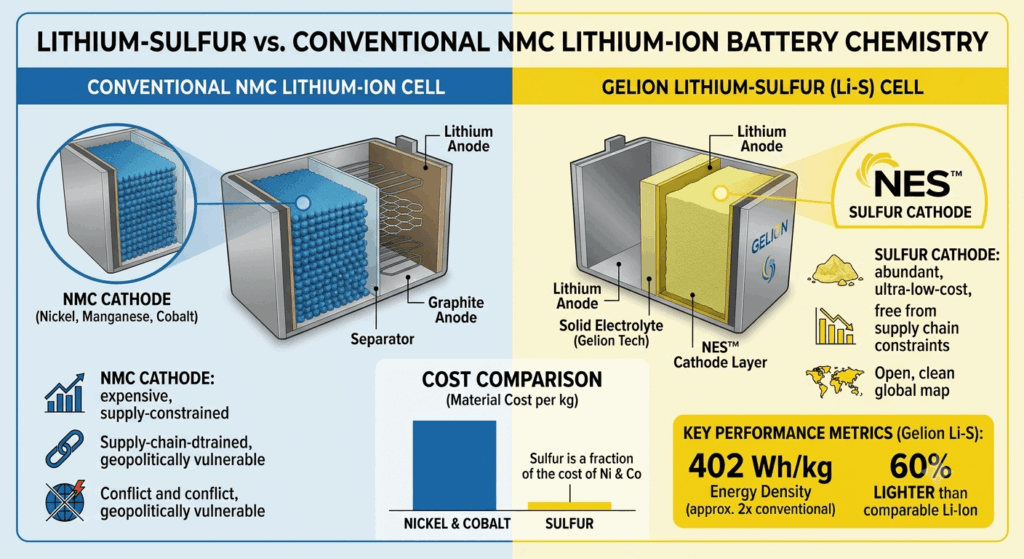
The premise is straightforward but potentially transformative: replace the expensive, supply-constrained nickel and cobalt in conventional EV battery cathodes with sulfur — which is abundant, ultra-low-cost, and free from the supply chain constraints that have made battery materials a strategic vulnerability for Western automakers.
This guide on Nissan + Oxford + Gelion partnership – can lithium-sulfur break the cost barrier? provides the complete, honest analysis — what the CoRe-SoLiS project actually involves, why lithium-sulfur chemistry has historically failed to commercialise and what Gelion’s NES technology claims to do differently, what the £3.4 million project and £2.4 million UK government backing actually buy, and the honest assessment of whether lithium-sulfur can genuinely deliver the cost breakthrough the EV industry needs.
The Players — Who Is Doing What in the CoRe-SoLiS Project
The Three Partners and Their Specific Roles
Gelion (technology provider):
Gelion is an Anglo-Australian energy storage and battery technology company founded as a spin-out from the University of Sydney. The company’s core intellectual property is its Nano-Encapsulated Sulfur (NES™) cathode active material — a proprietary technology that encapsulates sulfur at the nanoscale to address the historical performance limitations of sulfur-based battery chemistry.
Gelion’s UK subsidiary has been awarded £1.6 million of the £2.4 million Innovate UK grant funding, reflecting its role as the primary technology developer in the partnership. The company has previously demonstrated its GEN 3 lithium-sulfur technology achieving an energy density of 402 watt-hours per kilogram — over 60% lighter than a comparable lithium-ion battery.
Nissan Technical Centre Europe (automotive integrator):
Nissan’s involvement is through the NTCE, located east of Milton Keynes — the automaker’s primary research and development facility for European markets. Nissan brings its world-leading solid-state battery development capabilities to the partnership, informed by the company’s January 2025 launch of its first all-solid-state EV battery production line at its Yokohama plant in Japan.
The project aligns with Nissan’s broader EV36Zero investment in its Sunderland manufacturing hub, ensuring the UK remains at the heart of Nissan’s European electrification strategy. Nissan’s goal is to launch its first EV powered by solid-state batteries in 2028, and the CoRe-SoLiS project is designed to inform that timeline.
University of Oxford (fundamental science):
Oxford University, a global leader in solid-state battery science, provides advanced anode materials and cell-level expertise to de-risk integration. The University’s role is to address the fundamental scientific challenges of solid-state lithium-sulfur chemistry — particularly the interface stability between the sulfur cathode and the solid-state electrolyte — and to provide the materials science expertise that bridges Gelion’s NES technology and Nissan’s solid-state cell architecture.
The University’s involvement is particularly significant given its existing intellectual property in solid-state separators, which Gelion has previously licensed through Oxford University Innovation Limited.
The Technology — What Gelion’s NES Actually Does
The Chemistry Behind the Headline Claims
The conventional lithium-ion cathode problem:
Current lithium-ion EV batteries rely on cathode chemistries that include nickel, manganese, and cobalt (NMC) or nickel, cobalt, and aluminium (NCA). These materials are:
- Expensive: Nickel and cobalt prices have been volatile and persistently high
- Supply-constrained: Cobalt, in particular, is geographically concentrated in the Democratic Republic of Congo, with significant ethical and supply chain concerns
- Geopolitically vulnerable: China controls approximately 60-70% of global battery material processing capacity
The sulfur alternative:
Gelion’s NES technology replaces the conventional cathode entirely with nano-encapsulated sulfur. Sulfur is:
- Abundant: The tenth most common element in the universe and widely available globally
- Ultra-low-cost: A fraction of the cost of nickel or cobalt on a per-kilogram basis
- Free from supply chain constraints: No geographic concentration, no ethical sourcing concerns, no processing monopoly
The NES innovation — why this is different from previous lithium-sulfur attempts:
Lithium-sulfur batteries have been researched for decades. The fundamental challenge has always been the same: during charging and discharging, sulfur forms intermediate compounds called polysulfides that dissolve into the electrolyte, migrate to the anode, and cause rapid capacity fade and short cycle life.
Gelion’s NES technology addresses this through nano-encapsulation — coating sulfur particles at the nanoscale to physically contain the polysulfides and prevent their migration. The company claims this overcomes the historical limitations, “unlocking performance levels previously considered unachievable for sulfur cathodes”.
The solid-state synergy:
The CoRe-SoLiS project combines two independent pathways to push battery performance boundaries: solid-state electrolytes and sulfur cathode material. The project partners believe these technologies complement and extend each other.
The logic is compelling: solid-state electrolytes eliminate the flammable liquid electrolyte that conventional lithium-ion uses, improving safety. They also provide a more stable environment for the sulfur cathode, potentially further reducing polysulfide dissolution. Gelion CEO John Wood noted: “The two primary opportunities to push battery performance boundaries (independently) are solid-state and sulfur cathode material. This project combines both”.
The Numbers — What £3.4 Million and 402 Wh/kg Actually Mean
Contextualising the Project’s Scale and Ambition
The funding breakdown:
| Component | Amount |
|---|---|
| Total project cost | £3.4 million |
| Innovate UK grant funding | £2.4 million |
| Gelion UK subsidiary award | £1.6 million |
| Other partner contributions | £1.0 million |
The £2.4 million in public funding comes from Innovate UK under the Battery Innovation Concept Development Round 1 competition. This is a concept development grant — early-stage funding designed to prove technical feasibility rather than commercial-scale production.
The 402 Wh/kg context:
Gelion has previously demonstrated its GEN 3 lithium-sulfur technology achieving an energy density of 402 watt-hours per kilogram. For context:
- Current NMC lithium-ion: 230-270 Wh/kg at cell level
- Premium NMC (Tesla 4680): 260-290 Wh/kg
- Gelion GEN 3 Li-S: 402 Wh/kg (demonstrated)
At 402 Wh/kg, Gelion’s lithium-sulfur technology is approximately 40-75% higher energy density than current production lithium-ion, and over 60% lighter than a comparable lithium-ion battery.
The important caveat:
The 402 Wh/kg figure is a cell-level laboratory demonstration. The CoRe-SoLiS project’s goal is to translate this cell-level performance into an automotive-grade solid-state battery pack that meets Nissan’s performance, safety, and manufacturability requirements for production vehicles. This translation from cell to pack — and from lab to production line — is where most battery technologies fail.
The Competitive Landscape — “Cheaper Than China”
The Geopolitical Dimension of the CoRe-SoLiS Project
The Chinese battery cost advantage:
China currently dominates global battery production, with significant advantages in:
- Raw material processing: China controls the majority of lithium, cobalt, and nickel processing capacity
- Manufacturing scale: Chinese battery production volumes far exceed Western capacity
- Supply chain integration: Chinese manufacturers control the entire battery value chain from mining to cell production
The “Cheaper Than China” thesis:
In a research report published in June 2026 titled “Cheaper Than China,” Longspur Capital argued that Gelion has “successfully developed a battery cathode material platform that delivers the benefits of high-performance lithium ion but that could be produced in the West more cheaply than China today, levelling the playing field in this strategically important area”.
The thesis is that sulfur is so abundant and cheap, and Gelion’s NES manufacturing process so compatible with existing production lines, that the cost advantage Chinese manufacturers currently hold through scale and supply chain integration could be neutralised.
Nissan’s strategic position:
Nissan is betting on solid-state battery technology as part of its comeback plan, as the struggling Japanese automaker looks to turn things around. The company opened its first all-solid-state EV battery production line at its Yokohama plant in January 2025.
The CoRe-SoLiS project is designed to ensure Nissan’s solid-state EV offering remains competitive against Chinese competition. By combining Gelion’s sulfur cathode technology with Nissan’s solid-state cell expertise, the project aims to deliver cost-competitive batteries that can be produced in the UK and Europe rather than relying on Chinese supply chains.
The Challenges — Why Lithium-Sulfur Hasn’t Worked Before
The Honest Assessment of the Technical Hurdles
The polysulfide problem:
The single biggest challenge facing lithium-sulfur batteries is the polysulfide shuttle effect. During charging and discharging, the sulfur cathode forms soluble intermediate compounds — lithium polysulfides — that dissolve into the electrolyte, migrate to the lithium metal anode, and react with it. This causes:
- Capacity fade: Active material is lost from the cathode with each cycle
- Short cycle life: The battery degrades rapidly, often failing within hundreds of cycles rather than the thousands required for automotive applications
- Self-discharge: The battery loses charge even when not in use
The NES claim:
Gelion claims its nano-encapsulation technology overcomes these challenges by physically containing the polysulfides within the cathode structure. The encapsulation prevents the polysulfides from dissolving and migrating, theoretically enabling the cycle life required for automotive applications.
What road testing has not yet proven:
The CoRe-SoLiS project commenced in June 2026. At the time of this writing, the project has not yet produced an automotive-grade battery pack or demonstrated the cycle life required for production vehicles. The project’s goal is to “inform future scale-up, manufacturing, and commercialisation efforts” — meaning the technology remains in the research and development phase rather than production-ready.
The sceptical view:
Commenting on the project announcement, industry observer William Tahil noted: “How much did the University of Oxford already put into Oxis? Try again I suppose” — a reference to OXIS Energy, a previous UK lithium-sulfur battery company that entered administration in 2021 after failing to commercialise its technology.
The comparison is worth taking seriously: lithium-sulfur has been promising to deliver the cost breakthrough for decades, and multiple companies have failed to make the technology work at automotive scale.
The Timeline — When Could Lithium-Sulfur Reach Production?
The Honest Assessment of Commercialisation Realities
The CoRe-SoLiS project timeline:
Gelion’s commercial prototype target:
Gelion aims to introduce a commercial prototype in FY2027. This would be a significant milestone — demonstrating that the technology can be manufactured at scale and integrated into production-ready battery packs.
Nissan’s solid-state EV target:
Nissan’s goal is to launch its first EV powered by solid-state batteries in 2028. The CoRe-SoLiS project is designed to inform that timeline, but it is not the sole source of Nissan’s solid-state technology — the company has been developing solid-state batteries independently and through other partnerships.
The realistic production timeline:
Based on the project timeline and typical automotive development cycles:
- CoRe-SoLiS R&D: 2026-2029
- Scale-up and manufacturing development: 2029-2031
- Production vehicle integration: 2031-2033
- First lithium-sulfur EVs reaching consumers: 2032-2034 (realistic estimate)
This timeline means lithium-sulfur technology is a second-generation solid-state solution rather than a near-term breakthrough. Nissan’s 2028 solid-state EV will likely use a different chemistry (likely a conventional solid-state lithium-ion variant), with lithium-sulfur potentially arriving in the early 2030s if the CoRe-SoLiS project succeeds.
What This Means for Today’s EV Buyers
The Practical Purchasing Guidance
Should you wait for lithium-sulfur before buying an EV?
The honest answer, based on the timeline analysis above: no. A buyer who waits for lithium-sulfur-equipped production vehicles before purchasing an EV is waiting until the early 2030s at the earliest.
The wait-for-better-technology calculation:
At $1,500-$2,500/year in fuel cost savings versus a comparable gasoline vehicle, waiting 5-7 additional years for lithium-sulfur costs approximately $7,500-$17,500 in foregone savings. The cost advantage lithium-sulfur might eventually deliver would need to be substantial to justify that wait — and there is no guarantee the technology will deliver the cost breakthrough at production scale.
The appropriate response to the CoRe-SoLiS announcement:
- Monitor development progress: The CoRe-SoLiS project’s milestones over the next 2-3 years will provide genuine signal about whether lithium-sulfur is on track
- Incorporate into longer-term planning: For buyers considering their next vehicle after the next one, lithium-sulfur is relevant to consider
- Buy current EVs with confidence: Current lithium-ion technology is proven, available now, and delivers substantial cost savings over gasoline vehicles
Internal Links — Further Reading on Clean Energy Bazaar
The Nissan + Oxford + Gelion partnership – can lithium-sulfur break the cost barrier? guide connects to the battery technology and EV market guides on cleanenergybazaar.com.
For the Stellantis solid-state Dodge Charger Daytona guide covering the competitive solid-state landscape that the CoRe-SoLiS project sits within, our Stellantis begins road testing solid-state Dodge Charger Daytona guide covers the North American solid-state race. For the upcoming EV charger trends guide covering battery technology developments including solid-state and lithium-sulfur, our upcoming EV charger trends 2026-2027 V2G solid-state batteries guide covers the global battery innovation landscape. For the winter EV charging guide contextualising battery performance in extreme conditions, our winter EV charging guide Harbin -30°C vs wet Shanghai covers cold-weather battery behaviour. For the EU Omnibus automotive proposal guide covering the European policy framework for affordable EVs, our EU Omnibus proposal small affordable EV category guide covers the regulatory dimension of EV affordability.
Final Thoughts
Nissan + Oxford + Gelion partnership – can lithium-sulfur break the cost barrier? — and the June 2026 announcement of the CoRe-SoLiS project represents one of the most substantive attempts to answer that question in the Western battery industry.
The logic is sound: replacing expensive, supply-constrained nickel and cobalt with abundant, ultra-low-cost sulfur addresses the fundamental cost challenge that has kept EV batteries expensive. Gelion’s NES technology, with its demonstrated 402 Wh/kg energy density, offers genuine promise. The combination of Gelion’s cathode technology, Nissan’s solid-state expertise, and Oxford’s fundamental science creates a credible path to commercialisation.
The challenges are equally real. Lithium-sulfur has failed to commercialise for decades due to the polysulfide problem. The CoRe-SoLiS project is a concept development programme, not a production programme. The timeline to production vehicles is measured in years, not months — early 2030s at realistic assessment.
The honest verdict: the technology is promising, the partnership is credible, the UK government backing is meaningful, and the timeline to production is the early 2030s. Today’s EV buyers should purchase current lithium-ion vehicles with confidence while monitoring lithium-sulfur development for their next purchase decision.