Here’s a question that trips up EV buyers on both sides of the Atlantic every week.
Someone in Chicago asks whether they should buy a NACS charger or a J1772 charger given that their current car has J1772 but their next car will probably have NACS. Someone in Munich asks whether the Type 2 charger they’re buying today will still be compatible with whatever they drive in 2030. Someone buying their first EV in London asks whether the charging standard situation in Europe is as confusing as what they’ve been reading about in the US.
These are genuinely good questions and most answers to them are either oversimplified or out of date.
This guide on NACS vs Type 2 future-proof EV chargers US Europe 2026 gives you the honest, current answer to all three. What NACS and Type 2 actually are. How the connector transition in the US is actually progressing in 2026. Why Europe’s situation is genuinely more stable. What “future-proof” actually means for a home charger you’re going to use for the next 7-10 years. And the specific hardware decisions that protect your investment regardless of how the connector landscape evolves.
What NACS and Type 2 Actually Are — The Plain Language Version
Before comparing them for future-proofing purposes, it’s worth being precise about what each standard covers — because “NACS” and “Type 2” are often used loosely in ways that create more confusion than clarity.
NACS — North American Charging Standard
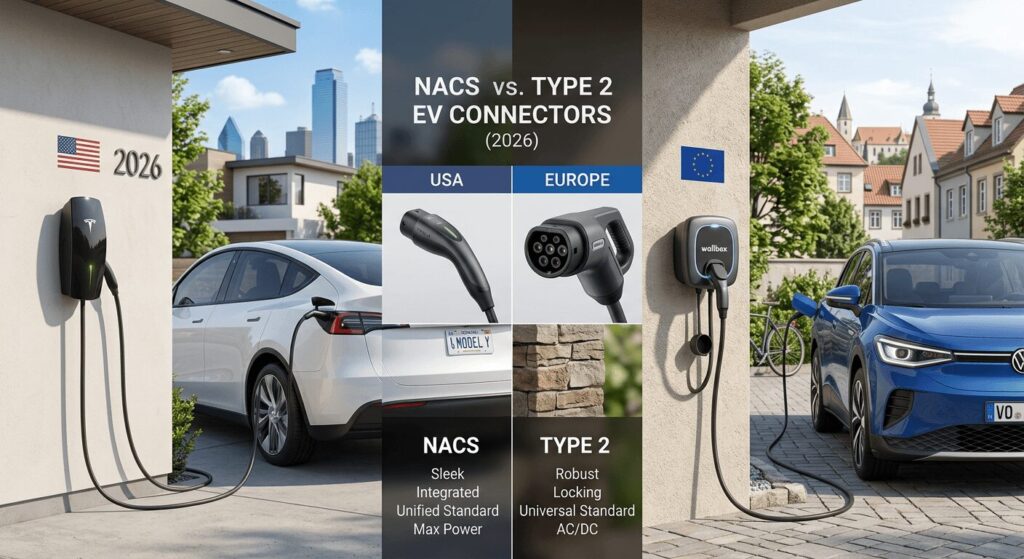
NACS (North American Charging Standard) is the connector and communication standard originally developed by Tesla for their Supercharger network. It was adopted as a formal SAE standard (SAE J3400) in 2023 and has since become the dominant new-vehicle charging connector standard across North America.
What NACS covers:
- A single compact connector that handles both AC (Level 1 and Level 2) and DC fast charging
- The physical connector design — smaller and lighter than J1772 or CCS1
- The communication protocol between charger and vehicle
- Both home charging and public fast charging from one connector type
Current NACS adoption status (2026):
- Tesla: All models, always
- Ford: All new vehicles from 2025 model year
- General Motors/Chevrolet: All new vehicles from 2025 model year
- Rivian: All new vehicles from 2025 model year
- Honda, Acura: NACS from 2025 model year
- Nissan: NACS from 2025 model year
- Toyota: NACS from 2025-2026 model year
- Hyundai/Kia: NACS from 2025 model year (US market)
- Volkswagen (US): NACS from 2026 model year
- BMW (US): NACS adapter programme, transitioning to native
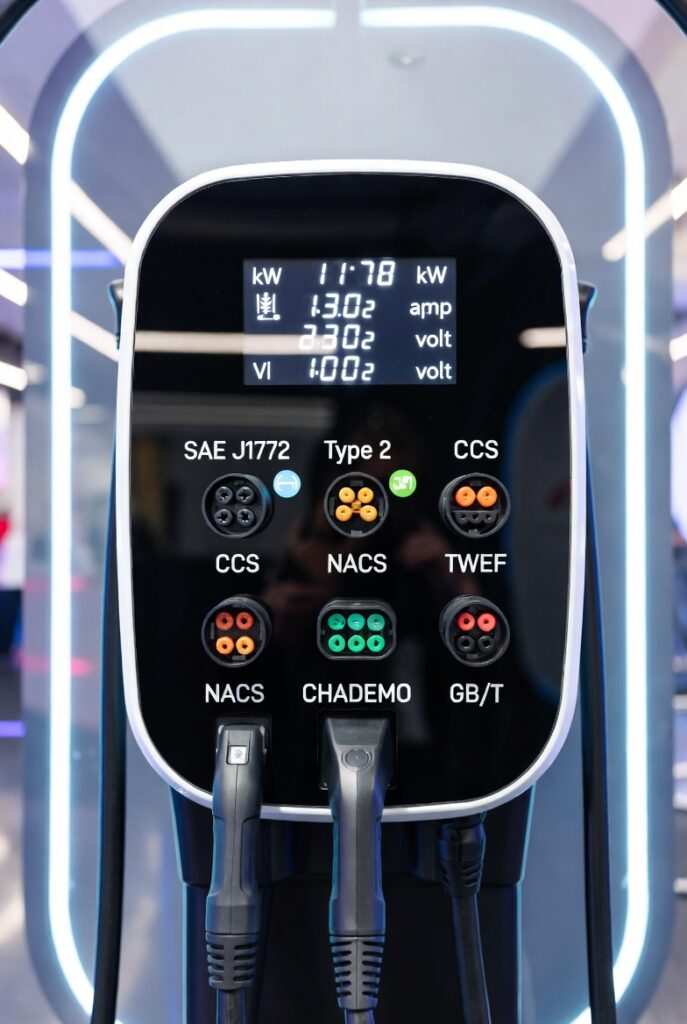
What NACS is replacing: J1772 (for AC charging) and CCS1 (for DC fast charging). Legacy J1772 and CCS1 vehicles can access NACS public charging via adapter.
What NACS is NOT: A global standard. NACS is a North American standard. It is not being adopted in Europe, Asia, or other markets. European Tesla vehicles use CCS2 — not NACS.
Type 2 — The European AC Charging Standard
Type 2 (IEC 62196-2, sometimes called Mennekes after its German designer) is the mandatory AC charging connector standard for EVs across the European Union and UK. It has been the European standard since a 2013 EU directive mandated its adoption across member states.
What Type 2 covers:
- AC charging only — single-phase (7.4 kW) or three-phase (up to 22 kW)
- The physical connector and communication protocol for AC home and public charging
- Does NOT cover DC fast charging — that’s handled by CCS2 (which adds DC pins below the Type 2 AC section)
Current Type 2 adoption status (2026):
- Every EV sold in Europe: Type 2 for AC charging, without exception
- UK: Type 2 universal
- Norway, Switzerland, Iceland: Type 2 universal
- No credible challenger to Type 2 in any European market
What Type 2 is NOT changing: Unlike the US market mid-transition from J1772 to NACS, the European Type 2 standard is not being replaced, challenged, or transitioned. It has been stable since 2013 and will remain the European standard through the foreseeable future.
The CCS2 relationship: CCS2 (Combined Charging System Type 2) adds DC fast charging pins below the Type 2 connector. Every European EV supports both Type 2 (AC) and CCS2 (DC) — they’re the same inlet with the DC pins added. This is different from the US situation where NACS is replacing both J1772 (AC) and CCS1 (DC) with a single unified connector.
The US Connector Transition — Where Things Actually Stand in 2026
The NACS vs Type 2 future-proof EV chargers US Europe 2026 comparison starts with understanding where the US connector transition actually is in 2026 — because the picture has changed significantly from 2023-2024 when the NACS announcements were being made.
The J1772 to NACS Transition Is Largely Complete for New Vehicles
As of 2026, the US EV market has effectively completed the new-vehicle transition from J1772/CCS1 to NACS. The vast majority of new EVs sold in the US from established manufacturers now use NACS natively. The exceptions are primarily:
- Some budget/entry-level vehicles from manufacturers slower to transition
- Commercial vehicles and fleet EVs which transition on different timescales
- Some imported vehicles from markets where NACS hasn’t been adopted
What this means for new US EV buyers: If you’re buying a new EV from any major US manufacturer in 2026, you almost certainly have NACS. Check your specific model’s documentation to confirm.
What this means for existing J1772/CCS1 owners: Your existing vehicle doesn’t change. J1772 and CCS1 charging infrastructure remains extensive and will continue to operate for the foreseeable future. The installed base of J1772 chargers in the US is measured in hundreds of thousands — they’re not disappearing.
The Public Charging Infrastructure Transition
Public charging infrastructure is transitioning more slowly than vehicles — which creates the adapter situation that many US EV owners are currently navigating.
Tesla Supercharger network: Fully NACS native, open to all NACS-compatible vehicles. The most reliable urban and highway fast charging network in the US now accessible to virtually all new US EVs.
Electrify America: Installing NACS connectors at existing stations alongside CCS1. New stations opening in 2026 primarily NACS native with CCS1 as legacy support.
EVgo: Similar transition — NACS installations accelerating, CCS1 maintained for legacy vehicles.
ChargePoint: Home and commercial chargers transitioning to NACS. Many existing ChargePoint Level 2 stations are J1772 — functional with NACS vehicles via adapter.
The adapter reality: NACS vehicles using J1772 public stations need the included NACS-to-J1772 adapter. J1772 vehicles accessing NACS stations need a J1772-to-NACS adapter (available from Tesla and third parties). Adapters work reliably — they’re not ideal as a permanent solution but are functional.
What the J1772 Legacy Means for Home Charger Buying
Here’s the specific implication of the US connector transition for home charger buying decisions — which is where the NACS vs Type 2 future-proof EV chargers US Europe 2026 question becomes most practically relevant.
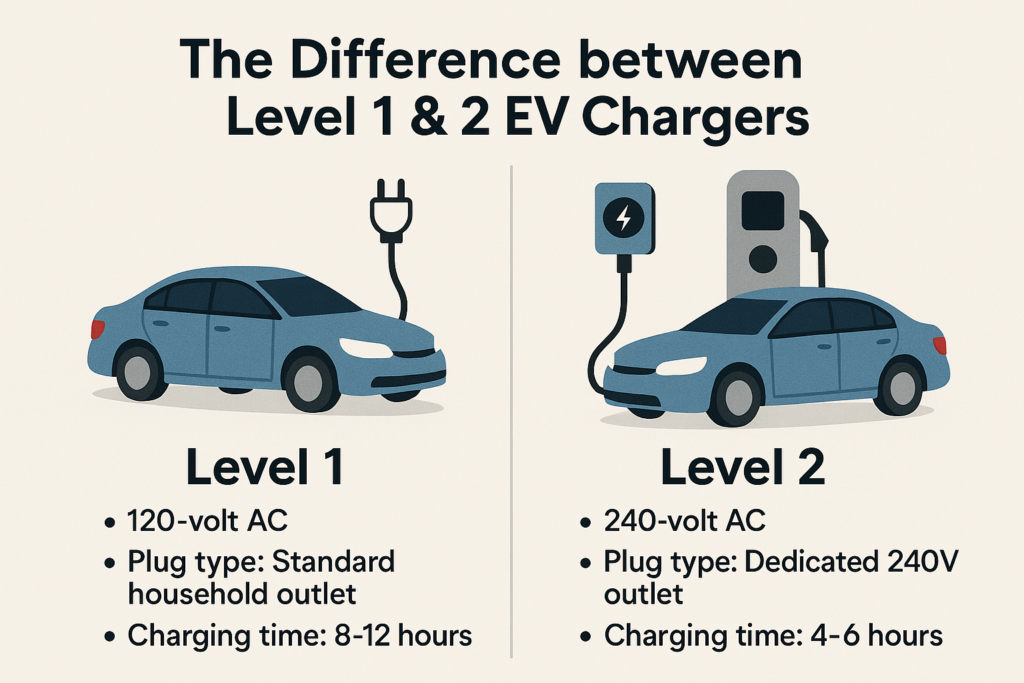
Scenario A: You have a NACS vehicle now. Buy a NACS home charger. No adapter needed. The cleanest solution. Tesla Wall Connector, Emporia Pro (NACS version), or any NACS-native home charger.
Scenario B: You have a J1772 vehicle now but plan to go NACS next. Two options:
- Buy a J1772 charger now and a NACS charger when you change vehicles — two purchases but both clean native connections
- Buy a dual-compatible charger now — ChargePoint Home Flex with NACS adapter, or Emporia Pro which is available in both J1772 and NACS versions at the same price
Scenario C: You have a J1772 vehicle and no near-term plans to change. Buy the best J1772 charger for your needs now. The J1772 network will support your vehicle for its entire usable life — the connector doesn’t become obsolete just because newer vehicles use NACS.
Scenario D: Mixed household (one NACS, one J1772). Buy the Tesla Universal Wall Connector — includes J1772 adapter in the box — or two separate chargers if your panel and parking configuration allows.
The European Type 2 Situation — Why It’s Genuinely Simpler
The European picture for NACS vs Type 2 future-proof EV chargers US Europe 2026 is straightforward enough to state in one paragraph.
Type 2 is the European EV charging standard. It has been since 2013. It will remain so for the foreseeable future. There is no European equivalent of the J1772-to-NACS transition happening. Tesla uses CCS2 in Europe (not NACS). Every other manufacturer uses CCS2 for DC fast charging and Type 2 for AC charging. A Type 2 home charger you buy today will work with every EV sold in Europe for the next decade without any adapter or compatibility concern.
The only nuance worth noting: the occasional question about whether NACS might eventually expand globally. The honest answer is that as of 2026 there is no credible evidence that NACS is being adopted in Europe, Asia, or any market outside North America. European manufacturers, the EU regulatory framework, and the established CCS2 infrastructure all point to Type 2/CCS2 remaining the European standard. A European EV owner who buys a Type 2 home charger in 2026 is making a future-proof purchase.
What “Future-Proof” Actually Means for a Home EV Charger
This is the core question and it’s worth answering precisely rather than vaguely.
A home EV charger is “future-proof” if it can charge the next EV you own without requiring significant hardware replacement or significant adapter complexity.
There are four dimensions of future-proofing that matter:
Dimension 1: Connector Compatibility
US buyers: A NACS charger is future-proof for the US market — all current and foreseeable new US vehicles use NACS natively. A J1772 charger works for current J1772 vehicles but will require an adapter for future NACS vehicles. Most J1772 chargers remain functional with adapters — they’re not obsolete, just slightly less clean.
European buyers: Any Type 2 charger is future-proof. No transition is happening. No adapter will ever be required for a European EV on a Type 2 charger.
Dimension 2: Power Level
A charger that can only deliver 32A (7.2 kW) might become a bottleneck if your next EV accepts 48A (11.5 kW) or higher. In Europe, a 7.4 kW single-phase charger might limit your next vehicle if it has 11 kW three-phase capability and you upgrade your home supply.
Future-proof power spec for US: A 48A (11.5 kW) NACS charger covers the maximum AC acceptance rate of all current and announced US EVs. The ChargePoint Home Flex’s adjustable amperage (16-48A) adds additional future-proofing by accommodating different vehicles’ different ceilings.
Future-proof power spec for Europe: An 11 kW three-phase Type 2 charger covers the AC maximum of all current mainstream European EVs (most are 7.4-11 kW). A 22 kW three-phase charger adds headroom for the few vehicles (Renault Zoe, Porsche Taycan with upgrade, Lucid Air) that accept 22 kW AC.
Dimension 3: Smart Feature Software Longevity
A charger’s smart features are only as good as the software supporting them. Brands that cease operations, stop updating firmware, or abandon their app ecosystem create functional problems even when the hardware is physically fine.
Established brands with credible software longevity:
- Tesla: The strongest software track record of any EV charger brand
- ChargePoint: The largest US charging network — their home charger software is tightly integrated with their broader network business
- Wallbox: Well-funded Spanish company with strong European market presence
- Myenergi: UK company with dedicated solar integration ecosystem
Newer brands with less established track records:
- Emporia: Excellent value and features but newer brand without the decade-long track record of ChargePoint
- Grizzl-E: Primarily hardware-focused — smart features are less central to their value proposition
Dimension 4: Bidirectional Charging Readiness
V2H (vehicle-to-home) and V2G (vehicle-to-grid) technology is moving from concept to accessible reality faster than most buyers anticipated two years ago. A charger with bidirectional hardware readiness has a longer useful life than one without — particularly for premium EV owners whose vehicles are increasingly bidirectional capable.
US bidirectional-ready chargers: The Tesla Wall Connector’s roadmap for V2H capability on compatible Teslas is the most credible. No standard US home charger is currently actively bidirectional.
European bidirectional-ready chargers: Wallbox Pulsar Plus is the most credible bidirectional roadmap among mainstream European home chargers. The Wallbox Commander 2 is the current premium bidirectional-capable option.
The Future-Proof Charger Recommendations — US Market
Best Future-Proof NACS Home Charger — Tesla Wall Connector
Price: $425 Connector: NACS Why it’s future-proof: Every new US EV uses NACS. The Tesla Wall Connector uses NACS natively. No adapter required for any current or foreseeable future US vehicle. Tesla’s software track record is the strongest of any charger brand. The 4-year warranty is the longest standard coverage available.
The one limitation: No J1772 compatibility without the Tesla Universal Wall Connector ($595) or a separate adapter purchase. For households with a current J1772 vehicle transitioning to NACS, the Universal Wall Connector is the more future-proof choice.
Best Future-Proof Dual-Compatible US Charger — ChargePoint Home Flex
Price: $699 Connector: J1772 (NACS adapter available separately) Why it’s future-proof:
- Adjustable amperage (16-48A) accommodates different vehicles’ different charging ceilings
- OCPP 1.6 compliance enables integration with future smart grid programmes
- ChargePoint’s network infrastructure means software support is tied to their ongoing business rather than a standalone charger product
- NEMA 14-50 plug option allows physical relocation if parking configuration changes
The one limitation: J1772 native means NACS vehicles need an adapter. Less clean than a native NACS charger for households already on NACS.
Best Future-Proof Value US Charger — Emporia Pro
Price: $399 Connector: NACS or J1772 (both available at same price) Why it’s future-proof:
- Available in NACS native — buy the right connector for your vehicle
- Solar integration future-proofs against rising grid electricity costs
- Load management adapts to different vehicles’ different draw rates
- NEMA 14-50 plug option allows relocation
The limitation: Newer brand with less established software longevity track record than ChargePoint or Tesla.
The Future-Proof Charger Recommendations — European Market
Best Future-Proof European Home Charger — Wallbox Pulsar Plus
Price: £649-£799 (UK); €699-€849 (Europe) Connector: Type 2 Why it’s future-proof:
- Type 2 is universal in Europe — no transition risk whatsoever
- Bidirectional charging hardware readiness — the most credible V2H roadmap of any mainstream European home charger
- Available in single-phase (7.4 kW) and three-phase (22 kW) versions — buy the right power level for your home supply
- Wallbox is well-funded with strong European market presence — credible software longevity
The limitation: 2-year warranty is shorter than the Myenergi Zappi or Easee One.
Best Future-Proof European Charger for Solar Owners — Myenergi Zappi
Price: £699-£849 (UK); €749-€899 (Europe) Connector: Type 2 Why it’s future-proof:
- Type 2 universal compatibility across all European EVs
- Solar divert capability becomes more valuable as solar adoption grows — a feature that appreciates in relevance over time
- Myenergi ecosystem integration (Eddi, Libbi) creates a whole-home energy management context that extends the charger’s functional value
- 3-year warranty
The limitation: No bidirectional charging roadmap.
Best Future-Proof European Charger for Three-Phase Owners — Easee One
Price: £549-£649 (UK); €499-€649 (Europe) Connector: Type 2 (untethered socket) Why it’s future-proof:
- Available in 22 kW three-phase — covers the maximum AC capability of any current or announced European EV
- Untethered socket means the cable is the wearing component rather than the installed unit — change cables as connector standards evolve (though Type 2 isn’t evolving)
- Dynamic load sharing between multiple units future-proofs for multi-EV households
- 3-year warranty
The limitation: Smaller UK installer network than Wallbox.
Cross-Market Compatibility — What Happens When US and European EV Worlds Intersect
The NACS vs Type 2 future-proof EV chargers US Europe 2026 question has a specific dimension for buyers who operate across both markets — either through travel, relocation, or grey-market vehicle imports.
Taking a NACS Vehicle to Europe
A US NACS vehicle (Tesla, Ford, GM, Rivian) in Europe faces a compatibility challenge:
- European public AC stations use Type 2 — NACS vehicles need a NACS-to-Type-2 adapter
- European DC fast charging uses CCS2 — NACS vehicles need a NACS-to-CCS2 adapter (complex, not widely available)
- European Tesla Superchargers use CCS2 (not NACS) — Tesla NACS vehicles in Europe need the CCS2 adapter
The practical implication: Taking a US NACS vehicle to Europe for extended use is technically possible but adapter-dependent and DC fast charging is particularly inconvenient. For occasional travel this is manageable. For long-term European use of a US-spec vehicle, the adapter complexity is a genuine operational inconvenience.
Taking a Type 2 European Vehicle to the US
A European Type 2 vehicle in the US:
- US public AC Level 2 stations use J1772 or NACS — Type 2 vehicle needs a J1772-to-Type-2 or NACS-to-Type-2 adapter
- US DC fast charging uses CCS1 or NACS — European CCS2 vehicles need adapters (CCS2-to-CCS1 is complex and uncommon; CCS2-to-NACS is emerging)
The practical implication: Same asymmetry as the US-to-Europe direction. Manageable for AC charging with adapters. DC fast charging cross-compatibility is the genuinely difficult part.
The Global Standard Question
Will there ever be a single global EV charging standard?
The honest 2026 answer: not in the foreseeable future. The US and Europe have invested too heavily in their respective standards infrastructure. The automotive manufacturers selling in both markets support both standards separately. The EU regulatory framework explicitly mandates Type 2/CCS2. NACS is explicitly a North American standard.
For US buyers: future-proof means NACS for the US market specifically. For European buyers: future-proof means Type 2 for the European market specifically. For buyers operating across both: two separate setups is the practical reality — there is no single charger that is native in both markets.
The Adapter Question — How Much Does It Actually Matter?
Adapters come up constantly in NACS vs Type 2 future-proof EV chargers US Europe 2026 discussions and the honest assessment is nuanced.
Adapters work reliably. A NACS-to-J1772 adapter for using a NACS vehicle on a J1772 home charger works without any meaningful performance degradation. A Type 2-to-CEE adapter for using a European EVSE at a CEE socket works perfectly. The electrical and communication protocols are preserved through well-designed adapters.
Adapters add wear over time. Every adapter connection is an additional mechanical interface that experiences wear with repeated use. A J1772 adapter used daily for 5-7 years at a home charger will show wear at the connection points in a way that a native connection doesn’t. This is a real consideration for daily home charging — less significant for occasional public charging.
Adapters add complexity. Forgetting an adapter when you need it, storing it in the car or with the charger, and managing multiple adapters for different scenarios adds operational complexity that a native connection eliminates.
The honest bottom line on adapters: For home charging — where you use the same charger daily for 5-10 years — native connector compatibility is genuinely preferable to adapter dependency. Buy the right connector for your vehicle today. For public charging — where adapters are used occasionally and the adapter lives in the car — the adapter solution is workable.
The Five-Year Outlook — What the Connector Landscape Looks Like in 2031
Understanding where the NACS vs Type 2 future-proof EV chargers US Europe 2026 landscape is heading helps calibrate how much to invest in future-proofing now.
United States — 2031 Outlook
By 2031, the US EV market will be essentially fully NACS for new passenger vehicles. The J1772 legacy installed base will still be operational — hundreds of thousands of Level 2 stations don’t get retired just because new vehicles use different connectors. J1772-to-NACS adapters will continue to be available and functional.
Implication: A NACS home charger bought in 2026 is the right long-term investment for the US market. A J1772 charger bought in 2026 will work throughout its hardware lifespan with adapters for future NACS vehicles — but native NACS is cleaner.
The bidirectional dimension: By 2031, V2H and V2G capability is likely to be more mainstream for premium US EV owners. A charger with bidirectional hardware readiness — or the ability to upgrade to bidirectional capability — will be more valuable in 2031 than in 2026.
Europe — 2031 Outlook
By 2031, Type 2/CCS2 will remain the European standard. No credible transition is underway. The EPBD requirements mandating Type 2 infrastructure in new buildings ensures continued investment in the standard. Tesla’s European Supercharger network uses CCS2 and will continue to.
Implication: A Type 2 home charger bought in 2026 is fully future-proof for Europe through 2031 and beyond. No adapter complexity, no transition risk, no compatibility concern.
The 22 kW question: By 2031, more European EVs may support 22 kW AC charging (currently limited to a few models). A 22 kW three-phase Type 2 charger bought in 2026 for a vehicle currently limited to 11 kW AC will fully utilise its capacity with a future 22 kW vehicle — genuine future-proofing for European three-phase owners.
Head to Head — NACS vs Type 2 Future-Proof EV Chargers US Europe 2026
| Dimension | NACS (US) | Type 2 (Europe) |
|---|---|---|
| New vehicle compatibility 2026 | All new US EVs | All European EVs |
| Transition risk | Low — transition complete | None — standard stable since 2013 |
| Adapter requirement | Needed for legacy J1772 vehicles | Never needed |
| DC fast charging | Integrated (NACS handles AC + DC) | Separate (CCS2 for DC) |
| Home charger longevity | 7-10 years with native vehicles | 10+ years, no compatibility risk |
| Three-phase capability | No (US single-phase only) | Yes (up to 22 kW) |
| Bidirectional readiness | Emerging (Tesla roadmap) | Emerging (Wallbox Pulsar Plus) |
| Global compatibility | North America only | Europe/UK only |
| Future standard risk | Minimal | Negligible |
Internal Links — Further Reading on Clean Energy Bazaar
The NACS vs Type 2 future-proof EV chargers US Europe 2026 comparison is the connector foundation. These guides cover every practical dimension.
For the specific J1772 vs Type 2 technical comparison including pin configurations, locking mechanisms, and cross-market adapter scenarios, our J1772 vs Type 2 connector guide covers every compatibility scenario in detail. For the full US home charger market with NACS-native options highlighted, our best home EV chargers 2026 US comparison covers ten options honestly. For the UK and European market, our best Level 2 EV chargers UK Europe 2026 guide covers every major option. For Tesla Model Y and Model 3 owners specifically navigating the NACS connector decision, our best home chargers Tesla Model Y Model 3 2026 guide covers the full picture. For understanding every charging spec beyond the connector, our EV charger specs 2026 guide translates everything into plain language. And for the smart EV charger features comparison that affects future-proofing through software, our smart EV chargers 2026 features worth the cost guide gives specific payback timelines.
Final Thoughts
The NACS vs Type 2 future-proof EV chargers US Europe 2026 question has different answers for different buyers — but clearer answers than most guides admit.
For US buyers: NACS is the future-proof connector standard. If you have a NACS vehicle now, buy a NACS charger. If you have a J1772 vehicle now but plan to go NACS next, either buy a dual-compatible charger (ChargePoint Home Flex, Tesla Universal Wall Connector) or accept a clean J1772 charger now and replace it when you change vehicles. J1772 chargers are not obsolete — they work perfectly for J1772 vehicles and work with NACS vehicles via adapter.
For European buyers: Type 2 is the future-proof connector standard. Full stop. There is no transition happening, no competing standard emerging, and no adapter complexity to manage. Buy the best Type 2 charger for your needs and don’t worry about connector future-proofing at all.
For buyers on the fence between markets: Accept that there is no single charger that is natively future-proof in both the US and European markets. NACS and Type 2 are different standards serving different markets. A charger that’s future-proof in Chicago is not the same charger that’s future-proof in Munich.
The best future-proof EV charger is the one that matches your market, your vehicle’s connector, your home’s power supply, and your realistic usage pattern — bought from a brand with credible software support longevity and installed to a standard that doesn’t create problems if you sell your home in five years.