Here’s a conversation that plays out every month in EV owner communities across the US and Europe.
Someone posts their electricity bill. It’s higher than they expected since getting the EV. They ask how everyone else manages charging costs. The replies flood in — switch to Octopus Go, try the PG&E EV2-A rate, get the Ohme Pro for Agile, the Zappi does it automatically. The original poster now has six conflicting recommendations and no idea which actually saves the most money for their specific situation.
The confusion is understandable. Time-of-use EV charging savings smart chargers that cut bills in US and Europe is a topic that involves three interacting variables — your electricity tariff, your charger’s scheduling capability, and your driving pattern — and getting all three right determines how much you actually save versus how much is theoretically possible.
This guide cuts through that confusion. It covers every major TOU tariff in the US and European markets that EV owners should know about. It compares which smart chargers integrate with each tariff most effectively. It gives you specific, honest savings figures based on real rate differentials rather than marketing claims. And it tells you the single most important action in the entire TOU optimisation picture — which isn’t buying a particular charger, but choosing the right tariff first.
Why Time-of-Use Savings Are the Biggest Lever in EV Charging Economics
Before getting into specific tariffs and chargers, understanding why TOU scheduling is so financially significant puts the rest of the guide in context.
The Rate Differential Is Enormous
Standard residential electricity rates in the US range from $0.12-$0.35/kWh depending on state and utility. Standard UK residential rates are approximately 24-28p/kWh. Standard German residential rates are €0.30-€0.40/kWh.
Off-peak TOU rates specifically designed for EV charging are dramatically lower:
- US overnight TOU rates: $0.05-$0.12/kWh
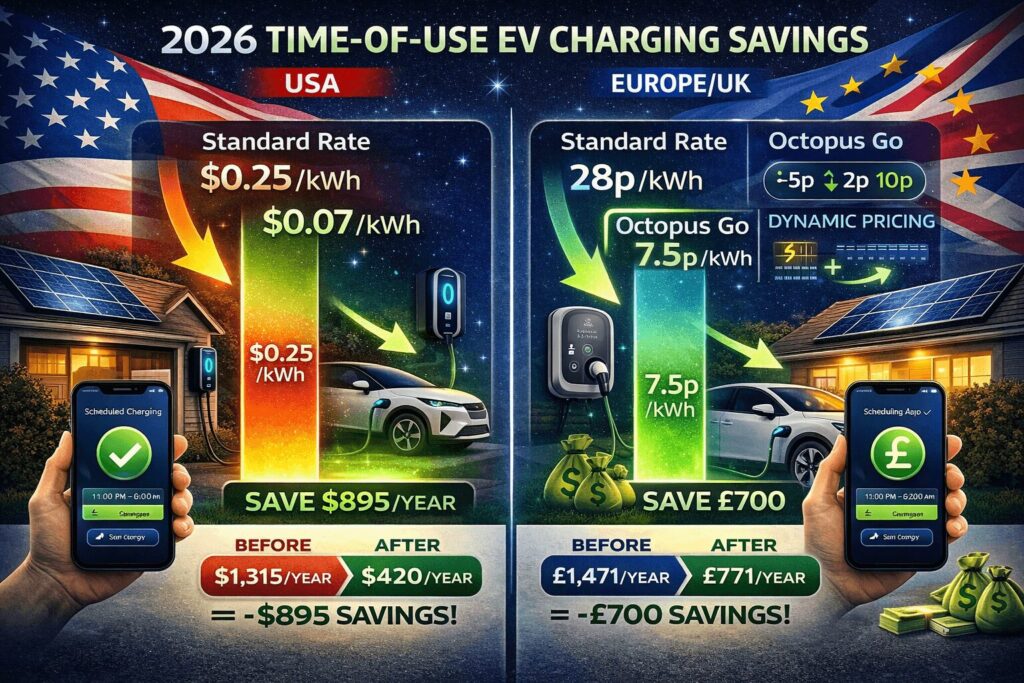
- UK Octopus Go overnight rate: 7.5p/kWh
- UK Octopus Agile cheapest periods: sometimes negative (grid pays you)
- German overnight Tarif: €0.15-€0.22/kWh where available
- Norwegian overnight: NOK 0.30-0.60/kWh (€0.03-0.06/kWh at current rates during surplus periods)
The rate differential between peak and off-peak in the UK is 16-20p/kWh. In the US, the differential is $0.07-$0.20/kWh depending on utility and plan. In Germany, the differential is €0.10-€0.20/kWh.
The Annual Saving on Typical EV Usage
UK example (10,000 miles/year, standard vs Octopus Go):
- Annual kWh drawn from charger: 3,594 kWh
- Standard rate (28p): £1,006/year
- Octopus Go rate (7.5p): £270/year
- Annual saving: £736
- 5-year saving: £3,680
US example (15,000 miles/year, standard vs TOU off-peak):
- Annual kWh drawn from charger: 4,929 kWh
- Standard rate ($0.16/kWh): $789/year
- Off-peak TOU rate ($0.08/kWh): $394/year
- Annual saving: $395
- 5-year saving: $1,975
German example (15,000 km/year, standard vs night tariff):
- Annual kWh drawn: 3,136 kWh
- Standard rate (€0.35/kWh): €1,098/year
- Night tariff (€0.20/kWh): €627/year
- Annual saving: €471
- 5-year saving: €2,355
These are not marginal savings. They are the most financially significant variable in home EV charging economics — larger than hardware choice, larger than installation cost, larger than standby efficiency. The tariff you’re on determines most of your electricity bill. The smart charger enables you to benefit from the better tariff automatically.
Understanding TOU Tariffs — The Different Types and How They Work
Not all TOU tariffs work the same way and the type of tariff you’re on determines which smart charger features deliver the most value.
Type 1: Fixed Window TOU (Most Common)
A fixed window TOU tariff has designated cheap periods at the same times every day — typically overnight. You pay the cheap rate during these windows and the standard rate outside them.
Examples:
- Octopus Go (UK): Cheap rate 11:30pm-5:30am, every day
- PG&E EV2-A (California): Cheap rate 11pm-9am, every day
- Xcel Energy EV rate (Colorado): Cheap overnight window
- Most US utility TOU tariffs: similar overnight windows
What you need from a charger: Basic scheduled charging — set it to charge during the cheap window, stop charging outside it. Any smart charger with a scheduling function handles this. Even the car’s built-in timer handles this adequately.
The financial value of the smart charger vs car timer: Minimal for fixed window TOU. A Hyundai Ioniq 5’s built-in charging timer does the same job as a £749 Hypervolt Home 3 Pro for fixed overnight window tariffs. The charger’s scheduling capability adds convenience but not unique financial value.
Type 2: Dynamic Real-Time Pricing (Most Financially Valuable)
A dynamic pricing tariff has electricity prices that change frequently — sometimes every 30 minutes — based on wholesale electricity market conditions. Prices can be very low (or negative) at times of high renewable generation and very high during demand peaks.
Examples:
- Octopus Agile (UK): Prices change every 30 minutes, set the night before based on wholesale markets. Can range from -15p/kWh (grid pays you) to 80p+/kWh during extreme peaks.
- ComEd real-time pricing (Illinois): Hourly price changes based on wholesale market
- Some Texas retail electricity providers: Real-time or hourly pricing
- Norwegian spot price electricity: Near-real-time wholesale pricing
What you need from a charger: Direct API integration with the tariff’s pricing data to automatically schedule charging during the cheapest half-hour windows. A car’s built-in timer can’t do this — it only knows fixed time windows. A charger with static scheduling captures most of the overnight savings but misses the optimal dynamic windows.
The financial value of the smart charger vs car timer: Significant for dynamic tariffs. The Ohme Home Pro’s direct Octopus Agile API integration captures £50-£150 more annual savings than a basic scheduled charger on the same tariff, by identifying and using the cheapest specific half-hour slots rather than a fixed overnight window.
Type 3: Demand Response / VPP Tariffs (Emerging)
Demand response tariffs pay you bill credits for allowing your charger (or EV battery) to be temporarily reduced during grid stress events. Virtual Power Plant programmes in California, Texas, and New York pay participants for grid services.
Examples:
- PG&E’s VPP programme (California)
- CPS Energy demand response (San Antonio)
- Austin Energy demand response programme
- UK Smart Export Guarantee (relevant when V2G becomes mainstream)
What you need from a charger: OCPP compliance and utility API integration for automated demand response participation. Most current home chargers handle this through utility partnership programmes rather than direct charger-level integration.
US TOU Tariffs — The Ones EV Owners Should Know About
California — PG&E EV2-A
Territory: Pacific Gas and Electric service area (most of Northern and Central California)
Rate structure:
- Off-peak: $0.07/kWh (11pm-9am, all days)
- Mid-peak: $0.16/kWh (various periods)
- On-peak: $0.35-$0.55/kWh (4pm-9pm, peak season)
Annual saving on typical charging (15,000 miles, all overnight): Standard rate ($0.25/kWh typical PG&E blended) vs EV2-A off-peak ($0.07/kWh): 4,929 kWh × ($0.25 – $0.07) = $887 annually
Best charger for PG&E EV2-A: Any smart charger with scheduling — ChargePoint Home Flex, Emporia Pro, Tesla Wall Connector. The fixed 11pm-9am window is handled equally well by all scheduled chargers. Prioritise other criteria (solar integration, load management) over tariff-specific features for EV2-A.
CARE/FERA programme: PG&E’s income-qualified programmes offer further rate reductions for qualifying households — EV2-A rates can drop to approximately $0.04/kWh off-peak for CARE participants.
California — SCE TOU-D-PRIME
Territory: Southern California Edison service area
Rate structure:
- Super off-peak: $0.11/kWh (8am-4pm, summer; all year on weekends and holidays)
- Off-peak: $0.16/kWh (various)
- On-peak: $0.38-$0.52/kWh (4pm-9pm)
An interesting SCE wrinkle: The TOU-D-PRIME “super off-peak” rate applies during the day (8am-4pm) — during solar generation hours. This creates a specific opportunity for solar-owning EV owners to charge from the grid at the cheapest rate during solar generation hours rather than exclusively from solar surplus. The Emporia Pro’s solar integration can optimise this — charging from grid during the super off-peak window and from solar surplus the rest of the time.
Best charger for SCE TOU-D-PRIME: Emporia Pro (solar + flexible scheduling handles the daytime super off-peak opportunity), or ChargePoint Home Flex for non-solar households.
Texas — Austin Energy Value and Time-of-Use
Territory: Austin Energy service area (City of Austin)
Rate structure:
- Off-peak: $0.024/kWh (9pm-noon, the cheapest EV charging rate of any major US utility)
- On-peak: $0.124/kWh (noon-9pm)
Annual saving on typical charging: Standard vs off-peak ($0.024/kWh): 4,929 kWh × ($0.15 – $0.024) = $621 annually
Austin Energy’s TOU rate is among the cheapest in the US for off-peak electricity. Combined with Austin Energy’s EV hardware rebate (up to $1,200), it creates one of the most financially compelling EV charging environments in America.
Best charger for Austin Energy TOU: Any smart charger with overnight scheduling. The Emporia Pro’s load management is particularly relevant given Texas’s electrical infrastructure vulnerabilities.
New York — Con Edison EV Rate
Territory: Consolidated Edison service area (New York City and Westchester)
Rate structure:
- Off-peak: $0.07-$0.10/kWh (11pm-7am)
- On-peak: $0.28-$0.40/kWh
Annual saving on typical charging: 4,929 kWh × ($0.25 – $0.08) = $838 annually
Best charger for Con Edison EV rate: ChargePoint Home Flex (good OCPP compliance for Con Edison’s smart grid programmes), JuiceBox 48 (Enel X Way’s utility partnership relationships are strong with Con Edison’s parent company).
Colorado — Xcel Energy EV Accelerate Home
Territory: Xcel Energy Colorado service area
Rate structure:
- Off-peak: approximately $0.05-$0.08/kWh (overnight)
- Standard: approximately $0.13/kWh
Additional feature: Xcel’s Smart Charging programme provides a monthly bill credit for participants who charge during designated overnight hours and allow occasional demand response events.
Best charger for Xcel Colorado: ChargePoint Home Flex (OCPP compliance enables Xcel demand response participation), Emporia Pro (for solar + TOU optimisation).
Illinois — ComEd Real-Time Pricing
Territory: Commonwealth Edison service area (Chicago and northern Illinois)
Rate structure: Hourly real-time pricing based on wholesale market. Prices typically range from $0.02-$0.08/kWh overnight to $0.20-$0.50+/kWh during demand events.
What makes ComEd different: Real-time pricing in Illinois creates the closest US equivalent to Octopus Agile in the UK. The financial value of dynamic optimisation — charging during the cheapest specific hours — is meaningful.
Best charger for ComEd real-time pricing: A charger with OCPP compliance and the ability to integrate with ComEd’s pricing API. ChargePoint Home Flex (OCPP 1.6) is the most accessible current option. As OCPP 2.0.1 chargers become more available, they’ll provide better real-time pricing integration.
UK TOU Tariffs — The Ones EV Owners Should Know About
The UK has the most developed EV-specific smart tariff market in the world. The combination of Octopus Energy’s products, other challenger energy suppliers, and established utilities creates genuine choice for UK EV owners.
Octopus Go — The Most Accessible UK EV TOU Tariff
Provider: Octopus Energy
Rate structure:
- Off-peak: 7.5p/kWh (11:30pm-5:30am, every day)
- Standard: approximately 24-28p/kWh (all other times)
Annual saving on typical charging (10,000 miles/year): Standard (28p) vs Octopus Go (7.5p): 3,594 kWh × (28p – 7.5p) = £737/year
What makes Octopus Go special: The rate differential is exceptional — charging at 7.5p versus the standard 28p rate is a 73% reduction in charging electricity cost. For most UK EV owners, switching to Octopus Go is the single highest-ROI action they can take.
Charger compatibility: Any charger with overnight scheduling works with Octopus Go — the fixed 11:30pm-5:30am window is handled by basic scheduling. The car’s built-in timer also works. A smart charger adds convenience (automatic departure-time optimisation) but isn’t required for the core Octopus Go saving.
Best charger for Octopus Go: Myenergi Zappi (integrates with Octopus API for seamless scheduling, adds solar divert for additional savings), Wallbox Pulsar Plus (good app scheduling, bidirectional readiness for future V2G with Octopus). The Ohme Home Pro’s direct Octopus API integration is the cleanest implementation but the fixed Octopus Go window makes it less differentiating than on Agile.
Octopus Agile — The Most Financially Sophisticated UK EV Tariff
Provider: Octopus Energy
Rate structure: Prices change every 30 minutes based on wholesale electricity market. Prices are set the afternoon before and can range from approximately -15p/kWh (negative — grid pays you to use electricity) to 80p+/kWh during demand events.
Annual saving potential (10,000 miles/year, optimal Agile scheduling): By consistently charging during the cheapest Agile windows (typically 2am-5am in winter, variable in summer): Average achieved rate: approximately 5-10p/kWh for well-optimised Agile charging Standard (28p) vs Agile optimal (7p): 3,594 kWh × (28p – 7p) = £755/year
The annual saving is similar to Octopus Go — but Agile provides additional opportunities during negative price periods and can occasionally provide even cheaper charging than Go’s fixed 7.5p.
What makes Agile different: The potential to charge during negative price periods (when Octopus pays you to charge). In a typical UK year, there are 100-200 hours of negative Agile pricing — mostly during periods of high wind generation when supply exceeds demand. Consistently charging during these periods adds £20-£50 annually in additional savings beyond what even Octopus Go delivers.
Why Agile needs a smarter charger than Go: The 30-minute pricing windows require real-time API integration to optimise. A car’s built-in timer set to “charge 11pm-6am” captures most overnight savings but misses the specific cheapest 30-minute windows within that period. An Ohme Home Pro with Agile API integration automatically finds and uses the cheapest specific windows — capturing £50-£150 more annually than a basic scheduled charger on the same tariff.
Best charger for Octopus Agile: Ohme Home Pro — the most direct and seamless Agile API integration of any mainstream UK home EV charger. The Myenergi Zappi also integrates with Octopus APIs and adds solar divert for additional savings.
OVO Drive Anytime
Provider: OVO Energy
Rate structure:
- EV charging: 7p/kWh at any time using a compatible charger (not time-restricted)
- Available via smart charger session identification
What makes OVO Drive Anytime different: Unlike Octopus Go’s overnight-only cheap rate, OVO Drive Anytime provides the cheap rate any time your compatible EV charger initiates a session — not just overnight. The charger communicates to OVO’s system that it’s an EV charging session, triggering the 7p rate.
Annual saving (10,000 miles/year): 3,594 kWh × (28p – 7p) = £755/year — same saving as Octopus Go but available at any time of day.
Best charger for OVO Drive Anytime: Compatible chargers specifically listed on OVO’s website. The Ohme Home Pro has strong OVO integration. Always check OVO’s current approved charger list as it changes with new partnerships.
British Gas Electric Driver
Provider: British Gas
Rate structure:
- Off-peak EV rate: approximately 7-8p/kWh (overnight)
- Standard rate: approximately 25-28p/kWh
Annual saving: Similar to Octopus Go at comparable usage levels.
Best charger for British Gas Electric Driver: Chargers with British Gas API integration — check British Gas’s current approved charger list. The Hypervolt Home 3 Pro has good British Gas integration.
E.ON Next Drive
Provider: E.ON Next (formerly E.ON UK)
Rate structure:
- Off-peak: approximately 8p/kWh overnight
- Standard: approximately 24-28p/kWh
Best charger for E.ON Next Drive: Any scheduled smart charger. Hypervolt has specific E.ON Next integration.
European TOU Tariffs — Key Markets
France — Heures Creuses (Off-Peak Hours)
Provider: EDF and most French electricity suppliers
Rate structure: Heures Creuses (off-peak hours) — typically 8 hours overnight, set by the local distribution network:
- Off-peak: approximately €0.13-€0.16/kWh
- Peak: approximately €0.22-€0.28/kWh
Annual saving (15,000 km/year): 3,136 kWh × (€0.25 – €0.14) = €345/year
How it works in France: French Heures Creuses times are programmed into the electricity meter and published for each address. Your off-peak hours may differ from your neighbour’s — they’re set by the local transformer’s load management. Check your EDF contract or meter documentation for your specific off-peak hours.
Best charger for Heures Creuses: Any smart charger with scheduling. The Wallbox Pulsar Plus, Easee One, and Myenergi Zappi all handle French Heures Creuses scheduling competently.
Netherlands — Dynamic Electricity Pricing
The Netherlands has a growing market for dynamic electricity pricing — similar in concept to Octopus Agile, with hourly prices based on wholesale market conditions.
Providers: Tibber, Frank Energie, Energie Samen, and others offer dynamic pricing to Dutch consumers.
Rate structure: Hourly prices set day-ahead based on EPEX wholesale market. Can range from €0.01-€0.05/kWh during solar surplus periods to €0.35-€0.60/kWh during demand peaks.
Annual saving potential: Similar to Octopus Agile in principle — consistently charging during cheap hours delivers significantly lower effective rates than standard tariffs.
Best charger for Dutch dynamic pricing: Chargers with OCPP compliance and dynamic pricing API integration. The Easee One’s OCPP 1.6 compliance enables integration with Dutch dynamic pricing providers through compatible energy management systems.
Norway — Spot Price Electricity
Norway context: Norway’s electricity market is unique — nearly 90% of generation is hydropower, and wholesale electricity prices (Nordpool spot) are among the lowest and most variable in Europe. Residential electricity prices in Norway closely track wholesale spot prices.
Rate structure: Hourly Nordpool spot prices plus grid charges. Spot prices can be near-zero or negative during periods of high hydro generation and can spike to €0.20-€0.30/kWh during cold weather when heating demand is high.
Annual saving potential: Norwegian EV owners who charge during low-price hours (typically overnight or when prices are below 5 øre/kWh) versus peak hours can save NOK 500-1,500 annually (€45-€135) depending on usage and spot price variance.
Best charger for Norwegian spot pricing: Chargers with Tibber API integration — Tibber is the leading Norwegian dynamic electricity provider with seamless EV charger integration. The Easee One was specifically designed with Norwegian market conditions in mind and has strong Tibber integration.
Germany — Time-of-Use Tariffs (Limited Availability)
Germany has been slower than the UK to develop consumer EV-specific TOU tariffs. Standard German residential tariffs are predominantly flat-rate — the same price regardless of time of day.
However, several dynamic pricing products are emerging:
Tibber (Germany): Available in Germany, similar to Norwegian product — hourly prices based on wholesale market.
Elli (Volkswagen Energy): VW’s energy division offers EV-specific smart charging tariffs for VW Group vehicle owners.
E.on Drive: E.on’s German EV charging tariff with some TOU features.
Annual saving potential (Germany): Limited by flat-rate tariff prevalence. Where TOU or dynamic pricing is available, savings of €200-€500 annually are achievable for 15,000 km/year drivers.
Best charger for German market: Easee One or Wallbox Pulsar Plus with OCPP compliance for integration with Tibber or other dynamic providers as they develop.
The Smart Charger TOU Integration Comparison — Which Charger Works Best With Which Tariff
This is the core practical guide that time-of-use EV charging savings smart chargers that cut bills in US and Europe buyers actually need.
US Market — Charger × Tariff Matrix
| Tariff | Best Charger | Why | Alternative |
|---|---|---|---|
| PG&E EV2-A (California) | Emporia Pro | Fixed window + solar integration maximises total saving | ChargePoint Home Flex |
| SCE TOU-D-PRIME (SoCal) | Emporia Pro | Daytime super off-peak + solar synergy | ChargePoint Home Flex |
| Austin Energy TOU | Any smart charger | Fixed window, any scheduler works | Grizzl-E Smart (budget) |
| Con Edison EV (NYC) | ChargePoint Home Flex | OCPP, Con Edison utility integration | JuiceBox 48 |
| ComEd real-time (Chicago) | ChargePoint Home Flex | OCPP 1.6 for dynamic pricing integration | Emporia Pro |
| Xcel Energy (Colorado) | ChargePoint Home Flex | OCPP for demand response participation | Emporia Pro |
| No TOU available | Emporia Pro | Load management saves panel upgrade | Grizzl-E Classic |
UK Market — Charger × Tariff Matrix
| Tariff | Best Charger | Why | Alternative |
|---|---|---|---|
| Octopus Go | Myenergi Zappi | API integration + solar divert for maximum combined saving | Ohme Home Pro |
| Octopus Agile | Ohme Home Pro | Direct Agile API integration, captures cheapest 30-min windows | Myenergi Zappi |
| OVO Drive Anytime | Ohme Home Pro | Strong OVO integration | Check OVO approved list |
| British Gas Electric Driver | Hypervolt Home 3 Pro | Good British Gas integration | Check approved list |
| E.ON Next Drive | Hypervolt Home 3 Pro | E.ON integration | Wallbox Pulsar Plus |
| Standard rate (no TOU) | Wallbox Pulsar Plus | Future-proof bidirectional for when TOU is adopted | Myenergi Zappi (solar) |
European Market — Charger × Tariff Matrix
| Country/Tariff | Best Charger | Why | Alternative |
|---|---|---|---|
| France (Heures Creuses) | Easee One | Good scheduling, competitive price | Wallbox Pulsar Plus |
| Netherlands (dynamic) | Easee One | OCPP for Tibber/dynamic integration | Zaptec Go |
| Norway (Nordpool spot) | Easee One | Designed for Norwegian market, Tibber integration | Zaptec Go |
| Germany (Tibber) | Easee One | OCPP compliance for Tibber | Wallbox Pulsar Plus |
| Spain (PVPC dynamic) | Wallbox Pulsar Plus | OCPP compliance, broad installer network | Easee One |
| Italy (standard rate) | Wallbox Pulsar Plus | Best overall, Italy’s flat rates limit TOU benefit | Easee One |
The Savings Calculator Framework — How Much Can You Actually Save?
Rather than generic figures, here’s the framework to calculate your specific TOU saving:
Step 1: Find Your Current Average Rate
Check your electricity bill for the average rate per kWh. This is your baseline.
Step 2: Find the Best Available TOU Rate in Your Area
- US: Check your utility’s website for EV-specific TOU plans. Search “[your utility] EV rate plan.”
- UK: Compare Octopus Go (7.5p overnight), OVO Drive Anytime (7p anytime), and British Gas/E.ON equivalents.
- Europe: Check Tibber availability, your country’s regulated off-peak programme, and utility-specific EV tariffs.
Step 3: Calculate Your Annual kWh
Annual miles (÷1.6 for km) ÷ your EV’s miles/kWh efficiency × 1.15 charging losses = annual kWh from charger.
Step 4: Calculate Annual Saving
(Current average rate – TOU off-peak rate) × annual kWh = annual saving
Step 5: Calculate 5-Year Saving
Annual saving × 5 = 5-year saving from TOU tariff switch
Step 6: Assess Whether a Smart Charger Upgrade Is Needed
If you’re on a fixed TOU window tariff (Octopus Go, PG&E EV2-A): Your car’s built-in timer may be sufficient. A smart charger adds convenience but marginal financial value for fixed window tariffs.
If you’re on a dynamic pricing tariff (Octopus Agile, ComEd real-time, Tibber): A smart charger with direct API integration captures £50-£150 (UK) or $75-$200 (US) additional annual savings versus a basic timer. Calculate whether this additional saving justifies the charger upgrade premium.
The Car’s Built-In Timer vs a Smart Charger — The Honest Comparison
One of the most practically important questions in time-of-use EV charging savings smart chargers that cut bills in US and Europe is whether you actually need a smart charger to benefit from TOU tariffs — or whether your car’s built-in charging timer is sufficient.
Fixed Window TOU Tariffs — Car Timer vs Smart Charger
For Octopus Go, PG&E EV2-A, and other fixed overnight window tariffs:
Car’s built-in timer: Set to charge between 11:30pm-5:30am (Octopus Go). The car charges at maximum rate during the cheap window. 100% of the TOU saving is captured. Works on any EV without any additional hardware.
Smart charger with scheduling: Same function, slightly more convenient management. The saving is identical to the car timer.
Smart charger with departure-time scheduling: Adds genuine value — the charger works backward from your departure time to minimise time-at-full-charge (which is slightly better for battery longevity) while ensuring full charge by departure. Genuinely useful. Worth approximately £0 in electricity savings but meaningful for battery care.
The honest verdict: For fixed window TOU tariffs, a smart charger adds convenience and battery management features — but not additional electricity savings. Don’t buy a £749 Wallbox specifically for Octopus Go savings — your EV’s timer captures them equally. Buy the smart charger for its other features (solar divert, load management, bidirectional readiness) and enjoy Octopus Go compatibility as a standard feature.
Dynamic Pricing Tariffs — Car Timer vs Smart Charger
For Octopus Agile, ComEd real-time, and Tibber dynamic pricing:
Car’s built-in timer: Can only set a fixed window (e.g., 11pm-7am). Captures all overnight savings within that window but can’t optimise for the specific cheapest 30-minute slots within the window. Misses negative price periods that may occur outside the configured window.
Smart charger with basic scheduling: Same as car timer for dynamic tariffs — captures fixed window savings but not dynamic optimisation.
Smart charger with direct API integration (Ohme Home Pro for Agile): Receives actual price data, identifies the cheapest specific slots, charges during those slots. Captures £50-£150 additional annual savings on Octopus Agile versus a basic overnight schedule.
The honest verdict: For dynamic tariffs, smart charger API integration delivers genuine additional value beyond what a car timer provides. The Ohme Home Pro’s Agile integration pays for its premium over a basic charger within 3-5 years for typical UK usage. For ComEd real-time or Tibber, OCPP-compliant chargers with dynamic pricing integration are the right investment.
Stacking TOU Savings With Other Smart Features
The time-of-use EV charging savings smart chargers that cut bills in US and Europe story is most financially compelling when TOU scheduling is combined with other smart features.
TOU + Solar Divert (The Most Powerful Combination)
For UK homeowners on Octopus Go with a Myenergi Zappi and solar panels:
Octopus Go saving (all overnight): £737/year Solar divert saving (30% of charging from solar): £95/year (electricity cost avoided) Combined annual saving vs standard rate, no smart features: £832/year 5-year combined saving: £4,160
For US homeowners on PG&E EV2-A with Emporia Pro + Vue and solar:
PG&E EV2-A saving (all overnight): $887/year Solar divert saving (30% from solar): $118/year Combined annual saving: $1,005/year 5-year combined saving: $5,025
The TOU + solar combination is where the financial case for a premium smart charger is most compelling — the combined savings justify even the most expensive smart charger within 1-2 years.
TOU + Load Management (The US Panel Problem Solver)
For US homeowners on TOU tariffs with 100-amp panels:
The Emporia Pro delivers TOU savings ($395/year) while simultaneously avoiding a panel upgrade ($1,500-$4,000 one-time cost) through load management.
Combined 5-year value: $1,975 (TOU) + $2,500 (panel upgrade avoided median) = $4,475
At $549-$599 total cost (Emporia Pro + Vue), the 5-year return on investment is approximately 7.5x. This is the most compelling financial case for any single smart charger feature combination in the US market.
Common TOU Mistakes That Cost EV Owners Money
Mistake 1: Staying on a Standard Tariff After Getting an EV
The single most expensive mistake. UK EV owners on standard 28p/kWh tariffs who could switch to Octopus Go at 7.5p are paying £737 more per year than necessary. The tariff switch is free. The saving is immediate.
Action: Switch to the best available EV TOU tariff in your area before your first charging session at home.
Mistake 2: Not Enabling Your Car’s Built-In Charging Timer
Buying an EV, plugging it in, and letting it charge immediately at whatever time you arrive home — paying standard rates for peak-time charging. Every mainstream EV has a built-in charging timer. It takes 10 minutes to set. Not setting it on Octopus Go costs £100-£200 annually in avoidable electricity costs.
Action: Set your car’s charging timer to your TOU off-peak window immediately. Don’t wait until you’ve bought a smart charger.
Mistake 3: Buying a Smart Charger for TOU Savings on a Fixed Window Tariff
Spending £749 on a Wallbox Pulsar Plus specifically for Octopus Go savings, when your car’s timer captures those savings equally. The Wallbox Pulsar Plus is an excellent charger — but not for this reason.
Action: Buy a smart charger for its non-TOU features (solar divert, bidirectional readiness, load management). Let TOU compatibility be a standard feature, not the purchase justification.
Mistake 4: Not Stacking All Available Savings
Getting onto Octopus Go but not also installing solar and the Myenergi Zappi. Or setting up TOU scheduling but not claiming the OZEV grant. Or optimising electricity cost but missing the federal tax credit. Each of these leaves money on the table that the other captures.
Action: Work through the full incentive and savings stack — tariff switch, grant eligibility, solar consideration, smart charger features — before finalising any decision.
Mistake 5: Choosing a Charger Before a Tariff
Buying a charger that has excellent integration with one specific tariff (Ohme Home Pro for Agile) before confirming you’ll be on that tariff. If you end up on Octopus Go rather than Agile, the Ohme’s specific Agile integration advantage disappears.
Action: Choose your electricity tariff first. Then choose the charger with the best integration for that specific tariff.
Internal Links — Further Reading on Clean Energy Bazaar
Time-of-use EV charging savings smart chargers that cut bills in US and Europe is the financial foundation that connects every practical guide on this site.
For the 5-year true cost analysis that puts TOU savings in the full ownership context, our 5-year true cost of home EV charger ownership 2026 US vs Europe comparison builds the complete financial picture. For the smart charger features comparison that includes TOU integration alongside solar divert and load management payback timelines, our smart EV chargers 2026 features worth the cost guide gives specific figures. For the Emporia Pro vs Myenergi Zappi smart connectivity comparison that covers TOU integration in depth, our best smart connectivity Wi-Fi app solar integration US Emporia vs Europe Zappi guide covers every relevant feature. For the US state rebates that reduce the net cost of smart charger hardware enabling these savings, our US EV charger rebates by state 2026 guide covers every major programme. For European incentives similarly reducing smart charger hardware costs, our EV home charging incentives Europe 2026 guide covers every country. For the full US home charger comparison, our best home EV chargers 2026 US guide covers ten options. And for the UK and European market, our best Level 2 EV chargers UK Europe 2026 guide covers every major option.
Final Thoughts
Time-of-use EV charging savings smart chargers that cut bills in US and Europe comes down to one insight that most guides bury or miss entirely: the tariff you’re on determines 80% of your electricity savings. The smart charger determines the remaining 20%.
Switch to the best available EV TOU tariff first. Then choose a charger that integrates well with that tariff — not the charger that’s most impressive on spec, but the one that captures the most value from your specific electricity pricing structure.
The honest action list:
- Switch to the best TOU tariff available in your area immediately — this single action saves £500-£900 (UK) or $400-$900 (US) annually. No hardware purchase required.
- Enable your car’s built-in charging timer for your TOU off-peak window — captures most of the saving with zero additional cost.
- Consider a smart charger if: you’re on a dynamic pricing tariff (Agile, ComEd real-time, Tibber) where API integration adds £50-£150 additional annual savings, or if solar divert is relevant to your situation.
- Stack TOU with solar divert for the most powerful combined saving — TOU + Zappi solar in the UK delivers £750-£800 annually, TOU + Emporia solar in the US delivers $500-$1,000 annually.
- Claim all applicable incentives — OZEV grant (UK flat owners), federal tax credit (US), utility rebates — to minimise the net cost of the smart charger hardware that enables these savings.
The money is there. The tariffs exist. The chargers exist. The combination of the right tariff and the right smart charger integration is the single most financially rewarding decision in EV ownership.