Here’s the question that responsible EV charger buyers are asking in 2026 and not getting straight answers to.
“If I buy a home EV charger today, will it still be the right hardware in two years when V2G and bidirectional charging become mainstream?”
The honest answer is more nuanced than either “yes, buy anything” or “wait for bidirectional.” And the nuance matters — because the difference between buying a charger that participates in the bidirectional revolution and one that gets bypassed by it is a decision being made right now, on the basis of specifications most buyers don’t know to check.
This guide on upcoming EV charger trends 2026-2027 V2G bidirectional what to buy now covers everything relevant to that decision. What V2G and V2H actually are. Which vehicles currently support them. Which chargers are genuinely positioned to participate. The honest timeline for when these technologies become practically accessible. The financial value they could deliver. And the specific buying decision that protects your investment — without telling you to wait indefinitely for a future that keeps moving.
What V2G and Bidirectional Charging Actually Are — The Plain Language Version
Before getting into trends and buying decisions, precision about terminology matters — because V2G, V2H, V2L, and bidirectional are used interchangeably in ways that create more confusion than clarity.
Bidirectional Charging — The Umbrella Term
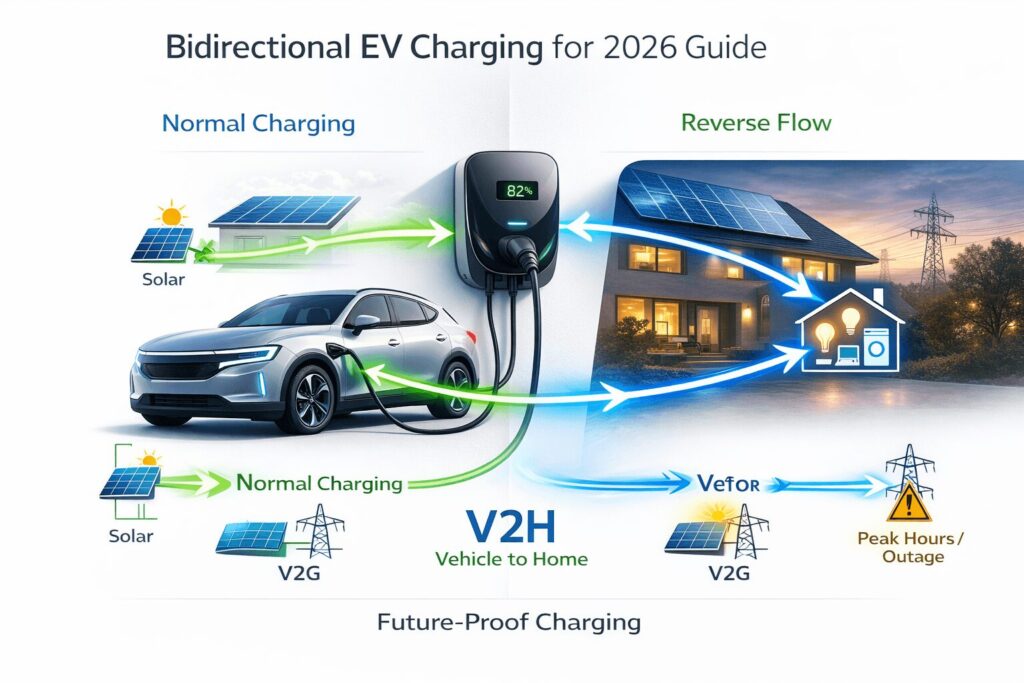
Bidirectional charging means an EV charger can move electricity in both directions — from the grid to the vehicle battery (normal charging) AND from the vehicle battery back out to power other things. “Bidirectional” is the hardware capability that enables V2G, V2H, and V2L.
A bidirectional charger is not doing anything different from a standard charger during normal charging sessions. The difference is in the hardware and software that enables the reverse flow — DC power from the battery through an inverter converting to AC, then out through the charger to wherever it’s needed.
V2G — Vehicle to Grid
V2G (Vehicle to Grid) means the EV battery can export electricity back to the national grid. The car becomes a distributed energy storage asset — charging cheaply when grid demand is low and grid electricity is cheap, then exporting electricity back to the grid when demand and prices are high, earning the owner a payment or credit.
The V2G value proposition: On a dynamic tariff like Octopus Agile in the UK, electricity prices can vary from -5p/kWh (the grid pays you to use electricity) to 80p/kWh at extreme peak demand. A V2G system that charges a 75 kWh battery at -5p and exports at 60p per kWh earns approximately £4.88 on a single charge-discharge cycle — potentially £1,000-£1,500 annually for a vehicle used consistently for V2G arbitrage.
The V2G reality check: V2G at scale requires coordination between the charger, the vehicle, the utility, and the grid operator. The communication protocols, grid connection requirements, and regulatory frameworks for V2G are still being developed in most markets. True V2G — where your car earns you money by selling electricity back to the grid — is available in limited pilot programmes in 2026 but is not yet mainstream consumer technology.
V2H — Vehicle to Home
V2H (Vehicle to Home) means the EV battery powers your home directly — bypassing the grid. Charge the battery cheaply overnight on an off-peak tariff, then use that stored electricity to power your home during expensive peak evening hours.
The V2H value proposition: For a UK homeowner on Octopus Go charging at 7.5p/kWh overnight and displacing peak electricity at 28p/kWh:
- Charge 20 kWh overnight at 7.5p: costs £1.50
- Use 20 kWh during peak hours instead of drawing from grid at 28p: saves £5.60
- Net saving per cycle: £4.10
Done 200 days per year: approximately £820 annually. Over 5 years: £4,100 — significant enough to justify the hardware investment for most homeowners with compatible vehicles.
The V2H reality check in 2026: V2H is closer to mainstream than V2G — several vehicles already support it in specific markets, and the regulatory and technical barriers are lower than grid export. However, widespread consumer V2H in the US and Europe is still in early adoption stages in 2026.
V2L — Vehicle to Load
V2L (Vehicle to Load) is the most immediately accessible bidirectional capability — using the EV battery to power individual appliances directly through an AC outlet built into the car or attached via an adapter.
Several current vehicles already support V2L:
- Hyundai Ioniq 5 and 6: 3.6 kW V2L output via adapter
- Kia EV6: 3.6 kW V2L output
- Ford F-150 Lightning: 9.6 kW Intelligent Backup Power (IBP), can power an entire home
- Rivian R1T and R1S: Camp Mode with AC outlets
V2L doesn’t require a bidirectional home charger — it uses the car’s own inverter to convert battery DC to AC. This is why V2L is already available on multiple vehicles while V2H and V2G require additional infrastructure.
The Technical Distinction That Matters for Buying Decisions
For home charger buying decisions, the critical distinction is:
V2L: Doesn’t require a special home charger. Available now on several vehicles. Not relevant to your charger buying decision.
V2H: Requires a bidirectional home charger (or a compatible integrated system). Available in limited markets with specific vehicles. Relevant to your charger buying decision if you want to future-proof.
V2G: Requires a bidirectional home charger plus utility/grid integration. Not yet mainstream. Relevant to your charger buying decision as a future capability.
The Current State of Bidirectional Home Charging — Where We Actually Are in 2026
Understanding upcoming EV charger trends 2026-2027 V2G bidirectional what to buy now requires an honest assessment of where bidirectional home charging actually is in 2026 — not where the marketing materials say it is.
Vehicles Supporting V2H in 2026
Nissan Leaf (with CHAdeMO V2H): The Nissan Leaf has supported V2H in Japan since 2012 via CHAdeMO bidirectional charging. In Japan, V2H is a mature technology — approximately 200,000 homes have V2H systems. In the US and Europe, the Leaf’s V2H capability has been technically present but regulatory and infrastructure gaps have limited practical deployment.
Hyundai Ioniq 5 and Kia EV6 (V2H in Korea, limited elsewhere): Both vehicles support V2H in Korea. In Europe and the US, V2H capability has been progressively enabled through software updates and compatible hardware. The Hyundai/Kia 800V architecture supports bidirectional charging and both manufacturers have committed to wider V2H deployment through 2026-2027.
Ford F-150 Lightning (V2H in US): The Ford F-150 Lightning with the Ford Pro Intelligent Backup Power system provides whole-home backup power via a Ford-specific bidirectional charging station (approximately $3,895 plus installation). This is the most accessible consumer V2H product in the US market in 2026.
Volkswagen ID.4 and ID.3 (V2H roadmap): Volkswagen has committed to bidirectional charging capability for ID series vehicles and has demonstrated V2H in controlled settings. Consumer availability of V2H for VW ID vehicles is expected in 2026-2027 for European markets, dependent on compatible charger hardware and regulatory approval.
Tesla (V2H/V2G roadmap): Tesla has the technology — their Powerwall home battery uses the same basic principles as V2H. Tesla CEO Elon Musk has confirmed V2G/V2H capability for Tesla vehicles is in development. As of 2026, Tesla vehicles do not support V2H in a consumer-accessible way outside specific pilot programmes. The expectation in the EV community is that Tesla will deploy V2H capability in 2026-2027 via OTA update on compatible hardware.
BMW iX and i7 (V2H in European pilots): BMW has been running V2H pilot programmes in Germany and the Netherlands with the iX and i7. Consumer availability is expected in key European markets through 2026.
Chargers Supporting Bidirectional in 2026
Currently active bidirectional chargers:
Wallbox Quasar 2 (DC bidirectional): The Wallbox Quasar 2 is the most accessible consumer bidirectional home charger in Europe and increasingly in the US. It uses DC power transfer — connecting directly to the car’s DC charging port (CCS2 in Europe, CCS1/NACS in US). Price: approximately £4,000-£5,000 (UK), $4,500-$5,500 (US). It currently works with CHAdeMO vehicles (Nissan Leaf) and is expanding compatibility to CCS2 vehicles.
Honestly: At £4,000-£5,000, the Wallbox Quasar 2 is a premium installation for early adopters and technology enthusiasts. The financial payback at this price requires consistent V2H use and favourable tariff conditions. It’s genuinely impressive hardware but not yet the mainstream consumer product that makes V2H accessible to the average homeowner.
SolarEdge Home EV Charger: SolarEdge’s integrated solar inverter + bidirectional EV charger system is available in Europe and is expanding to the US. The integration with solar is particularly elegant — V2H uses solar-stored energy rather than grid electricity, improving the financial case significantly.
Wallbox Pulsar Plus (bidirectional roadmap): The Wallbox Pulsar Plus is specifically designed with bidirectional hardware readiness — the hardware can support V2H when software activation is completed. Wallbox has been explicit that V2H capability will be activated via OTA update for compatible vehicles. As of 2026, this capability is in advanced testing rather than fully deployed for all compatible vehicles.
Ohme Home Pro (V2G pilot): Ohme has been involved in UK V2G pilot programmes — their hardware is designed with V2G capability in mind and they have experience with grid-connected bidirectional charging through utility partnerships.
The Gap Between “Bidirectional Ready” and “Bidirectional Active”
This distinction is critical for upcoming EV charger trends 2026-2027 V2G bidirectional what to buy now buying decisions.
Several chargers are described as “bidirectional ready” or having a “V2H roadmap” — including the Wallbox Pulsar Plus, the Emporia Pro in future versions, and several others. What this means in practice varies enormously:
Genuinely bidirectional hardware (bidirectional now): Wallbox Quasar 2, SolarEdge Home EV Charger, some Ford Pro hardware. These can do V2H with compatible vehicles today.
Bidirectional hardware ready, software pending (bidirectional soon): Wallbox Pulsar Plus. The hardware supports bidirectional power flow. Software activation for compatible vehicles is in development and testing.
Bidirectional architecture planned, hardware not yet bidirectional (bidirectional eventually): Many charger brands that use “V2H ready” marketing language for products where the current hardware doesn’t actually support bidirectional power flow. In these cases, “V2H ready” means the brand plans to develop bidirectional products in the future — it doesn’t mean your specific charger will become V2H capable via update.
The honest buying decision implication: Unless you’re specifically buying a charger with genuinely bidirectional hardware (Wallbox Quasar 2) or credible bidirectional hardware readiness (Wallbox Pulsar Plus), “V2H ready” marketing language is aspirational rather than functional. Don’t pay a premium for bidirectional claims that aren’t backed by specific hardware capability and a concrete software deployment timeline.
The Regulatory and Grid Integration Reality
One of the most underdiscussed aspects of upcoming EV charger trends 2026-2027 V2G bidirectional what to buy now is that V2G and V2H face regulatory and grid integration barriers that technology alone doesn’t solve.
US Regulatory Landscape for V2G/V2H
Interconnection requirements: In the US, exporting electricity from a home battery (or EV battery) to the grid requires interconnection approval from the local utility. The process varies by utility but typically involves an application, a technical review, and sometimes physical infrastructure upgrades. This process can take months.
Net metering complications: V2G — where your EV earns money by selling electricity back to the grid — requires net metering or feed-in tariff arrangements with your utility. Not all US utilities offer net metering, and those that do often have caps on exported capacity.
Virtual Power Plant (VPP) programmes: The most practical current path to V2G earnings in the US is through utility Virtual Power Plant programmes — where enrolled participants allow their home battery or EV to be dispatched during grid stress events in exchange for payments. Pacific Gas & Electric’s VPP programme, Austin Energy’s VPP, and similar programmes are expanding. Ford F-150 Lightning owners can already participate in some of these programmes.
The realistic US V2G timeline: Widespread consumer V2G in the US is a 2027-2030 story rather than a 2026 reality. The regulatory and utility integration work required to scale V2G is proceeding but slowly. V2H (home power only, no grid export) faces fewer regulatory hurdles and is more likely to be broadly accessible in 2026-2027.
European Regulatory Landscape for V2G/V2H
EU regulatory framework: The EU’s revised Electricity Directive includes provisions supporting V2G integration and smart charging. EU member states are required to remove regulatory barriers to bidirectional charging as part of clean energy transition obligations.
UK regulatory progress: The UK has been particularly active in V2G development. Ofgem and BEIS (now DESNZ) have funded multiple V2G trial programmes. Octopus Energy’s Powerloop programme has been one of the most extensive real-world V2G trials globally, using Nissan Leaf vehicles. The UK regulatory framework for V2G is more developed than most other European markets.
German regulatory landscape: Germany has been slower than the UK on V2G regulatory development but is accelerating. The German energy industry is increasingly interested in V2G as a grid balancing tool given the country’s high renewable generation and grid balancing challenges.
The realistic European V2G timeline: The UK is ahead of continental Europe on V2G regulatory readiness. Consumer V2G products with genuine commercial availability and utility integration are more likely in the UK in 2026-2027 than in Germany, France, or Southern Europe where regulatory frameworks are less developed.
V2H (home-only power, no grid export) is less regulatory-dependent and is expected to be more broadly accessible in Europe through 2026-2027 as compatible vehicles and chargers become available.
Other Upcoming EV Charger Trends 2026-2027
Beyond V2G and bidirectional, several other trends are shaping what EV chargers will look like and do in 2027:
OCPP 2.0.1 Becoming the Standard
OCPP (Open Charge Point Protocol) 2.0.1 is the commercial-grade communication protocol that enables deeper smart grid integration, better cybersecurity, and more sophisticated demand response participation than the older OCPP 1.6.
As utility smart grid programmes become more sophisticated and as V2G deployment requires better bidirectional communication protocols, OCPP 2.0.1 will increasingly become the standard that matters for utility integration.
What this means for buying decisions: Chargers with OCPP 2.0.1 now — ABB Terra AC, Andersen A2, some commercial Wallbox products — are better positioned for future utility programme participation than OCPP 1.6 chargers. For most residential buyers in 2026, OCPP 1.6 is adequate. For buyers planning to participate in V2G or VPP programmes as they develop, OCPP 2.0.1 is worth specifying.
Higher Power AC Charging Becoming More Common
Several new vehicle announcements for 2026-2027 include higher AC charging rates than the current 7.2-11 kW mainstream:
Upcoming higher AC rates:
- Several manufacturers announcing 22 kW three-phase AC charging as standard rather than optional
- Some announcements of 30+ kW single-phase AC charging in development
- Growing interest in 19.2 kW (80A) home charging in the US following the Lucid Air’s lead
What this means for buying decisions: Three-phase 22 kW chargers bought now in Europe are genuinely future-proof — they cover the maximum AC rate of any current or announced European EV. In the US, 48A (11.5 kW) covers current vehicles but may become limiting if higher-rate vehicles emerge. The ChargePoint Home Flex’s adjustable amperage provides some future-proofing flexibility.
Integrated Solar + Storage + EV Charging Systems
The trend toward whole-home energy management — where solar generation, battery storage, and EV charging are managed as an integrated system — is accelerating. Several manufacturers are developing integrated products:
SolarEdge: Already has an integrated solar inverter + home battery + EV charger system. The V2H capability means the EV battery and home battery can work together.
Tesla (Powerwall + Wall Connector): Tesla’s Powerwall and Wall Connector are already integrated in the Tesla app. Full bidirectional V2H would complete this ecosystem.
Myenergi (Zappi + Eddi + Libbi): Myenergi’s ecosystem of EV charger, solar diverter, and home battery storage is already available. V2H would be the natural addition to this ecosystem.
What this means for buying decisions: Buyers planning to install rooftop solar within the next 2-3 years should consider whether their chosen EV charger integrates with their planned solar system. A Myenergi Zappi now, with Libbi battery storage planned for 2027, creates a more coherent long-term ecosystem than a non-Myenergi charger that doesn’t integrate.
Dynamic Tariff Integration Becoming Standard
As dynamic electricity pricing — Octopus Agile in the UK, real-time pricing in some US markets — becomes more widespread, smart EV charger integration with real-time tariff data will become an expected feature rather than a premium differentiator.
What this means for buying decisions: OCPP-compliant chargers with open API access — ChargePoint Home Flex, Ohme Home Pro, Wallbox Pulsar Plus — are better positioned for integration with future tariff products than proprietary-protocol chargers. The Ohme Home Pro’s current Octopus API integration is a preview of what smart tariff integration will look like across more charger brands and tariff products.
Wireless EV Charging — Still Further Away Than Headlines Suggest
Wireless (inductive) home EV charging gets significant media coverage but its mainstream consumer availability is further away than headlines suggest.
Current state in 2026:
- Witricity’s inductive charging pads are in limited OEM deployments (Mercedes EQ, some BWM models as optional)
- WiTricity has licensees but no mass-market consumer product yet
- Charging efficiency at 3.6-11 kW inductively is improving but still 3-8% less efficient than wired charging
- Installation requires precise vehicle positioning and dedicated pad installation
- Cost: $3,000-$5,000 for current systems
Realistic timeline: Consumer wireless home EV charging at meaningful power levels (7.4 kW+) and reasonable cost (under $1,000) is a 2028-2030 development rather than a 2026-2027 reality. Don’t factor wireless charging into your 2026 buying decision.
The Honest Buying Decision Framework — What to Buy Now
This is the section that upcoming EV charger trends 2026-2027 V2G bidirectional what to buy now buyers actually need — and most guides avoid writing because it requires making specific recommendations rather than hedging.
The Core Principle: Don’t Wait, But Buy Smart
The advice to “wait for bidirectional charging before buying a home charger” has been circulating since 2021. Buyers who followed that advice in 2021 have now spent five years on Level 1 charging or public charging dependency while perfectly functional chargers were available and affordable. And in 2026 they’re still being told to wait.
Don’t wait. Buy a charger that serves your needs today. The question is which charger makes the best buying decision given the upcoming trends.
The Decision by Market and Scenario
US buyers — standard home installation:
If you have a NACS vehicle and no solar: Buy the Tesla Wall Connector ($425). The 4-year warranty, seamless Tesla integration, and NACS native connectivity is the cleanest current solution. Not bidirectional now but Tesla’s V2H roadmap is the most credible of any US charger brand. When Tesla activates V2H, Wall Connector owners are best positioned to participate.
If you have a NACS vehicle and solar panels: Buy the Emporia Pro NACS ($399 + Vue $150-$200). Solar divert pays for itself in 1-2 years. Load management solves panel capacity issues. When bidirectional V2H becomes accessible, Emporia has announced next-generation products — upgrading later is less expensive than not benefiting from solar divert for 2-3 years while waiting.
If you have a J1772 vehicle transitioning to NACS: Buy the ChargePoint Home Flex ($699). Adjustable amperage accommodates your current vehicle and future NACS vehicles (with adapter). OCPP 1.6 positions it better than non-OCPP chargers for future utility programme participation.
If you specifically want bidirectional capability now (US): The Ford F-150 Lightning + Ford Pro Intelligent Backup Power is the most accessible V2H product in the US market today. For non-Ford vehicles, genuine bidirectional home charging options in the US are limited and expensive.
European buyers — standard home installation:
If you don’t have solar (UK/Europe): Buy the Wallbox Pulsar Plus (£649-£799 / €699-€849). The most credible bidirectional roadmap of any mainstream European home charger. When V2H becomes available for your vehicle through the Wallbox Pulsar Plus’s OTA update, you’re positioned to participate without buying new hardware. Smart features adequate for TOU scheduling.
If you have solar (UK/Europe): Buy the Myenergi Zappi (£699-£849 / €749-€899). Solar divert pays for itself regardless of when V2H arrives. The Myenergi ecosystem (Zappi + Eddi + Libbi) creates a whole-home energy management platform that becomes more valuable as V2H capability arrives. When Zappi adds V2H — which Myenergi has indicated is in their roadmap — existing Zappi owners are well positioned.
If you specifically want bidirectional capability now (Europe): Wallbox Quasar 2 (£4,000-£5,000). Genuine V2H capability available today with compatible vehicles. Expensive but functional. For Nissan Leaf owners in the UK, this is the most accessible current V2H solution.
If you’re in the UK on Octopus Agile: Ohme Home Pro (£699-£799). Current Agile API integration is the most financially valuable smart feature available today, and Ohme’s V2G pilot experience positions them well for when grid-connected bidirectional becomes commercially available.
The Five Chargers That Best Balance Current Value and Future Positioning
1. Wallbox Pulsar Plus (Europe/UK): The best combination of current smart features, bidirectional hardware readiness, and credible V2H roadmap for a mainstream European charger at a mainstream price. Buy it now, get V2H via OTA when it arrives.
2. Tesla Wall Connector Gen 3 (US): Tesla’s V2H roadmap is the most credible of any US charger brand. The Wall Connector’s current value (seamless Tesla integration, 4-year warranty, 48A NACS) is excellent. V2H participation when Tesla deploys it makes this a future-proof buy.
3. Emporia Pro (US): Solar integration and load management deliver immediate financial value. Emporia’s next-generation product announcements include bidirectional capability — current owners are within an ecosystem that’s moving toward bidirectional rather than away from it.
4. Myenergi Zappi (UK/Europe): Solar divert excellence today plus the Myenergi ecosystem’s natural path toward V2H integration. The Zappi’s value doesn’t depend on V2H arriving — it pays for itself on solar divert alone.
5. Ohme Home Pro (UK): Octopus API integration today delivers dynamic tariff savings that no other mainstream UK charger matches. V2G pilot experience and regulatory engagement position Ohme well for when grid-connected bidirectional becomes commercially available.
The Features Worth Paying for Now vs the Features Worth Waiting For
The upcoming EV charger trends 2026-2027 V2G bidirectional what to buy now question is partly about what to pay for today:
Worth paying for now:
- Solar integration (Emporia Pro, Myenergi Zappi) — pays for itself in 1-2 years regardless of future trends
- Load management (Emporia Pro) — saves panel upgrade costs immediately
- Smart tariff integration (Ohme Home Pro, Myenergi Zappi for Octopus) — saves money on every charging session
- NACS native connectivity (US) — eliminates adapter complexity for the foreseeable future
- IP67 weather resistance (Grizzl-E Ultimate) — protects your hardware immediately and for its entire lifespan
Worth paying for with clear expectation of future return:
- Bidirectional hardware readiness (Wallbox Pulsar Plus) — pay the modest premium over non-bidirectional alternatives but not the full Quasar 2 premium
- OCPP 2.0.1 (ABB Terra, Andersen A2) — positions you for future utility programme participation
Not worth paying for yet:
- Full bidirectional V2G capability (Wallbox Quasar 2 at £4,000-£5,000) — the premium is too high relative to the current financial return for most buyers
- Wireless charging premium — technology too early and too expensive
Internal Links — Further Reading on Clean Energy Bazaar
The upcoming EV charger trends 2026-2027 V2G bidirectional what to buy now guide is the forward-looking complement to the current buying guides across this site.
For the full European smart charger comparison including Wallbox’s bidirectional roadmap in detail, our Wallbox vs Myenergi Zappi vs Andersen smart charger Europe 2026 guide covers every relevant difference. For the smart EV charger features that pay for themselves today — with specific financial payback timelines that inform the V2G waiting decision, our smart EV chargers 2026 features worth the cost guide is the essential companion. For the NACS vs Type 2 connector future-proofing question that interacts with bidirectional standards, our NACS vs Type 2 future-proof EV chargers US Europe 2026 guide covers every compatibility scenario. For the full US home charger market including every charger mentioned in this guide, our best home EV chargers 2026 US comparison covers ten options. For the UK and European market, our best Level 2 EV chargers UK Europe 2026 guide covers every major option. And for understanding the load balancing technology that intersects with bidirectional charging infrastructure requirements, our load balancing EV chargers 2026 guide covers the full picture.
Final Thoughts
The upcoming EV charger trends 2026-2027 V2G bidirectional what to buy now question deserves a direct answer — and here it is.
V2G and V2H are real, valuable, and coming. But they’re not here in mainstream consumer form today — and waiting for them before buying a home charger has an opportunity cost measured in years of suboptimal charging.
The right approach in 2026 is to buy the best charger for your current needs from a brand and product line that is credibly positioned to participate in bidirectional charging when it arrives — rather than paying a premium for bidirectional capability that isn’t yet delivering financial returns for most buyers.
The honest bottom line by market:
- US: Tesla Wall Connector for NACS households. Emporia Pro + Vue for solar households. Don’t pay the Quasar 2 premium yet unless you have a specifically compatible vehicle and a compelling V2H financial case.
- UK/Europe, no solar: Wallbox Pulsar Plus. Bidirectional OTA update is the most credible mainstream V2H path in the European market.
- UK/Europe, with solar: Myenergi Zappi. Solar divert pays for itself now. V2H comes later as an additional benefit rather than the primary value proposition.
- UK, Octopus Agile: Ohme Home Pro. Dynamic tariff integration is the most financially valuable smart feature available today and positions you well for V2G when it arrives.
Buy the right charger now. The V2H and V2G future will arrive on its own timeline — and when it does, the chargers listed above are the ones most likely to participate in it.