India’s electric vehicle subsidy programme has undergone a fundamental shift in design philosophy. The first phase, FAME-II, was built to create a market. The second phase, PM E-DRIVE, is built to scale one.
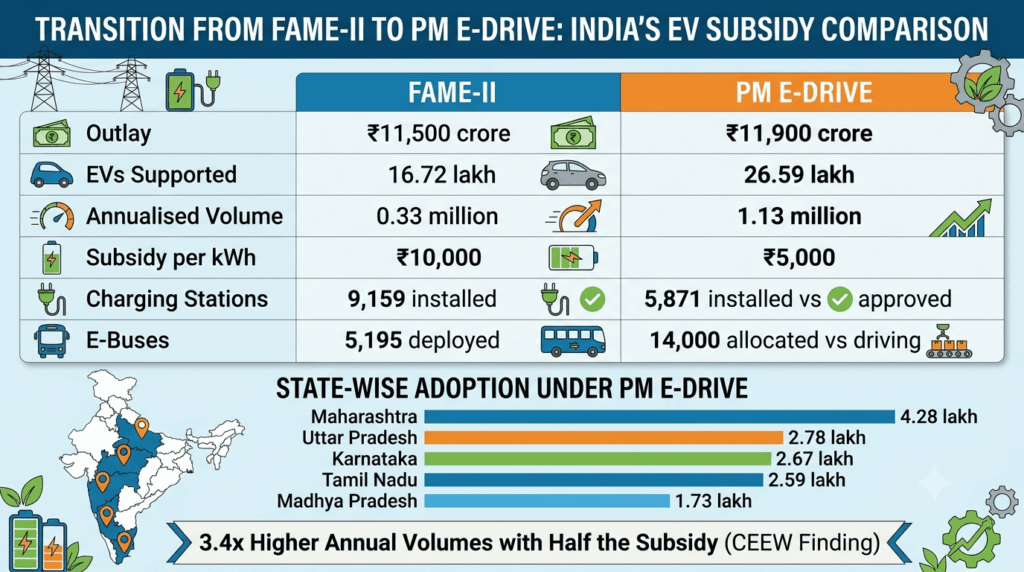
The numbers tell the story of that transition. FAME-II ran from April 2019 to March 2024 with an outlay of ₹11,500 crore and supported 16.72 lakh electric vehicles over five years. PM E-DRIVE, launched in April 2024, has an outlay of ₹10,900 crore, later revised to ₹11,900 crore, and has already supported 26.59 lakh vehicle sales as of June 2026.
But the more revealing comparison is not the total volume. It is the efficiency. The per-kilowatt-hour subsidy was halved from ₹10,000 under FAME-II to ₹5,000 under PM E-DRIVE. Yet PM E-DRIVE delivered 3.4 times higher annualised EV volumes. This is the story of FAME-II to PM E-DRIVE: India’s evolving EV subsidy landscape, and what that evolution reveals about the maturing of India’s electric vehicle market.
FAME-II: Building the Foundation
The Faster Adoption and Manufacturing of Electric Vehicles in India Phase-II scheme was implemented from April 1, 2019, to March 31, 2024, with a total budgetary support of ₹11,500 crore. Its purpose was market activation. It provided demand incentives for electric two-wheelers, three-wheelers, and four-wheelers, along with grants for electric buses and public charging stations.
The outcomes were substantial. FAME-II supported the sale of approximately 16.72 lakh electric vehicles, including e-2Ws, e-3Ws, and e-4Ws. It deployed 5,195 e-buses and installed 9,159 public charging stations as of January 2026. An allocation of ₹912.50 crore was directed toward charging infrastructure.
FAME-II cast a wide net. It included private passenger cars, a segment that PM E-DRIVE would later exclude. Its subsidy structure was generous, offering ₹10,000 per kilowatt-hour for electric two-wheelers and three-wheelers. This was necessary at a time when battery costs were higher and consumer awareness was lower. FAME-II was designed to convince early adopters that electric vehicles were viable.
PM E-DRIVE: Scaling with Efficiency
The PM Electric Drive Revolution in Innovative Vehicle Enhancement scheme was launched in September 2024 and is being implemented from April 1, 2024, to March 31, 2028. Its original outlay was ₹10,900 crore, which was subsequently increased to ₹11,900 crore when the scheme was extended to March 2028.
The design philosophy changed. PM E-DRIVE deliberately shifted focus toward mass mobility. It covers electric two-wheelers, three-wheelers, buses, ambulances, and trucks. It moves beyond private passenger cars to prioritise vehicles that serve broader public and commercial transportation needs.
The subsidy structure was recalibrated. The demand incentive for electric two-wheelers and three-wheelers was halved to ₹5,000 per kilowatt-hour. For registered electric two-wheelers, the incentive is now ₹2,500 per kilowatt-hour, capped at ₹5,000 per vehicle. For electric buses, ₹4,391 crore has been allocated for the deployment of 14,028 e-buses, with 14,000 already allocated. For charging infrastructure, ₹2,000 crore has been earmarked for nationwide public charging stations.
The results have been striking. As of June 2026, 26.59 lakh electric vehicles have been sold under PM E-DRIVE against an incentive-supported target of approximately 28.30 lakh. Maharashtra leads with 4.28 lakh vehicles supported, followed by Uttar Pradesh with 2.78 lakh, Karnataka with 2.67 lakh, and Tamil Nadu with 2.59 lakh.
The Numbers Compared
| Metric | FAME-II (2019-2024) | PM E-DRIVE (2024-2028) |
|---|---|---|
| Total outlay | ₹11,500 crore | ₹10,900 crore (revised to ₹11,900 crore) |
| Duration | 5 years | 4 years (extended to March 2028) |
| EVs supported | 16.72 lakh | 26.59 lakh (as of June 2026) |
| Annualised volume | 0.33 million | 1.13 million |
| Subsidy per kWh | ₹10,000 | ₹5,000 |
| Charging stations | 9,159 installed | 5,871 approved, 0 installed (as of July 2026) |
| E-buses | 5,195 deployed | 14,000 allocated |
The CEEW study published in December 2025 quantified the efficiency gain. Despite halving the per-unit demand incentive to ₹5,000 per kilowatt-hour, PM E-DRIVE enabled 3.4 times higher annual EV volumes than FAME-II. The study described this as a decisive shift from market activation to system-wide consolidation.
The Market Composition Shift
The composition of EV sales has changed alongside the subsidy structure. Under FAME-II, electric three-wheelers, particularly e-rickshaws, dominated the market in the early years. By FY25, electric two-wheelers had emerged as the largest segment, with over 1.15 million units sold under PM E-DRIVE.
This transition signals a move from informal and commercial use toward broader household and enterprise uptake. Commercial electric four-wheelers also saw a clear uptick by FY25, pointing to growing fleet electrification in urban logistics and shared mobility. Electric buses, though still a small share, showed steady growth, signalling early institutional adoption.
Karthik Ganesan, Fellow and Director of Strategic Partnerships at CEEW, framed the shift precisely: “The shift from FAME-II to PM E-DRIVE marks an important inflexion in India’s EV policy. Delivering 1.13 million electric vehicles with lower per-unit incentives suggests that parts of the market are beginning to stand on their own”.
The State-Level Divide
The national numbers mask significant variation across states. Maharashtra recorded the highest number of EVs supported under PM E-DRIVE at 4.28 lakh, followed by Uttar Pradesh at 2.78 lakh and Karnataka at 2.67 lakh. Tamil Nadu and Madhya Pradesh followed with 2.59 lakh and 1.73 lakh respectively.
But the pattern of adoption varies by income level. Higher-income states such as Delhi, Goa, and Karnataka show diversified adoption across electric cars, buses, and two-wheelers. Electric two-wheeler penetration in these states is nearly five times higher than in lower-income states. Lower-income states such as Bihar and Tripura remain heavily reliant on electric three-wheelers, which account for over 52 percent of EV penetration in these regions.
The policy implication is clear. The next phase of India’s EV transition will depend on targeted interventions rather than assuming uniform adoption across the country. Apoorv Minocha, Research Analyst at CEEW, recommended formalising a national 2030 EV target, aligning state-level goals, improving data transparency, and recalibrating incentives based on actual uptake.
The Charging Infrastructure Gap
One area where the transition from FAME-II to PM E-DRIVE has not delivered is charging infrastructure deployment.
Under FAME-II, 9,159 public charging stations were installed as of January 2026. Under PM E-DRIVE, proposals for 5,871 chargers across nine states have been approved. Karnataka received approval for 1,571 chargers, followed by Delhi with 1,146 and Rajasthan with 805. An additional 691 chargers proposed by three oil marketing companies have also been approved.
However, as of July 22, 2026, no charging stations had been installed under PM E-DRIVE. The infrastructure component remains at the approval and implementation stage. By September 2026, ₹851 crore had been approved for the deployment of 8,147 chargers to three oil marketing companies and 10 states.
The gap between approval and deployment is a risk to the scheme’s overall impact. Charging infrastructure is essential for sustaining EV adoption growth, particularly for buyers without access to home charging.
What Comes Next
The evolution from FAME-II to PM E-DRIVE has demonstrated that India’s EV market can deliver higher volumes with lower subsidies. The next phase will determine whether that efficiency can be extended to segments and states that have not yet experienced significant adoption.
PM E-DRIVE has been extended to March 2028. The ₹2,000 crore allocation for charging infrastructure and the ₹780 crore for testing agency modernisation are intended to address the supply-side and quality-side barriers that remain. The Phased Manufacturing Programme under both schemes encourages local production of electric vehicles and key components, including battery packs.
But the CEEW study’s recommendation is worth taking seriously. The next phase must focus on policy coherence, infrastructure readiness, and targeted interventions rather than assuming uniform EV adoption across the country. The states that have led adoption will continue to grow. The states that have lagged will need targeted support to ensure an inclusive transition.
FAME-II built the market. PM E-DRIVE scaled it. The next scheme, whatever form it takes, will need to complete it.