Vehicle-to-grid technology has spent years as the electric vehicle industry’s most promising but least deployed innovation. The concept is elegant. Electric vehicles have large batteries. Most sit idle for the vast majority of the day. If those batteries could send power back to the grid during peak demand, they would become distributed energy assets rather than passive loads.
The barrier has never been the technology. It has been the commercial model. V2G requires predictable vehicle schedules, reliable bidirectional hardware, utility partnerships, and a revenue mechanism that justifies the investment. Most passenger cars fail at least one of those tests.
School buses pass all of them.
V2G goes commercial: the school bus fleets leading the charge are not pilot projects or demonstration vehicles. They are operating fleets, returning real power to real grids, and generating real revenue for school districts. The question is no longer whether V2G works for school buses. It is how quickly the model scales.
Why School Buses Are Perfect for V2G
The case for school bus V2G begins with the schedule. School buses run predictable routes in the morning and afternoon. They return to centralised depots where they remain parked for extended periods, including evenings, weekends, and the entire summer break.
That predictability is critical. A V2G system needs to know when a vehicle will be available to discharge and when it will be needed for transport. A commercial truck might be dispatched at any hour. A passenger car might be driven at any time. A school bus operates on a fixed schedule that is known months in advance.
The summer break is the single most valuable characteristic. School buses sit idle from June through August, precisely when electricity demand peaks across most of the United States. The batteries that powered children to school in May become grid assets in July.
The battery size reinforces the advantage. Electric school buses have large packs, some exceeding 200 kilowatt-hours. That is roughly three to four times the capacity of a typical passenger EV. A single school bus can discharge more energy in one grid event than several passenger cars combined.
The depot model adds another layer of efficiency. School buses are concentrated in centralised locations with existing electrical infrastructure. A V2G deployment does not need to aggregate hundreds of individual vehicles across a city. It can connect an entire fleet at a single site.
The Commercial Operators Leading the Charge
Three companies have moved school bus V2G from concept to commercial deployment. Their experiences define the current state of the market.
Zum: The Largest Fleet Operator
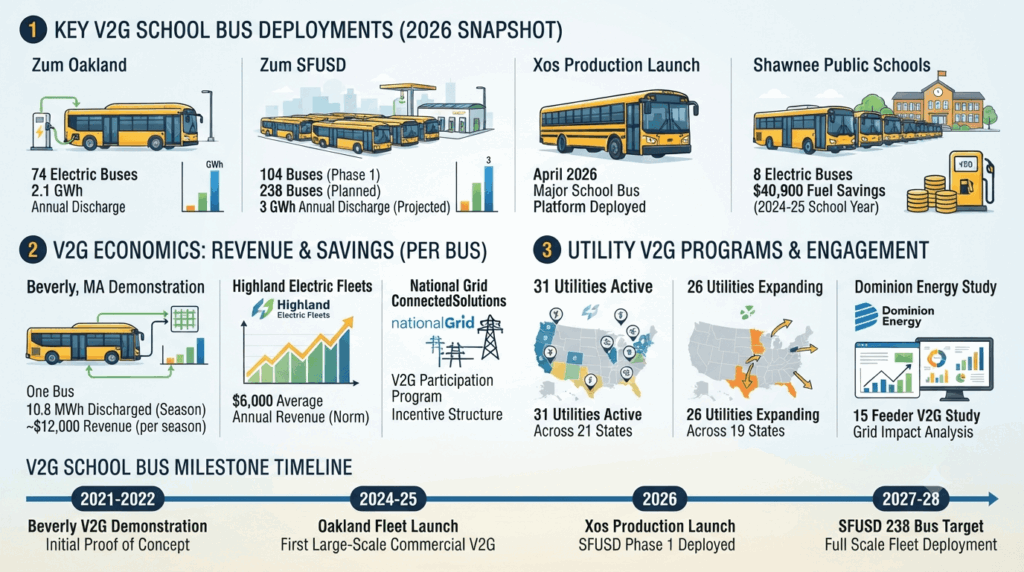
Zum, a California-headquartered student transportation company, operates the largest V2G-enabled school bus fleet in the United States. Its 74-bus fleet for Oakland Public Schools has 2.1 GWh of annual discharge capacity. The company describes itself as operating the first fully electric school bus fleet in the US, deployed in Oakland for the 2024-25 school year.
Zum is expanding aggressively. In May 2026, the company announced it will deploy 104 all-electric buses to San Francisco Unified School District (SFUSD), with plans to expand to 238 buses by the 2027-28 school year. The charging infrastructure has in-built bidirectional capability, making it the largest bidirectional electric school bus fleet in the US. The buses have the combined capacity to provide up to 3 GWh of power back to the local grid annually.
Zum also deployed a fully electric school bus fleet for Branford Public Schools in Connecticut, beginning in the 2026-27 school year. All buses feature built-in bidirectional V2G capabilities.
Xos: The Hardware Platform
Xos, Inc. announced that V2G capability entered production in April 2026 on a major electric school bus platform in North America. The rollout represents the first production deployment of bidirectional capability within the company’s commercial EV platforms, with a roadmap to extend the technology across step vans, powertrains, and energy storage systems.
The significance of Xos’s entry is that it moves V2G from retrofit or custom installations to factory-built capability. The technology applies to newly produced vehicles and will not retroactively apply to existing vehicles. Commercial fleet operations such as school buses present favourable conditions for V2G deployment because vehicles follow predictable routes and return to centralised depots where they remain parked for extended periods.
Tellus Power: The Infrastructure Provider
Tellus Power has emerged as a leading provider of bidirectional charging infrastructure for school bus fleets. The company deployed the 74-bus V2G system for Zum’s Oakland fleet and is expanding into larger-scale projects. Srikanth Kanaparthi, senior VP of technology at Tellus Power, has described school buses as uniquely positioned for electrification, citing their predictable schedules and centralised depots.
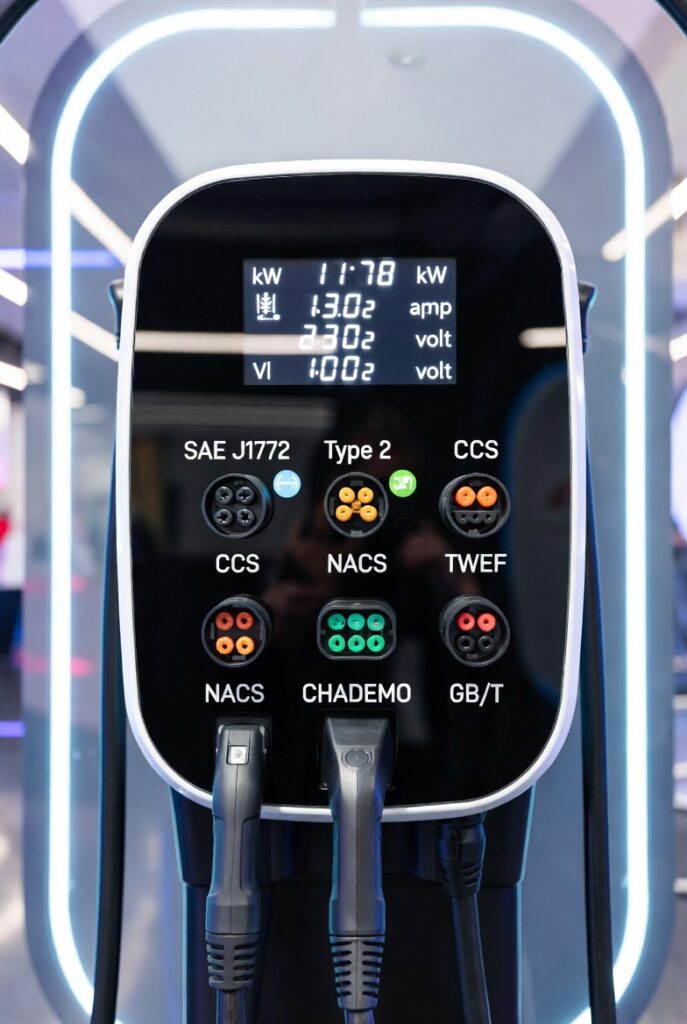
Tellus Power’s involvement illustrates a critical point about the V2G market. The hardware that enables bidirectional charging is not the same as the hardware that enables conventional charging. V2G requires chargers capable of managing power flow in both directions, with communication systems that can respond to utility signals in real time. Companies that specialise in this technology are becoming essential infrastructure partners for fleet operators.
The Economics: What V2G Actually Pays
The revenue figures for school bus V2G require careful interpretation because the most widely cited number is also the most misleading.
The headline figure originates from Beverly, Massachusetts. During summers 2021 and 2022, a single electric school bus discharged about 10.8 MWh into the local distribution grid. National Grid’s ConnectedSolutions virtual power plant program paid nearly $12,000 per season for that service.
That figure has been widely quoted as evidence of V2G’s commercial potential. But Highland Electric Fleets, which operates the buses, has stated that the realistic annual figure is lower. CEO Duncan McIntyre told Utility Dive: “More like $6,000 per year is the norm”.
The two figures are not contradictory. One represents a summer’s output. The other annualises it. The distinction matters because summer is the entire premise. Buses sit idle from June through August, which is when utility peak demand arrives across most of the country.
At $6,000 per year, grid revenue is not negligible. It pays for a charger over time. But it does not pay for a bus. School districts that treat V2G revenue as the business case for electrification are reading the Beverly headline instead of the Highland number.
The more important economic calculation is the combination of V2G revenue and operational savings. Shawnee Public Schools in Oklahoma saved roughly $40,900 in fuel costs during the 2024-2025 school year compared with diesel buses. The district’s electric buses have been sending power back to the Oklahoma Gas & Electric grid, earning credits that flow directly back into funding local schools.
For school districts, the value proposition is cumulative. Lower fuel costs. Lower maintenance costs. Grid revenue. Reduced exposure to diesel price volatility. Improved air quality around schools. No single component justifies the investment on its own. Together, they make the case.
The Utility Side: How Grid Operators Are Responding
The commercial deployment of school bus V2G depends as much on utilities as on fleet operators. The grid side of the equation determines whether V2G revenue is available and how much it is worth.
At least 31 utilities in 21 U.S. states are involved in school bus V2G projects. Utility Dive reported in September 2026 that at least 26 utilities in 19 states operate vehicle-to-grid programs.
The programs vary significantly in structure and compensation. National Grid’s ConnectedSolutions program pays for grid services during summer peak demand periods. Oklahoma Gas & Electric credits Shawnee Public Schools at a kWh-rate multiple times what the district spent on charging. Other utilities offer demand response payments, capacity market participation, or virtual power plant aggregation.
The geographic distribution of V2G school bus projects reflects both utility interest and state policy support. California leads in deployment, followed by Massachusetts, New York, and Connecticut. Massachusetts has invested $33.3 million into school bus fleet electrification through the Massachusetts Clean Energy Center, claiming that money pulled in over $132 million from other sources.
The utility perspective extends beyond revenue. For grid planners, school bus V2G offers a predictable, controllable resource. Dominion Energy studied 15 distribution feeders in Virginia and found 11 capable of supporting full bus electrification without upgrades. That kind of analysis matters because it tells utility planners where V2G can be deployed without costly infrastructure investment.
The Scale of the Opportunity
The commercial V2G deployments of 2026 represent a fraction of the potential market.
As of mid-2026, about 230 of the nation’s roughly 6,700 electric school buses were in fully deployed V2G projects, with the capacity to supply about 8 megawatt-hours of power at a given time. That is a tiny fraction of grid demand. PJM, the largest U.S. regional grid, needs more than 160,000 megawatts to meet peak demand.
But the trajectory is clear. U.S. school districts have ordered 13,931 electric buses, and more than 5,100 are already running routes. The number of electric school buses on the road is expected to more than double to around 14,625, or 3% of the total fleet.
The gap between deployed V2G and electric bus adoption is the opportunity. Most electric school buses on the road today are not V2G-enabled. As older models are replaced and new procurements specify bidirectional capability, the V2G-enabled share will rise.
Tellus Power believes electric school bus adoption could grow three to five times in the next few years. If that projection holds, and if V2G capability becomes standard rather than optional, the grid resource represented by school bus fleets will grow from a curiosity to a meaningful contributor to grid stability.
What Comes Next
The commercial deployment of school bus V2G has passed the proof-of-concept stage. The technology works. The economics are real, if modest. The utility partnerships are in place. The question now is scale.
Three factors will determine how quickly the model expands.
First, procurement standards. When school districts specify V2G capability in their bus procurements, they create demand for bidirectional hardware. Xos’s decision to make V2G a factory option rather than a retrofit is a signal that the industry sees V2G as a standard feature rather than a niche add-on.
Second, utility program design. The revenue available to school districts depends on utility compensation structures. As more utilities develop V2G programs and participate in capacity markets, the value of school bus V2G will increase.
Third, the broader V2G market. School buses are the beachhead, not the endpoint. The lessons learned from school bus deployments, the hardware developed for school bus applications, and the utility relationships established through school bus programs will inform V2G deployments for other fleet types. Commercial vans, delivery trucks, and transit buses all share the characteristics that make school buses suitable for V2G.
The school bus fleets leading the charge are not just electrifying transportation. They are proving that parked vehicles can be grid assets. The commercial model is working. The question is how quickly it scales.